5 Ways to Practice Flute Effectively and Make It Stick
Learning how to practice flute effectively comes down to structure, not extra hours. The five ways below cover it: a schedule that brings each skill back just before you forget it, timed blocks inside every session, honest self-ratings, a short practice log, and a session length you can keep. If you want the scheduling done for you, start with item 1. If you only have 20 minutes a day, items 2 and 5 matter most. If you plateau and can't say why, items 3 and 4 will show you.
Most flutists sit down, play the piece they like, run a scale, and leave unsure whether anything improved. The passage you fixed last week has quietly slipped. The first five minutes go to deciding what to do. That is the learn-forget cycle, and more time at the instrument does not break it.
This article is about organizing practice, not about how to play. How you hold, blow or finger the flute belongs to your teacher. We use MemoRep, a spaced repetition practice planner, as the worked example, and every item also works with a notebook and a timer.
1. Let spaced repetition choose what to practice
Spaced repetition means reviewing a skill at growing intervals, timed for the moment it is about to fade, so you stop relearning the same passages. It is the base for the other four items, because it answers "what do I practice today?"
Why it works
The Ebbinghaus forgetting curve shows that recall drops steeply soon after learning and flattens with each well-timed review. Random practice ignores this. You overpractice what is fresh and neglect what is fading.
For a flutist, that means the passage you cleaned up on Tuesday is shaky by the next Tuesday. A schedule surfaces it at the right time. It also removes decision fatigue, since the plan tells you what comes next.
Practice what is about to fade, not what you feel like playing.
How to set it up
In MemoRep, you create a project for a goal such as a recital program. You fill it with skills, and a skill is a concrete piece of work: a passage, exercise, warm-up or technique. When you pick a focus, the planner gathers the ready skills and the estimated time.
- Create one project per goal and mark one as your main focus.
- Keep each skill small enough to finish in a few minutes, such as "Etude 4, bars 9 to 16".
- Open the planner and work through what is ready.
Accounts open through Google sign-in with no complex setup. Every current feature is free during beta, and the first 200 musicians to sign up keep the future Premium plan free.
2. Break each session into timed blocks
Divide every session into short blocks with a fixed time per skill. A timed block keeps the session balanced and stops one favorite piece from eating the whole slot.
Why it works
Without a clock, practice drifts toward what feels good. Ten minutes of a favorite piece turns into twenty, and the unglamorous skills never get their turn. Timing forces balance and makes your session length predictable.
A timer also gives you permission to move on. If a skill is going nowhere at minute four, you skip it and let the schedule bring it back. MemoRep's running session keeps the active skill, time, notes and controls together, and you can pause or skip a skill.
A block that ends on time beats a block that ends when you get bored.
How to set it up
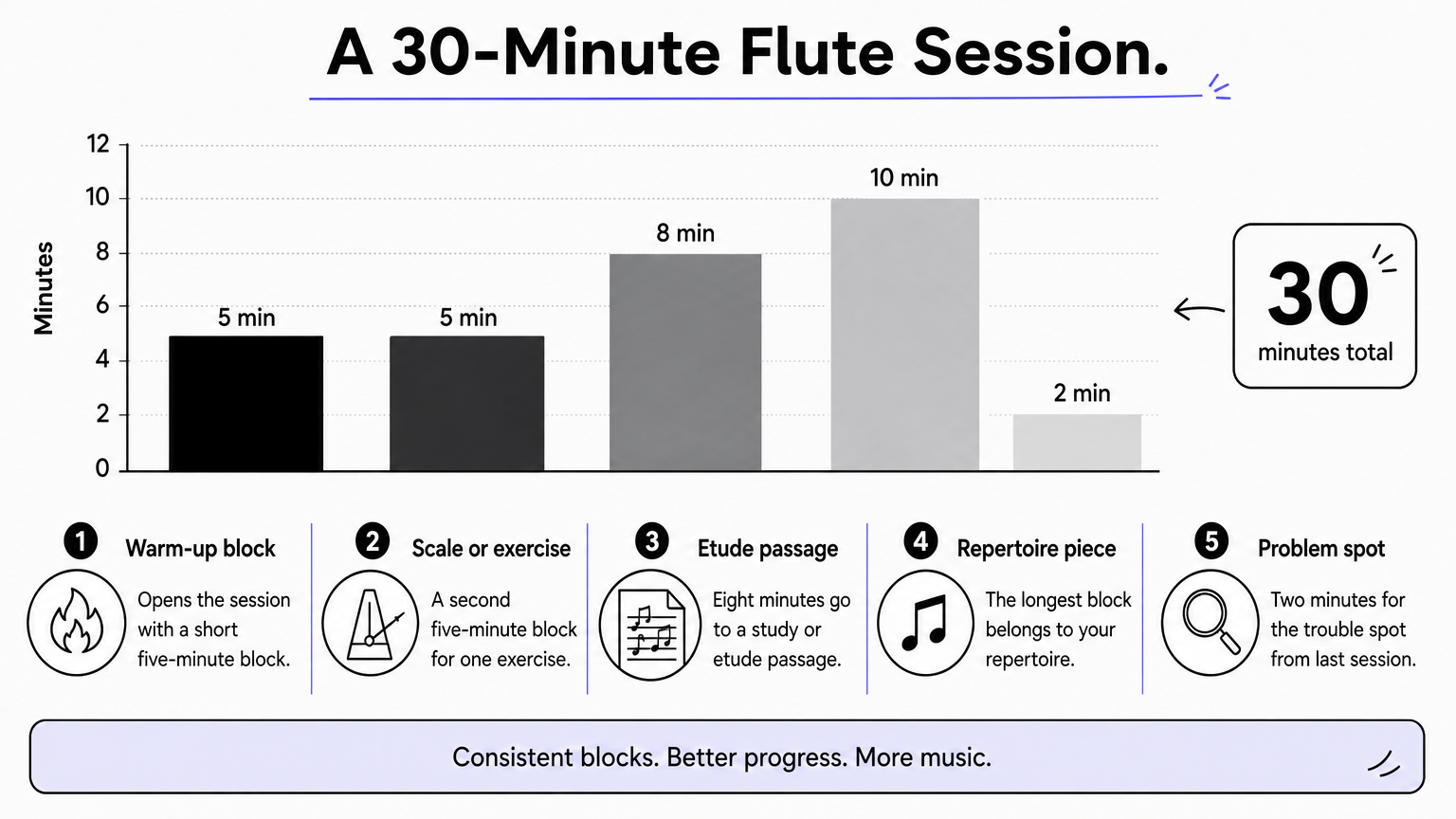
Here is a 30-minute session. Your teacher decides what fills each block, and the timing is yours.
| Block | Minutes |
|---|---|
| Warm-up | 5 |
| Scale or exercise | 5 |
| Study or etude passage | 8 |
| Repertoire | 10 |
| Problem spot from last session | 2 |
| Total | 30 |
3. Rate every skill honestly after you play it
Rate each skill right after you finish it, using the same few labels every time. Your rating is the data that tells the schedule how quickly you forget, so an inflated rating makes the plan worse.
Why it works
Overrating pushes the next review too far away, and the skill fades before it returns. Underrating wastes minutes on material you already own. If something felt easy but fell apart next session, it was not Easy.
In the classic SM-2 algorithm, a Good rating sets reviews at 1 day, then 6 days, then roughly 15 (6 times 2.5). An Again rating sends the skill back to the start. MemoRep is built on SM-2 and uses the Again, Hard, Good and Easy scale.
Rate the first pass, not the best of ten tries.
How to set it up
Define your labels once, then stick to them. MemoRep shows the next-review date before the session is saved, so you can see what each rating does.
| Rating | What it means |
|---|---|
| Again | You could not play it cleanly. |
| Hard | You got through it, but only with effort. |
| Good | You played it as intended, with small slips. |
| Easy | It felt effortless on the first pass. |
4. Log what happened in a short practice journal
Write down what happened in each session in under a minute. A log turns "I think I'm improving" into something you can check, and it shows patterns your memory edits out.
Why it works
After a week, you will not remember which passages kept earning Again or which days you played well. A journal shows it. If the same skill returns badly three sessions running, that is worth bringing to your teacher.
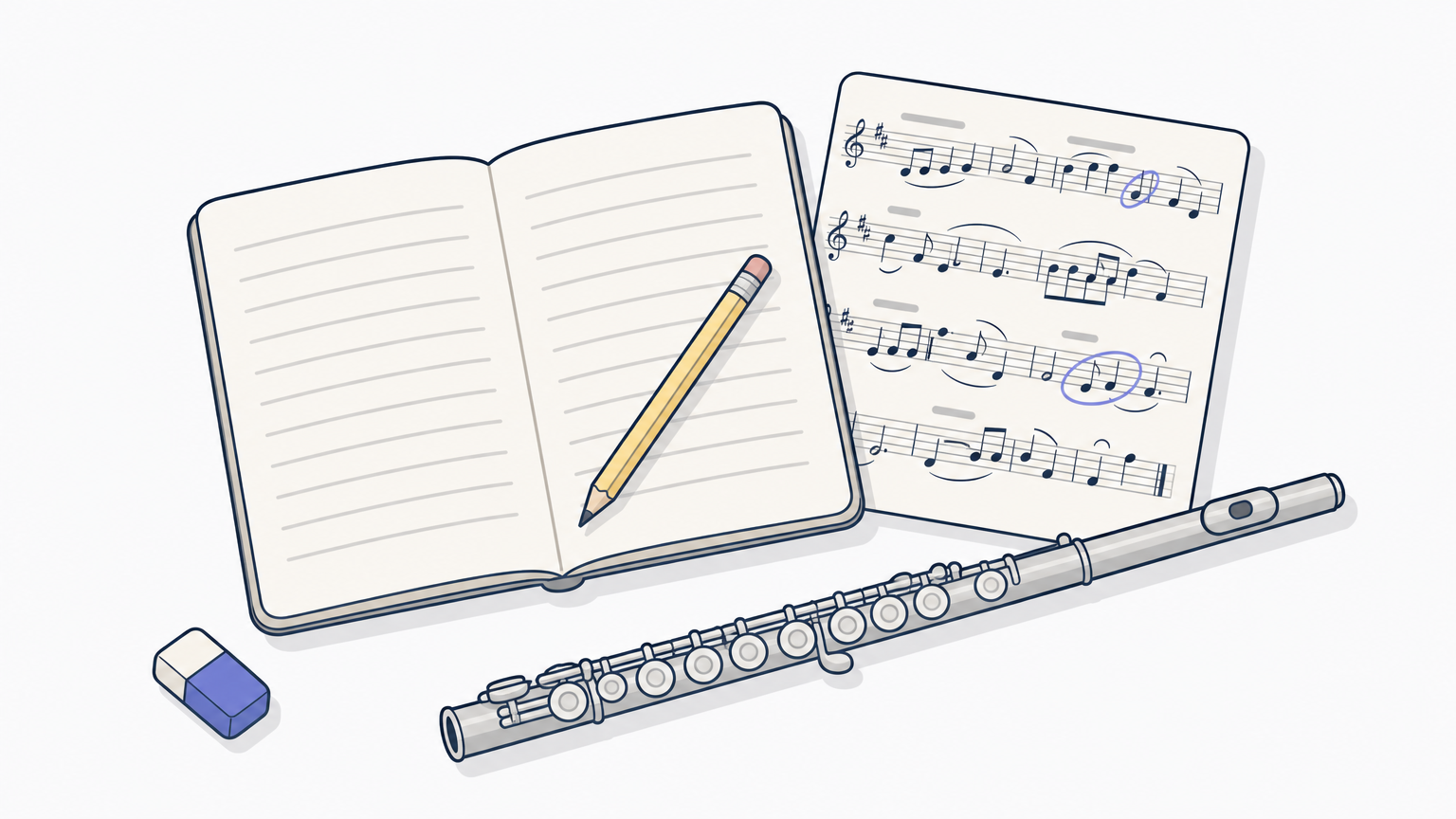
MemoRep lets you log what happened and keeps a practice journal. You can save notes and image evidence, such as a photo of your marked-up score, at the skill or session level. Video upload is not available yet and is planned for Premium.
What you don't write down, you will repeat.
How to set it up
Keep the template short enough that you never skip it. Copy this into a notebook or a notes app:
Date:
Skills practiced:
What went wrong:
Start with next time:
5. Set a session length and frequency you can keep
Choose a daily session length you will actually repeat, and protect it. Spaced practice needs regular sessions, so a modest routine you keep beats an ambitious one you abandon.
Why it works
Frequent short sessions give each skill more chances to be reviewed than one long weekly session. As for how many hours a day to practice flute, most players need far fewer than they fear. Missed days happen, so plan for a delayed review rather than a failed week.
A fixed time and a reminder help most. MemoRep sends practice reminder notifications, but a phone alarm works too.
The right amount of practice is the amount you will do tomorrow.
How to set it up
These are rules of thumb, not research findings, so confirm the numbers with your teacher.
| Player | Daily time |
|---|---|
| Beginner | 15 to 30 minutes |
| Returning adult or intermediate | 30 to 45 minutes |
| Advanced student | 45 to 90 minutes, split into two sessions |
Start with one change this week
Effective flute practice comes from structure: a schedule that resurfaces skills before they fade, timed blocks, honest ratings, a one-minute log, and a session length you can sustain. None of it replaces your teacher, who decides what you work on. It only makes sure the work you are given sticks.
Pick one item and run it for a week. If you want the scheduling, timing, rating and journaling in one place, try MemoRep and claim a free founding membership while the limited offer lasts.