

How to Build a Music Practice Routine That Sticks
You sit down to practice, open your instrument case, and then spend the first ten minutes deciding what to work on. Scales? That piece you struggled with last week? The new section you barely started? By the time you pick something, half your session is gone. This is what happens without a real music practice routine, and it's the single biggest reason practice feels inefficient even when you're putting in the hours.
Building a practice schedule for musicians that actually holds up isn't about willpower or blocking off more time. It comes down to structure: knowing exactly what to revisit, when to revisit it, and how to balance new material with things you've already learned so they don't slip away. Get that structure right and consistency follows naturally, because you're never staring at a blank practice session wondering where to start.
In this guide, you'll learn how to design a routine around your actual goals, how to sequence warm-ups, technique, repertoire, and a daily sight-reading routine, and how spaced repetition keeps older material fresh without eating into time for new skills. We'll also cover common mistakes that cause routines to fall apart after a week or two, and how tools like MemoRep can take the guesswork out of scheduling entirely.
Why a structured routine beats random practice
Most musicians don't fail because they lack talent or time. They fail because their practice has no shape. You repeat what's comfortable, avoid what's hard, and never revisit material long enough for it to stick. Research on memory, going back to Ebbinghaus's forgetting curve and how he measured it, shows that skills fade predictably unless they're reinforced at the right intervals. Random practice ignores this entirely, so you end up relearning the same passage over and over instead of actually mastering it.
The hidden cost of unstructured practice
Without a plan, every session becomes a negotiation with yourself about what to work on, and that negotiation costs you focus before you've even started. A structured routine removes that decision entirely: you know your warm-up, your technical work, and your repertoire rotation before you pick up your instrument. This isn't about rigidity, it's about protecting your limited practice time from being wasted on indecision.
A routine doesn't just organize your practice, it decides what's worth your attention today.
What structure gives you that randomness can't
Consistency compounds. When you revisit a scale, a passage, or a technique on a predictable schedule, you're working with your memory instead of against it. This is the core idea behind spaced repetition and the schedules it runs on: instead of cramming a skill once and letting it decay, you touch it again right before it fades, which locks it into long-term memory far more efficiently than repeated cramming ever could.
| Approach | What happens | Result over time |
|---|---|---|
| Random practice | You work on whatever feels urgent or interesting | Old material decays, gaps reappear |
| Structured, spaced routine | Each skill resurfaces at the right interval | Skills stay sharp with less total review time |
Structure also gives you something random practice never will: a clear record of what you've actually covered. That alone eliminates the guilt of wondering if you're neglecting something important.
Step 1. Set clear, measurable practice goals
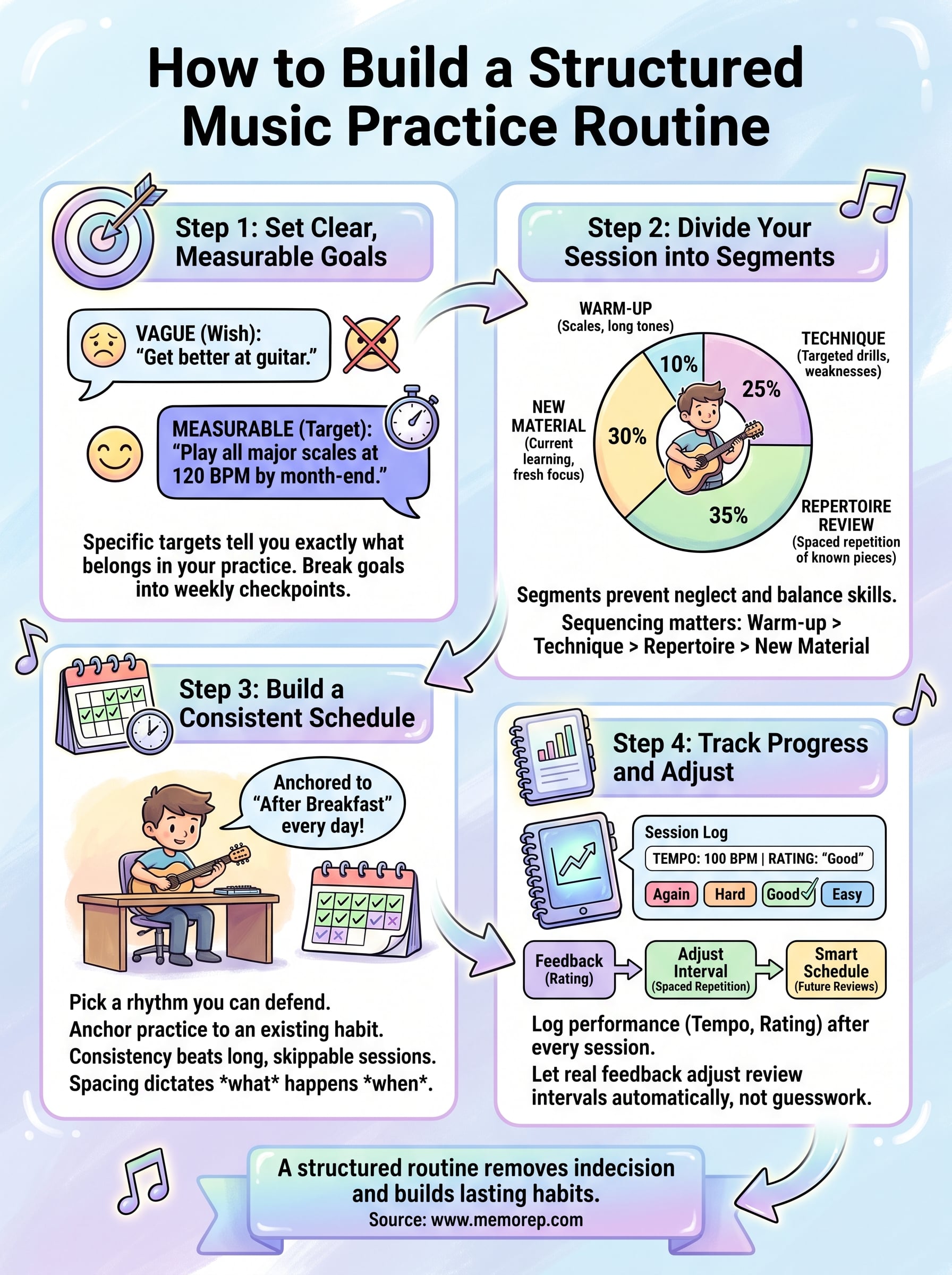
Every solid music practice routine starts with a goal you can actually measure, not a vague wish like "get better at guitar," which is the whole point of practicing with measurable targets and fast feedback. Vague goals give you nothing to plan around, so your sessions drift back into randomness within a week. Instead, pick targets tied to specific skills, pieces, or techniques, with a timeframe attached.
Turn vague intentions into concrete targets
Specific goals tell you exactly what belongs in your practice schedule for musicians and what doesn't. Compare the two approaches:
- Vague: "Improve my sight-reading."
- Measurable: "Sight-read one new piece at grade 3 level, three times a week, for a month."
- Vague: "Get better at scales."
- Measurable: "Play all major scales at 120 BPM cleanly by the end of the month."
A goal you can't measure is just a wish you're hoping to bump into during practice.
Break goals into weekly checkpoints
Large goals need smaller checkpoints, or you'll lose track of progress until frustration sets in. Set a weekly target, like raising a scale's tempo by five BPM or memorizing eight new bars, and write it down somewhere you'll see before each session. Reviewing these checkpoints weekly also flags when a goal is unrealistic early, before it derails your motivation. Once goals are concrete, the next step is shaping your actual session around them.
Step 2. Divide your session into focused segments
Once your goals are set, the next move is shaping your session so nothing gets neglected. A single music practice routine that lumps everything together tends to collapse into whatever feels easiest that day. Splitting your time into distinct segments forces balance between warm-up, technique, repertoire, and weak spots, so no single area quietly disappears from your schedule.

A simple segment breakdown
Here's a layout that works for most instruments and skill levels, adjustable to your session length, and it slots neatly into a weekly plan that balances technique, repertoire, and theory:
- Warm-up (10%): scales, long tones, or finger exercises to prepare your hands and ears.
- Technique (25%): targeted drills on the specific weakness from your weekly checkpoint.
- Repertoire review (35%): pieces you've already learned, revisited on a spaced schedule.
- New material (30%): whatever you're currently learning, tackled while you're freshest.
Why order matters as much as content
Sequencing isn't arbitrary. Warming up before technique prevents sloppy repetitions from becoming habits, and reviewing repertoire before diving into new material keeps older skills from quietly fading while you focus on what's new.
Segments protect the skills you already have while making room for the ones you're still building.
This is also where a spaced repetition system earns its keep, since it tells you exactly which repertoire pieces belong in today's review slot instead of leaving that decision to guesswork.
Step 3. Build a consistent practice schedule
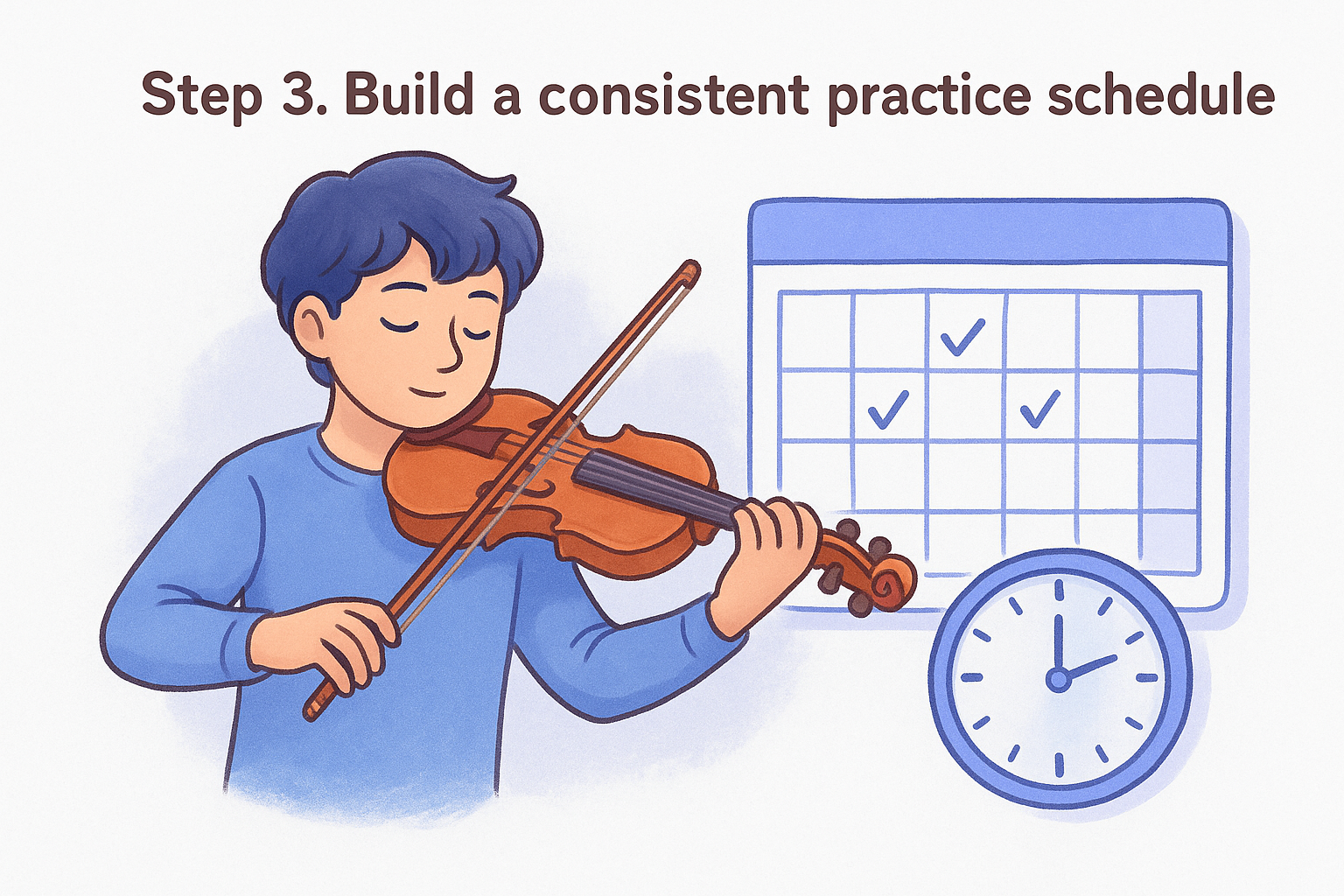
Goals and segments only work if you actually show up on a schedule that fits your real life, not an idealized version of it. A practice schedule for musicians doesn't need to be long, it needs to be repeatable. Five focused days beat seven inconsistent ones, because missed days break the spacing your memory depends on and force you to relearn material you thought was solid instead of memorizing music faster the first time.
Pick a rhythm you can defend
Start by choosing fixed practice windows tied to something already in your day, like right after breakfast or before dinner, so you're not relying on willpower to remember. Anchoring practice to an existing habit removes the daily decision of "when will I fit this in today."
- Set the same time slot on your calendar, even on light days.
- Keep sessions short but non-negotiable rather than long and skippable.
- Treat weekends as review days, not off days, since gaps hurt spaced material most.
The best schedule isn't the longest one, it's the one you actually keep.
Let spacing dictate what happens when
A fixed time slot handles consistency, but spaced repetition handles content, deciding which pieces or drills resurface today versus next week. Instead of guessing whether a passage needs review, a scheduling system like MemoRep's adaptive scheduler tracks each item's interval automatically, so your fixed practice window always has a ready-made agenda waiting for you.
Step 4. Track progress and adjust as you improve
Without tracking, you can't tell whether your music practice routine is actually working or just keeping you busy. Rate each item after every session using a simple scale like Again, Hard, Good, or Easy, and let that feedback decide when it resurfaces. This is the same feedback loop that drives spaced repetition algorithms, and it's what turns a static schedule into one that adapts to your real performance instead of a fixed guess.
What to log after every session
Keep the record light, whether you use a notebook or one of the ready-made practice log templates, or you'll abandon it within a week. Track just enough to spot patterns:
- Tempo or accuracy achieved on each drill
- How the piece felt: Again, Hard, Good, Easy
- Any recurring mistake worth flagging for next session
If you're not tracking difficulty, you're guessing when to review, not scheduling it.
Adjust intervals based on real feedback
Understanding your own data matters more than collecting it. A piece rated Easy twice in a row can wait longer before its next review, while one rated Again needs to resurface within a day or two, not next week. Manually recalculating these intervals for a dozen pieces gets tedious fast, which is exactly the gap MemoRep was built to close, adjusting each item's schedule automatically so your practice schedule for musicians stays accurate without spreadsheets or guesswork.
Turning practice into a lasting habit
A music practice routine sticks when it removes decisions, not when it demands more discipline. Clear goals tell you what to work toward, segmented sessions keep every skill in rotation, a fixed schedule builds the habit, and tracking makes sure the whole system adjusts to how you're actually performing, not how you hoped you'd perform. Put those four pieces together and you stop dreading practice, because you already know what today's session looks like before you even open your case.
Guessing when a piece needs review, or scrambling to remember your own progress, is exactly the friction that kills routines within a few weeks. If you'd rather let an algorithm handle that math, see the science behind MemoRep's practice scheduling and claim one of the remaining free-for-life beta spots, and build a practice schedule for musicians that runs itself.