How to Practice Cello Effectively: A 4-Step Weekly System
The way to practice cello effectively is to split your music into small named items, work on a few of them in a short session most days, rotate between them instead of repeating one for an hour, and bring each item back at growing gaps based on how the last pass went. Four steps cover it: build practice cards, fix a daily window, mix and space your reviews, then rate each pass and review your week.
Most cellists who feel stuck are not short on hours. You sit down for 40 minutes, spend ten of them deciding what to play, drift toward the pieces you enjoy, and touch the awkward passage once a week. By lesson day, part of last week's progress has faded and you can't say which spots need attention. That is a planning problem, not a talent problem.
This guide gives you a repeatable weekly system built on spacing and interleaving. It covers when, how often, and in what order to practice. It does not cover how to play. Bowing, fingering, intonation, and technique belong to your teacher, who can hear and see you. MemoRep, a spaced repetition platform for musicians, is built around the same scheduling ideas, so you will also see where an app can take the bookkeeping off your hands.
Why cello practice stalls without a system
Cello practice stalls when the hardest decision, what to work on today, gets made on the spot and the answer is whatever feels good. A system replaces that daily guess with a plan, so every minute at the instrument goes to the right item.
What effective practice means
Time at the cello is not the same as progress. Learning means a lasting change in memory, and two findings explain how to get one. Spacing says that skills fade along a forgetting curve, first fast, then slowly, so revisiting an item just before it fades makes it stick longer than cramming. Interleaving says that alternating between several passages beats a long block on one, because your brain has to retrieve each skill again every time you return to it.
Spacing also applies to the week. Cello professors commonly point out that 45 minutes a day beats four hours twice a week. The shorter, more frequent sessions also spare your body the strain of long repetitive blocks.
Practice works best when each item returns just before you would forget it, not when you grind on it for an hour.
What this guide covers and what your teacher owns
This system decides what comes up today and how often. It never decides how a passage should be played. If a shift keeps failing, the fix is a conversation with your teacher, not a tip from an article. Teaching yourself cello without a teacher is possible, but this system will only organize your work, not correct it.
Before you start, gather four things:
- The list of pieces, studies, and exercises you are working on now
- Notes from your last lesson, including anything your teacher marked
- A timer, plus a tuner or metronome if your teacher wants you to use one
- A place to log results, either a notebook or an app
Step 1. Break your music into practice cards
A practice card is one small, nameable piece of work, such as eight bars of a Bach prelude or one scale. Cut your repertoire into cards so each piece can be rated on its own and scheduled on its own.
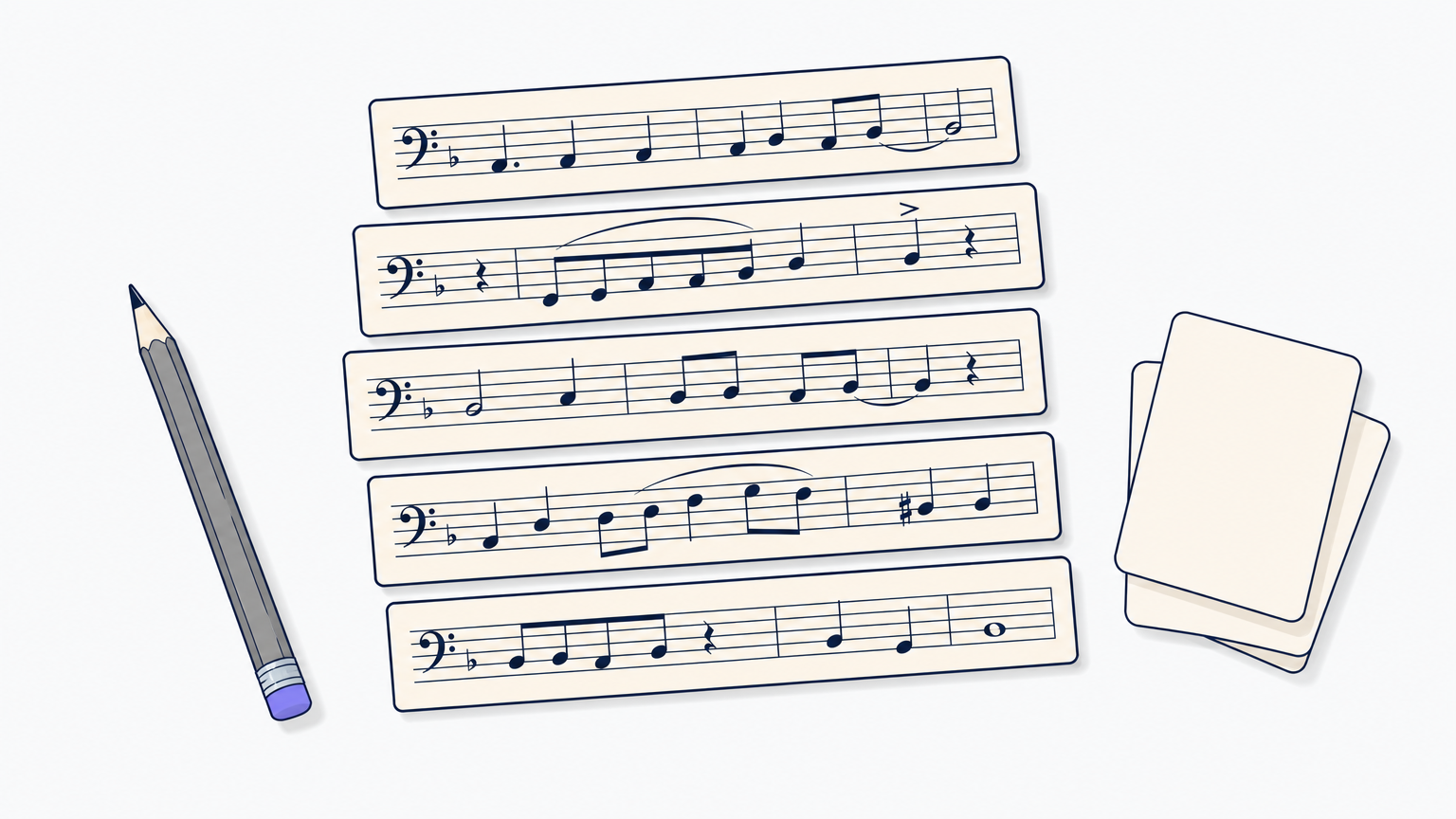
Size each card to one problem
Test every card with a simple rule. If you cannot say within a minute whether a pass went well, the card is too big. A good card takes two to five minutes to run through. Cutting a four-page movement into page-long cards hides the one bar that keeps failing, while cutting it by phrase or by trouble spot exposes it.
Each card holds the what. Your teacher supplies the how, so copy the instruction from your lesson into the card's note. A fingering, a bowing, or a reminder your teacher gave you belongs there, in their words.
Cards hold what to practice and when. Your teacher decides how.
Example cards for a cello student
Here is how a student working on a Bach suite, a study, and a concerto might split a week's material:
| Card | Kind | Note to copy from your lesson |
|---|---|---|
| Suite No. 1 Prelude, bars 1 to 8 | Repertoire passage | Bowing your teacher marked |
| Suite No. 1 Prelude, bars 9 to 16 | Repertoire passage | Fingering your teacher chose |
| G major scale and arpeggio | Scale work | Tempo and pattern your teacher assigned |
| Study, second line | Etude section | The goal your teacher named for it |
| Concerto, the shift in bar 23 | Trouble spot | Your teacher's instruction for it |
Start with 8 to 12 active cards. Add a new one only when your due cards are finished, so the list never outgrows your time.
Step 2. Fix a daily window and a session length
Choose a window you can repeat most days, 30 to 45 minutes for many adult learners, and protect it. Consistency beats volume, and a plan you can keep beats a heroic plan you drop in week two.
Choose how many days and how long
There is no universal number of hours. Advanced students sometimes work for several hours, split into blocks. The great violin pedagogue Ivan Galamian suggested around four hours was adequate for serious players. For everyone else, the sensible answer is less than that, done more often. Use these as starting points and adjust with your teacher:
| Level | Typical daily window | Practice days per week |
|---|---|---|
| First year | 20 to 30 minutes | 5 |
| Intermediate or returning adult | 30 to 45 minutes | 5 to 6 |
| Advanced or preprofessional | 60 minutes or more, in blocks | Set with your teacher |
Five days a week is enough for steady progress, and a rest day lowers your risk of burnout. Increase length gradually, and stop if you feel pain or strain. Tell your teacher about it.
Set up the space so you can start in a minute
Friction kills routines. Keep the cello out on a stand, if you have room, so you are playing within a minute of sitting down. Silence your phone, keeping only the timer, tuner, or metronome app you need. Put your card list where you can see it.
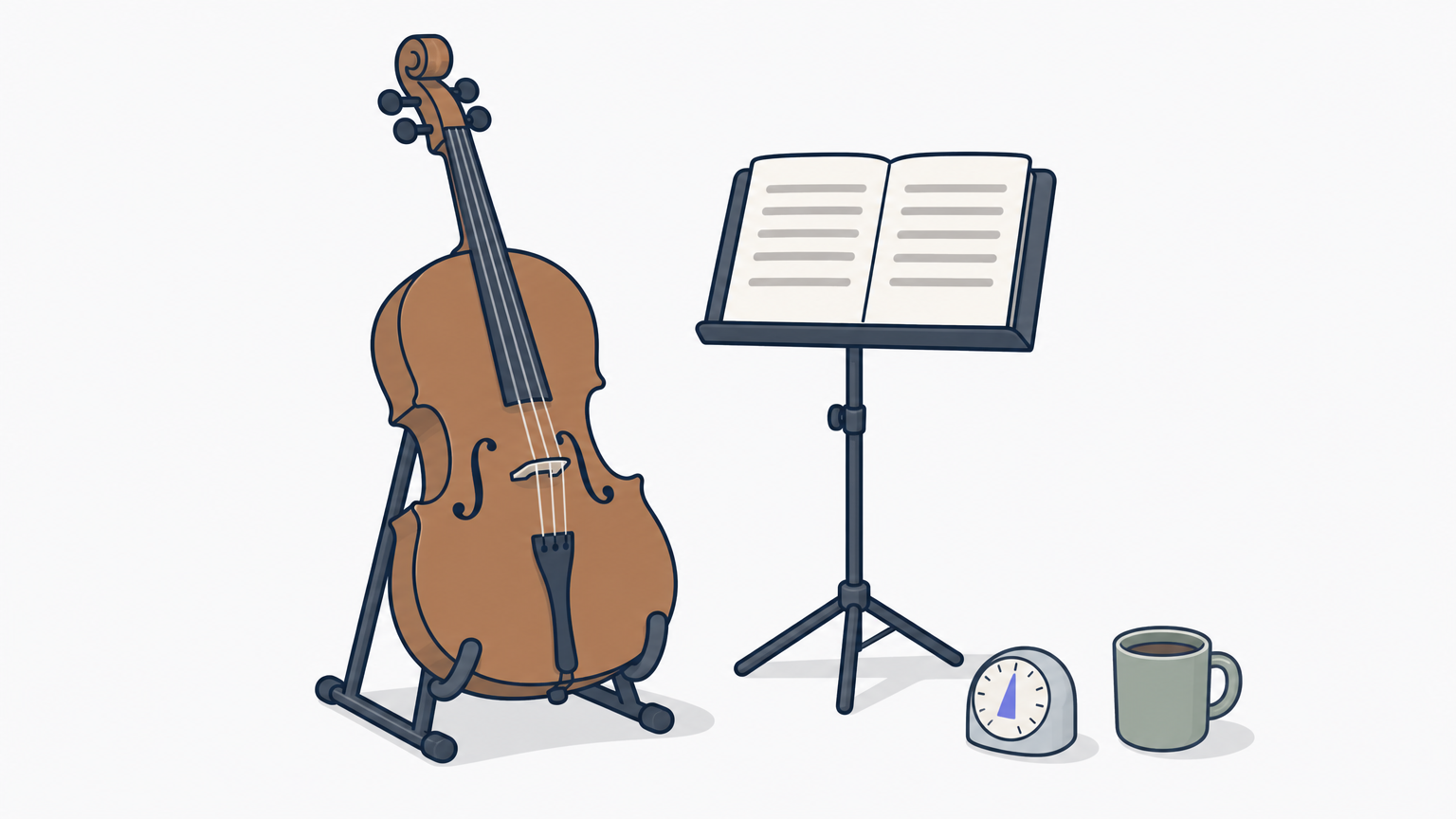
Then attach the session to something you already do, like right after coffee or right before dinner. A fixed trigger removes the daily negotiation with yourself.
Decide the time once, then stop deciding it every day.
Step 3. Mix cards and space your reviews
Inside a session, rotate between cards in short rounds. Across days, bring each card back at growing gaps. Together these two moves are how you practice cello effectively without adding hours.
Rotate cards inside a session
Say five cards are due and you have 30 minutes. Block practice gives each card six minutes in a row. Interleaved practice gives each card three minutes, goes around twice, and lets the hardest card take a third visit if time remains. Each return forces you to recall the passage from scratch, which is exactly what a performance demands.
Keep each round short enough that you do not drift into mindless repetition. Rotate before the card gets boring, not after.
Let intervals grow
Each time a card goes well, wait longer before the next review. The classic SM-2 algorithm, which MemoRep builds on, starts with a one-day gap, then six days, then multiplies by an ease factor, 2.5 by default. If every review goes well, a card comes back like this:
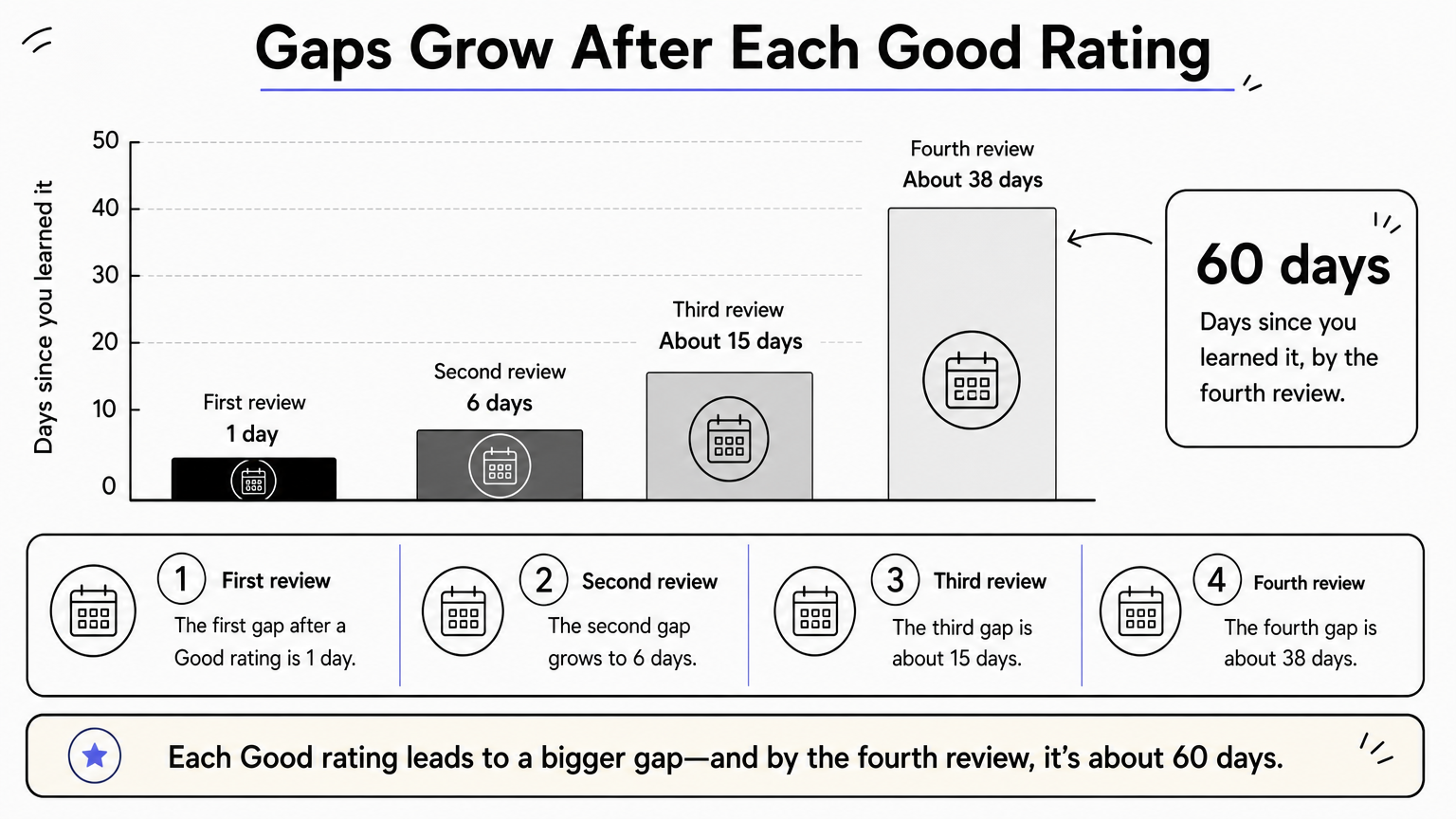
| Review | Gap after a "Good" rating | Days since you learned it |
|---|---|---|
| 1st | 1 day | 1 |
| 2nd | 6 days | 7 |
| 3rd | about 15 days | 22 |
| 4th | about 38 days | 60 |
A card you fail goes back to a short gap. A card you find hard grows more slowly, and an easy one grows faster. That is why the schedule beats a fixed rotation: it spends your minutes on what is fading, not on what is solid. A paper notebook can do this, but the arithmetic gets tedious across a dozen cards.
Review a card when it is about to fade, and you spend the fewest minutes keeping it.
Step 4. Rate each pass and review your week
After each card, rate it honestly with four options: Again, Hard, Good, Easy. The rating is what tells the schedule when the card should return.
Rate the result, not the effort
Judge the outcome of the pass, not how hard you tried. A simple standard is consistency: if you play the passage correctly more often than not, it is at least Good. This table keeps ratings consistent from day to day:
| Rating | What it means | What happens next |
|---|---|---|
| Again | You could not get it reliably | Card returns soon, often the next session |
| Hard | You got it, but only with effort or inconsistently | Shorter gap than usual |
| Good | It went as expected | Normal gap |
| Easy | It felt effortless | Longer gap |
Inflated ratings push cards out too far, and you lose them. When in doubt, choose the lower rating.
Review your week and hand off to your teacher
Spend ten minutes once a week, say Sunday, looking at the log. Which cards got Again or Hard more than once? Which cards are too big to rate cleanly? Split those. Write the stubborn ones on a short list and bring that list to your next lesson. Your teacher then sees exactly where you struggle and can tell you how to fix it, which is the one part this system leaves alone.
A notebook handles this if you are disciplined. MemoRep automates the scheduling: it surfaces each card when the skill is ready for another pass, adjusts to your ratings, tracks progress, and sends a daily practice reminder, so your session starts with a list instead of a decision.
The weekly review turns your practice log into a short, useful list for your teacher.
Start with one week
Effective cello practice comes down to planning, not heroics. Cut your music into small cards, practice most days in a window you can keep, rotate cards and space their return, and rate each pass honestly. Then carry your stubborn cards to your teacher, who owns the question of how to play them.
Try the system for one week by hand, and you will feel the difference when you stop spending your first ten minutes deciding. When you want the scheduling handled for you, try MemoRep while the free-for-life subscription is available.