Guitar Practice System: How To Practice Guitar Effectively
Most guitarists don't have a practice problem, they have a structure problem. You sit down, noodle around on something familiar, maybe attempt that riff you've been stuck on, and 45 minutes later you're not sure what you actually accomplished. If you've been searching for how to practice guitar effectively, the answer isn't more hours. It's a better system.
Effective guitar practice comes down to knowing exactly what to work on, how long to spend on it, and when to revisit it before the skill starts slipping. Without that framework, you end up overworking things you've already learned and neglecting the pieces that actually need attention. That's wasted effort, and it compounds over weeks and months into frustrating plateaus.
This guide breaks down a complete guitar practice system, from structuring your sessions and choosing the right exercises to scheduling reviews at the right intervals. It's the same kind of spaced repetition methodology that powers MemoRep, where practice cards and adaptive scheduling take the guesswork out of deciding what to play next. Whether you're a beginner building foundations or an intermediate player pushing past a wall, this framework will help you get more out of every session.
What effective guitar practice looks like
Effective practice is deliberate and measurable, not just time spent with a guitar in your hands. Most people treat practice as open-ended playing, which feels productive but rarely is. The difference between a guitarist who improves fast and one who plateaus is straightforward: the fast improver walks into every session knowing exactly what they're targeting and how they'll know when they've hit it.
If you can't describe what "done" looks like before you start, you're not practicing, you're just playing.
The three components of a productive session
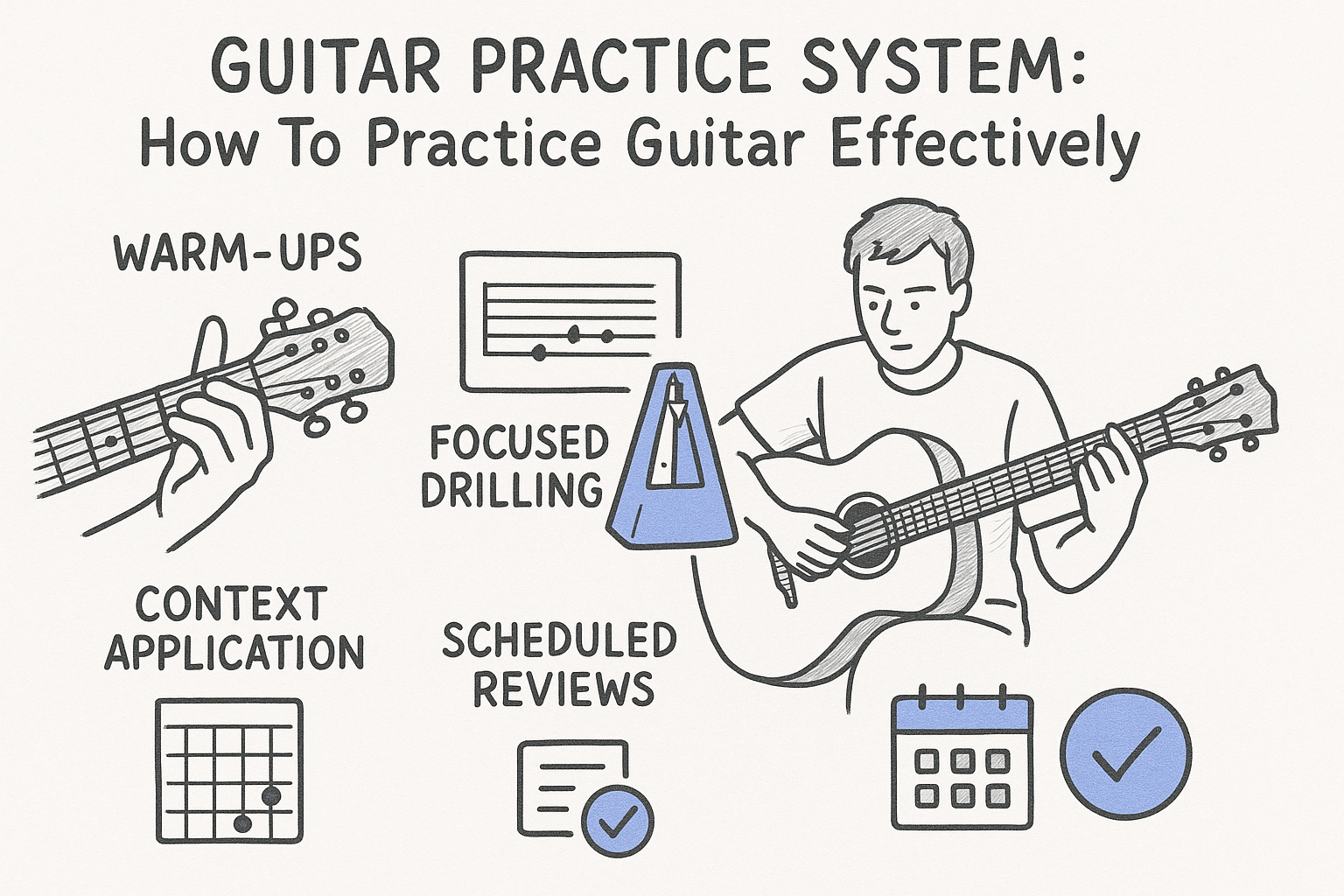
Every session that actually moves the needle contains three distinct elements: focused drilling on a specific skill, context application where you use that skill inside a real musical passage, and review of previously learned material before it gets rusty. Most guitarists do the middle part and skip the other two entirely. That's why songs you learned six months ago feel shaky and new techniques never fully stick.
Here's what each component does for you:
- Focused drilling: Isolate a technique or passage, set a target tempo, and repeat it with full attention until you hit your benchmark.
- Context application: Play the drilled material inside a real song or chord progression so your brain builds the musical connection, not just the mechanical one.
- Review: Revisit older material on a schedule so it stays sharp without eating up all your available practice time.
What a 45-minute session actually looks like
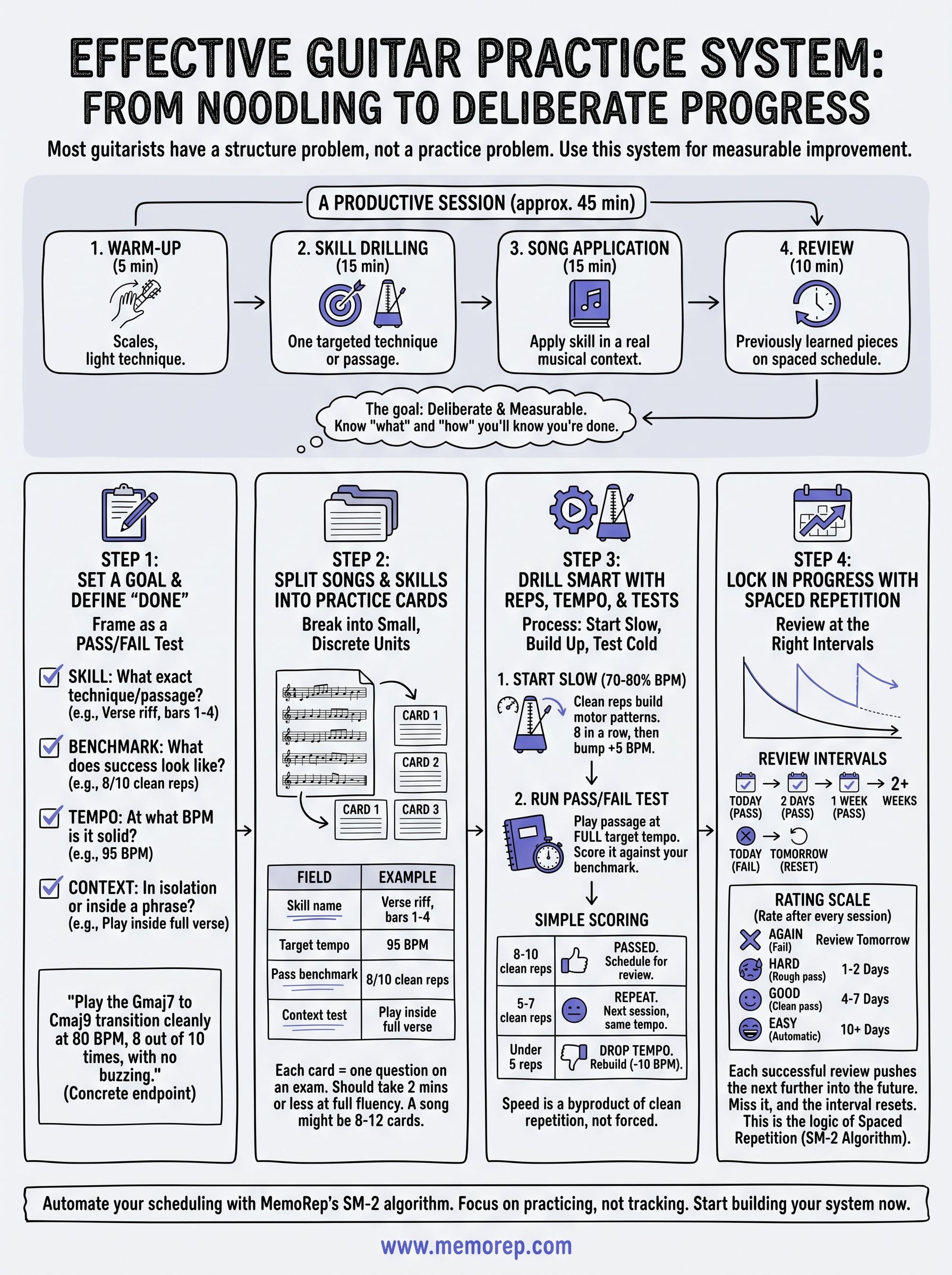
Understanding how to practice guitar effectively becomes much clearer when you see it mapped out in real time. Here's a practical session template you can use as a starting point:
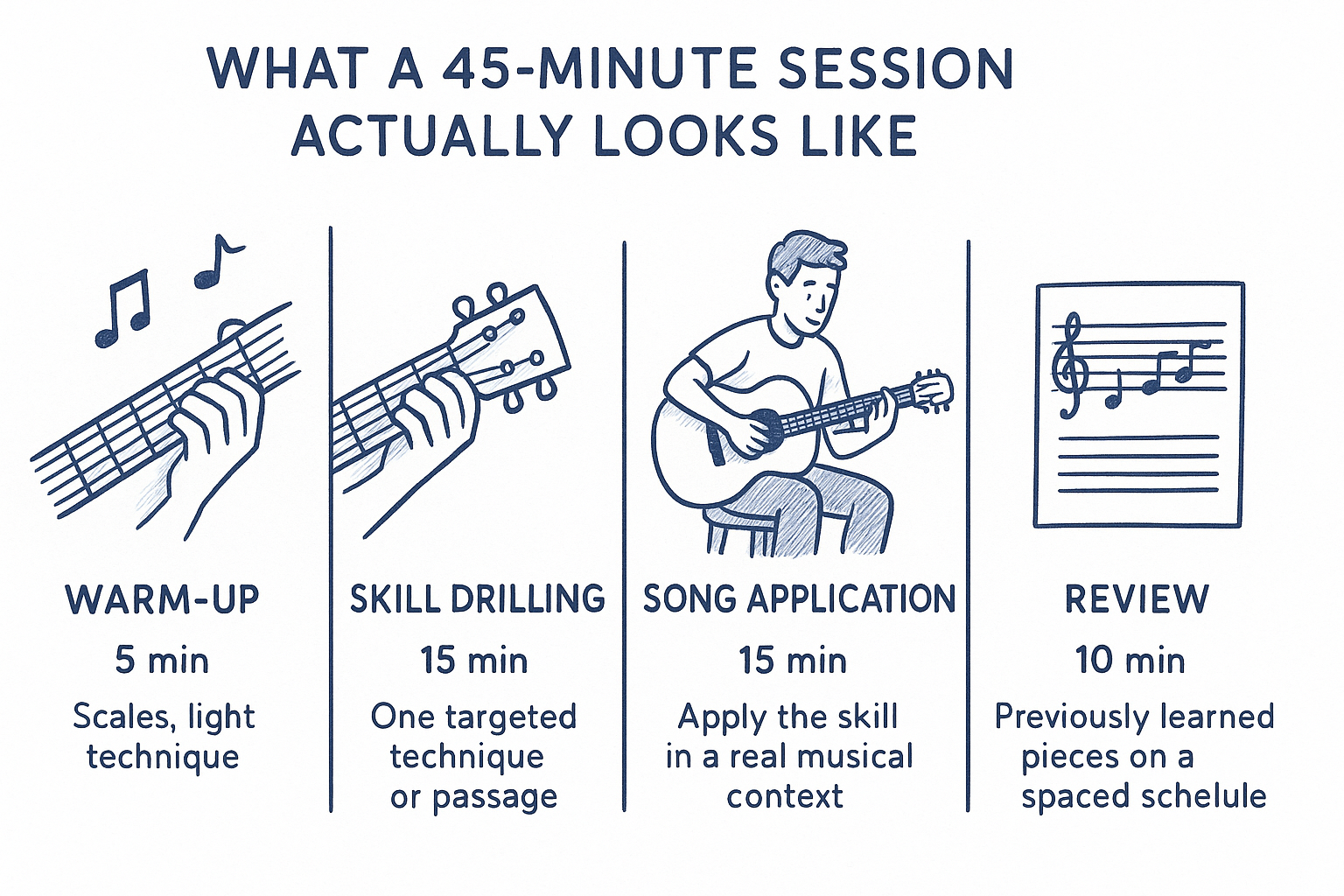
| Block | Duration | Focus |
|---|---|---|
| Warm-up | 5 min | Scales, light technique |
| Skill drilling | 15 min | One targeted technique or passage |
| Song application | 15 min | Apply the skill in a real musical context |
| Review | 10 min | Previously learned pieces on a spaced schedule |
Your actual time splits will shift depending on where you are in learning a piece, but the structure stays consistent. Keeping all four blocks in every session prevents the common trap of chasing new material while letting older skills quietly fade.
Step 1. Set a goal and define "done"
Before you pick up your guitar, you need to write down a specific goal for the session. Not "practice the intro to that song" but something with a clear endpoint. Vague intentions produce vague results, and you will never know if you actually improved without a concrete benchmark to measure against.
Turn your goal into a pass/fail test
The most effective way to set a practice goal is to frame it as a pass/fail test you can run at the end of the session. This forces you to be specific upfront and gives you an honest answer when time is up.
Use this template before every session:
- Skill: What exact technique or passage are you targeting?
- Benchmark: What does success look like? (e.g., 8 out of 10 clean repetitions)
- Tempo: At what BPM will you consider it solid?
- Context: Will you test it in isolation or inside a full musical phrase?
A good goal sounds like: "Play the Gmaj7 to Cmaj9 transition cleanly at 80 BPM, 8 out of 10 times, with no string buzzing."
Knowing how to practice guitar effectively starts here, before your fingers touch the strings. Once you have a goal written down, your session has direction and, more importantly, an honest ending point you can carry forward into your review schedule. Without that endpoint, you will always default to playing what feels comfortable rather than what actually needs work.
Step 2. Split songs and skills into practice cards
Once you have a goal, the next step is breaking your material into small, discrete units called practice cards. Each card represents one specific thing you're working on: a chord transition, a scale pattern, a four-bar phrase, or a technique like hammer-ons. The smaller the unit, the easier it is to measure progress and schedule reviews accurately without losing track of what still needs work.
What belongs on a practice card
A practice card isn't a vague category like "practice the solo." It's a concrete, isolated piece of musical content that you can drill, test, and rate in a single session. Think of each card as one question on an exam: answering it correctly should take two minutes or less at full fluency. Use this template to build each one:
| Field | Example |
|---|---|
| Skill name | Verse riff, bars 1-4 |
| Target tempo | 95 BPM |
| Pass benchmark | 8/10 clean reps |
| Context test | Play inside full verse |
How to split a song into cards
Learning how to practice guitar effectively means resisting the urge to treat a whole song as one task. Instead, map out every distinct section, transition, and technique the song requires, then assign each one its own card. A three-minute song might produce eight to twelve individual cards, and that's completely normal. Work through them one at a time, and the full song builds itself naturally over time.
Breaking material this small feels slow at first, but it eliminates the vague "I sort of know this" trap that keeps most guitarists stuck indefinitely.
Step 3. Drill smart with reps, tempo, and tests
Having a practice card tells you what to drill. This step tells you how to drill it so the skill actually transfers to real playing. Random repetition without structure just burns time. You need a specific rep target, a tempo that challenges you without breaking your mechanics, and a test at the end to confirm whether the skill actually landed.
Start below your target tempo
Set your metronome to 70-80% of your target BPM before you run a single rep. This feels too slow, and that's the point. Clean reps at a manageable tempo build the motor pattern correctly. Once you hit eight clean reps in a row at that speed, bump the tempo by five BPM and repeat. Keep climbing until you reach your benchmark tempo.
Speed is a byproduct of clean repetition, not something you force by playing fast and hoping for the best.
Run a pass/fail test at the end of every drill
Understanding how to practice guitar effectively means building honest checkpoints into every session, not just practicing and hoping it sticks. After your drilling block ends, close your notes and run your pass/fail test cold. Play the passage at full target tempo and score it against your benchmark from Step 1.
Use this simple scoring template at the end of each card:
| Result | Action |
|---|---|
| 8-10 clean reps | Mark as passed, schedule for review |
| 5-7 clean reps | Repeat next session at same tempo |
| Under 5 reps | Drop tempo 10 BPM, rebuild |
Step 4. Lock in progress with spaced repetition
Passing a drill once does not mean you own the skill. Forgetting is the default, and if you don't revisit material on a deliberate schedule, it fades faster than you expect. Spaced repetition solves this by scheduling each practice card for review at the exact interval when the skill is about to slip, so you spend the minimum time necessary to keep the maximum amount of material sharp.
How spaced repetition works for guitar
The core idea behind spaced repetition is that each successful review pushes the next review further into the future. Nail a card today and you review it in two days. Nail it again and you wait a week. Miss it and the interval resets. This is the logic behind the SM-2 algorithm that MemoRep uses to schedule your guitar practice cards automatically, replacing manual tracking with a system that adjusts based on your actual performance.
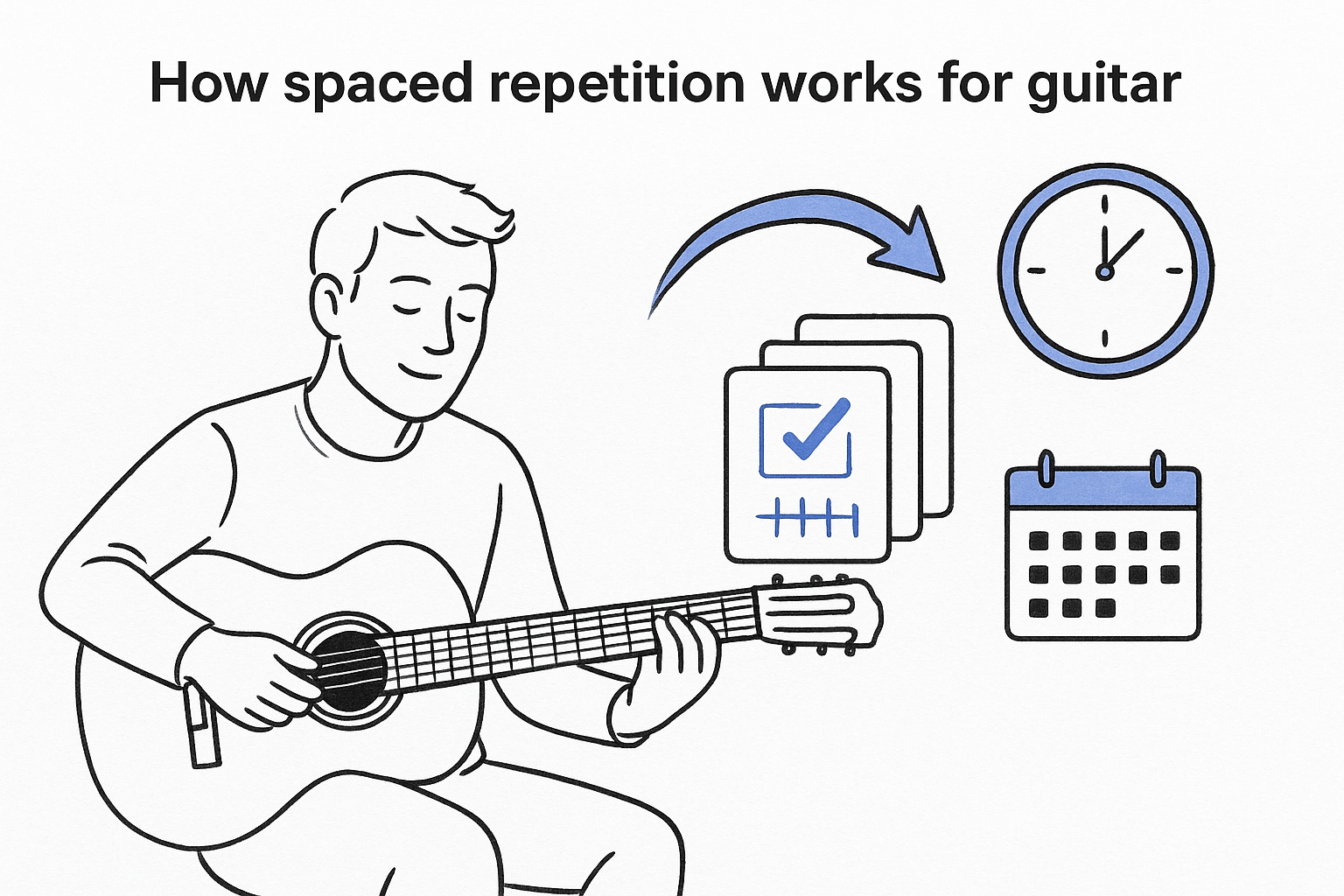
The goal isn't to practice everything every day. It's to practice the right thing on the right day.
Rate each card after every session
Understanding how to practice guitar effectively at this stage means giving each card an honest rating immediately after your pass/fail test. Use this four-point scale to drive your scheduling:
| Rating | Meaning | Next review |
|---|---|---|
| Again | Couldn't complete the benchmark | Tomorrow |
| Hard | Passed but felt rough | 1-2 days |
| Good | Clean pass at target tempo | 4-7 days |
| Easy | Felt automatic and solid | 10+ days |
Your ratings directly control your review schedule, so honest scoring matters more than optimism. If you inflate your scores, the algorithm spaces reviews too far apart and skills start slipping before you revisit them.
Next steps
You now have a complete framework for how to practice guitar effectively: clear session structure, goal-setting with a pass/fail benchmark, breaking material into discrete practice cards, drilling with reps and tempo progression, and locking progress in with spaced repetition reviews. Each step builds on the last, and the system works only when you run all four together consistently.
The hardest part of any practice system is maintaining it over time without letting it collapse into the old habit of unstructured playing. That's exactly where automation helps. Instead of manually tracking which cards are due for review, MemoRep handles the scheduling for you using the SM-2 algorithm, so you open the app and it tells you what to practice today.
Start building your practice card system now and stop leaving progress to chance. Try MemoRep free and get a lifetime premium subscription while the beta program is still open.