How to Memorize Piano Music in 4 Steps That Last
The most reliable way to learn how to memorize piano music is to treat it as a memory project, not only a playing project. Split the piece into short chunks, build four kinds of memory for each chunk (structural, aural, visual, and physical), test yourself with the score closed, and review each chunk on a spaced schedule. Do that and a piece that used to vanish after a week stays with you for months.
Most pianists know the problem. You play a passage ten times on Monday, it feels solid, and by Friday the second page is gone. Or it holds at home and falls apart in front of other people. Repetition creates a feeling of knowing, but the feeling and the memory are two different things, and only one of them survives a performance.
This guide gives you four steps with concrete actions for your next session. They work for a pop arrangement, a jazz chart, or a long classical piece. MemoRep is built around the scheduling side of this problem, so you will see where spaced review fits. One boundary applies throughout: this guide covers memory and practice organization only. What to play and how to play it stays with your teacher.
Why memorized pieces fall apart
Memorized pieces fall apart because most players lean on one or two kinds of memory and never revisit the piece at the right moment. Fix both problems and how to memorize piano music becomes a repeatable routine instead of a gamble.
Four memories, four ways to fail
A secure performance rests on four memories working together. Each one covers for the others when something goes wrong, and each one fails in its own way.
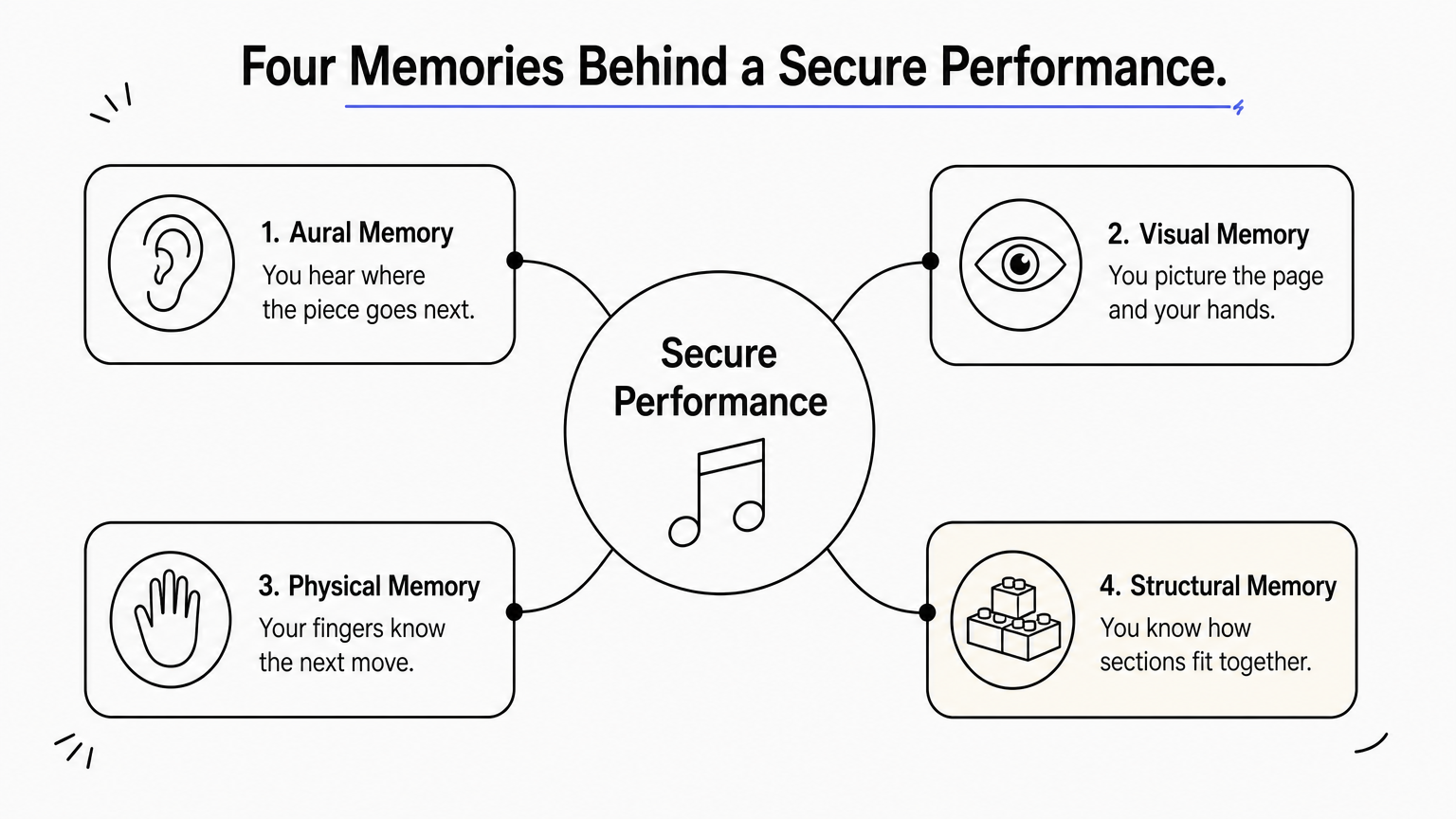
| Memory | What it tells you | Warning sign you rely on it too much |
|---|---|---|
| Aural | How the piece sounds and where it goes | You only catch wrong notes after you hear them |
| Visual | What the page, the keys, and your hands look like | You slip as soon as the music stand is empty |
| Physical | What your fingers do next | One slip leaves you lost, with no idea where to restart |
| Structural | How the piece is built, section by section | Its absence is the usual cause of blanks |
Most people build the first three by accident and skip the fourth. That is why a slip so often turns into a full stop.
Why repetition alone is not enough
Repetition builds physical memory quickly, and physical memory is also the most fragile. A different piano, a nervous room, or one interrupted measure can break the chain, and nothing else is there to catch you.
Time works against you too. Hermann Ebbinghaus showed in the 1880s that new memories fade fast and then more slowly, and that reviewing something just before you forget it strengthens it far more than another repeat right now. One long session on Sunday feels productive and still fades by Thursday.
Memory is built by well-timed retrieval, not by the number of times you play through.
What to have ready before you start
Memorizing on top of shaky reading locks mistakes into memory, so check these first:
- You can play the whole piece cleanly, without fluffing through a hand.
- You have a printed copy of the score that you can mark in pencil.
- You have a daily slot for practice, even a short one.
- Your teacher has told you where the phrases and sections are, if you are unsure.
Step 1. Split the piece into chunks
Chunk the piece into phrases, give each phrase its own practice card, and cap how much new material you take on per day. Small units are what make learning how to memorize piano music quickly possible, because your brain stores complete units better than long strings.
Choose chunks that match the music
A chunk is a musical sentence, not an arbitrary count of measures. Use the phrase marks in your score, the repeated material, and whatever section names your teacher gives you. For a long classical piece, divide it first into its large sections, then divide each section into phrases.
Repeats help you here. Mark every place where a phrase comes back, and mark where it comes back slightly changed. Those small changes are exactly where memory slips happen.
A chunk is a musical sentence, so memorize sentences, not measures.
Turn each chunk into a practice card
Give every chunk its own card, so you can track and schedule it separately. A card needs three things: a location, a clear pass condition, and room for notes. Copy this template:
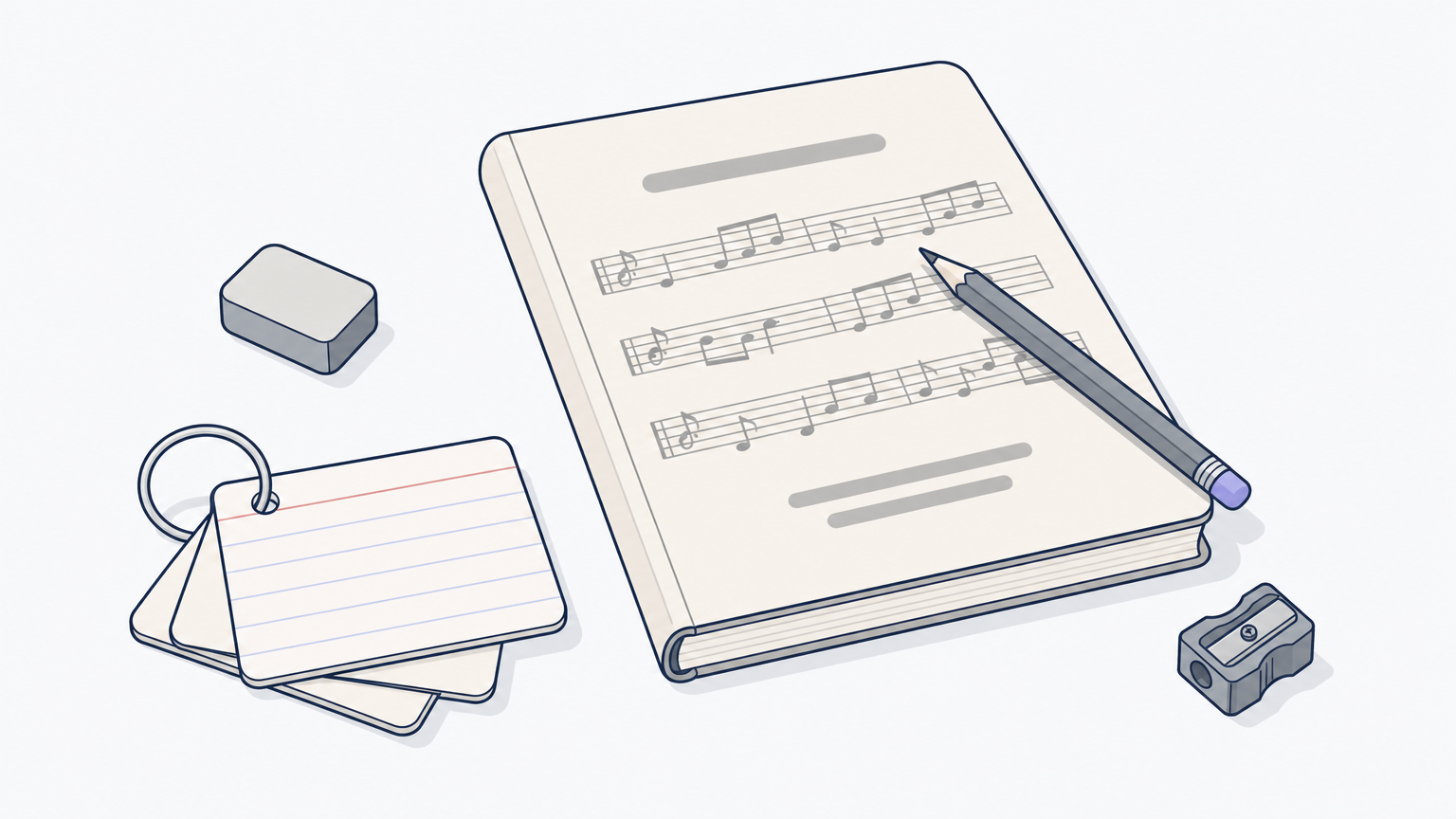
Card: [Piece title], bars 1-8
Pass: play from memory, score closed, no stops
Notes: [where you slipped last time]
In MemoRep, you keep all the cards for one piece inside a single project, so the whole piece stays organized in one place.
Cap the daily load
Take on one or two new phrases per day, no more. Earlier chunks come back through review instead of fresh memorizing. You will see the memorized portion grow every day, which beats the frustration of a whole page that never quite holds.
Step 2. Build four memories per chunk
For each chunk, add a structural, an aural, a visual, and a physical anchor, starting with the structural one. This is the most dependable way to memorize a piece, because if one memory fails during a performance, another is ready.
Anchor it structurally and by ear
Make a structural map on your marked copy. Label each phrase in plain words, such as "question", "answer", or "same as bar 1, but higher". Mark repeats and the spots where a repeat changes. Use the vocabulary you already have, and ask your teacher to check your labels if you are unsure.
Then add the aural anchor. Sing or hum the line away from the piano. If you cannot get through a phrase without the keys, you do not know it yet. Listening to one recording of the piece also helps, as long as you do not copy every quirk of the performer.
If you can sing the phrase and say what it is called, you own it.
Check the visual and physical memories
For the visual memory, play with the stand empty, or close your eyes and picture the page and your hands on the keys. If the picture blurs at one spot, that spot is your weak link.
Physical memory deserves suspicion. Test it by stopping in the middle of a chunk and saying what comes next before you play it. Change conditions too: another keyboard, another time of day, a short walk before you sit down. If your hands only work when everything stays the same, you are leaning on muscle memory alone.
Step 3. Practice recall, not rereading
Recall practice means you try to produce a chunk from memory first, and only then check the score. It works because effortful retrieval strengthens memory more than looking at the notes does, and it is the real answer to how to memorize piano sheet music: you let go of the page.
Attempt first, check second
Follow this loop for every chunk:
- Close the score or turn it face down.
- Play the chunk from memory, even if it feels shaky.
- Open the score and mark every note, rhythm, or entrance you missed.
- Write those errors in the card's notes.
- Rate the attempt honestly before you move on.
Honest ratings matter. MemoRep uses Again, Hard, Good, and Easy, and the schedule is only as good as the rating you give it.
Create islands in the piece
Choose several starting points at phrase beginnings, and begin from a different one each session. Many players know the first page perfectly and the last page barely, because they always start at bar 1. Starting points scattered through the piece are sometimes called islands.
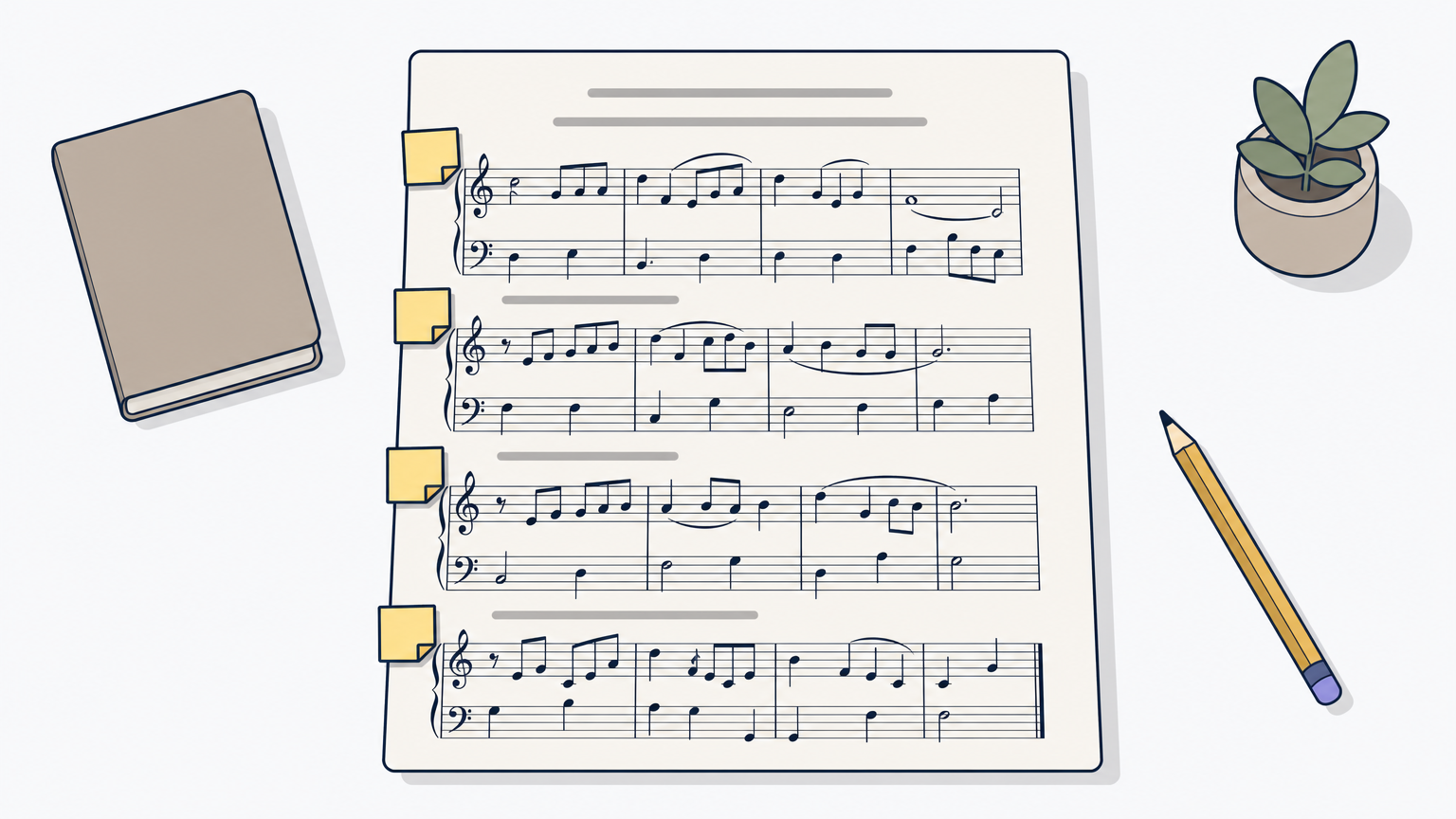
If a slip happens, jump forward to the next island, never backward. Going back restarts the problem and teaches your hands to stumble in the same place.
Always be able to start from the middle, because that is where slips happen.
Rehearse your recovery
Once a day, stop yourself in the middle of a chunk on purpose, then restart at the next island without pausing to think. It takes one minute. It trains the exact skill you will need when something goes wrong in a performance, and it makes slips feel routine instead of catastrophic.
Step 4. Schedule reviews so it lasts
Review each chunk shortly before you would forget it, and let the gaps grow as the chunk gets stronger. Spacing is what lets you memorize piano music fast without long sessions, because short, well-timed reviews beat one marathon.
A review schedule that grows
The SuperMemo SM-2 algorithm starts with a gap of about 1 day, then about 6 days, then multiplies each gap by an ease factor. With a typical factor of 2.5, a chunk you rate Good each time looks like this:
| Review | Gap since last | Approximate day |
|---|---|---|
| Learned | none | Day 0 |
| 1 | 1 day | Day 1 |
| 2 | 6 days | Day 7 |
| 3 | about 15 days | Day 22 |
| 4 | about 38 days | Day 60 |
Treat this as an illustration. Hard shortens the next gap, Easy lengthens it, and Again brings the chunk back sooner. MemoRep runs this scheduling for you, so each day you see only the chunks that are due.
Keep a long piece in rotation
A long classical piece can mean dozens of chunks at different stages. Give every chunk its own card, and then add joining cards for the transitions between chunks, since slips cluster at the seams. Once chunks and joins are steady, add cards for whole sections played start to finish.
Old and new material mix in each session. You warm up with reviews that are due, then spend your fresh effort on the one or two new phrases for the day.
Run dress rehearsals before the performance
In the last two weeks, play the whole piece once per session with the score out of sight. Record it, and play it for someone when you can. A listener changes how you play, and that exposes weak spots that private practice hides.
Turn every slip from these runs into a new card note, and keep reviewing on schedule. Do not cram on the final day. A short review of what is due is enough.
Start with one chunk tonight
Memorizing a piece is a process: chunk it, anchor it four ways, test yourself with the score closed, and review it on a growing schedule. None of it needs marathon sessions. It needs small units, honest self-testing, and reviews that arrive at the right time.
Pick the first phrase of your current piece, write its card, and run the attempt-first loop once. Tomorrow, repeat it and add one more phrase. If you would rather not track the intervals and ratings by hand, see how MemoRep works and claim the limited-time free-for-life subscription so the schedule takes care of itself.