How to Use Spaced Repetition for Math Mastery
You solve a problem type perfectly on Monday, then blank on the same concept three weeks later. That's not a math ability issue, it's a forgetting curve issue, and spaced repetition for math is the fix most students never try correctly. Flashcards alone don't cut it here, because math isn't vocabulary. You're not memorizing a fact, you're rebuilding a problem-solving skill under slightly different conditions each time.
This guide shows you how to apply spaced repetition specifically to math: formulas, proof techniques, problem patterns, and the procedural steps that make solutions click. You'll learn what to put on a "card" when the answer isn't a single word, how to space out review sessions so skills stay sharp instead of fading, and how to grade your own recall honestly so the schedule actually adapts to you. The goal is retention that survives an exam, not just short-term recognition.
We'll cover practical setup steps, common mistakes that sink spaced repetition for math learners, and how a system built around real skill practice, not flat flashcards, keeps you reviewing the right concept at the right moment instead of guessing what to revisit next.
Why spaced repetition is different for math
Most people learn about spaced repetition through language apps or exam-prep flashcards, and that shapes how they try to apply it to math. That's the mistake. A vocabulary card asks you to recognize a fact you already stored. A math card asks you to rebuild a problem-solving process from scratch, often under conditions that shift slightly each time you see it. Confusing the two is why so many students try spaced repetition for math once, get frustrated, and quit.
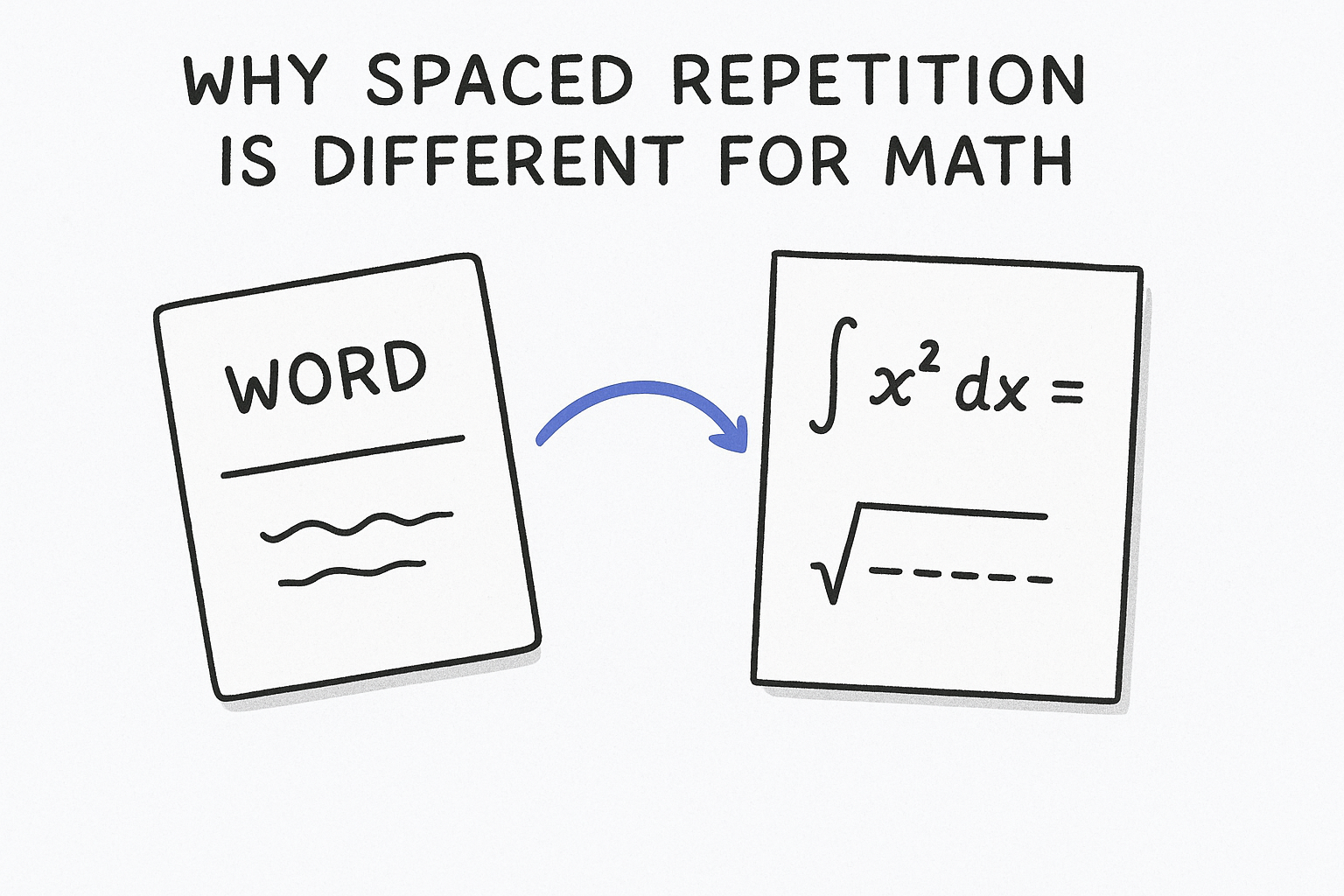
Math skills decay differently than facts
Ebbinghaus mapped how memory for isolated facts fades on a predictable curve, and that curve still applies to math, but procedural knowledge fades faster and less evenly than a memorized date or word. You can forget how to set up an integration by parts problem while still recognizing the formula on sight. The forgetting curve for a skill isn't one smooth line, it's uneven, because different pieces of the skill (setup, execution, error-checking) decay at different rates.
A math skill doesn't fade all at once, the setup goes first, long before you forget the formula itself.
Recognition isn't recall
Recognizing a formula on a page is nothing like producing the right approach when a problem is stripped of hints. Standard flashcard apps reward recognition because the answer sits right there on the back of the card. Math mastery requires active recall under near-exam conditions: no formula sheet, no answer key glowing in your peripheral vision, just you and a blank page. If your review process lets you peek before you've committed to a full solution path, you're training recognition, not the skill you'll actually need on test day.
Where generic flashcard apps fall short
Swiping through a deck built for vocabulary doesn't map cleanly onto math because the unit of practice is wrong. A word has one correct answer. A math problem has a correct process that can branch, a step that's easy to skip, and an answer that's only half the story if you can't explain how you got there.
| Fact flashcards | Math practice cards | |
|---|---|---|
| What's tested | Recognition of a stored fact | Execution of a multi-step process |
| Correct answer | Fixed and singular | Method-dependent, often with checkable steps |
| Failure mode | "I forgot the word" | "I forgot which technique applies here" |
| Ideal review | Quick flip, instant grade | Full write-out, self-graded on process |
That table is the reason a system built specifically around practical skill practice, rather than flat question-and-answer decks, changes outcomes. The next four steps show you how to build that system for math specifically, starting with how you break a topic down into something reviewable in the first place.
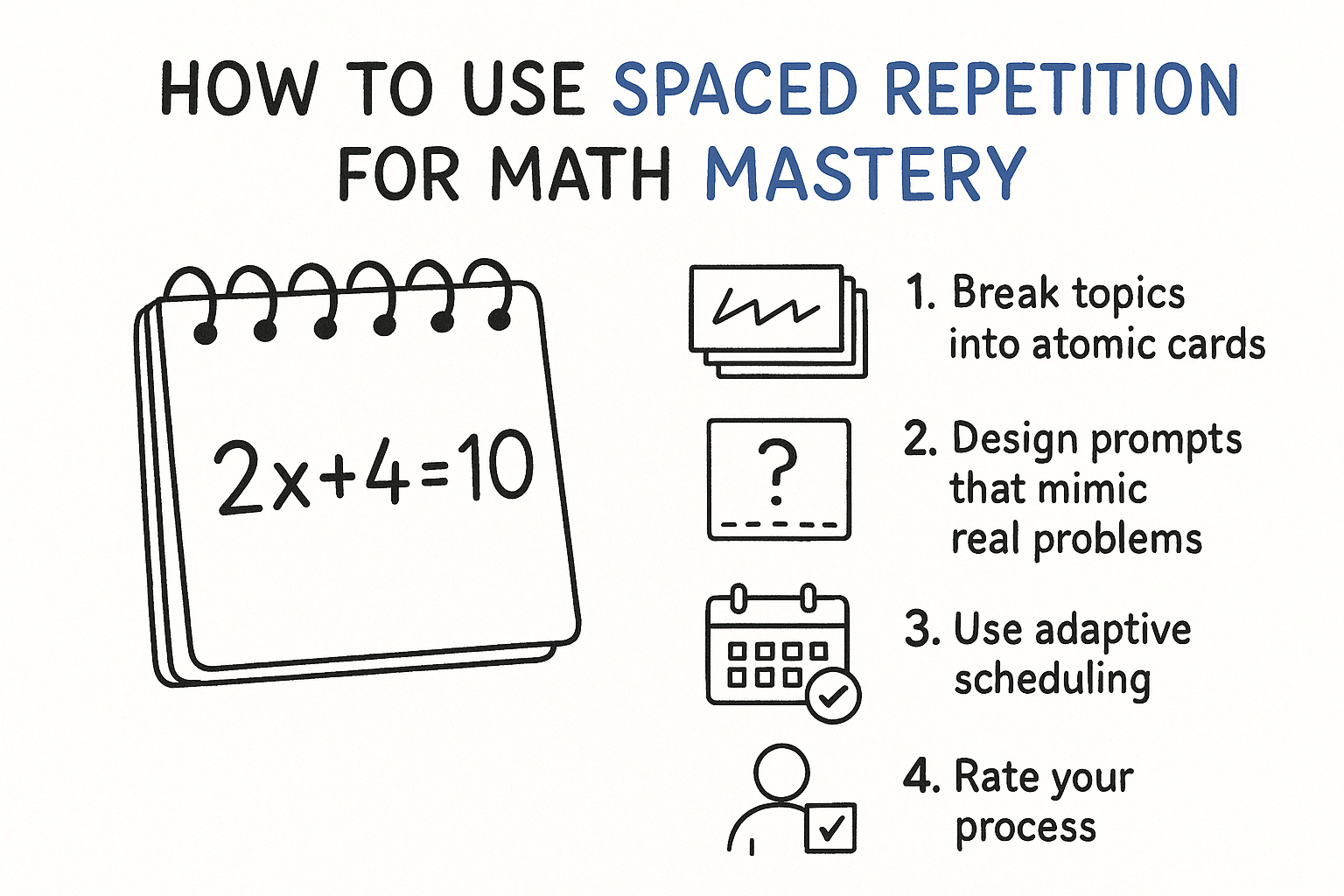
Step 1. Break topics into atomic practice cards
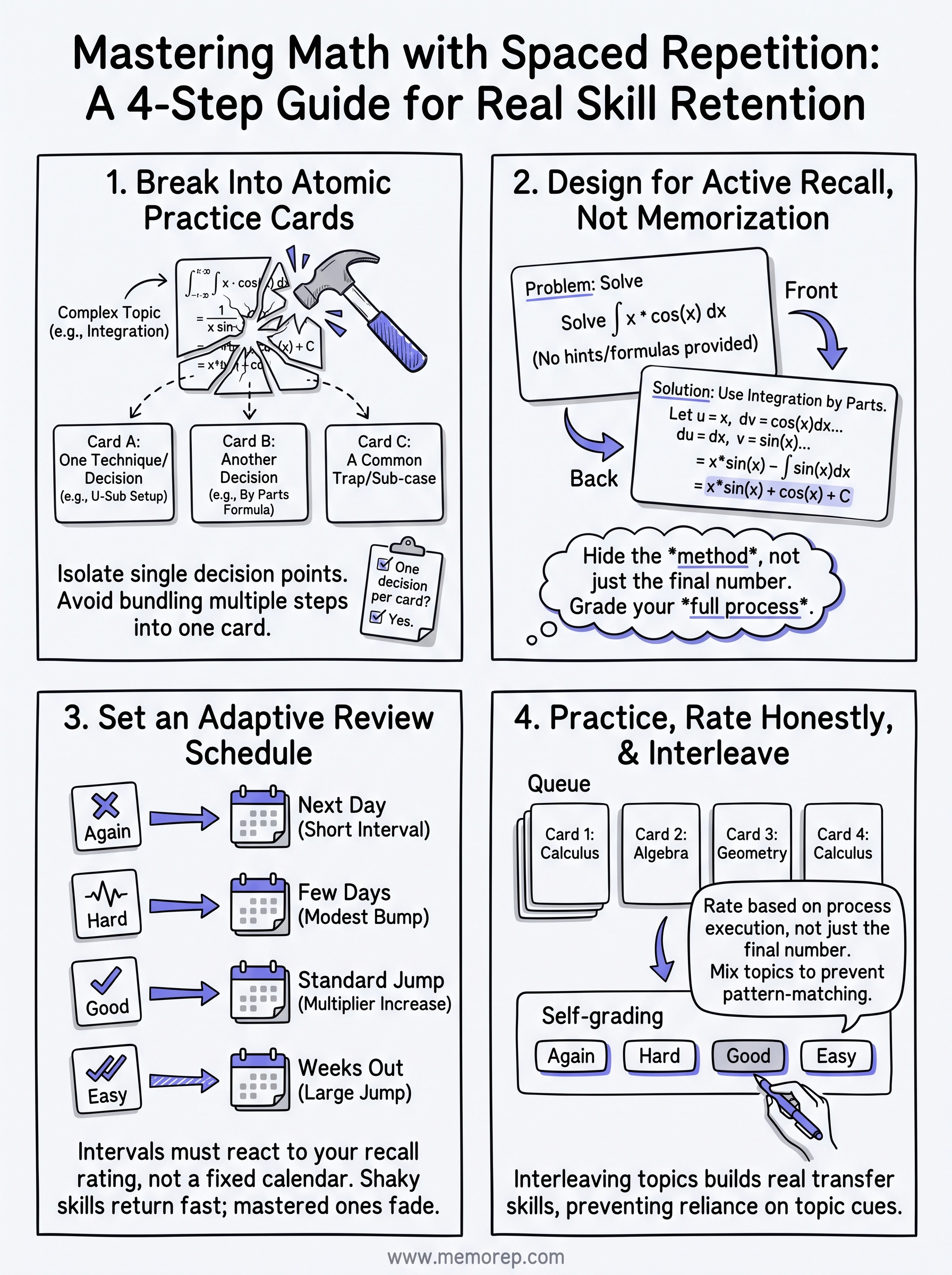
Grabbing a whole chapter like "integration techniques" and turning it into one review card guarantees failure. The chapter has a dozen decision points buried inside it, and a single card can't isolate which one you're shaky on. Atomic practice cards split a topic into the smallest reviewable unit: one technique, one setup pattern, one type of trap. This is the step most people skip when they try flashcards for math, and it's the reason those attempts stall out fast.
Find the decision point, not the topic
Every math skill hides a series of small decisions: which substitution to try, which identity applies, when to split a fraction versus combine it. Isolate each decision point into its own card instead of bundling them under a broad label. If a problem type has three distinct sub-cases, make three cards, not one. This is what separates real math practice cards from a generic flashcard deck.
If you can't name the exact decision a card is testing, it's not atomic yet, it's still a topic.
A quick way to check atomicity
Before you save a card, run it through this checklist:
- Does the card test one technique or decision, not several stacked together?
- Could you rate your recall (Again, Hard, Good, Easy) on this card without it depending on a different skill first?
- Would a friend who's shaky on just this one piece, and solid everywhere else, get it wrong specifically because of this card?
- Is the prompt short enough to write on one line, even if the solution takes a full page?
If any answer is no, split the card further.
Group atomic cards into a project, not a pile
Once you have atomic cards, organize them by course or skill area, not dump them into one giant deck. A "Calc II" project with sub-groups for integration, series, and polar coordinates keeps your review sessions from turning into a random grab bag. This structure is exactly what a spaced repetition platform built for skills, rather than flat facts, should let you set up before you write a single card.
Step 2. Design cards for active recall, not memorization
Once your cards are atomic, the next failure point is how you write them. A card that shows a formula and asks you to recognize it trains the wrong muscle. Active recall practice means the prompt gives you only what a real problem gives you: a scenario, maybe a diagram, and nothing else. You supply the setup, the method, and the full solution before checking anything.
Write the prompt like a fresh problem
Skip prompts like "What's the formula for the chain rule?" Instead, write a full problem that forces you to choose the chain rule without being told to. A math flashcard that names the technique in the question defeats the point, because on an exam nothing announces which method applies. Vary the surface details (different variables, different numbers) each time you revisit a card so you're not just pattern-matching the exact problem you saw last week.
Hide the method, not just the answer
Generic flashcards hide the answer and show the question. Math cards need to hide the method too. Put the problem on the front, and on the back, put the full worked solution, not just a final number. Grading yourself on the number alone lets arithmetic slips masquerade as full understanding, and lets guesses masquerade as recall.
If your card only checks the final number, you're grading luck, not understanding.
Build in a self-check step
Before rating a card Again, Hard, Good, or Easy, compare your written-out process against the back, step by step, not just the final line. A simple template keeps this honest:
Problem: [full problem text]
My setup: [what I wrote before checking]
Correct method: [technique used on the back]
Where I diverged: [step number, or "none"]
Rating: Again / Hard / Good / Easy
This forces you to locate the exact step where your process broke, which is the information that actually improves your next attempt.
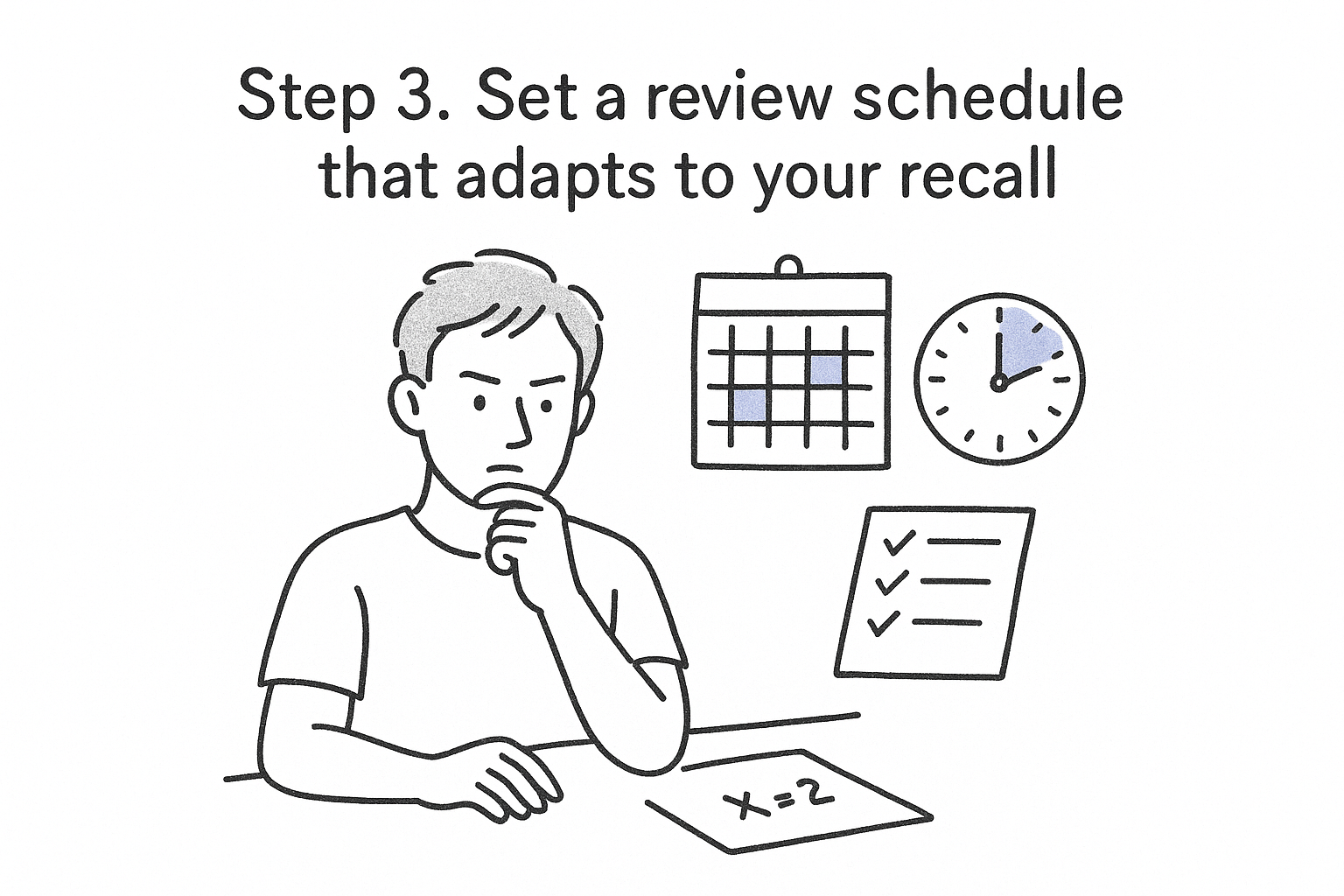
Step 3. Set a review schedule that adapts to your recall
A fixed calendar, review every three days no matter what, ignores the one signal that actually matters: how well you recalled the card last time. Adaptive scheduling built on the SuperMemo SM-2 model pushes easy cards further out and pulls struggling cards back in fast, so your review time goes where the forgetting is actually happening. For math specifically, this matters more than for vocabulary, because a technique you nailed cold doesn't need the same attention as one where you blanked on the setup halfway through.
Why fixed intervals fail for math
Rigid schedules treat every card the same, which punishes you twice. Easy cards eat up review time you don't need to spend, while a shaky technique gets buried under a pile of cards you've already mastered. Spaced repetition scheduling for math has to react to your actual performance on each card, not a generic timetable, because procedural skills decay at wildly different speeds depending on how well you understood the method the first time.
A schedule that ignores your last recall attempt is just a calendar, not spaced repetition.
Let your rating set the next interval
Your honest rating on each attempt should directly move the next review date:
- Again: reset to a short interval, often the next day, because the setup didn't stick at all.
- Hard: a modest bump, a few days out, since you got there but it was slow or shaky.
- Good: a solid multiplier increase, the standard spacing jump.
- Easy: a large jump, weeks out, because the skill is stable.
Start conservative, then trust the adjustment
Begin new cards with short intervals, a day or two, since you have no history yet to judge decay speed. Once you've rated a card two or three times, the algorithm has enough data to widen or shrink the gap on its own, and that's when the schedule starts doing the real work for you.
Step 4. Practice, rate honestly, and interleave topics
All the setup work in the first three steps falls apart if you fudge the rating step. Honest self-rating is what feeds the algorithm accurate data, and a generous "Good" on a card you actually fumbled just pushes a weak skill further out of sight until it resurfaces on an exam.
Rate the process, not the outcome
Grade yourself on how you got there, not just whether the final number matched. A correct answer reached through a lucky guess or a memorized shortcut deserves a Hard, not a Good, because the underlying technique still isn't solid. Use this quick gut-check before you rate:
- Did I choose the method without hints? If not, that's Again or Hard.
- Did I execute every step cleanly, or did I patch a mistake mid-solution? Patched work rarely earns Easy.
- Could I explain my setup to someone else right now? If you hesitate, rate it down.
Rate the method you used, not the number you landed on, or the schedule will lie to you.
Why interleaving beats blocked practice
Reviewing ten integration-by-parts cards in a row feels productive, but it lets you coast on pattern recognition instead of decision-making, since you already know which technique applies before reading the problem. Interleaved practice mixes topics within a session so you have to identify the right approach cold, the same way an exam forces you to jump between problem types without warning. Research on interleaving versus blocked study consistently shows better long-term transfer, even though it feels harder and slower in the moment, which is exactly the point.
Building interleaving into your sessions
Mix cards from different projects, algebra, calculus, geometry, or whatever you're tracking, into the same review queue rather than clearing one deck before starting another. A spaced repetition system that pulls due cards across all your topics automatically does this mixing for you, so you never have to manually shuffle a session to avoid blocked practice.
Making spaced repetition part of your math routine
Getting spaced repetition to work for math comes down to four habits: build atomic cards around single decisions, write prompts that demand a full solution instead of a memorized fact, let your rating drive the schedule instead of a fixed calendar, and mix topics so you're always choosing a method, not coasting on pattern recognition. Skip any one of these and you're back to swiping through flashcards that train recognition instead of the skill you actually need on exam day.
None of this requires more study time, just a better structure for the time you already spend. Once your cards are atomic and your ratings are honest, the adaptive scheduling does the heavy lifting, surfacing the setup you're shaky on before it fades and leaving the solid skills alone.
If you want a system built around this exact workflow, see how memoRep's scheduling algorithm works, then grab a free spot in the current beta.