Deliberate Practice: Ericsson's Research Explained (No PDF Needed)
You searched for a deliberate practice pdf because you want the real source, not another blog post paraphrasing a paraphrase. Maybe you're chasing Anders Ericsson's original papers, or you just want to understand what
Why deliberate practice matters more than hours put in
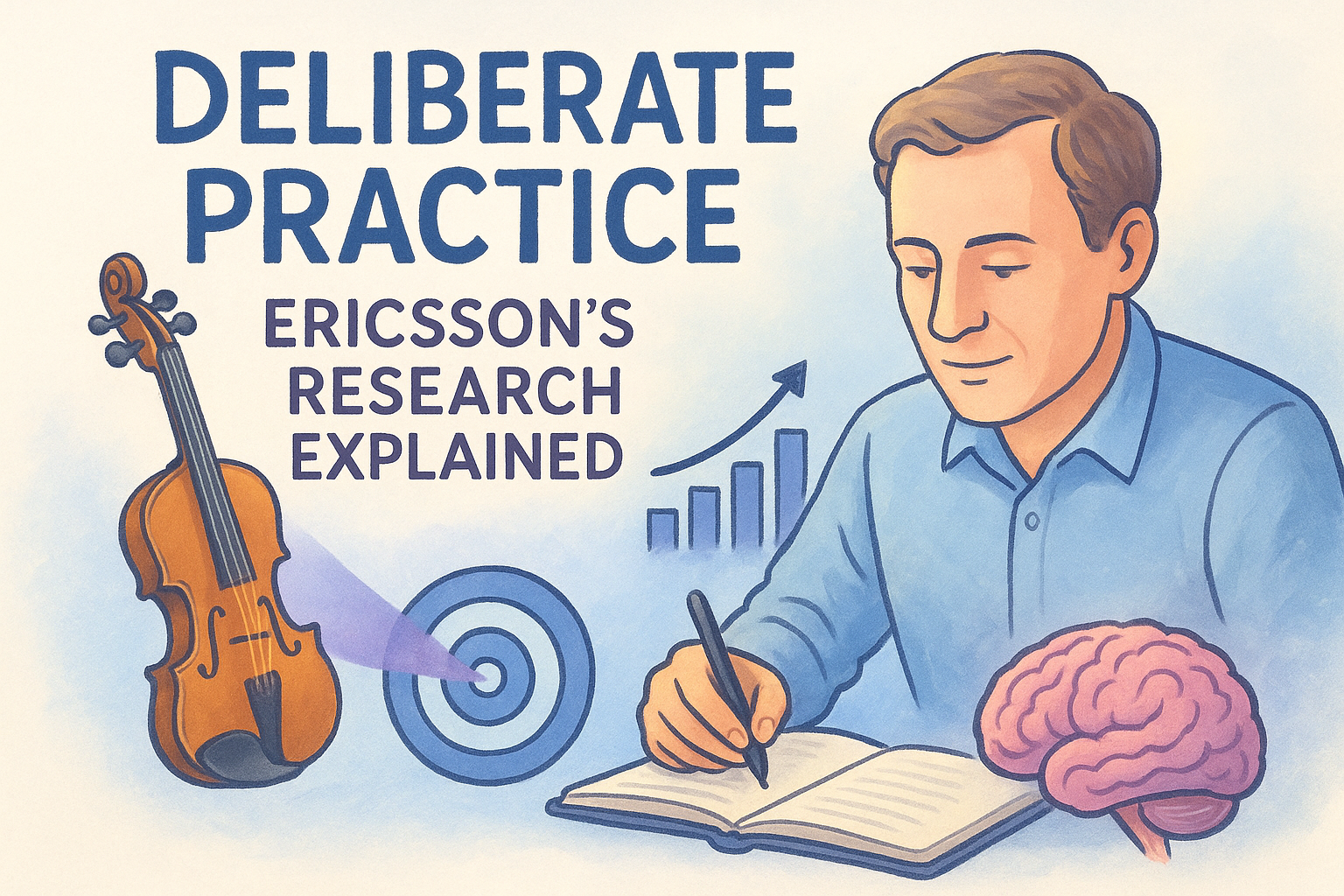
Most people assume that clocking hours automatically makes you better. Play scales for ten years and you'll master the guitar, right? Ericsson's research says otherwise. His 1993 paper, co-authored with Ralf Krampe and Clemens Tesch-Romer, found that elite performers don't just practice more, they practice differently. Violinists at the top of their conservatory logged roughly the same total hours as their peers, but they spent those hours on focused, effortful drills targeting specific weaknesses rather than casual repetition. The gap wasn't time. It was the quality of attention inside that time.
The 10,000-hour rule oversimplifies a real finding
Malcolm Gladwell's popularization of the "10,000-hour rule" took Ericsson's data and flattened it into a headline. Ericsson himself pushed back on this in later interviews and in his book Peak, pointing out that the number was an average, not a threshold, and that the type of practice mattered far more than the hour count. Raw repetition without a clear target barely moves the needle. A guitarist who plays the same three chords for two hours a day for a year has logged over 700 hours, yet may show almost no measurable improvement if nothing about those sessions changes. Compare that to someone who spends 20 focused minutes a day isolating a specific transition, tracking errors, and adjusting technique based on what went wrong.
Hours tell you how long someone practiced. They don't tell you if they got better.
Feedback is the ingredient most practice routines skip
Here's what separates deliberate practice from just showing up: a tight feedback loop. Ericsson's model requires that you know, almost immediately, whether what you just did worked. Musicians who practice alone in front of a mirror or a recording device get faster feedback than those who play through a piece and move on. Immediate correction compounds. Skip it, and you rehearse your own mistakes into muscle memory. This is why a student working with a teacher who flags errors in real time often progresses faster than a self-taught player putting in triple the hours, even though both would report similar totals if you only counted minutes.
Just doing something over and over is a different activity than deliberate practice, and the difference between mindless repetition and deliberate work decides whether you improve at all. Some researchers group ordinary repetition, structured lessons, and rehearsal all under a single label of "practice," which is exactly why people searching for a deliberate practice pdf often end up confused by generic advice. The table below breaks down what separates the two:
| Aspect | Mindless repetition | Deliberate practice |
|---|---|---|
| Goal | Vague ("get better") | Specific, measurable sub-skill |
| Feedback | Delayed or absent | Immediate, targeted |
| Difficulty | Comfortable, within current ability | Just beyond current ability |
| Mental effort | Low, autopilot | High, full attention |
| Adjustment | Rarely changes approach | Constantly refines technique |
Skills decay faster than most learners expect
There's a second reason hours alone don't guarantee skill: forgetting. Hermann Ebbinghaus documented this over a century before Ericsson, showing that newly learned material fades in a predictable curve of memory decay unless it's revisited at the right intervals. Apply that to a saxophone player learning a tricky chord voicing. Nail it in one session, skip it for three weeks, and you're often back to near-square one. The hours you spent building that skill didn't disappear, but without reinforcement at the right moment, the neural pathway weakens faster than most people realize. This is exactly the gap that spaced repetition tools were built to close, scheduling a return to that chord voicing right before it would otherwise slip.
Why this distinction matters for anyone practicing a physical skill
If you're a musician, athlete, or anyone building a hands-on skill, this changes how you should think about progress. Logging practice time in a journal feels productive, but it measures the wrong variable. Measurable improvement on a specific, well-defined component of your skill is the real signal. Try this instead of counting minutes:
- Pick one narrow sub-skill (a chord transition, a specific interval, a footwork pattern) rather than "get better at guitar" broadly.
- Set a threshold for success you can judge in real time, like hitting the transition cleanly five times in a row without hesitation.
- Record yourself or use a metronome, mirror, or coach to get feedback within seconds, not days.
- Push slightly past your comfort zone each session, not so far that you're overwhelmed, not so little that nothing changes.
Once you separate what deliberate practice actually means from generic time-on-task, the next question becomes practical: how do you actually build a routine around it without turning every session into a research project? That's what the rest of this piece covers, starting with how to translate Ericsson's principles into something you can do this week.
How to apply deliberate practice to your own skill
Reading about deliberate practice is easy. Applying it to your own trumpet playing, golf swing, or coding drills is where most people stall out. You don't need a deliberate practice pdf to start, you need a repeatable process for practicing deliberately that turns Ericsson's principles into something you actually do on a Tuesday night after work. The deliberate practice techniques below are the same ones that show up across sports psychology, music pedagogy, and skill-acquisition research, just stripped of the jargon.
Break your skill into testable components
Start by naming the exact sub-skill you're targeting, not the broad category. "Get better at piano" isn't a target. "Play the left-hand arpeggio in bar 12 without missing the third note" is. Narrow targets let you judge success in real time, which is the whole point. Once you've picked the component, ask yourself three questions before you touch your instrument or equipment:
- What does success look like in this specific drill? (five clean reps in a row, a time under 30 seconds, zero missed notes)
- What's slightly beyond my current ability, not wildly beyond it?
- How will I know, within seconds, whether a rep worked or failed?
Most people who read Ericsson's work in isolation, or search for a deliberate practice ericsson pdf hoping for a checklist, miss that this narrowing step is the actual work. Everything else follows from picking the right target.
Build feedback into every session
Getting feedback fast is nonnegotiable. Record yourself on your phone and listen back immediately. Use a mirror if you're working on form. Play with a metronome if timing is the issue. Tight feedback loops are what separate a session that builds skill from a session that just burns time. If you're learning alone, without a coach correcting you in real time, you have to manufacture that correction yourself, and that means reviewing every rep, not just the ones that felt off.
Feedback you get tomorrow can't fix the mistake you made today.
Track progress without turning it into homework
Writing everything down in a notebook, or filling in a music practice journal template, sounds disciplined until week three, when you stop doing it because it's tedious. Progress tracking should tell you two things at a glance: what you worked on, and how it went. That's it. Anything more elaborate turns into a chore you abandon.
This is exactly the gap tools like MemoRep were built to close. Instead of a blank notebook page, you log a practice card for that arpeggio, rate how the session went using an Again, Hard, Good, or Easy scale, and the scheduling algorithm decides when you should revisit it based on how you actually performed, not on a fixed weekly plan you made up in advance. You're not guessing whether it's time to circle back to that shaky transition. The system tells you, using the same spaced repetition logic that keeps skills from decaying between sessions.
Once your sub-skills are defined, your feedback loop is tight, and your tracking is automated rather than manual, you've built the practical version of what Ericsson described in dense academic language three decades ago. The next section looks at what his original studies actually measured, and why the details matter more than the popularized summary most people have heard.
What Ericsson's original research actually found
Before Ericsson became shorthand for "practice smart, not just hard," he was a cognitive psychologist studying the psychology of how experts actually get good. Anders Ericsson's most cited paper, published in Psychological Review in 1993 with Ralf Krampe and Clemens Tesch-Romer, studied violinists at a Berlin music academy, splitting them into skill tiers based on faculty assessment. Detailed diaries tracked exactly how each student spent every hour of their week, not just how many hours they logged. That distinction is the whole paper. Ericsson wasn't measuring time on task, he was measuring what happened inside that time.
The violinist study and what it actually measured
All the violinists reported similar total hours devoted to "practice" in the broad sense, including lessons, solo rehearsal, and group performance. What separated the top tier from the rest was time spent in solitary, structured drilling aimed at specific technical problems, the activity Ericsson labeled deliberate practice. Best performers logged more hours in this narrow category specifically, not in music-related activity generally. He built the theory of deliberate practice on four strict conditions, and a session only counts if it meets all four:
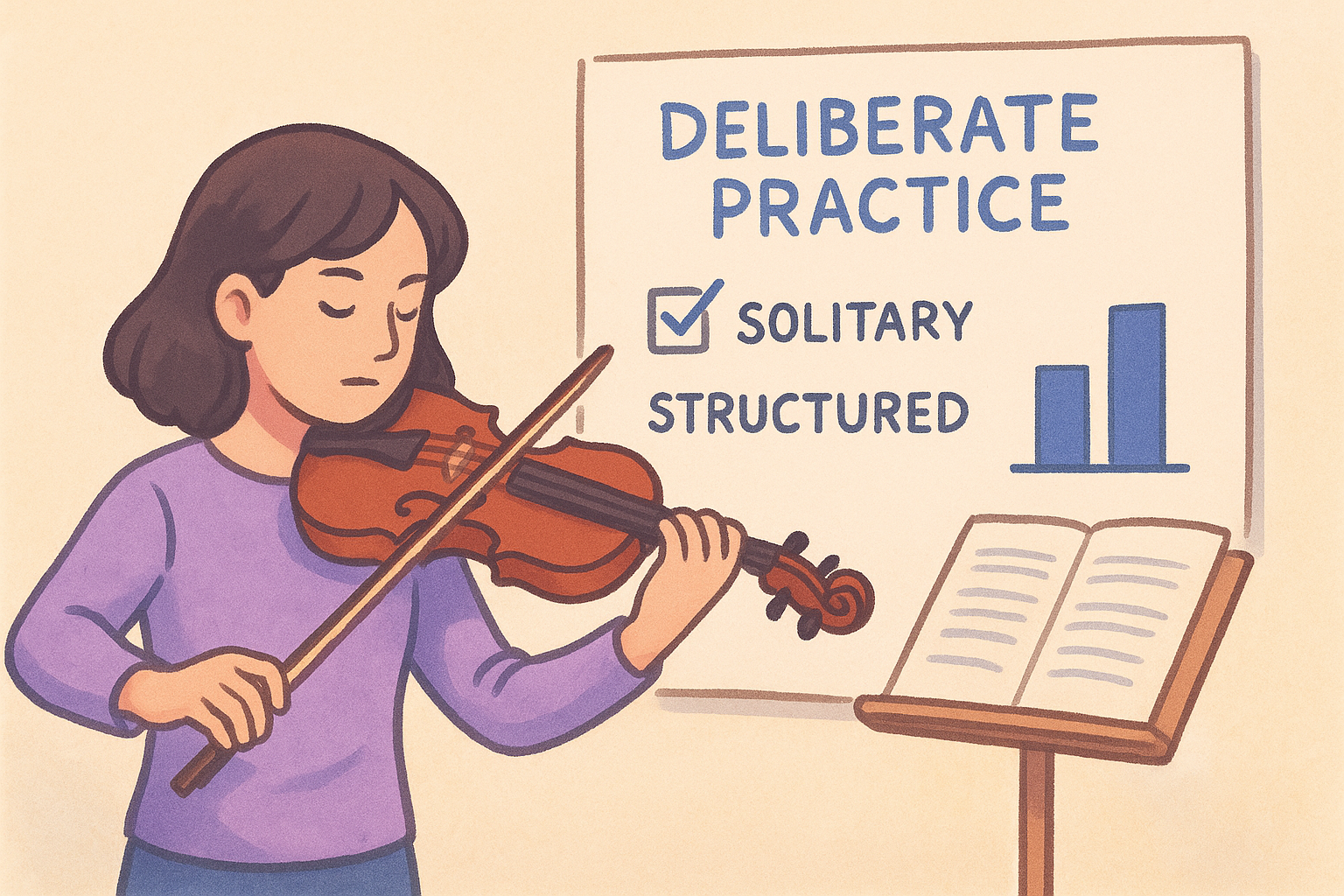
- The activity has a specific, well-defined goal (fix this fingering, not "play better")
- It requires effortful, focused attention rather than autopilot repetition
- It generates immediate feedback on whether the attempt succeeded
- It pushes slightly beyond your current skill level, not comfortably within it
That four-part definition is stricter than most people assume when they search for a deliberate practice ericsson pdf expecting a general practice guide. Ericsson wasn't describing any structured lesson or rehearsal. He was describing a narrow activity that most practicing musicians spend surprisingly little time on.
Ericsson didn't find that experts practiced more. He found they spent more time doing a specific, harder kind of practice most people skip.
Why the paper never mentioned 10,000 hours as a rule
Here's the detail that gets lost in every secondhand summary: Ericsson's paper reports an average of roughly 10,000 hours logged by the best violinists by age 20, not a threshold that guarantees expertise. Averages hide variance, and the variance in his data was substantial. Some top performers had logged fewer hours; some middling performers had logged more. Gladwell's later popularization in Outliers turned an observed average into a causal rule, which Ericsson spent years afterward correcting in interviews, op-eds, and his 2016 book Peak, co-written with Robert Pool, still one of the best books on deliberate practice.
What later research added and complicated
Subsequent studies pushed on the original findings in ways worth knowing if you're going to cite this research seriously. A 2014 meta-analysis by Macnamara, Hambrick, and Oswald examined deliberate practice across domains and found it explained a smaller share of skill variance in some fields, particularly ones with a strong innate-ability component, than the original framework implied. That doesn't undo Ericsson's core mechanism, feedback and focused effort still beat mindless repetition inside any single domain, but it does mean deliberate practice isn't a universal formula that erases every difference in talent, starting point, or opportunity. Treat it as a powerful lever on the practice side of the equation, not a guarantee that swamps every other factor.
The stages of an effective deliberate practice session
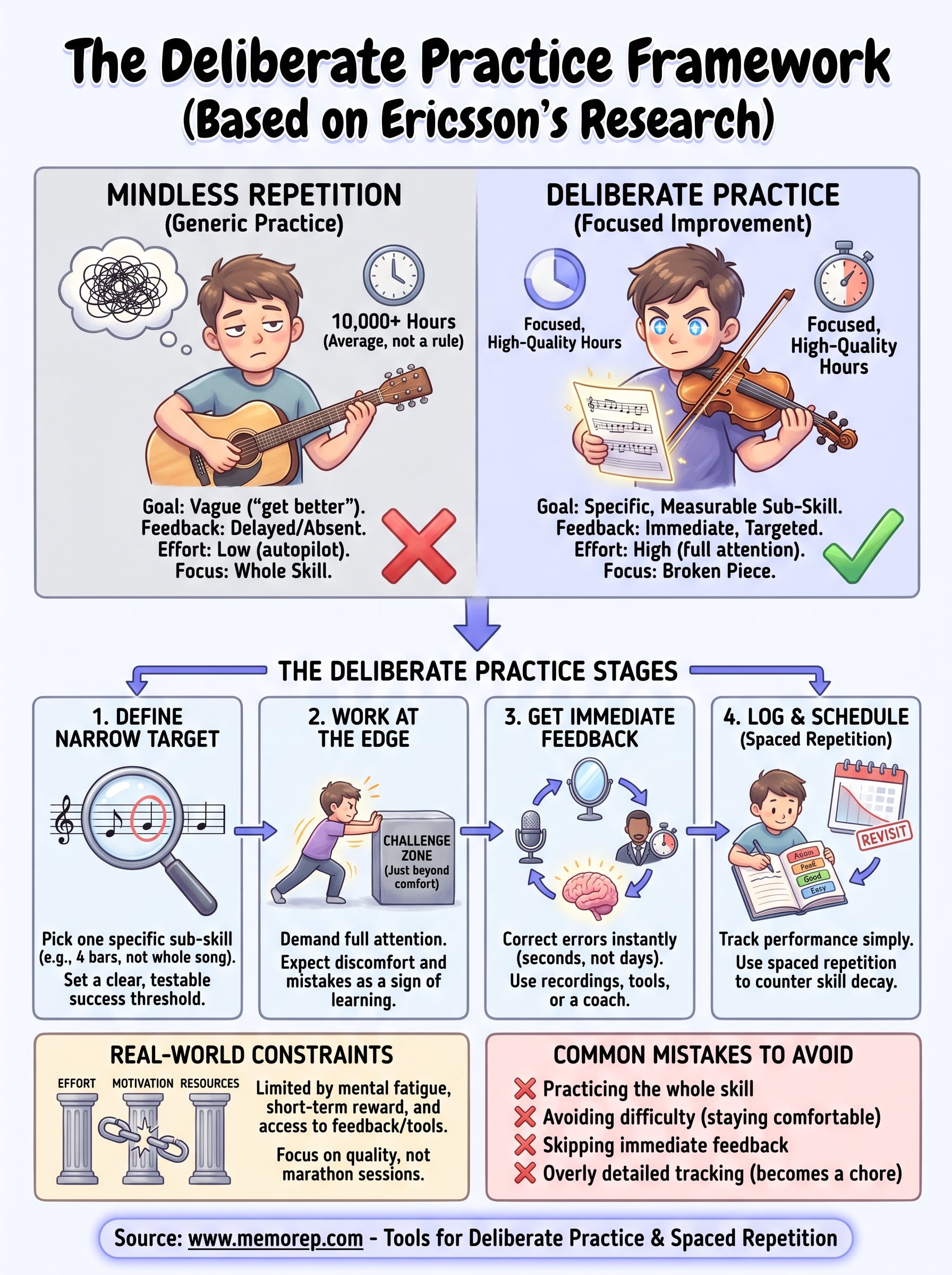
A session built around Ericsson's principles has a shape to it, not just a start and stop time. Skip a stage and the whole thing drifts back into ordinary repetition, the kind you were trying to avoid by reading a deliberate practice pdf in the first place. Think of a session as four short phases: define the target, work at the edge of your ability, get feedback and correct, then close with a quick note on what happened. None of this requires special equipment. It requires doing the four phases in order, every time, until it becomes automatic.
Stage one: name the target before you touch anything
Before you pick up your instrument, open your notebook, or step onto the court, decide exactly what this session is for. Vague intentions produce vague sessions. "Work on my backhand" is not a target. "Hit ten backhands in a row that land past the service line" is. Write the target down somewhere visible, even a sticky note on your music stand, so you can't quietly drift off it halfway through.
- State the sub-skill in one sentence.
- Set a number you can hit or miss (reps, seconds, accuracy percentage).
- Confirm the target sits just past your current level, not comfortably inside it.
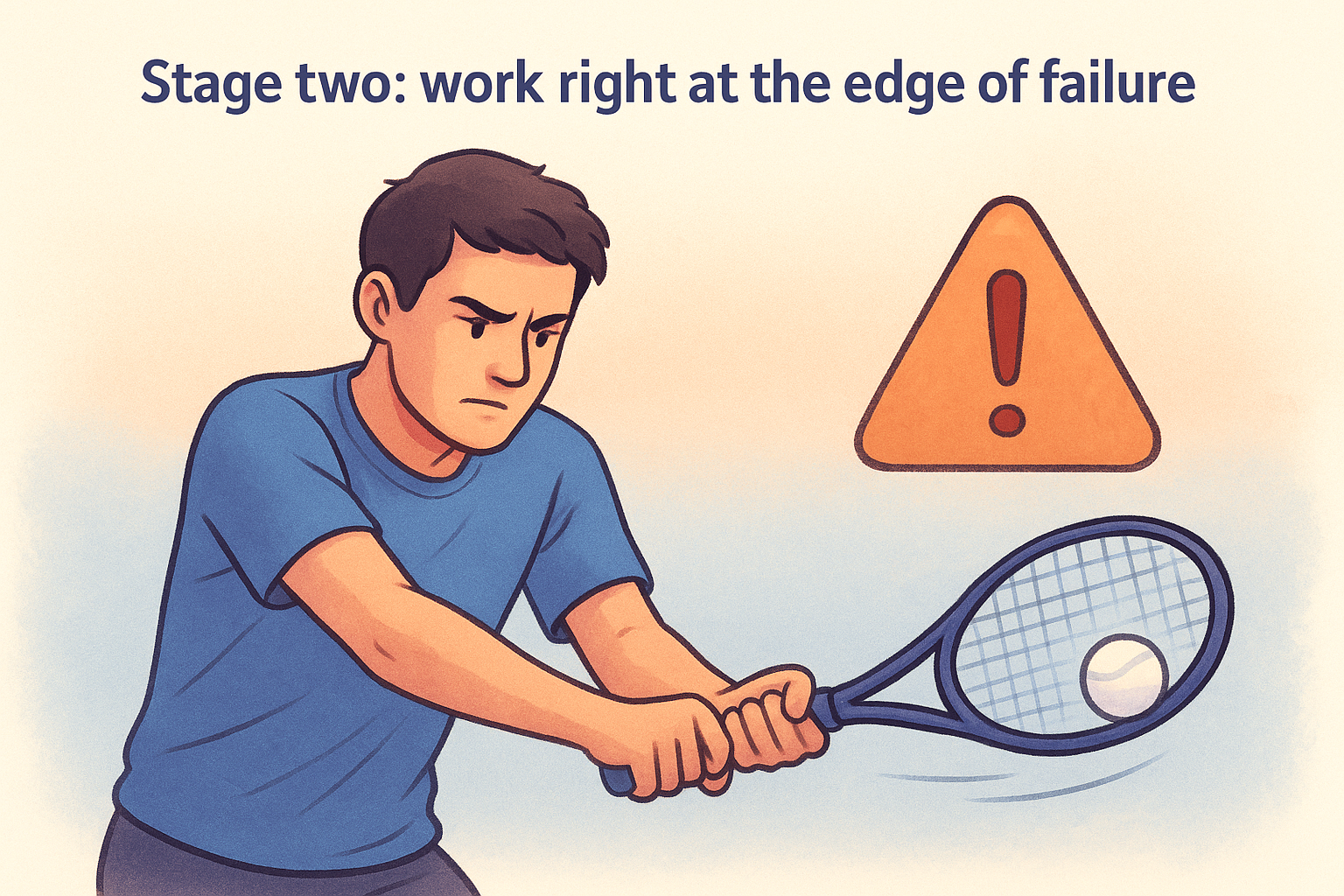
Stage two: work right at the edge of failure
Once the target is set, the actual drilling starts, and this is where most sessions quietly collapse into autopilot. Ericsson's research found that skill only grows when the task is hard enough to force full attention but not so hard that you're guessing blindly, the same calibrated challenge behind getting into a flow state. Full attention is nonnegotiable here; this is not the stage for practicing while half-watching TV. If you're succeeding on every rep without effort, the target was too easy. If you're failing every rep with no idea why, it was too hard. Adjust mid-session rather than waiting until next time to fix it.
A session with no failed reps taught you nothing new.
Expect some frustration in this stage. That discomfort is the signal that you're actually pushing past your current ceiling instead of rehearsing what you already know.
Stage three: correct fast, then log what happened
Every rep needs a verdict, and you need it within seconds, not after the session ends. Listen back to the recording, check the mirror, glance at the stopwatch, whatever gives you an answer immediately. Immediate correction is what turns a failed rep into progress instead of a repeated mistake. Adjust your grip, your timing, or your angle right then, and try again before the feeling fades.
When the session wraps up, close the loop with a short note on how it went, using something as simple as an Again, Hard, Good, or Easy rating. That single word tells you, and a tool like MemoRep, whether this sub-skill needs to come back tomorrow or can wait a week. Skip this step and you're back to guessing when to revisit the arpeggio you struggled with three weeks ago, which is exactly the decision fatigue deliberate practice is supposed to eliminate.
Real-world examples of deliberate practice in action
Theory is easy to nod along to. Seeing what deliberate practice looks like on the ground makes the four-part definition stick. Below are examples from music, sports, and chess, three domains where researchers have documented the pattern closely enough that you don't need a deliberate practice pdf to see it in action, you just need to watch how the best practitioners actually spend their time.
Musicians isolating the four hard bars
A classical pianist working on a concerto rarely plays the piece start to finish during practice. Instead, she isolates the four bars where her fingering breaks down, slows the tempo until she can play them cleanly, then gradually speeds up while checking for errors after every pass. Isolated repetition like this looks tedious from the outside, almost boring compared to hearing the full piece performed. But it's exactly the mechanism Ericsson documented in his violinist study: focused, effortful work on a narrow weak point, with feedback after every attempt, rather than run-throughs that reinforce whatever habits already exist, good or bad.
Athletes drilling one movement in isolation
Basketball players who shoot free throws for an hour without changing anything are logging hours, not necessarily improving. Compare that to a player who films every shot, checks elbow position and release angle against the recording, and adjusts one variable at a time across a session. Micro-adjustments based on immediate video feedback is what separates a shooting drill from a deliberate practice session. Swimmers do something similar with stroke mechanics, working a single phase of a stroke (the catch, the pull, the recovery) in isolation before reassembling the full motion, exactly the sub-skill decomposition Ericsson's framework calls for.
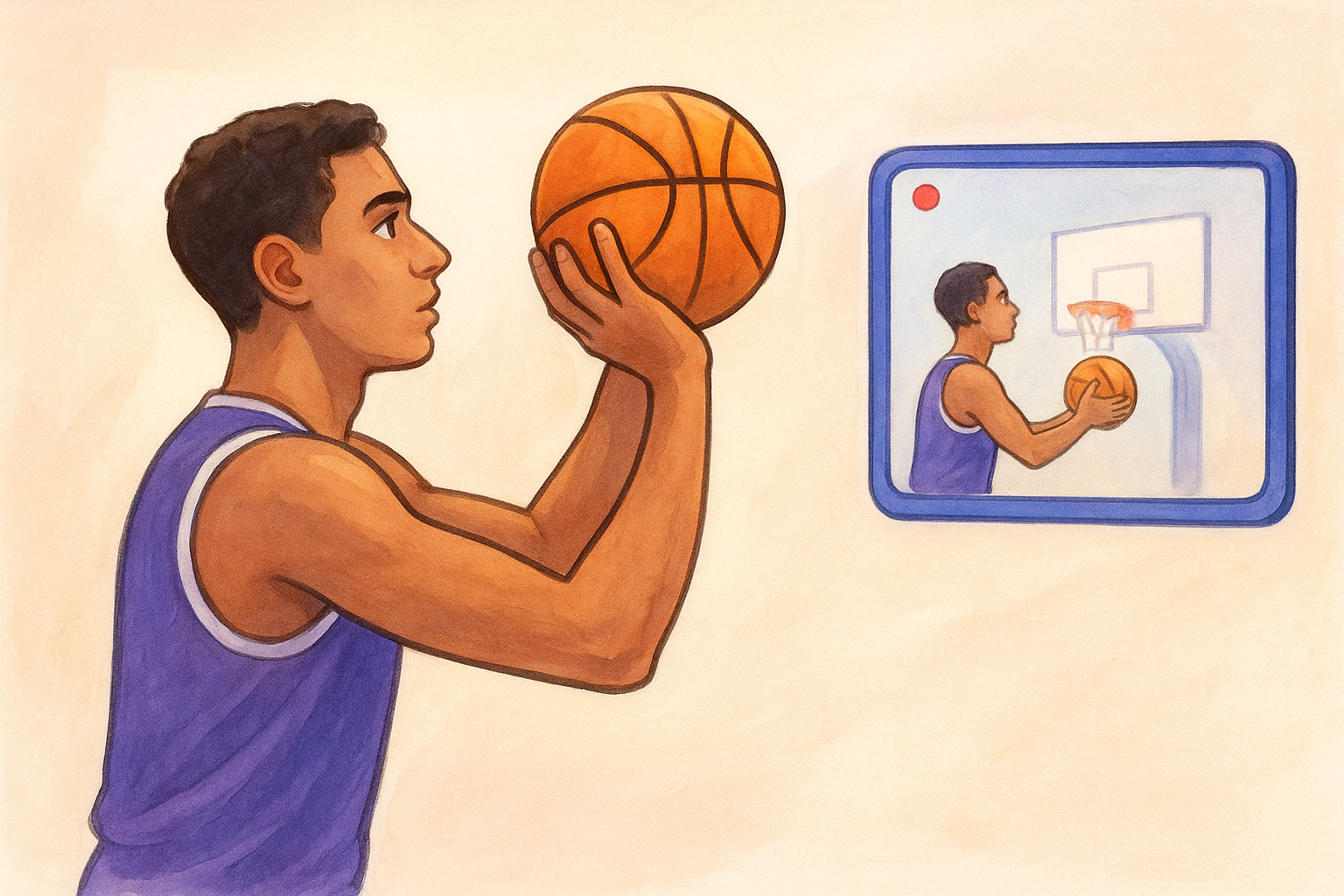
The best performers don't practice the whole skill more. They practice the broken piece of it more.
Chess players studying positions, not just playing games
Chess offers one of the cleanest examples researchers point to when discussing a deliberate practice ericsson pdf style breakdown, because the data is unusually granular. Strong players spend disproportionate time studying annotated master games and solving tactical puzzles alone, checking their proposed move against the recorded best move immediately, rather than simply playing more games against opponents. Solitary study with instant feedback against a known correct answer produces faster improvement than casual play, where mistakes often go unnoticed for dozens of moves.
What these examples share
Across all three domains, the pattern repeats even though the skills look nothing alike:
| Domain | Broad activity (not deliberate practice) | Narrow deliberate practice version |
|---|---|---|
| Piano | Playing the concerto start to finish | Isolating four problem bars at slow tempo |
| Basketball | Shooting free throws for an hour | Filming and adjusting release angle rep by rep |
| Chess | Playing casual games online | Solving tactical puzzles against a known answer |
Every example strips the skill down to a testable piece, forces effort at the edge of ability, and delivers feedback fast enough to correct the next attempt. That's the pattern worth copying, regardless of what you're trying to get better at.
The three constraints that limit your practice time
Ernest Ericsson didn't stop at defining deliberate practice, he also asked why nobody, not even elite violinists, does eight hours of it a day. His research identified three real limits on how much of this focused work anyone can sustain: effort, motivation, and resources. Anyone who searches for a deliberate practice pdf expecting a formula that scales infinitely misses this part of the paper. The constraints aren't obstacles to work around once and forget, they're permanent features of how deliberate practice functions, and building a routine that ignores them is why so many ambitious practice plans collapse by day three.
Effort caps how long a session can run
Deliberate practice demands full concentration on a task at the edge of your ability, and that kind of concentration is exhausting in a way casual repetition never is. Ericsson's violinists rarely trained in this mode for more than about four hours a day total, broken into shorter blocks with rest between them, even though some logged far more hours in music-related activity overall. Mental fatigue sets in faster than physical fatigue, and once it does, your feedback loop degrades. You stop noticing mistakes accurately, which means you stop correcting them accurately.
You can't force more deliberate practice by adding hours. You force it by protecting the hours you already have.
Motivation fades faster than most planners assume
Getting through a session that's designed to feel hard, by definition, isn't naturally rewarding the way playing a piece you already know well feels rewarding. Motivation dips exactly when you need it most, right at the edge of your ability where progress feels slow and mistakes pile up. Short-term reward matters here more than people admit. Ericsson noted that sustained deliberate practice across years requires some structure, whether that's a teacher, a competition deadline, or a visible tracking system, because willpower alone rarely survives months of deliberately uncomfortable work.
Resources decide whether you can practice this way at all
Access matters just as much as intent. A violin student at a Berlin conservatory has a teacher correcting fingering in real time, a practice room, and a curriculum designed around progressive difficulty. A hobbyist practicing alone in an apartment has none of that built in by default. Structured feedback and quality materials aren't guaranteed just because someone wants to practice deliberately, and this gap is exactly why the deliberate practice ericsson pdf crowd sometimes gets discouraged: the paper describes conditions a research lab could control, not what a solo learner has sitting in their living room.
Here's how the three constraints show up day to day, and what closes each gap:
| Constraint | What it limits | Practical fix |
|---|---|---|
| Effort | Session length and quality of focus | Shorter, harder sessions instead of long, soft ones |
| Motivation | Consistency over weeks and months | External structure: a teacher, deadline, or tracking tool |
| Resources | Access to feedback and materials | Recordings, mirrors, apps, or a coach who corrects in real time |
None of these constraints are arguments against deliberate practice. They're the reason a sustainable routine looks like short, well-fed sessions rather than marathon ones, and why the next section on common mistakes starts with the ones people make trying to brute-force their way past exactly these limits.
Common mistakes that undermine deliberate practice
Knowing the theory doesn't stop people from sabotaging their own sessions. After looking at Ericsson's four-part definition and the stages that should follow from it, it's worth naming the specific ways practitioners drift away from deliberate practice without realizing it. Recognizing these patterns is often the fastest fix available, faster than reading another deliberate practice pdf or rewatching a tutorial. Most of these mistakes aren't laziness. They're the brain defaulting to what's comfortable instead of what's productive.
Practicing the whole skill instead of the broken piece
Guitarists play the whole song. Golfers hit full rounds. Coders rebuild entire features from scratch. Whole-skill repetition feels productive because you're doing the real thing, but it buries your weak point inside dozens of things you already do well. If you can't name the exact bar, swing phase, or function that's failing, you're rehearsing your current level rather than pushing past it. Go back to the isolation examples from the piano and basketball sections: the fix is always the same, cut the skill down until you're only touching the part that actually needs work.
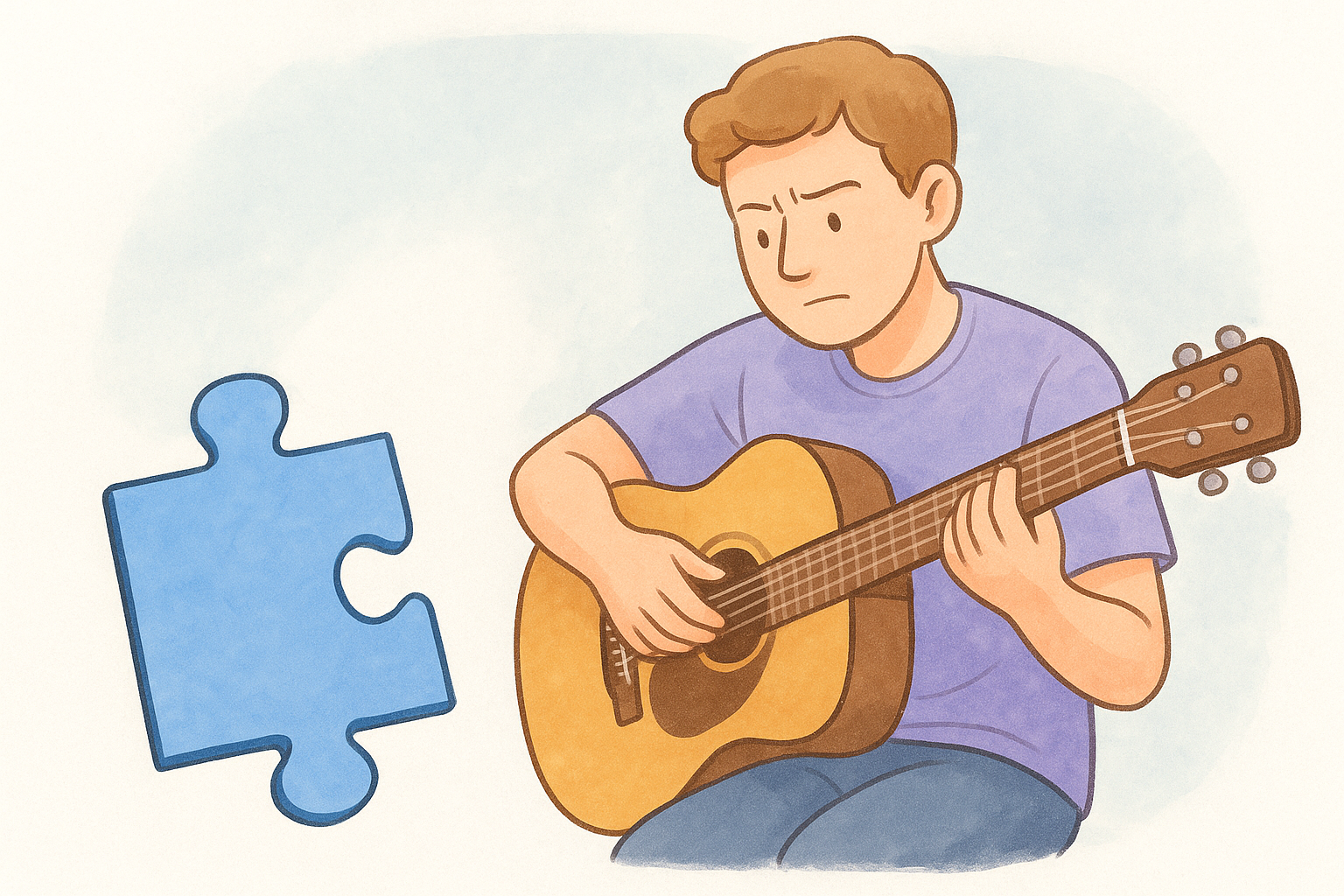
Avoiding difficulty because it feels unproductive
Sessions that feel smooth and error-free are pleasant, and pleasant is exactly the problem. Comfortable repetition produces no new feedback because nothing is failing. Deliberate practice requires working right at the edge of your ability, which means some reps should feel shaky. If an entire session goes by without a single mistake, you weren't stretching, you were maintaining.
A practice session with zero mistakes wasn't deliberate practice, it was a rehearsal of what you already know.
Skipping feedback because it's inconvenient
Recording yourself, checking a mirror, or reviewing a metronome readout takes extra seconds most people don't bother with. Skip that step often enough and you start rehearsing errors instead of correcting them. Delayed feedback is functionally the same as no feedback, since the moment to fix a specific rep has already passed by the time you notice the pattern days later.
Ignoring your own effort ceiling
After reading about the four hard hours a day that even elite violinists rarely exceed, some learners still try to force two-hour sessions of maximum focus every single day. That backfires fast. Mental fatigue quietly lowers the quality of your feedback loop long before you notice you're tired, so the back half of a marathon session often does more harm than good.
Tracking nothing, or tracking everything
The two failure modes here sit at opposite extremes:
- No tracking at all: you forget which sub-skills need revisiting, so you default to whatever feels familiar that day, which is usually the thing you least need to practice.
- Overly detailed tracking: a spreadsheet with ten columns per session becomes a chore within two weeks, and chores get abandoned.
The fix sits in the middle: a single rating per sub-skill, logged in seconds, that tells a scheduling system when to bring that skill back. This is the specific gap MemoRep was built to close, so the tracking step survives past week one instead of quietly disappearing along with the rest of the plan.
Making deliberate practice part of your routine
Ernest Ericsson's research, stripped of the popularized shortcuts, comes down to something simple: pick a narrow target, push right at the edge of your ability, get feedback fast, and log what happened. You don't need a deliberate practice pdf sitting in a folder to do this, you need a routine that survives past week two. That's the real test. Most practice plans die not from bad theory but from tracking that becomes tedious and scheduling decisions nobody wants to make every day.
That's the exact gap spaced repetition scheduling was built to close, and it's why MemoRep exists. You rate a session, the system decides when that skill comes back, and the decision fatigue disappears. If you want to see the mechanics behind it, see how MemoRep decides when each skill comes back, then grab one of the remaining beta spots while premium access is still free.