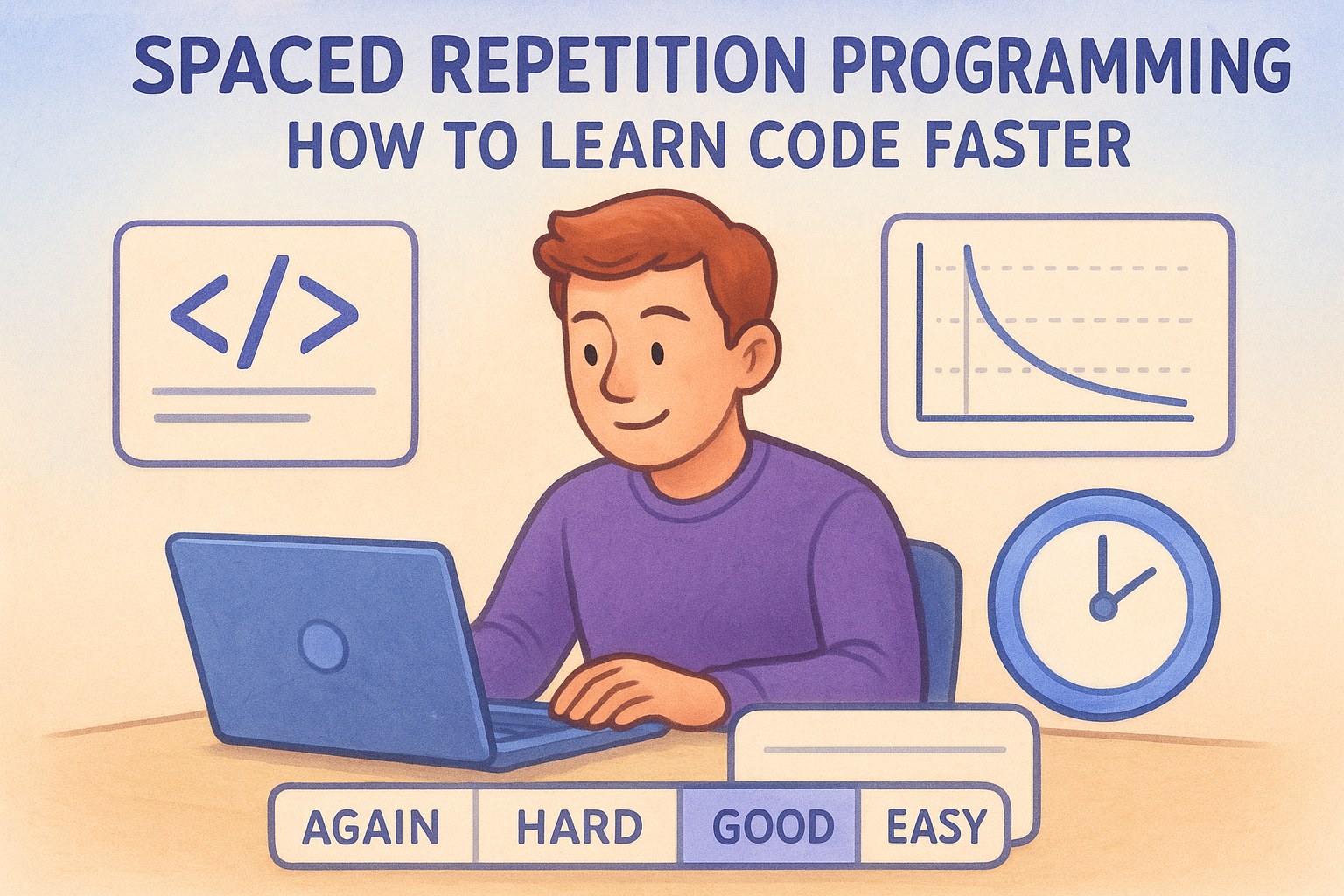
Spaced Repetition Programming: How to Learn Code Faster
You forget syntax the moment you stop using it. You solve a tricky algorithm problem once, feel confident, then blank on the same pattern three weeks later. Spaced repetition programming fixes that by scheduling review of coding patterns, syntax, and problem-solving techniques right before your brain would normally let them fade.
The short answer: you don't need flashcards to make spaced repetition work for code. What you need is a system that tracks which coding patterns you've practiced, rates how well you recalled them, and resurfaces the ones going stale, whether that's a regex trick, a sorting algorithm, or a language-specific idiom. This turns random practice into a deliberate schedule built around what your memory actually needs.
In this article, you'll learn how the forgetting curve applies to programming skills, why flashcard apps fall short for practical coding practice, and how to build a repetition-based routine that keeps your skills sharp instead of rusty. We'll also cover practical tools, including MemoRep, that automate the scheduling so you spend less time deciding what to review and more time actually coding.
Why spaced repetition matters for learning to code
The forgetting curve doesn't skip programmers
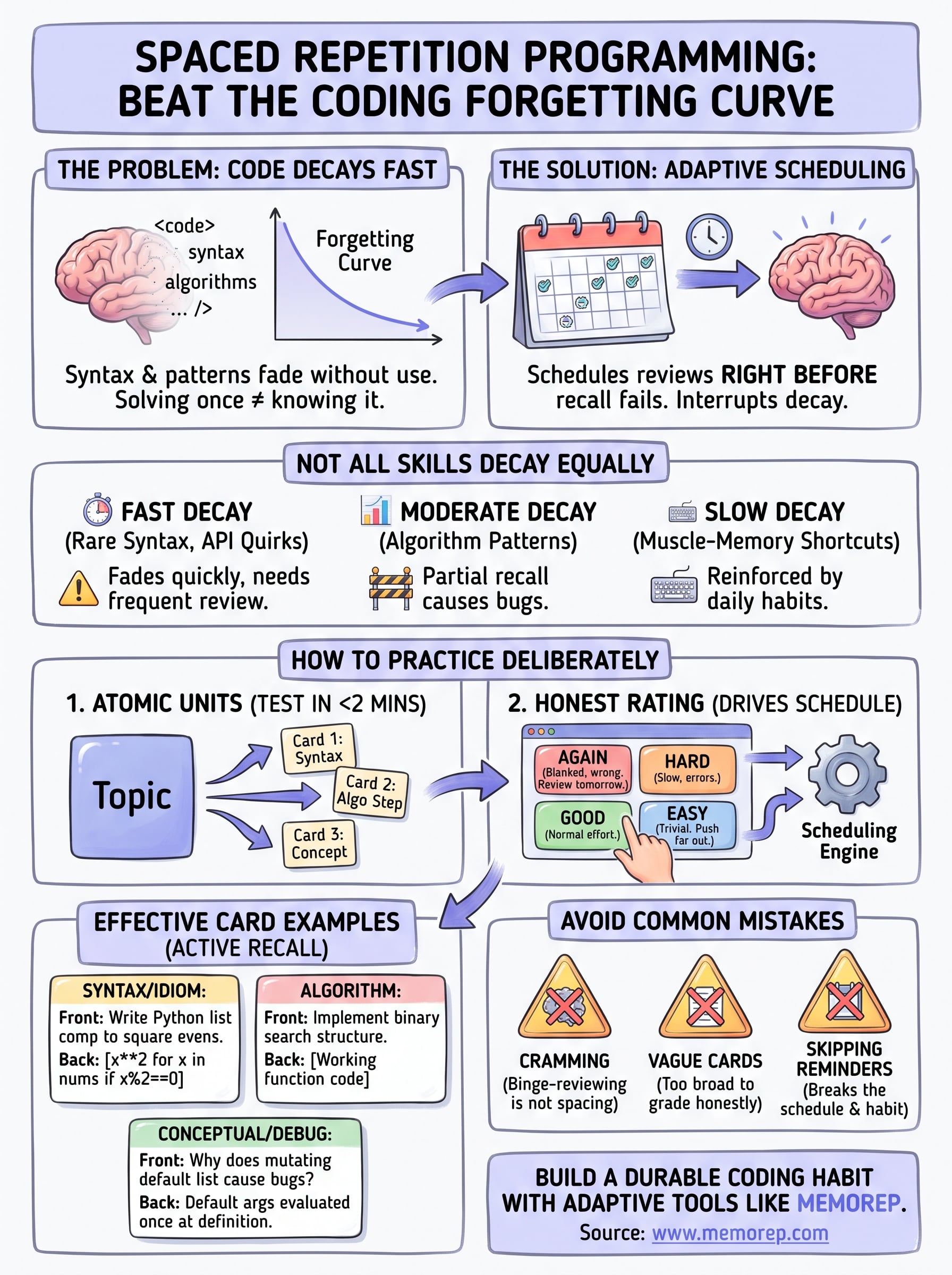
Hermann Ebbinghaus mapped out how memory decays exponentially without reinforcement back in the 1880s, and his findings hold up just as well for a for-loop as they do for a vocabulary list. Within a day of learning something new, you lose roughly half of it if you never revisit it, a pattern Ebbinghaus documented and later researchers confirmed across dozens of memory studies (see the American Psychological Association's overview of memory research). Coding knowledge follows the same curve: the syntax for a language feature, the steps of a sorting algorithm, or the quirks of an API you used once all fade at a predictable rate unless something interrupts that decline. Spaced repetition works by interrupting it right before recall would otherwise fail, which is the whole point of spaced repetition programming as a practice method rather than a one-off study trick.
Skills you don't schedule for review are skills you're scheduled to forget.
Solving it once isn't the same as knowing it
Confidence right after solving a problem is misleading. You look at the solution, understand the logic, maybe even code it yourself, and it feels locked in. That feeling has little to do with long-term retention. Real programmers relearn the same patterns over and over precisely because they never built a system to bring old material back at the right interval. This is why so many developers can pass a coding interview loop after weeks of grinding problems, then blank on the exact same pattern six months later when it resurfaces on the job. Without a repetition schedule, you're not building a durable skill, you're building short-term pattern matching that expires the moment the pressure lifts.
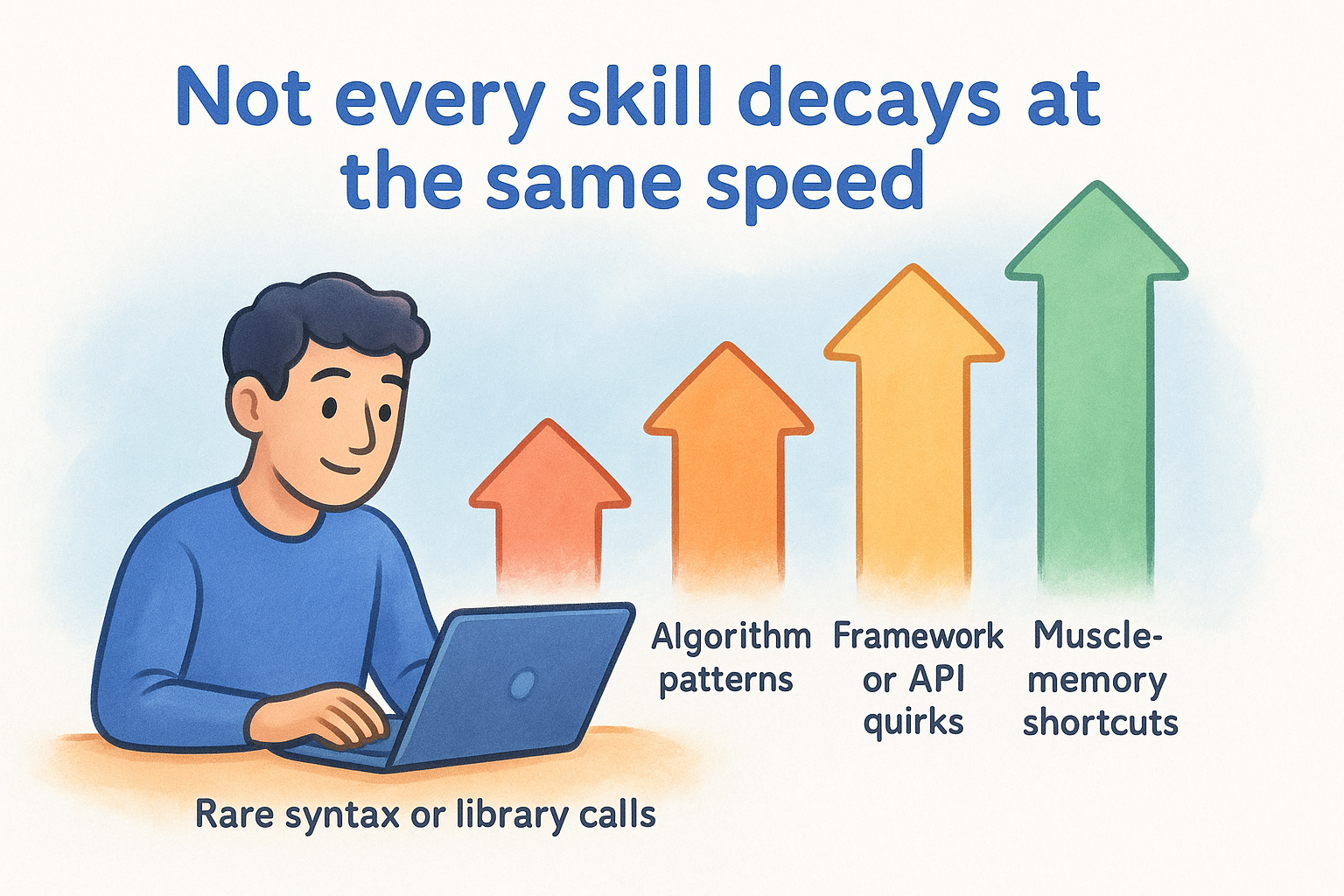
Not every skill decays at the same speed
Programming knowledge isn't uniform, and treating it that way wastes review time on things you already remember while neglecting what's actually slipping. Rarely used syntax and unfamiliar libraries fade fastest, since you get no daily reinforcement outside your review sessions. Algorithmic patterns fade slower but harder, because half-remembering a binary search often means writing a broken one instead of no attempt at all.
| Skill type | Decay speed | Why it fades |
|---|---|---|
| Rare syntax or library calls | Fast | No daily exposure outside scheduled review |
| Algorithm patterns | Moderate | Partial recall produces bugs, not fluency |
| Framework or API quirks | Moderate | Frequent updates make old knowledge stale |
| Muscle-memory shortcuts | Slow | Reinforced by daily typing habits |
Understanding which category a skill falls into tells you how aggressively to schedule it, and that's exactly the gap a structured system closes.
How to apply spaced repetition to programming practice
Turning spaced repetition programming from theory into a daily habit means learning how to practice deliberately, breaking your learning into small, reviewable units instead of vague topics like "get better at Python." A unit should be something you can test yourself on in under two minutes: recall the syntax for a list comprehension, recreate a binary search from memory, or explain why a specific race condition happens. Vague goals don't get scheduled well because there's nothing concrete to rate.
Break practice into atomic units
Each unit becomes a card in your system, and MemoRep lets you organize these into projects so your algorithm drills stay separate from your framework syntax or your instrument practice if you're juggling multiple skills. Group similar cards together, but let the scheduling engine decide which ones surface today rather than reviewing a whole project at once.
Rate your recall, don't just review it
After attempting a card from memory, rate how it went using an Again, Hard, Good, or Easy scale. This self-rating system is what drives adaptive scheduling, pushing struggling cards back sooner and pushing mastered ones further out.
- Again: You blanked or got it wrong, review it tomorrow.
- Hard: You recalled it, but slowly or with errors.
- Good: You recalled it correctly with normal effort.
- Easy: It felt trivial, push the next review far out.
The rating you give today decides how much time you save next week.
Honesty here matters more than anywhere else in the process. Inflating your rating just to move faster defeats the entire point, because the algorithm can only protect skills it knows are shaky.
Example flashcards for coding concepts and syntax
Seeing real examples makes spaced repetition programming concrete instead of abstract. The best cards test recall of something you'd actually need mid-task, not trivia you'd never use while coding, which is the core of writing memory cards that actually work. Below are a few formats worth stealing, organized by the type of knowledge they target.
Syntax and idiom cards
These cards should force you to write the pattern from scratch, not just recognize it. A weak card asks "what does list comprehension do?" A strong card hands you a plain-English task and makes you produce working syntax.
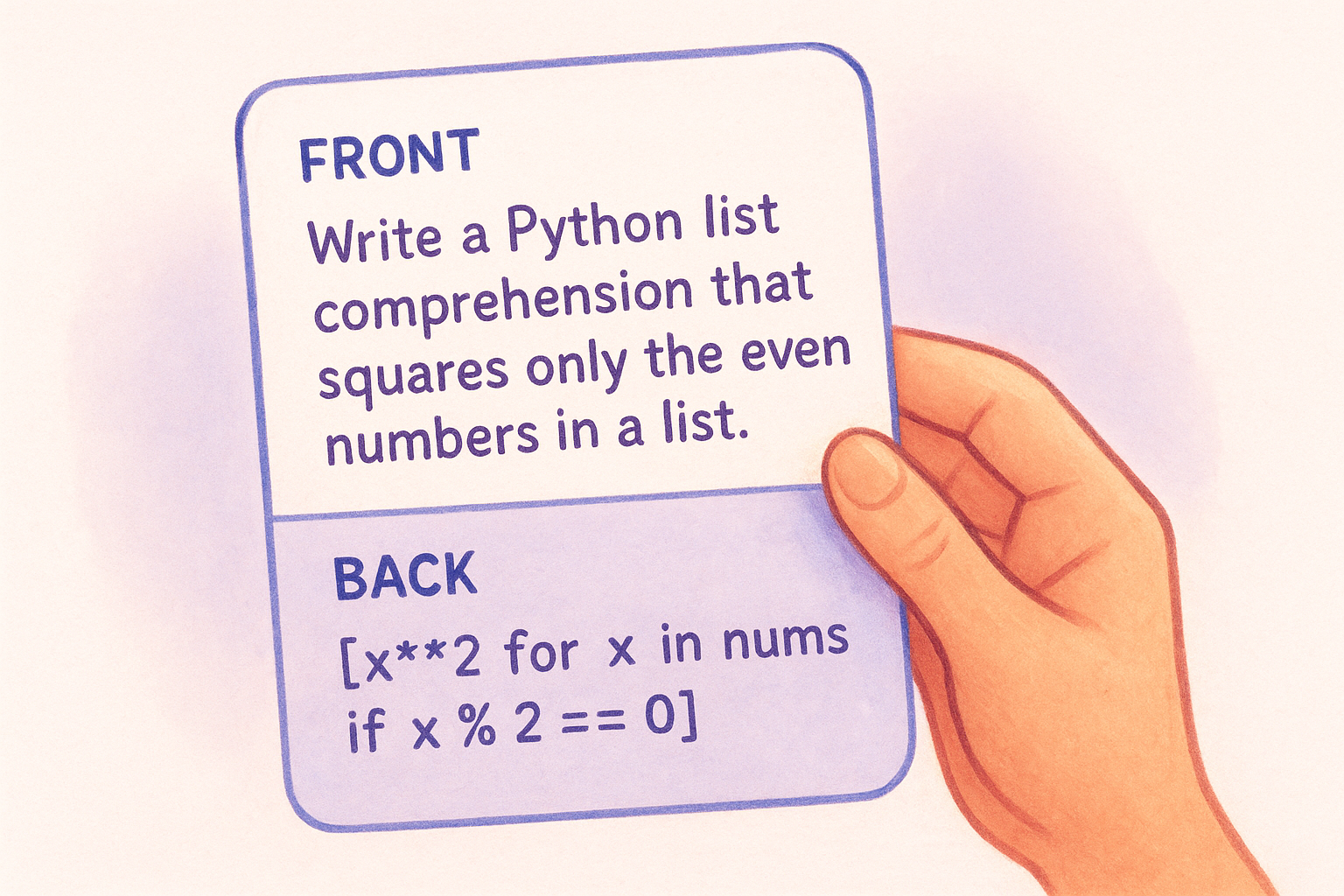
Front: Write a Python list comprehension that squares only the even numbers in a list.
Back: [x**2 for x in nums if x % 2 == 0]
A card that only asks you to recognize an answer teaches recognition, not recall.
Algorithm and pattern cards
Algorithms deserve cards that test the full structure, not just a fragment, since partial recall here produces bugs rather than fluency. Try a card like this:
Front: Implement binary search on a sorted array (no library calls).
Back: [your working function, checked against a test case]
Grade yourself Hard if you needed a hint about the midpoint calculation, even if the final answer was correct.
Conceptual and debugging cards
Concepts and gotchas fade just as fast as syntax, and they're easy to skip because they feel "understood" rather than memorized. Debugging cards work well phrased as a scenario:
Front: Why does mutating a list default argument in Python cause bugs across function calls?
Back: Default arguments are evaluated once at function definition, so the same list object persists across calls.
Within MemoRep's practice card format, these three types can live in the same project without confusing the schedule, since each card is rated independently on its own recall history.
Common mistakes that undermine spaced repetition for coders
Even a solid system breaks down if you fight against it. Most coders who quit spaced repetition programming early don't fail because the method is flawed, they fail because they recreate the same bad habits the system was built to fix.
Cramming instead of spacing
Binge-reviewing twenty cards in one sitting after ignoring them for two weeks isn't spaced repetition, it's cramming with extra steps. The whole value of interval scheduling comes from spreading recall attempts across days, not compressing them into one exhausting session. If you consistently let your queue pile up, you're training short-term recognition, not durable memory.
Cramming your review queue defeats the reason you built one.
Writing cards too broad to grade honestly
A card like "understand recursion" can't be rated Again, Hard, Good, or Easy in any meaningful way, because there's no single, testable answer behind it. Split broad topics into atomic questions you can actually attempt from memory in under two minutes. Vague cards produce vague ratings, and vague ratings feed a scheduling algorithm bad data.
Skipping reminders and losing the streak
Missing a few days doesn't ruin your progress, but ignoring your reminders entirely does, since the whole schedule assumes you show up close to the due date. Below are the habits worth watching for:
- Batching reviews once a week instead of daily
- Rating everything Good to move faster and avoid discomfort
- Adding new cards faster than you can review existing ones
- Turning off notifications and relying on memory to check the app
MemoRep's practice reminder notifications exist specifically to counter that last habit, nudging you back before a skill slips too far to recover cheaply, because memory apps fail without notifications.
Building a lasting coding practice habit
Skills fade unless you schedule reinforcement, and that's the whole case for spaced repetition programming. You now know how the forgetting curve applies to syntax and algorithms, how to break topics into atomic cards, and which habits quietly sabotage the whole system. None of that matters unless you actually run the schedule day after day instead of relying on willpower to remember what needs review.
That's the gap a dedicated tool closes. Rather than tracking decay manually or trusting a generic flashcard app built for vocabulary, you want something built around adaptive scheduling and honest self-rating. If you want to inspect the algorithm behind that scheduling before committing to anything, see the spaced repetition engine powering memoRep, then decide if it fits how you practice.