How to Get into Flow State: 8 Proven Techniques
You sit down to practice, and twenty minutes later you're still fumbling through warm-ups, checking your phone, wondering why nothing feels effortless today. Learning how to get into flow state isn't about willpower. It's about setting up the right conditions before you even pick up your instrument or start your drill, so your brain slides into that focused, almost automatic mode where time disappears and progress happens fast.
Flow state shows up when the challenge in front of you matches your skill level closely enough to demand full attention, but not so much that it triggers frustration. That's why random, unstructured practice kills flow before it starts: you spend more energy deciding what to work on than actually working on it. The fix is a practice structure that removes those decisions for you and keeps difficulty calibrated to where you actually are.
Below are eight techniques that musicians and skill learners use to trigger flow reliably, from environment setup to session pacing. Some rely on timing, others on feedback loops that keep you locked into the right challenge zone, similar to how spaced repetition keeps practical skills sharp without you having to track them manually. Try a few, notice what clicks, and build them into your next practice session.
1. Match skill and challenge with a spaced repetition plan
How it works
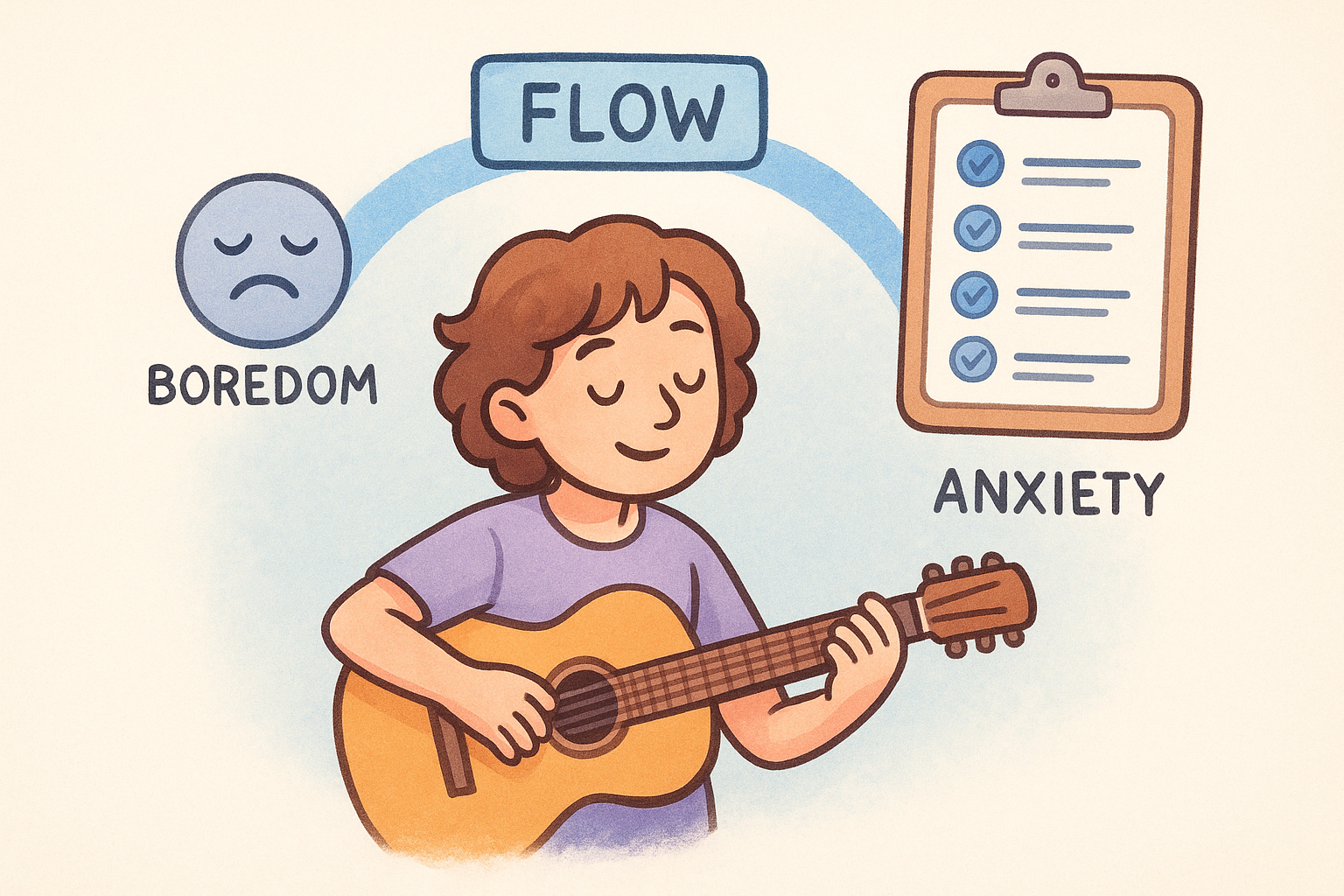
Psychologist Mihaly Csikszentmihalyi mapped flow as a narrow channel between boredom and anxiety: too easy and your mind wanders, too hard and you freeze up. A spaced repetition plan keeps you inside that channel automatically. Instead of picking exercises at random, you log what you practiced and how it went, and an algorithm decides what to bring back and when, based on how close that skill is to slipping from memory. This is the same logic behind what the Ebbinghaus forgetting curve means for practice and the SuperMemo SM-2 method, tools originally built for memorization but just as effective for scales, chord changes, or any repeatable drill.
Why it triggers flow
Flow depends on immediate calibration, your brain needs to sense that the task ahead is right at the edge of your current ability. A well-timed review session hits that edge almost every time: the skill hasn't decayed enough to feel frustrating, but it's faded just enough that autopilot won't cut it. You're forced into full attention without the task feeling punishing. Compare that to grabbing a random old piece and either breezing through it (boring) or butchering it because you haven't touched it in months (anxiety-inducing).
Flow isn't about trying harder, it's about practicing the exact thing your brain is ready to relearn, right when it's ready.
How to put it into practice
You don't need a spreadsheet to run this system, but you do need consistent tracking, which is exactly the gap a spaced repetition app built for musicians like MemoRep fills. Set it up like this:
- Create a practice card for each skill, passage, or drill you're working on, organized inside a project (a music practice journal template works the same way on paper).
- After each session, rate the attempt using an Again/Hard/Good/Easy scale.
- Let the scheduling algorithm decide the next review date based on that rating, so decaying skills resurface before they get rusty.
- Trust the queue instead of second-guessing what to work on next.
- Repeat daily, letting the interval between reviews stretch as you get more consistent.
Someone learning a new song might rate a tricky bridge section as
2. Eliminate distractions before you start
How it works
Distraction removal means clearing every trigger that could pull your attention away before you start playing or drilling, not while you're already deep into a session. Phones, open browser tabs, background chatter, even a cluttered practice space all compete for the same limited attention your brain needs to enter flow. Attention residue, the term researchers use for the mental leftover from switching tasks, means that even a quick phone check can cost you several minutes of degraded focus afterward, according to research summarized by the American Psychological Association (https://www.apa.org/topics/research/multitasking).
Why it triggers flow
Flow requires sustained, unbroken attention on a single task, and that state takes time to build, usually several minutes of uninterrupted effort before your brain settles in. Every notification or interruption resets that buildup to zero, forcing you to start over. Musicians who rehearse in a room with a buzzing phone rarely report losing themselves in the music; they report constant low-grade friction instead.
You can't multitask your way into flow, you can only remove enough friction that focus has nowhere else to go.
How to put it into practice
Treat this as a two-minute setup ritual before every session, not an occasional cleanup:
- Put your phone in another room or switch on airplane mode.
- Close every browser tab and app unrelated to practice.
- Tell whoever's around that you're unavailable for the next block of time.
- Set your instrument, sheet music, or materials within reach so you're not hunting mid-session.
- Pick a spot you associate only with focused work, not scrolling or chatting.
Once this becomes routine, sitting down in that space signals to your brain that distractions are off the table, which shortens the runway into deep focus considerably. Pair this with a structured practice queue, like the one a spaced repetition plan gives you, and you remove both external and internal sources of friction at the same time.
3. Set clear goals and get immediate feedback
How it works
Every flow-triggering practice session starts with a specific, bounded goal, something like "clean up the transition at bar 32" instead of "get better at the song," which is the same narrowing that practicing deliberately step by step asks for. Clear goals give your brain a finish line to aim for, and immediate feedback tells it whether the last attempt landed or missed. Musicians who rely on a metronome, a recording, or a teacher's cue get that feedback in real time; those who just run through material blind rarely know if they're improving until much later, if at all.
Why it triggers flow
Feedback loops are one of the core conditions Csikszentmihalyi identified for entering flow state reliably, right alongside clear goals and matched challenge. When you know instantly whether a rep worked, your brain adjusts on the fly instead of drifting into vague repetition. That tight loop of attempt, feedback, adjust keeps attention locked on the present moment rather than wandering toward whether you're wasting your time.
No feedback, no flow, your brain needs proof that effort is producing results, second by second.
How to put it into practice
Build feedback into the structure of your session, not as an afterthought:
- State the goal for each drill in one sentence before you start ("three clean run-throughs at tempo").
- Use a metronome, tuner, or recording app to catch errors as they happen.
- Rate each attempt honestly, Again, Hard, Good, or Easy, right after you finish it.
- Log that rating somewhere consistent, like a practice card in MemoRep's project tracking or another music practice tracker app, so the next session picks up exactly where feedback left off.
Over a few weeks, this habit turns vague sessions into a running conversation between goal and result, which is exactly the friction-free loop flow needs to take hold.
4. Build a consistent pre-practice ritual
How it works
A pre-practice ritual is a short, repeated sequence you run through before every session, the same five or ten minutes each time, regardless of what you're about to work on. Think of a guitarist working from a beginner guitar practice plan who always tunes up, plays the same warm-up scale, then checks yesterday's notes before starting. That sequence isn't about the music itself, it's a behavioral cue that tells your nervous system what's coming next. Athletes use the same trick before free throws or serves, and the mechanism is identical: repetition builds a shortcut your brain recognizes instantly.
Why it triggers flow
Flow needs a runway, and a ritual shortens it dramatically. Instead of your brain slowly figuring out "okay, we're practicing now," the ritual acts as a trigger sequence that skips the warm-up confusion entirely. Csikszentmihalyi's research on flow found that people entered the state faster when they had a consistent entry point rather than jumping straight into variable, high-stakes tasks. Musicians who skip this step often spend the first ten minutes just getting oriented, which eats into the window where deep focus could otherwise be building.
A ritual isn't superstition, it's a signal your brain learns to trust faster than willpower ever could.
How to put it into practice
Keep the ritual short enough that you'll actually do it every time:
- Pick a fixed opening move, like tuning, stretching, or reviewing yesterday's cards.
- Do it in the same order, every session, for at least two weeks.
- Keep it under five minutes so it never feels like a chore.
- End the ritual by pulling up your next scheduled item, whether that's a MemoRep practice queue or a handwritten list.
Once the sequence becomes automatic, sitting down to practice starts feeling like flipping a switch rather than talking yourself into focus.
5. Practice during your peak focus hours
How it works
Everyone has a window in the day when concentration comes easier, energy runs higher, and decisions feel less effortful. Researchers call this your chronotype, the natural rhythm that governs when your brain is primed for demanding cognitive work versus when it's better suited for routine tasks. For some people that window opens early, before the rest of the household wakes up; for others it lands mid-afternoon or late at night. Figuring out how to get into flow state consistently means figuring out when your own brain is actually available for it, then protecting that slot like an appointment you can't miss.
Why it triggers flow
Stacking a demanding practice session on top of already-low energy is the fastest way to kill flow before it starts. When you practice during a low-energy slump, your working memory has less to work with, so even well-matched challenges start to feel harder than they should. Practicing during your peak window removes that extra tax, letting the challenge-skill balance from technique one actually hold up in real time instead of collapsing under fatigue.
Flow doesn't fight your biology, it works with whatever window your brain already hands you for free.
How to put it into practice
Finding your window takes a little observation, not guesswork:
- Track energy and focus levels at three or four points across a normal day for one week.
- Notice which slot consistently produces your cleanest, most absorbed sessions.
- Protect that slot on your calendar the same way you'd protect a meeting.
- Save your hardest material, new passages, tricky transitions, tough drills, for that window specifically.
- Push lighter review or maintenance work into lower-energy hours instead.
Once you've locked in that window, pair it with a queued-up practice list so you're not wasting your best hour deciding what to do with it.
6. Single-task instead of multitasking
How it works
Single-tasking means running one skill, one drill, one piece of music at a time, start to finish, before switching to anything else. Multitasking during practice, jumping between a warm-up, a new passage, and a review card without finishing any of them, feels productive but actually splits your attention into fragments too small for flow to form. Your brain can only hold one demanding task in working memory at full capacity; anything layered on top competes for the same limited resources, which is the core of cognitive load theory explained for skill learners.
Why it triggers flow
Switching tasks forces your brain to reload context every single time, and that reload costs several seconds of degraded performance even for simple switches, according to research from the American Psychological Association (https://www.apa.org/topics/research/multitasking). Stack enough of those switches into a practice session and you never build the sustained attention flow requires. Sticking with one task lets your brain settle into a rhythm where each rep informs the next, instead of starting cold every few minutes.
Flow rewards depth over breadth, one finished drill beats five half-started ones every time.
How to put it into practice
Structure your session around finishing one thing before starting another:
- Pull up a single practice card or drill and commit to it for a set block, ten or fifteen minutes works well.
- Resist the urge to peek at your next item until the current one is done or you've hit a natural stopping point.
- If a distracting thought about another skill pops up, jot it down and let it wait.
- Use a visible timer so you're not tempted to check progress every thirty seconds.
- Move to the next card only after logging a rating for the one you just finished.
This habit pairs naturally with a queued practice list, since you already know what's coming next without needing to decide mid-session.
7. Use distraction-free focus music
How it works
Instrumental or ambient tracks without lyrics, sudden tempo shifts, or unpredictable drops can mask background noise without pulling your attention away from the task in front of you. Distraction-free focus music works because your brain treats predictable, low-variation sound as background, something it can tune out almost entirely, while it treats sudden changes in volume or melody as a signal worth investigating. Genres built for this purpose, lo-fi beats, white noise, brown noise, or slow ambient soundscapes, stay flat enough that they never compete for the same attention your practice demands.
Why it triggers flow
Silence sounds ideal on paper, but for a lot of people it actually amplifies every small noise around them, a creaking floorboard, traffic outside, a neighbor's television. That kind of unpredictable background noise breaks concentration faster than steady, engineered sound does. Music with lyrics does the opposite of what you want here too: your brain processes language automatically, which pulls a slice of attention away from the drill you're running, even when you're not consciously listening to the words.
The right background sound doesn't add focus, it just removes the noise that was stealing yours.
How to put it into practice
Test a few options before settling on one, since not everyone's brain responds the same way to the same sound:
- Try lo-fi instrumental playlists, brown noise, or ambient soundscapes without vocals.
- Keep volume low enough that it sits under your instrument or drill sounds, not over them.
- Avoid anything with unpredictable tempo or dynamic swings that could pull focus mid-session.
- Stick with the same track or playlist across sessions so it becomes another entry ritual cue, similar to the pre-practice routine from technique four.
- Skip music entirely if you notice it's competing rather than blending, some drills genuinely need silence.
8. Take deliberate recovery breaks
How it works
Recovery breaks are short, planned pauses you take between focused practice blocks, not the kind of break that happens when your attention already collapsed. A deliberate break might mean stepping away for five minutes after twenty-five minutes of focused drilling, stretching, getting water, or just staring out a window without your phone. The point isn't rest for its own sake, it's giving your brain enough downtime to reset before fatigue starts eating into the quality of your next session.
Why it triggers flow
Flow can't survive on a depleted brain. Mental fatigue narrows working memory and slows the feedback loop that flow depends on, so a session that started sharp turns sluggish somewhere around minute forty. Spacing recovery into your practice keeps that decline from setting in, which is a big part of learning how to get into flow state on a repeatable basis rather than by accident once in a while. Musicians who push through exhaustion without breaks often report the opposite of flow: frustration, sloppy reps, and a session that feels longer than it actually was.
Flow doesn't come from grinding longer, it comes from protecting the sharpness that makes each rep count.
How to put it into practice
Build recovery into the shape of your session instead of waiting until you crash:
- Work in blocks of 20 to 40 minutes, then take a break of 5 to 10 minutes.
- Step completely away from your instrument or materials during the break, no scrolling, no half-practicing.
- Move your body a little, a short walk or stretch resets focus faster than sitting still.
- Log your rating for the last card before you step away, so you return knowing exactly where to pick up.
- Notice when fatigue creeps in earlier than usual and shorten your next block accordingly.
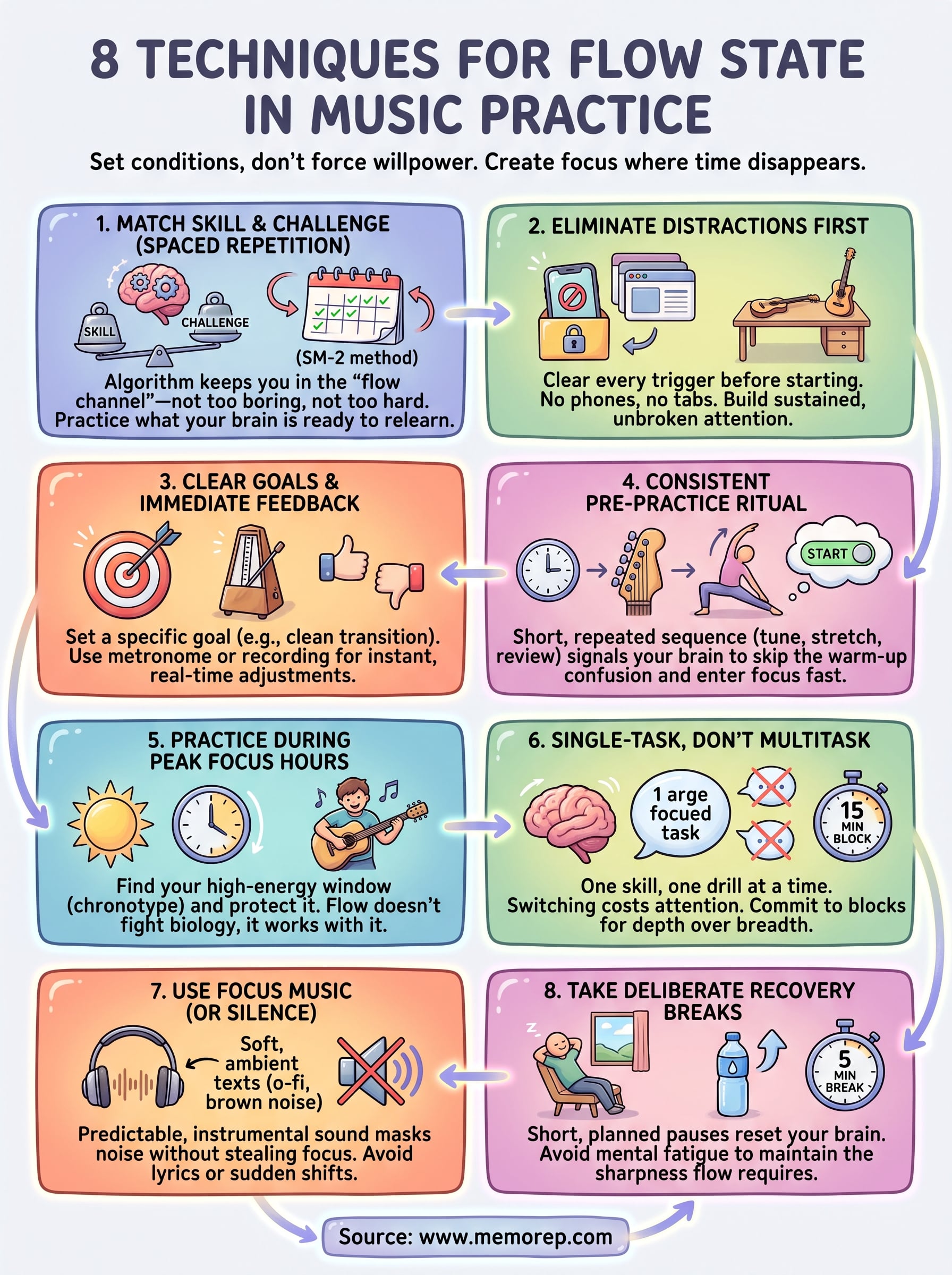
Turning flow into a daily habit
Flow state isn't a lucky accident that happens once in a while when the stars align. It's a byproduct of conditions you control: matched challenge, removed distractions, clear feedback, protected energy, and real recovery. Stack even three or four of these eight techniques into your routine and you'll notice sessions feel shorter, sharper, and less like a grind you're pushing through.
The piece that ties everything together is knowing exactly what to practice next without burning attention on the decision itself. That's the whole point of a structured practice queue, it hands you the right challenge at the right moment, every session, so flow has fewer obstacles standing between you and the work.
If you're ready to stop guessing and start practicing on a schedule built for flow, see how MemoRep decides what you practice next and try it in your next session.