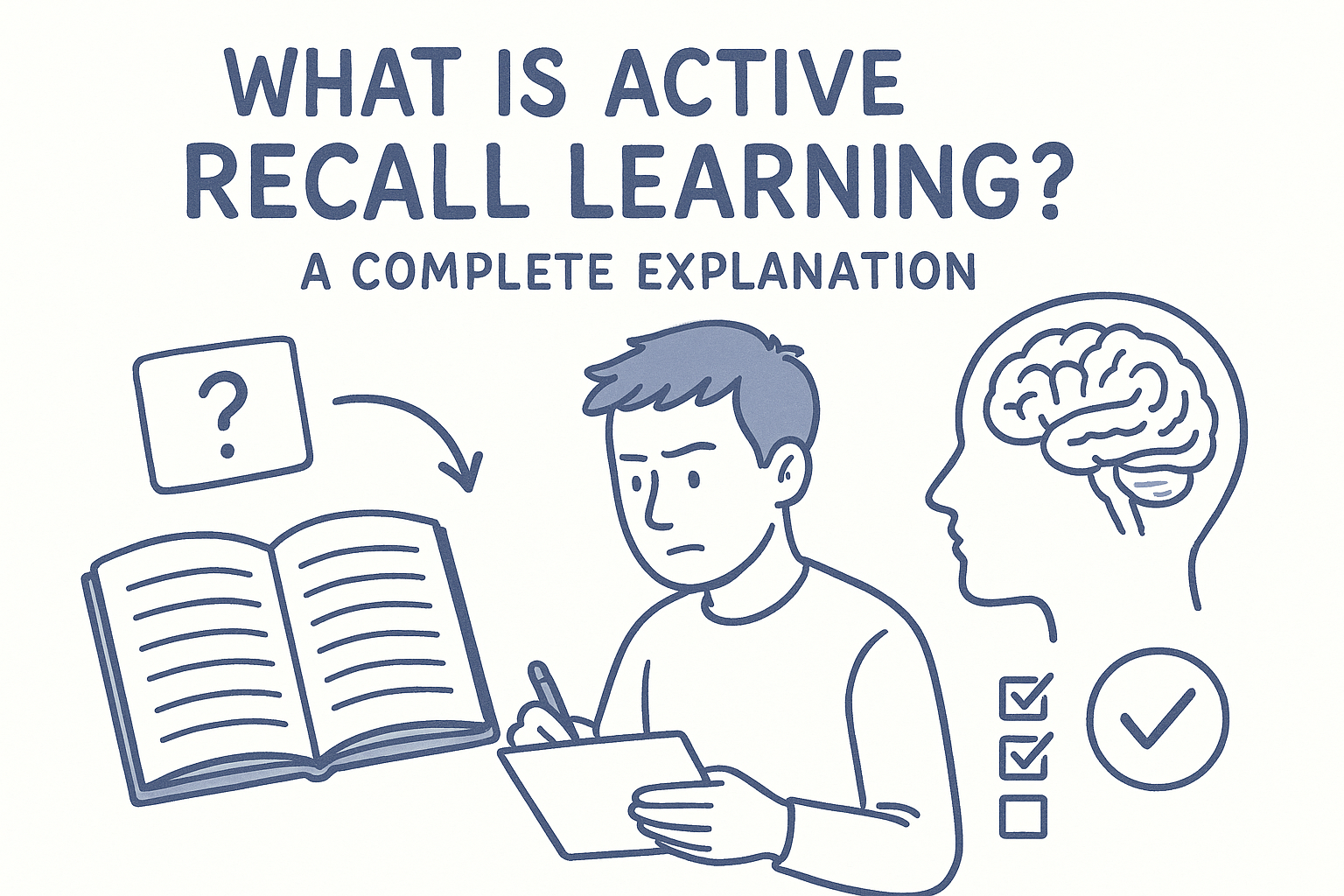
What Is Active Recall Learning? A Complete Explanation
You practice a scale for twenty minutes, feel solid, then fumble the same passage two days later. That gap between feeling like you know something and actually being able to produce it on demand is exactly what active recall learning targets. It's a study method built on retrieving information or a skill from memory, rather than passively reviewing notes or replaying a technique until it feels familiar.
At its core, active recall means testing yourself instead of re-reading, re-watching, or re-running through material. You force your brain to pull an answer, a chord shape, or a technique out of memory without looking, which is what actually strengthens the neural pathway. This is different from passive review, which feels productive but leaves knowledge shallow and fragile under pressure.
In this article, you'll get a full breakdown of how active recall works, why it beats passive study methods according to decades of memory research, and how to apply it whether you're memorizing facts or building muscle memory for a physical skill. We'll also cover how pairing it with spaced repetition, the system MemoRep is built around, makes the effect even stronger.
Why active recall works better than rereading notes
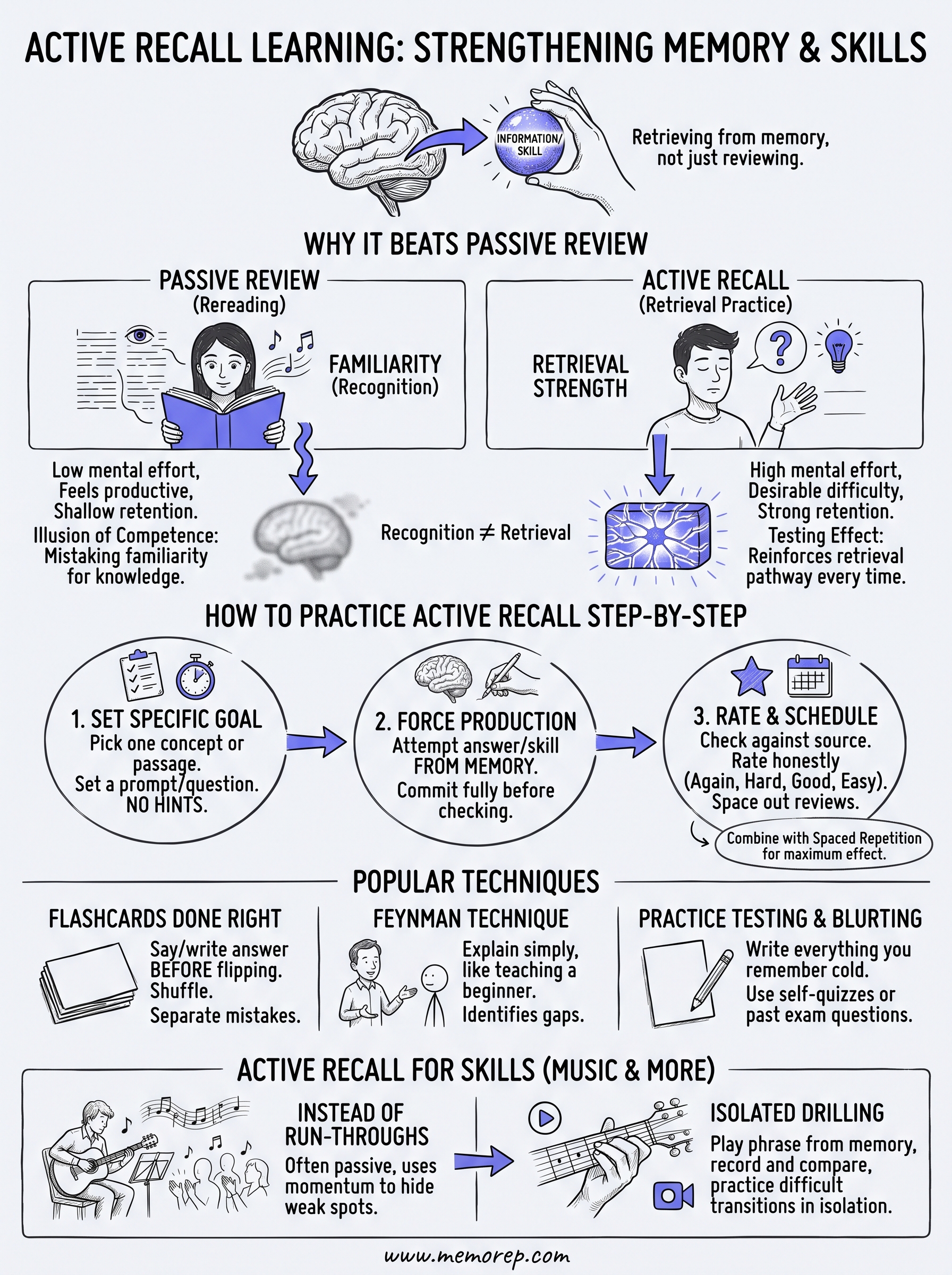
Most students and musicians default to rereading because it feels efficient. You scan the page, hum through the piece, and everything looks familiar. That familiarity is the trap. Recognition is not the same as retrieval, and rereading only trains recognition. Active recall forces retrieval, which is the actual skill you need when you're on stage, in an exam, or improvising over changes with no sheet music in front of you.
The testing effect explains the gap
Cognitive psychologists call this the testing effect, and it's one of the most replicated findings in memory research. Studies going back to the 1970s, and confirmed repeatedly since, show that people who quiz themselves on material remember it far longer than people who simply reread it the same number of times. The National Institutes of Health has published research on this exact effect, showing that retrieval practice produces stronger long-term retention than repeated exposure, even when the rereading group spends more total study time. The mechanism is straightforward: every time you successfully pull information from memory, you reinforce the retrieval path itself, not just the information sitting at the end of it.
Rereading trains your eyes to recognize the answer. Active recall trains your brain to produce it.
Rereading builds familiarity, not retrieval strength
Think about the last time you reread a chapter before a test and felt confident, only to blank on questions that used different wording. That's the illusion of competence, a well-documented phenomenon where repeated exposure convinces you that you know something you actually can't retrieve on command. Musicians hit the same wall constantly. You can play a passage while looking at the score a hundred times and still freeze the moment the sheet music disappears, because looking at notation and producing the notes from memory are two separate skills that don't automatically transfer.
What the comparison actually looks like
Laid side by side, the difference between the two approaches is stark, and it holds whether you're memorizing vocabulary, chemistry formulas, or a guitar solo.
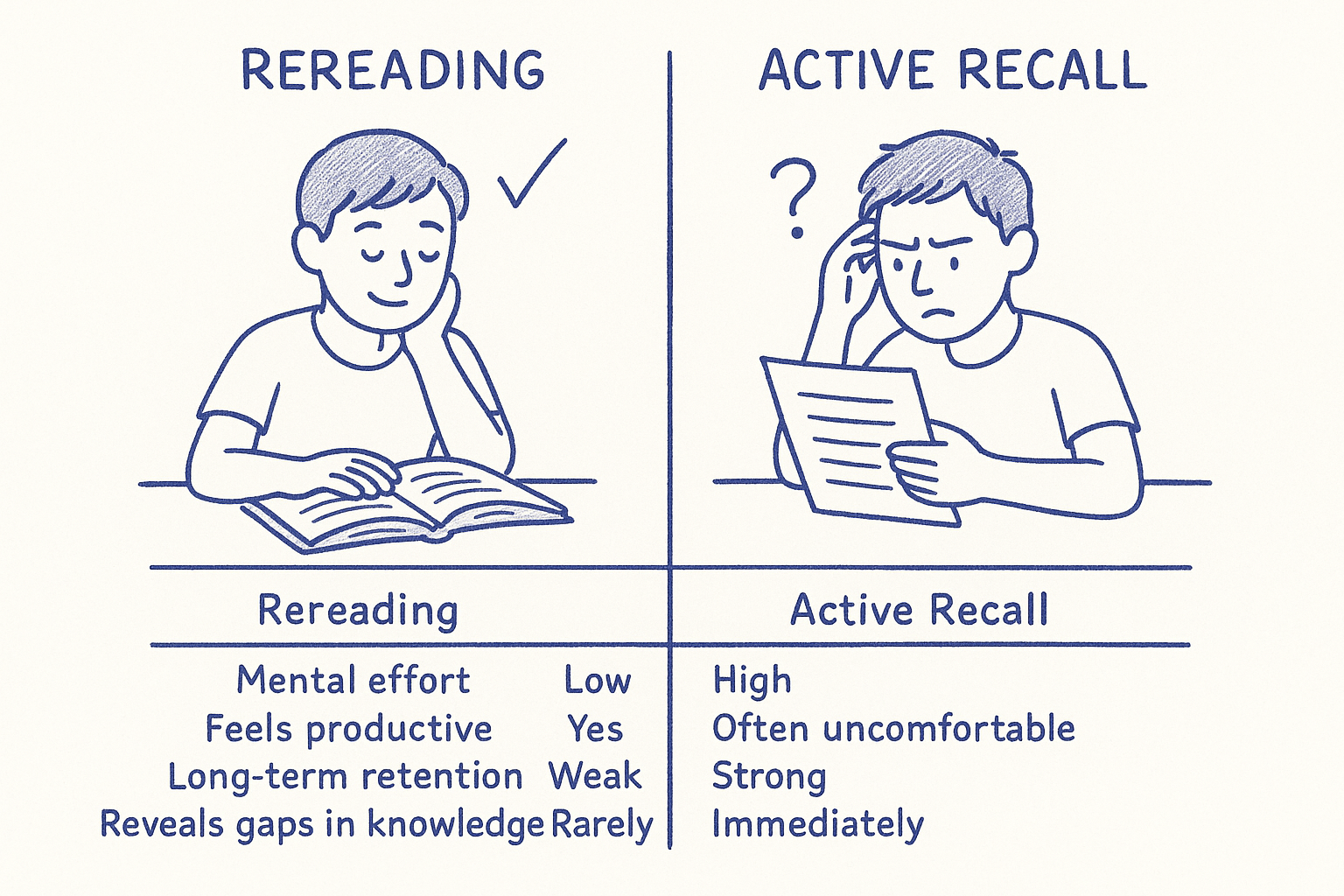
| Factor | Rereading / Passive Review | Active Recall |
|---|---|---|
| Mental effort required | Low | High |
| Feels productive while doing it | Yes | Often uncomfortable |
| Builds long-term retention | Weak | Strong |
| Reveals what you don't actually know | Rarely | Immediately |
| Transfers to real performance conditions | Poor | Strong |
Notice that discomfort row. That struggle you feel when you try to recall a chord progression without the tab open is a good sign, not a bad one. Researchers call it "desirable difficulty," the idea that a bit of productive friction during learning produces deeper, longer-lasting memory traces than smooth, easy review ever does.
One more piece worth understanding is timing. Active recall works best when it's spaced out rather than crammed into a single session, because retrieving something after it's started to fade forces a stronger reconsolidation than retrieving it while it's still fresh. That's the entire premise behind spaced repetition systems, and it's why pairing active recall with a scheduling tool, rather than relying on memory or willpower to decide when to review, tends to produce far more consistent results over weeks and months.
How to practice active recall step by step
Knowing that active recall learning beats rereading is one thing. Turning it into a repeatable habit is another. The process below works whether you're memorizing biology terms or drilling a jazz standard, and it only takes a few minutes to set up before each session.
Set up before you open your notes
Before you touch the material, decide exactly what you're testing yourself on. Vague goals like "review chapter 4" or "practice the solo" invite passive rereading by default. Break the material into small, testable chunks first.
- Pick one concept, formula, or musical phrase, not a whole chapter or piece
- Write or state a specific question or prompt for it
- Put away the source material, book, sheet music, or notes, completely out of sight
- Set a short timer, five to ten minutes, so you don't drift back into passive habits
Run the retrieval, not the review
This is where most people slip back into old patterns without noticing. Force production, don't hint yourself toward the answer.
- Ask yourself the question or attempt the phrase from memory, out loud or on paper
- Resist peeking, even for a second, until you've committed to an answer
- Only then check against the source material
- Note exactly where the gap was, a wrong note, a missed date, a mixed-up formula
If you glance at the answer before you've fully committed to one, you've traded retrieval for recognition again.
Rate yourself and schedule the repeat
Once you've checked your answer, rate how it went. Most spaced repetition systems, including MemoRep, use a simple four-point scale: Again, Hard, Good, Easy. Honesty here matters more than ego. Marking a shaky recall as "Easy" just to feel good about your progress sabotages the whole system, because it pushes the next review further out than your memory can actually support.
Repeating this loop, retrieve, check, rate, is what separates active recall from a one-off study trick. Skipping the honest rating step is the single most common way people undermine their own results, so treat it as seriously as the retrieval itself.
Popular active recall techniques to try today
You don't need fancy tools to start practicing active recall. Several techniques have been tested for decades and work across almost any subject, from anatomy to arpeggios. Pick one that fits your material and start today rather than waiting to find the "perfect" method.
Flashcards done right
Flashcards are the most obvious active recall tool, but most people use them wrong. Flipping too fast or peeking before you've fully committed to an answer turns a flashcard into a passive review tool in disguise. The fix is simple: say your answer out loud or write it down before you flip the card, every single time.
- Write one question per card, never a whole topic
- Force a full answer before checking
- Shuffle the deck so order doesn't cue the answer
- Separate cards you got wrong for extra repetitions that same session
The Feynman technique for deeper understanding
Explaining a concept in plain language, as if teaching it to someone with no background, exposes gaps that flashcards can miss. This works especially well for material that requires understanding relationships, not just isolated facts, like how a chord progression resolves or why a chemical reaction happens the way it does. If you stumble or reach for jargon to cover a gap, that's the spot to go back and study.
Practice testing and blurting
Close the book and write down everything you remember about a topic, cold, with no prompts. This technique, sometimes called "blurting," surfaces exactly what's solid in your memory and what's missing. Practice testing using past exam questions or self-written quizzes works the same way, and research from Cognitive Research: Principles and Implications has repeatedly shown practice testing outperforms rereading for long-term retention.
The technique matters less than the discomfort of retrieving without a safety net.
Combining techniques with spaced repetition
Any of these techniques gets stronger when you layer spaced repetition on top. A flashcard you nail today doesn't need reviewing tomorrow, but one you fumble does. Manually tracking that timing for dozens of cards or drills across multiple subjects gets unmanageable fast, which is exactly the gap tools like MemoRep are built to close by scheduling each item's next review automatically based on how you actually performed.
Using active recall for practical skills like music
Active recall gets described in academic terms most of the time, but musicians and other skill learners need a different lens on it. You're not just retrieving facts, you're retrieving motor patterns, and that changes what "testing yourself" actually looks like. Instead of flashcards, your recall attempt is playing a passage from memory, executing a technique cold, or naming the next chord in a progression before your fingers find it automatically.
Recall attempts look different for physical skills
With a physical skill, the retrieval step is the performance itself, done without the score, the tab, or a video demonstration running in the background. Muscle memory only forms when you force your hands to produce the movement from a mental cue, not when you copy what you're watching in real time. Try these recall-based drills instead of straight repetition:
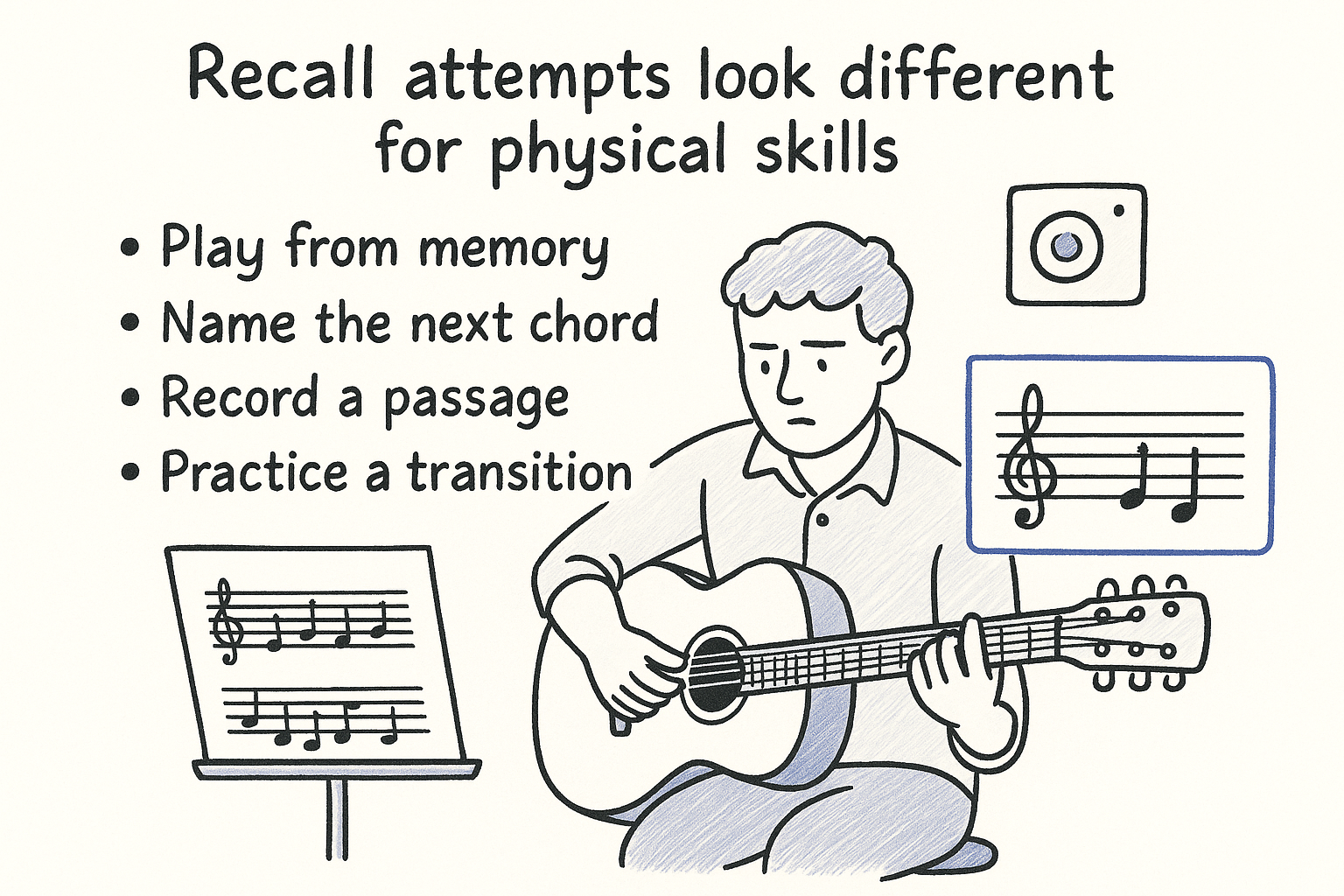
- Play a phrase from memory, then check it against the sheet music
- Name the next chord or fingering before your hands move there
- Record yourself attempting a passage cold, then compare to a reference recording
- Practice a transition point (measure 32 to 33, for example) in isolation, out of context, so you can't ride momentum from what came before
Why isolated drilling beats full run-throughs
Most musicians default to full run-throughs because they feel like real practice. But a run-through lets you glide past weak spots on momentum built from the parts you already know well. Isolated drilling on the specific measure, transition, or technique that keeps failing is where actual retrieval strengthening happens, because there's nowhere to hide.
A full run-through hides your weak spots. Isolated drilling exposes them.
Rating a physical skill honestly
Rating yourself on a physical attempt is harder than rating a flashcard, since "good" can mean different things depending on tempo, tone, or timing. Judge the attempt against a clear standard you set beforehand, hit the notes at performance tempo, clean tone, no hesitation, rather than against how it felt in the moment. This is exactly the kind of judgment call that a practice management platform built for skills, rather than adapted from language-learning flashcards, is designed to support, since it schedules the next attempt based on how the skill actually held up, not on vague confidence.
Turning active recall into a lasting habit
Active recall only pays off if you keep doing it, session after session, long after the novelty wears off. The technique matters less than the consistency. A single retrieval attempt barely moves the needle, but weeks of honest self-testing, spaced out and rated without ego, is what actually rewires memory and motor skill alike.
The hardest part isn't understanding active recall learning, it's remembering what to test yourself on and when, especially once you're juggling scales, repertoire, and technique drills at the same time. That's the exact decision fatigue a scheduling system is built to remove. MemoRep applies the same spaced repetition science covered in this article to practical skills specifically, tracking every card and telling you what to retrieve today based on how you actually performed last time.
If you want to see the algorithm behind it, check out the science powering MemoRep before you build your first practice deck.