Deliberate Practice Worksheet: How to Use It, Step by Step
A deliberate practice worksheet is a one-page plan that makes you pick one skill, set a measurable target, rehearse it in a short block, record feedback, and schedule the next review. You can copy the worksheet below into a notebook or document and fill it in. It takes about ten minutes a week, and it works for therapists, musicians, and anyone learning a practical skill.
Most people practice by feel. You rate yourself "pretty good," repeat what is comfortable, and three weeks later you cannot remember what you decided to improve. Therapists describe the same trap: years of experience can settle into an "OK" plateau when nothing in the routine forces you to target a weak spot. Choosing too many goals at once makes it worse.
This guide gives you the worksheet as plain text first. Then it walks through four steps: rate yourself and choose one focus, set a target and plan the rehearsal, capture feedback and log the result, and schedule the review. Each step explains what to write in the matching block, with examples you can adapt.
Why a worksheet beats good intentions
A deliberate practice worksheet turns vague effort into a repeatable cycle. It works because it forces decisions in writing: what to work on, how you will know it improved, who will give you feedback, and when you will return to it.
What the worksheet does
Structured forms for deliberate practice already exist in clinical training. The Taxonomy of Deliberate Practice Activities (TDPA), created by Daryl Chow and Scott Miller, asks therapists to rate themselves across areas of their work and then narrow down to a focus. The same logic carries over to any skill: measure where you are, pick one thing, and check whether it moved.
The worksheet below is a general version. It does not tell you what to work on, because that decision belongs to you and your supervisor or teacher. It only gives the decision a structure.
A worksheet does not make you practice harder. It makes you decide before you start.
The worksheet to copy
Paste this into a document, a notes app, or a notebook. Fill in one sheet per focus skill.
DELIBERATE PRACTICE WORKSHEET
Week of: ______   Skill area: ______

1. BASELINE (rate each skill 0-10)
Skill A: __   Skill B: __   Skill C: __   Skill D: __
Evidence behind each rating: ______

2. ONE FOCUS
Focus skill: ______
Anti-goals (what I will NOT work on now): ______

3. TARGET
Specific target: ______
How I will verify it: ______
Deadline: ______

4. REHEARSAL PLAN
Exact task to repeat: ______
Minutes per block: ___   Repetitions per block: ___
Sessions this week: ___
Where it breaks down (my stretch point): ______

5. FEEDBACK
Source (supervisor, teacher, recording, client rating): ______
What I noticed: ______
What I will change next time: ______

6. RESULT AND REVIEW
Rating after (0-10): ___
Again / Hard / Good / Easy: ______
Next review date: ______
How the blocks map to the research
Research on expert performance keeps returning to the same elements. Each one has a home on the sheet.
| Element | What it means | Worksheet block |
|---|---|---|
| Specific goal | One skill with a measurable result | Blocks 2 and 3 |
| Full attention | Short, focused rehearsal | Block 4 |
| Feedback | Information from outside your own impression | Block 5 |
| Working at the edge | Practicing just beyond what feels easy | Block 4, stretch point |
| Repetition over time | Returning to the skill on a schedule | Block 6 |
Step 1. Rate yourself and choose one focus
Start with block 1. List four to eight skills that matter in your work or playing, rate each from 0 to 10, and then circle one. That circled skill is your only focus for the week.
Rate each skill with evidence
Write a number, then write what the number rests on. A recording, a teacher's comment, a client's session rating, or a performance you could compare against all count. Ratings tend to drop once you have to justify them. That drop is useful, because it shows where your self-image runs ahead of your evidence.
If you cannot name any evidence for a skill, mark it "unknown" rather than guessing. An unknown skill is a good candidate for a feedback source in step 3.
Narrow to one focus and one anti-goal
Pick the skill where an improvement would change your results most, not the one you enjoy most. Then write it in block 2. Daryl Chow reported that even three focus areas were too many, since he had forgotten all three within weeks. His fix was a single focus. Take that lesson and choose one skill, not two.
Then fill in the anti-goal line. An anti-goal is something you explicitly decide not to work on yet, such as "no new material this month" or "no second skill until review day." It protects the focus when a new idea shows up midweek.
One focus per sheet is the rule that makes everything else on the page work.
Step 2. Set a target and plan the rehearsal
Block 3 holds the target and block 4 holds the plan. Together they answer two questions: what will be true when this works, and what exactly will you repeat to get there?
Write a target you can verify
A good target names a number, a deadline, and a way to check. If you cannot check it, it is a wish. Compare these.
| Vague | Verifiable |
|---|---|
| Get better at asking for client feedback | Ask for feedback at the end of 4 of my next 5 sessions and log what I heard |
| Work on the bridge section | Play bars 17 to 24 at 80 bpm, three clean runs in a row, on two separate days |
| Draw hands better | Complete 5 ten-minute hand studies and compare the last with the first |
Notice that none of these targets tells you how to do the skill. They only define what success looks like. The method comes from your supervisor, teacher, or training.
Plan a short rehearsal block
Name the exact task you will repeat, the minutes per block, and the repetitions. Short blocks protect attention. Fifteen minutes is a sensible starting point, and you can adjust after a week.
Then fill in the stretch point: the moment where the task starts to fall apart. That is where the rehearsal should concentrate, not on the parts that already feel smooth.
A worked example: you plan 15-minute blocks, three sessions this week. That is 45 minutes total, with 6 repetitions per block, so 18 repetitions of one task. A tiny plan like this is easier to complete than a one-hour session you will skip.
A plan you can finish in 15 minutes beats a perfect plan you never start.
Step 3. Capture feedback and log the result
Block 5 records where feedback came from and what changed. Block 6 records how it went. Practice without feedback is just repetition, so decide on the source before the session, not after.
Choose a feedback source before you start
Pick one source per sheet. Options include a supervisor who watches or listens, a teacher, a recording you review against your target, or a client's own rating of the session. Write it down in block 5 now.
If you work with clients, protect their privacy. Get proper consent for recordings, remove identifying details from your notes, and follow your supervisor's and profession's rules. When in doubt, ask your supervisor before you record.
Rate the result and log it
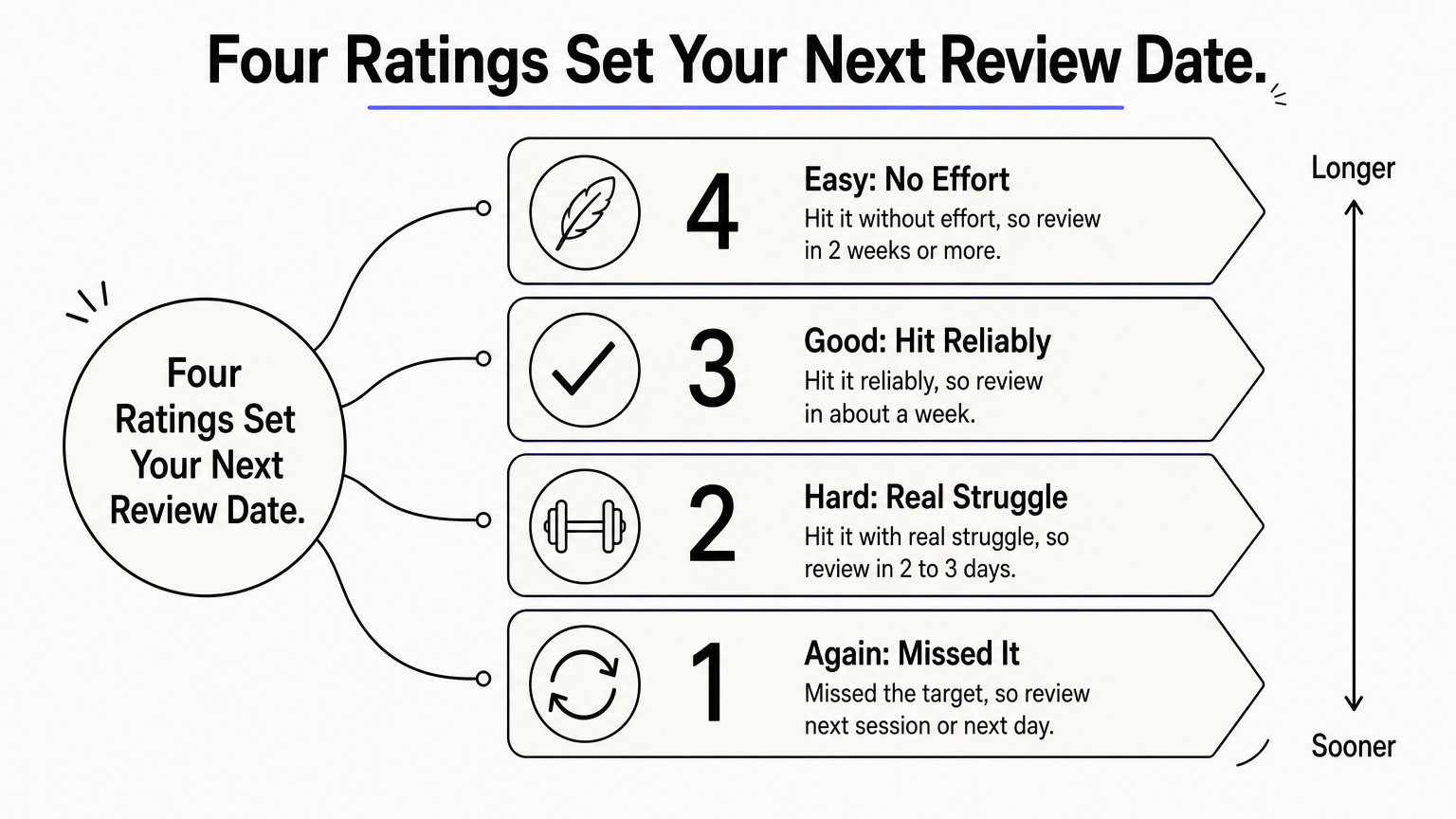
After the rehearsal, give the skill a new 0 to 10 rating in block 6. Then add a four-level judgment of how recall felt. The Again, Hard, Good, Easy scale is the one spaced repetition tools use, and it also works on paper.
| Rating | What it means | Starting rule for the next review |
|---|---|---|
| Again | Missed the target | Next session or next day |
| Hard | Hit it, but with real struggle | In 2 to 3 days |
| Good | Hit it reliably | In about a week |
| Easy | Hit it without effort | In 2 weeks or more |
These intervals are a starting rule of thumb for paper tracking, not a fixed formula. Adjust them if a skill fades faster than expected.
The rating is only useful if it decides when you come back to the skill.
Step 4. Schedule the review and repeat
The last line of the sheet is the next review date. Without it, a skill you just improved will fade, and the next sheet will start from a lower baseline than you hoped.
Put a date on the page
Hermann Ebbinghaus's forgetting curve showed that memory drops fastest soon after learning and slows later. The practical lesson is to revisit a skill just before it fades, then stretch the gap each time it holds. Write the date in block 6, put it in your calendar, and when it arrives, start a new sheet with that skill's rating as the baseline.
On paper, this works for one or two skills. Around a dozen, tracking dates by hand becomes its own job, and deciding what to practice today drains energy before you pick up the instrument or the case notes.
Let software handle the scheduling
This is the part MemoRep automates. You create a skill, which is a concrete piece of work such as a passage, exercise, warm-up, or technique. You practice it in a timed session and rate it Again, Hard, Good, or Easy. MemoRep then shows the next-review date before the session is saved. Scheduling follows the Ebbinghaus forgetting curve and the SuperMemo SM-2 algorithm, and there are no flashcards.
You can keep several projects, mark one as your main focus, save notes and image evidence at the skill or session level, and keep a practice journal. MemoRep never tells you how to play or what technique to use. It only decides when each skill returns, so the content stays between you and your teacher or supervisor.
Your worksheet decides what to improve, and the schedule decides when you look at it again.
Start with one page this week
A deliberate practice worksheet works because it forces five decisions: one focus, a verifiable target, a short rehearsal, a feedback source, and a review date. Copy the sheet, fill in one block at a time, and keep the plan small enough to finish. Repeat it weekly and your ratings will start telling you something true.
If you would rather not track review dates by hand, claim a founding membership at MemoRep. The first 200 musicians to create an account receive the future Premium plan free, permanently. Google sign-in opens your planner, and you can start your first project right away.