The Beginner's Guide to Deliberate Practice in 4 Steps
The beginner's guide to deliberate practice comes down to four steps. Split a skill into small parts, work on them in short focused blocks, get honest feedback after each block, and bring every part back on a schedule before you forget it. Do that for a few weeks and your practice time starts producing measurable gains instead of just repetitions.
Most beginners practice the opposite way. They run through whatever feels familiar for as long as they feel like it, and they never check whether anything improved. Hours pile up, the same mistakes survive, and skills you learned last month quietly fade.
This guide walks through the method in order. You will learn what separates deliberate practice from plain repetition, then follow four concrete steps with examples and a sample 30-minute session. One note up front: it covers how to organize and review your practice, not what to play or how to execute a technique. That call belongs to your teacher.
What deliberate practice is and what you need first
Deliberate practice is purposeful, structured practice aimed at a specific improvement, done with full attention and checked with feedback. Psychologist Anders Ericsson and his colleagues developed the idea in a 1993 study of violin students at a Berlin music academy. The students rated as the best had logged more solo practice by age 20 than the less accomplished groups, and they treated that time as hard, planned work.
Deliberate practice versus ordinary repetition
The difference shows up in six places, and you can use this table as a quick self-check on your own sessions.
| Ordinary practice | Deliberate practice | |
|---|---|---|
| Goal | "Practice for a while" | One specific, checkable target |
| Unit of work | The whole piece or routine | Small parts |
| Attention | Autopilot | Full focus, no distractions |
| Difficulty | Comfortable | Just beyond your current level |
| Feedback | Occasional or none | After every block |
| Revisiting | Whenever you remember | On a schedule |
Deliberate practice is not more practice. It is practice with a target, a check and a plan to return.
What to have ready before step 1
You need four things. First, one skill you care about. Second, a source of direction, such as a teacher, a coach or a set curriculum, that tells you what matters next. Third, a timer. Fourth, a place to write results, whether a notebook, a spreadsheet or an app.
The method rests on five principles: a clear goal, small parts, work at the edge of your ability, feedback, and reflection with spaced revisits. The four steps below cover all five.
Step 1. Pick a skill and split it into parts
Start by choosing one skill and writing the result you want as a sentence you can check with a yes or no. Your teacher supplies the "what". Your job is to make the target measurable.
Write a target you can check
"Get better at my song" cannot fail, so it cannot guide you. A checkable target names a result, a standard and a count. The examples below show the difference.
- Vague: "Practice my song." Checkable: "Sing the chorus from memory, three clean run-throughs in a row."
- Vague: "Work on the intro." Checkable: "Play the intro at the tempo my teacher set, 8 out of 10 attempts."
- Vague: "Do some drawing." Checkable: "Finish five timed two-minute sketches in one sitting."
Cut the skill into parts of 5 to 15 minutes
Next, break the skill into parts small enough to finish inside one block. In MemoRep, a skill is a concrete piece of work such as a passage, an exercise, a warm-up or a technique you can practice and review. Use the same idea for any craft.
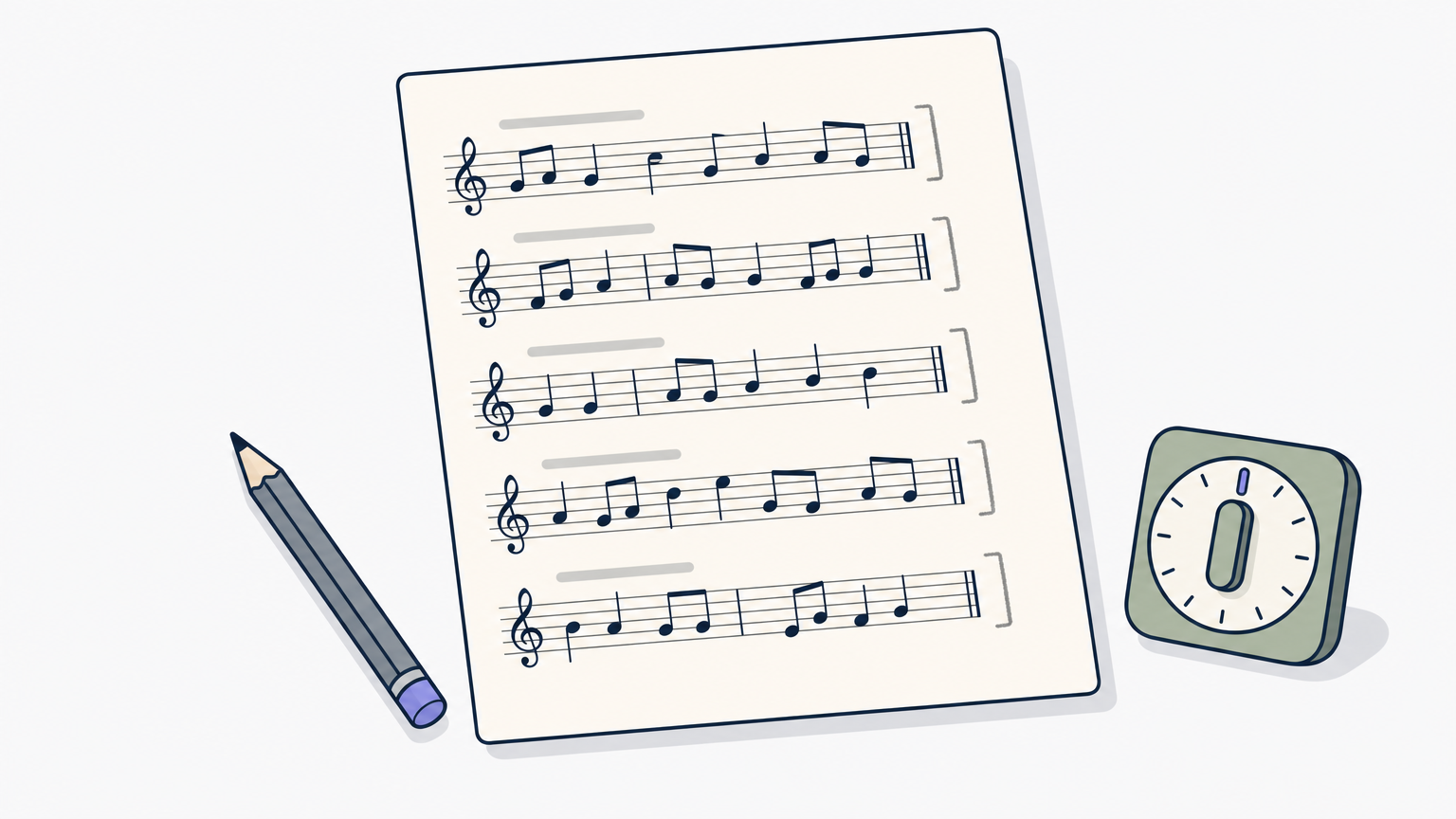
If a part cannot be worked in 15 minutes, split it again. A song might become intro, verse, chorus, bridge, the move from bridge to chorus, and ending. Keep three to six active parts at first, because a long list adds decision fatigue and steals practice time.
If a part does not fit in one focused block, it is not a part yet. Split it again.
Step 2. Run a focused, timed practice block
A good block is short, timed and single-purpose. For most beginners that means 25 to 45 minutes. Ericsson's top violinists kept individual sessions to about 90 minutes at most, so longer is not better.
Set the timer and protect the block
Put your phone out of reach and give each part a time budget before you begin. Work on one part at a time, and move on when the timer ends, not when you feel done. Here is a sample 30-minute session you can copy.
| Block | Minutes | Purpose |
|---|---|---|
| Warm-up skill | 5 | A part you recently rated Good or Easy |
| Skill A | 10 | The part due for review or the one your teacher flagged |
| Skill B | 10 | A second part, different from A |
| Rate and log | 5 | Score each part, write one line of notes |
| Total | 30 |
Work at the edge of your ability
Practice that always succeeds teaches you little, and practice that always fails teaches you nothing. You want a mix of hits and misses. If you clear a part every time, make the target stricter, or move to a harder part with your teacher's guidance.
If you miss several attempts in a row, stop repeating the miss. The part is probably too big, so split it smaller or bring the problem to your teacher. This keeps effort high without turning the session into a pile of failed repetitions.
Aim for sessions where you succeed some of the time. Never missing means the target is too easy, and always missing means the part is too big.
Step 3. Get feedback and record what happened
Feedback is the part that turns repetition into improvement. Without it you are guessing, and you cannot judge your own work in the moment while you are also performing it.
Choose your feedback source
You have three options, and the strongest routines use at least two.
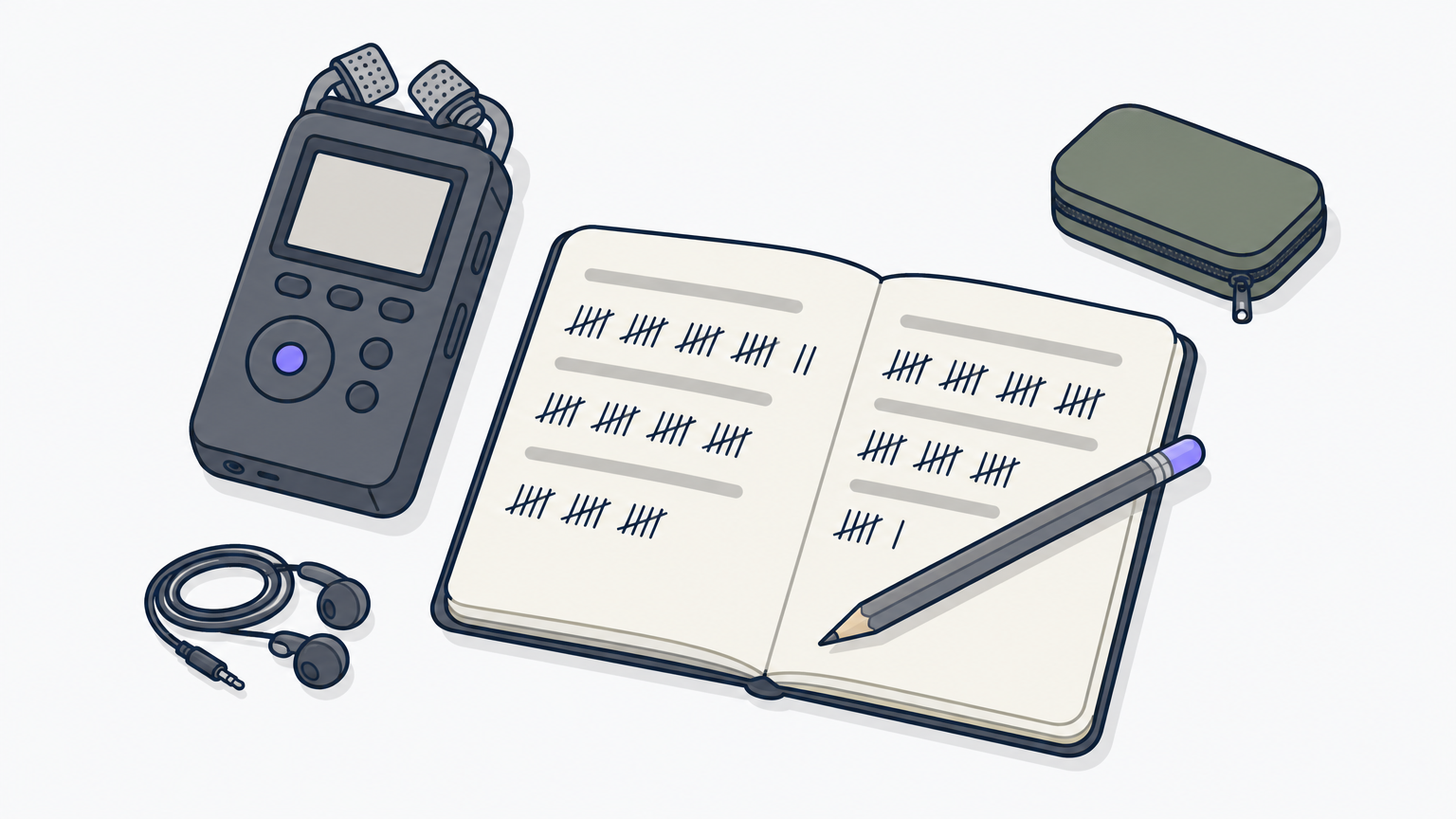
- A teacher or coach. They see errors you cannot, and they decide what comes next.
- A recording. Audio or a photo of your work, compared with your last attempt.
- A count. Successful attempts out of ten, written down. Seven out of ten on Monday and nine out of ten on Thursday is real evidence.
Notes and images are easy to store with each session. Video takes more space, so keep only the clips you will actually review.
Rate each part honestly
After each part, give it a rating. The four-level Again, Hard, Good, Easy scale used by spaced repetition tools works well because it also sets the next review.
| Rating | What it means | What happens next |
|---|---|---|
| Again | You failed or had to restart | Comes back very soon |
| Hard | You succeeded, but with strain | Comes back after a short gap |
| Good | You succeeded as planned | Comes back after a normal gap |
| Easy | It felt effortless | Comes back after a long gap |
Add one line of notes about what went wrong or right. Inflating a rating pushes the next review further away, so you are the one who pays for flattering yourself.
A rating is a message to your future self. Write the one you would want to receive.
Step 4. Revisit each skill on a schedule
Skills fade when you leave them alone, and spaced reviews stop the fade. Hermann Ebbinghaus showed in 1885 that memory drops quickly after learning and then levels off. Each successful review flattens the drop, so the next gap can be longer.
Space your reviews with growing gaps
The SuperMemo SM-2 algorithm, published by Piotr Wozniak, puts a first review at 1 day and a second at 6 days. After that, each gap is multiplied by an ease factor that starts at 2.5. With consistently good ratings, the gaps look like this.
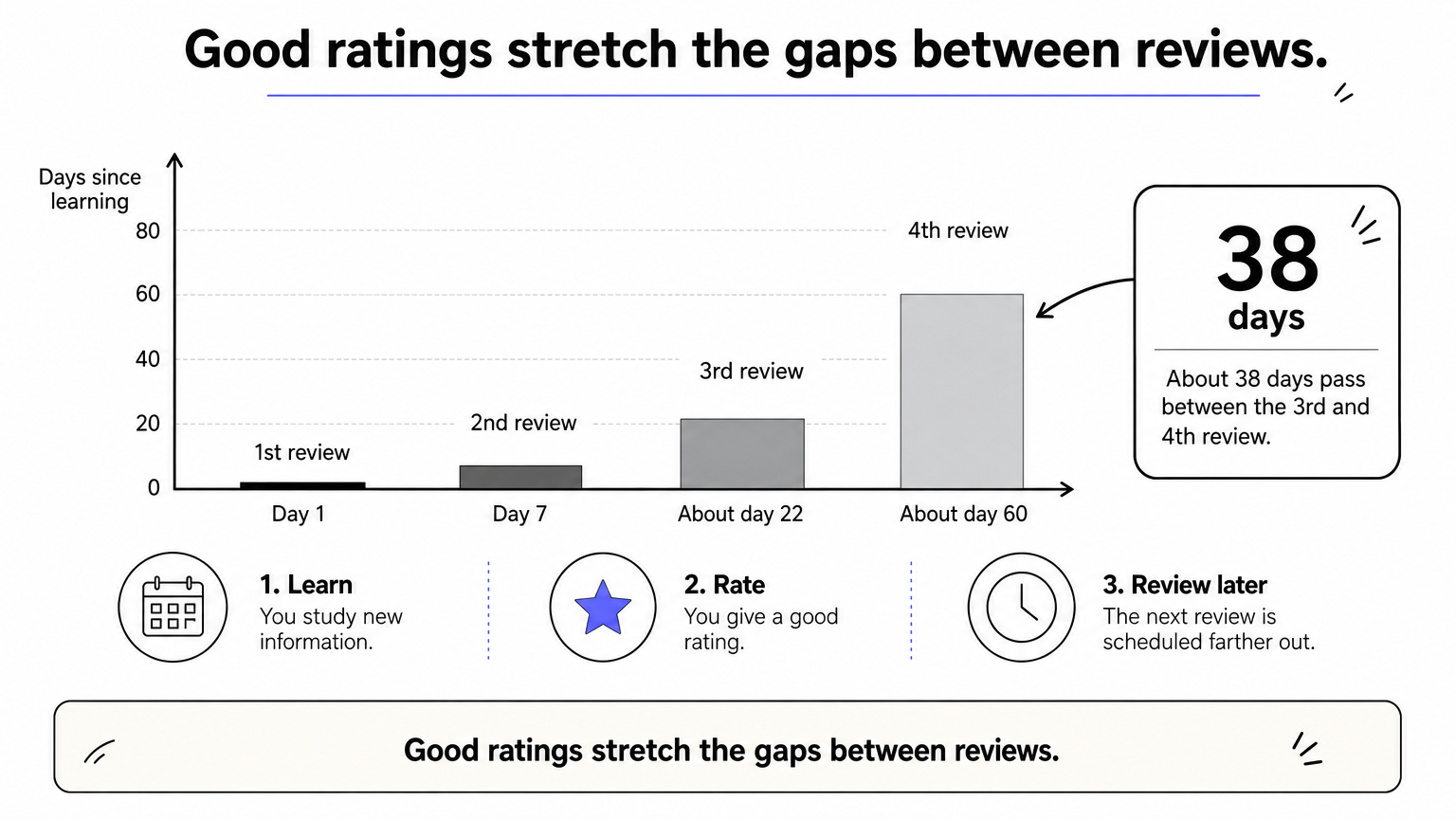
| Review | Gap after previous | Day since learning |
|---|---|---|
| 1st | 1 day | Day 1 |
| 2nd | 6 days | Day 7 |
| 3rd | about 15 days | about Day 22 |
| 4th | about 38 days | about Day 60 |
Treat these as an illustration, not a law. A rating of Again resets the part to the short gaps. That is the system working, because it catches a skill at the moment it starts to slip.
Let a system decide what is next
You can do this with a calendar and a spreadsheet: one row per part, a column for the last rating, a column for the next date. It works, but you have to open it and decide every day, and that is where most people quit.
MemoRep automates the decision. It uses the forgetting curve and SM-2 scheduling to tell you what to practice and when, without flashcards. When you pick a musical focus, it gathers your project's ready skills and their estimated time. After each part you rate it Again, Hard, Good or Easy, and it shows the next-review date before the session is saved.
The best schedule is the one that decides for you, so practice time goes to practicing.
Start with one skill this week
Deliberate practice is a loop. Set a checkable target, split the skill into small parts, work them in timed blocks, get feedback and rate the result, then bring each part back at growing intervals. None of it requires talent or special gear, only a little structure around the time you already spend.
Pick one skill, write one target, and run a 30-minute block using the table above. If you would rather not track the dates yourself, you can try MemoRep and claim a free-for-life Premium plan while the founding offer for the first 200 musicians lasts.