How to Memorize Classical Music for Performance in 5 Steps
The most reliable way to memorize classical music is to cut the piece into short chunks, play each chunk with the score closed, and review it on a widening schedule: tomorrow, then three days later, then a week later. Once the chunks hold, you join them and rehearse full run-throughs under performance conditions. Memory built this way lasts for weeks, not just until tomorrow morning.
Most players do it the other way. They play the piece from the top until it "feels" known, and that feeling is misleading. A seven-minute piece holds thousands of notes, and brute-force repetition leaves you with a memory that is strong in the evening, patchy the next day, and fragile on stage. The weak spots are usually the same ones every time, and you often learn about them in front of an audience.
This guide gives you a four-step method that covers the memory side of practice: how to organize, test, and schedule what you learn. It does not tell you how to play or analyze the music, because that is your teacher's job. At MemoRep we build a spaced repetition practice app that schedules practice cards, so scheduling reviews is the part of practice we handle, and it is the part that decides whether a piece sticks.
Why spaced recall beats repeated playing
Memory lasts when you pull it out of your head at the right moments, not when you replay the piece while reading it. The method below combines two ideas, active recall and spaced repetition, and applies them to a score.
What actually makes a memory last
The Ebbinghaus forgetting curve describes how a new memory fades fast right after learning and then more slowly. Each successful recall flattens the curve, so the next gap before you forget gets longer. That is why a review at the moment of near-forgetting is worth more than ten reviews in a row.
Playing along with the score does not count as recall. You are reading, not remembering. Real recall means the score is closed and you produce the music yourself. Closing the score is the whole point.
A memory strengthens when you retrieve it just before it fades, not when you replay it while reading.
What you need before you start
Gather a few simple things first:
- A clean copy of the score with measure numbers (add them in pencil if they are missing)
- A pencil for marking chunks and trouble spots
- A way to track reviews: a notebook, a spreadsheet, or an app like MemoRep
- Your teacher's input on where the sections of the piece begin and end
Give yourself time, too. You can cover the notes of a short piece in a few days, but a stable memory needs several weeks of spaced reviews. Start at least a month before the performance.
Step 1. Split the piece into practice chunks
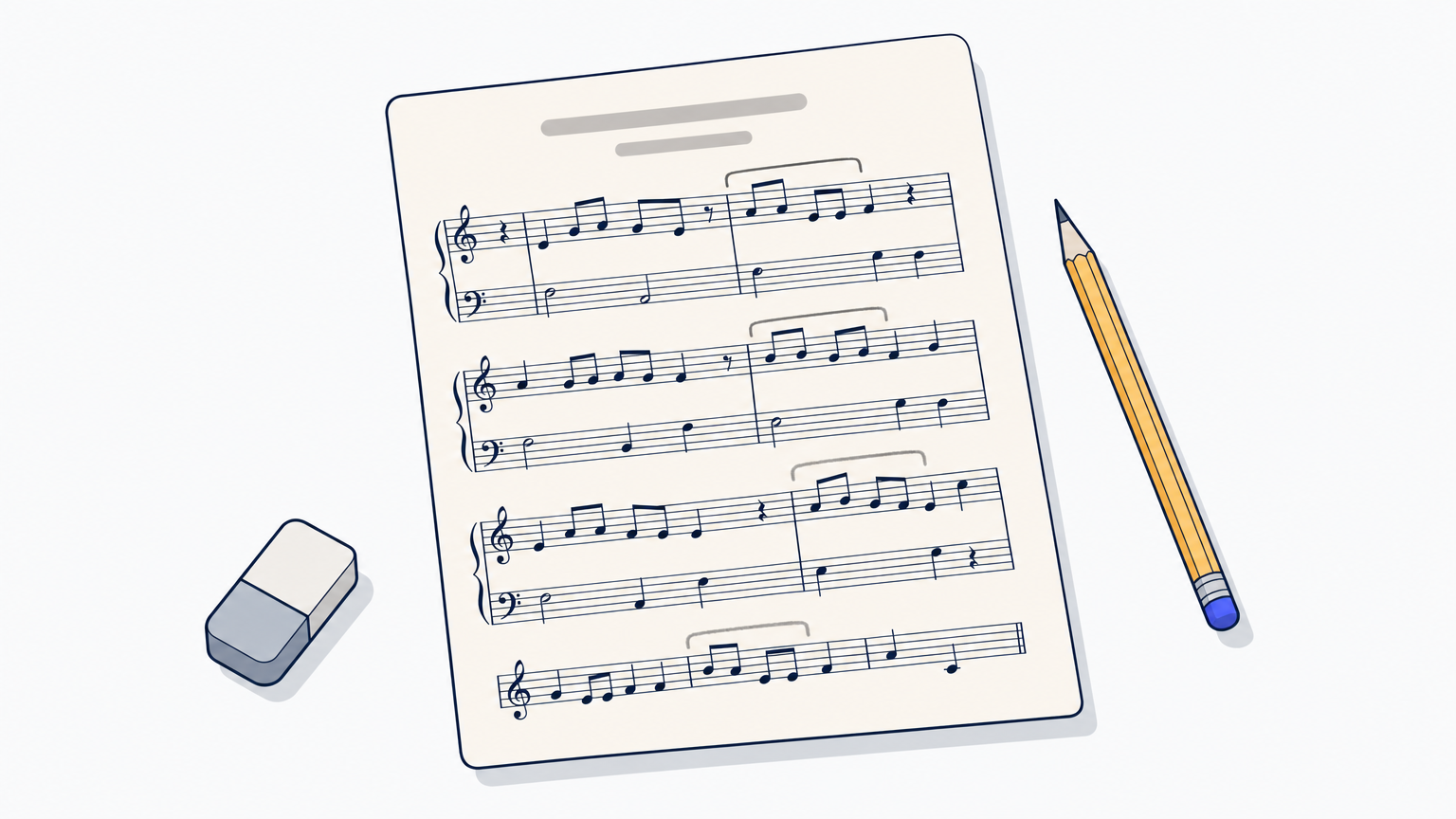
Divide the piece into chunks of roughly 4 to 8 measures, ending where a phrase or section naturally ends. Small chunks give you a clear target and make it obvious what failed when you stumble.
Mark the chunks in the score
Pencil a bracket around each chunk and label it with a number or letter, such as 1, 2, 3. Ask your teacher to check the boundaries, since choosing where phrases end is a musical decision. Let each chunk overlap the next by one measure so the joins are already built in.
Turn each chunk into a card
Each chunk becomes one practice card with a name like "Piece title, mm. 1-6". Take a three-page piece with 72 measures. At 6 measures per chunk, you get 12 cards. That number matters in Step 3, because you will introduce only a few new cards per day.
One chunk, one card: small units make it clear what you know and what is slipping.
Step 2. Learn each chunk with the score closed
For each new chunk, look at the score briefly, close it, play from memory, then open it to check. Repeat until you play the chunk cleanly twice in a row. This is the play, check, fix loop.
Run the play, check, fix loop
- Study the chunk for a short, fixed time.
- Close the score or turn it over.
- Play the chunk from memory, even if it is shaky.
- Open the score and note exactly where you stalled.
- Repeat until two clean passes in a row.
Play at a tempo where you can recall without stopping. A stall mid-chunk teaches your memory to stall there again. Mark each stall point with a pencil dot so you know which spots to check first next time.
Cap the number of new chunks per day
New material is the most expensive thing you can add to your memory. With 12 cards, learn 2 new chunks per day, and the whole piece is learned in 6 days. If you want it faster, add a chunk or two, but reviews will grow to match. Cramming everything in one day recreates the old problem: it feels fine tonight and is gone by Friday.
You can also rehearse a chunk away from your instrument. Sit with the score closed and run it through in your head. If your mental version breaks at a certain measure, that spot needs another pass.
Close the score first, then check it. The effort of recalling is what builds the memory.
Step 3. Schedule reviews before chunks fade
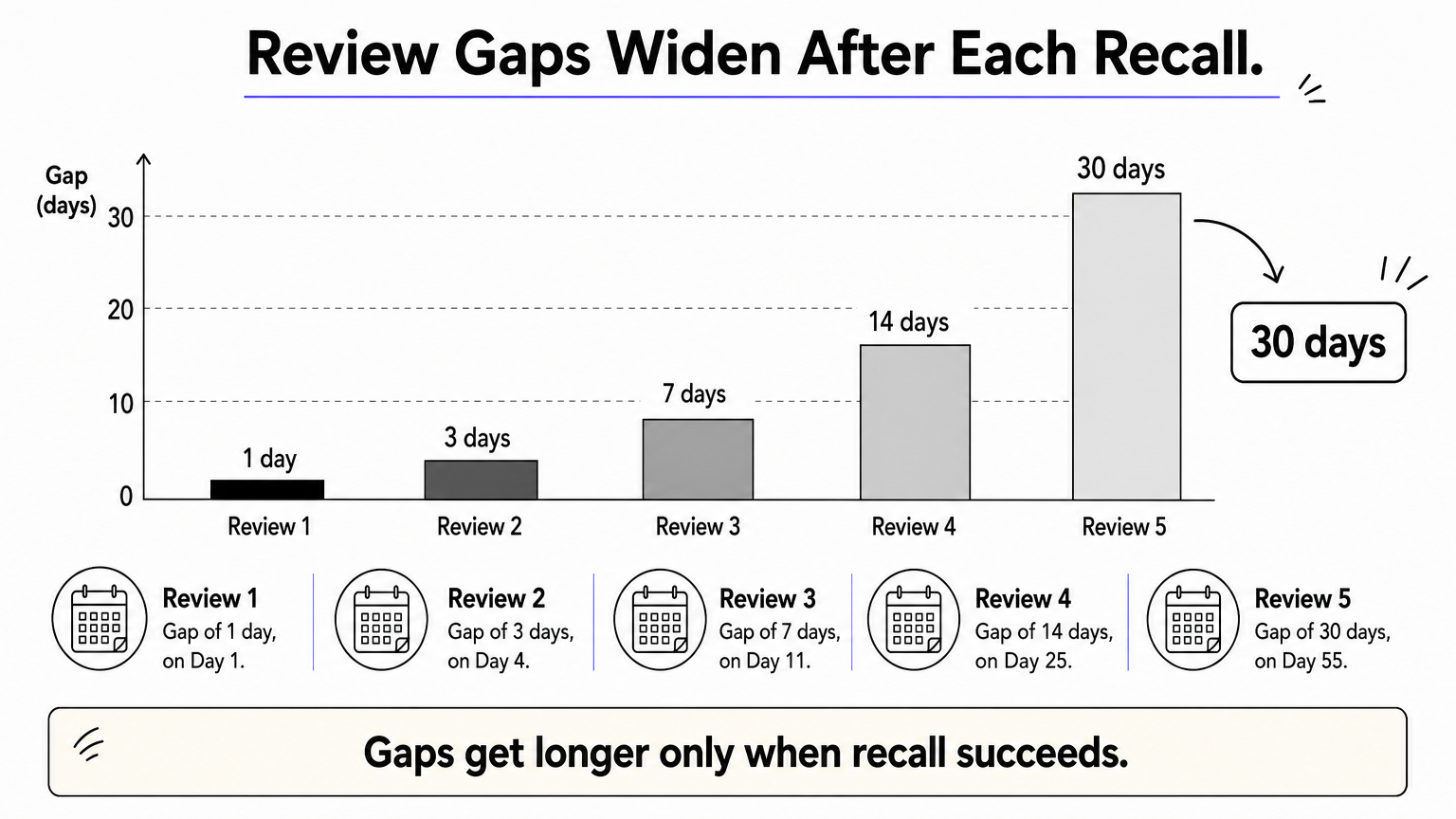
Review each chunk at growing intervals: the day after learning, then 3, 7, 14, and 30 days later. A chunk you play cleanly earns a longer gap, and a chunk you miss comes back sooner.
Use a widening review schedule
Here is a schedule you can run on paper, counted from the day you first learn a chunk (Day 0):
| Review | Gap after previous | Day number |
|---|---|---|
| 1 | 1 day | Day 1 |
| 2 | 3 days | Day 4 |
| 3 | 7 days | Day 11 |
| 4 | 14 days | Day 25 |
| 5 | 30 days | Day 55 |
For a performance in a month, compress the last two gaps and add a review in the final week. The principle stays the same: gaps get longer only when recall succeeds.
Rate every review honestly
After each review, rate how it went. In MemoRep the four ratings are Again, Hard, Good, and Easy. Use them like this:
- Again: you blanked or needed the score. The card returns tomorrow.
- Hard: you recalled it with effort or hesitation. Repeat a similar gap.
- Good: clean recall. Move to the next interval.
- Easy: effortless. Skip ahead to a longer gap.
Tracking this by hand across 12 cards gets tedious. MemoRep does it automatically with the Ebbinghaus forgetting curve and the SuperMemo SM-2 algorithm, adjusts each card to your ratings, and sends a daily notification listing what is due. It is free during the beta for the first 200 users, if you want to see how it works.
Honest ratings drive the schedule: a generous "Good" on a shaky chunk just delays the blank until performance day.
Step 4. Link the chunks and rehearse like a performance
Once chunks are rated Good, play them in overlapping pairs, then in full pages, then straight through. Finish by running the whole piece under conditions that feel like the real thing.
Join chunks and add transition cards
Play chunk 1 then chunk 2 from memory, then chunks 2 and 3, and so on. Add a card for every join that gave you trouble, such as "mm. 5-8, across the page turn". Transitions are where most memory slips happen, so they deserve their own review schedule. When pairs are solid, play full pages, then the whole piece.
Start from random places
Shuffle your chunk cards and draw one. Start the piece there, from memory, with no warm-up. It works as a game: if you can start from any card, you are not relying on a single chain from measure 1. In a slip on stage, you can jump to the next chunk you know cold.
Rehearse under pressure
In the last two weeks, play the piece straight through without stopping a few times. Record yourself, then play for a friend or family member. Decide in advance that after a slip you will skip to the start of the next chunk instead of restarting. Keep reviews running until the day before the performance so weak chunks still get attention.
Practice recovering from a slip and it stops being a catastrophe.
Start with one page
To memorize classical music reliably, work in small chunks, test yourself with the score closed, space your reviews, and rehearse the full piece as you would perform it. The schedule does most of the work, so your job is to show up when a card is due and rate it honestly.
Pick one page today, split it into cards, and learn two chunks. Tomorrow, review them. If you would rather not track intervals by hand, try MemoRep and let it tell you what to practice and when.