Spaced Repetition Algorithms: What They Are and How They Work
You've probably heard that spaced repetition helps you remember things longer, but the actual mechanics stay a mystery to most people. How does an app know to show you a scale you practiced twelve days ago instead of the one from yesterday? The answer lives inside spaced repetition algorithms, and once you understand them, you'll trust them a lot more with your practice time.
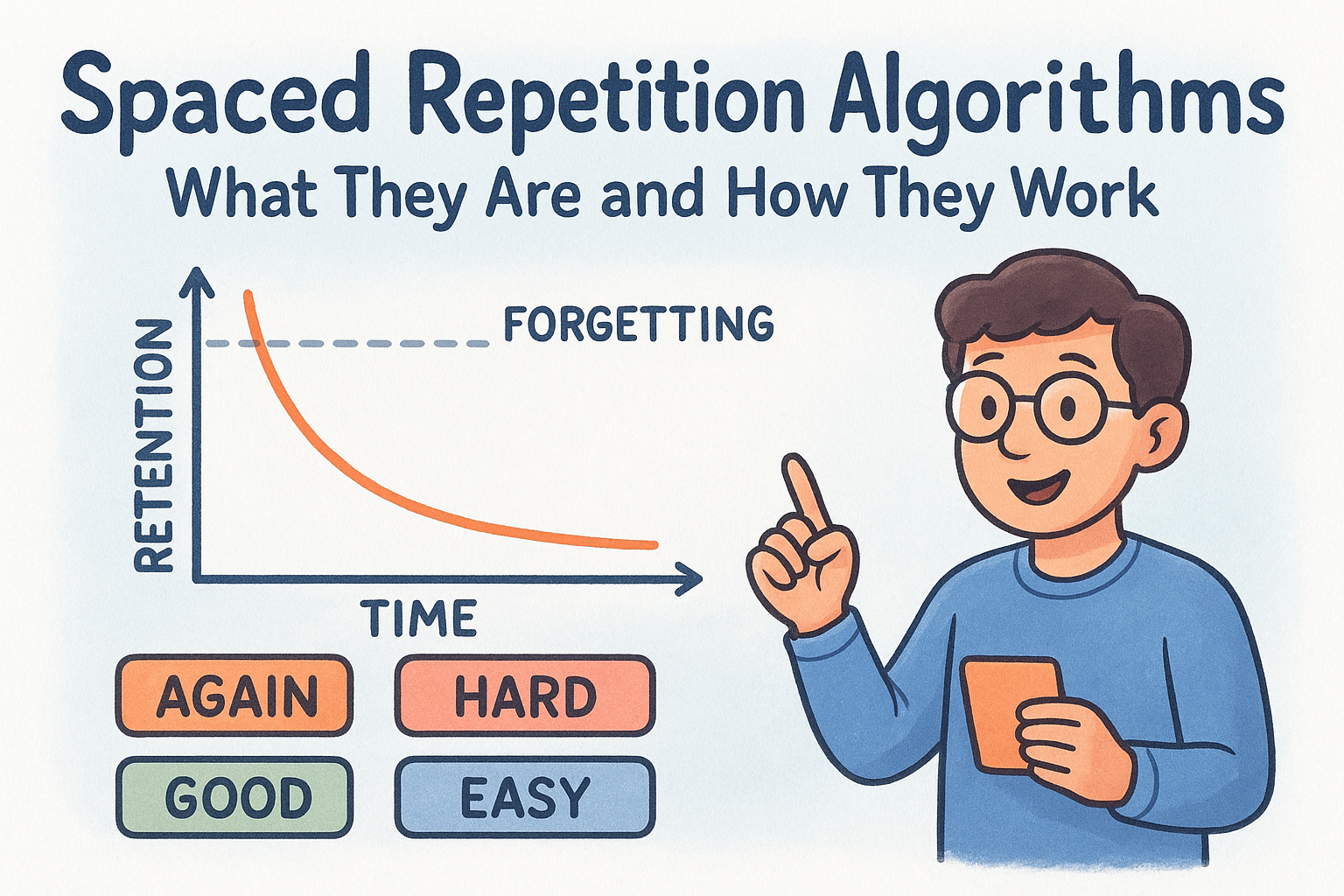
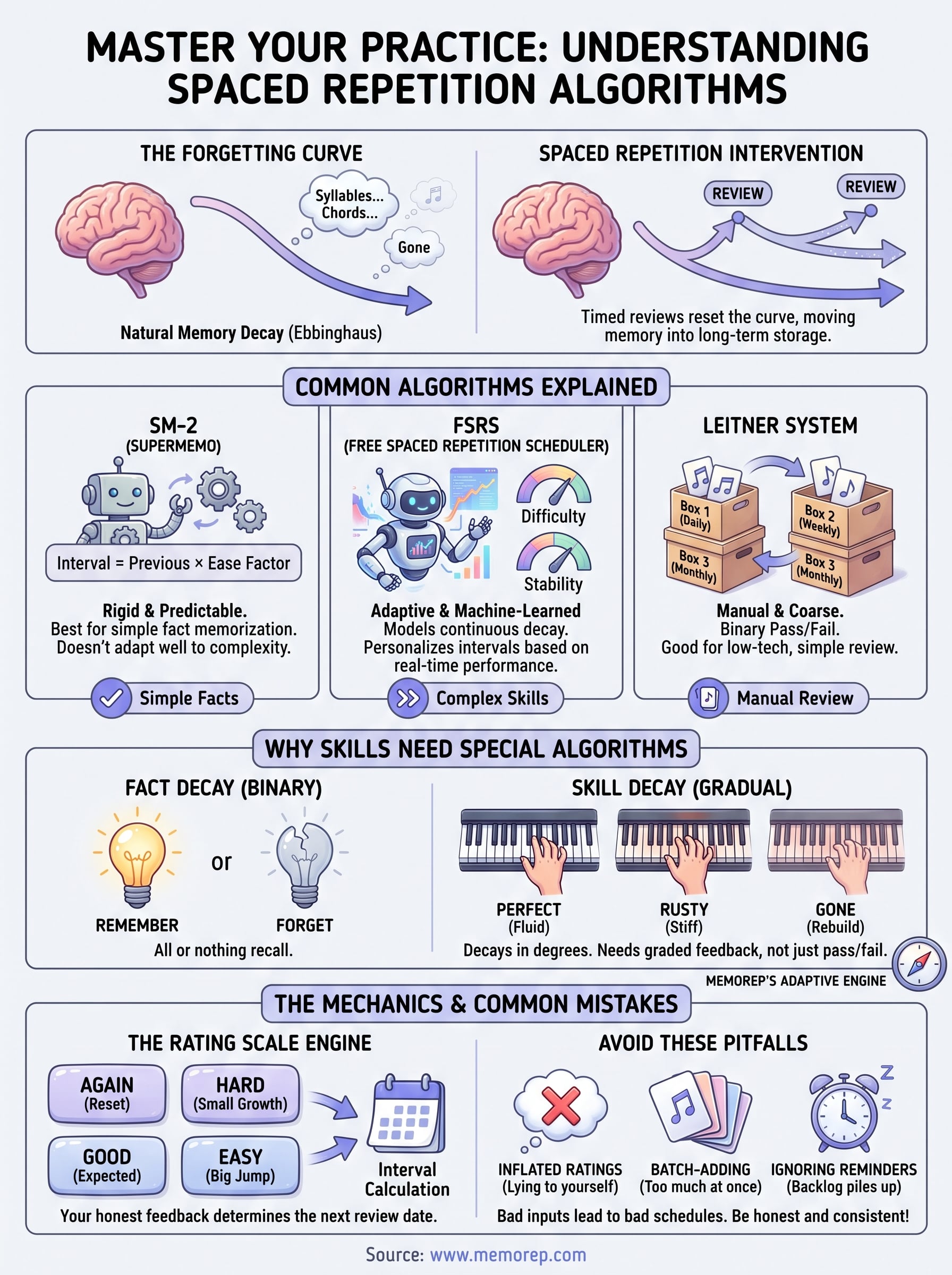
At the core, these algorithms are just math models that predict when a skill or memory is about to fade, based on how the Ebbinghaus curve models memory decay. Different implementations, from the original SuperMemo SM-2 to newer approaches like FSRS, calculate that fading point differently, using your past performance to adjust future intervals. Some are simple and rigid, others adapt in real time to how well you're actually doing.
In this article, you'll get a clear breakdown of how these algorithms work, the main types you'll encounter, and what separates a good implementation from a mediocre one. If you're trying to choose a tool, or just want to understand why your practice app schedules things the way it does, this will give you the full picture.
Why spaced repetition algorithms matter for retention
Memory decay isn't a personal failing, it's a predictable curve. Hermann Ebbinghaus proved this back in the 1880s by testing his own recall of nonsense syllables, and his data still holds up: without review, you forget roughly half of what you learned within a day, and the decline continues from there. This is why spaced repetition algorithms exist at all. They exploit a simple fact: reviewing something right before you'd naturally forget it resets the decay curve and stretches the interval before the next review is needed. Skip that window, and you're not reinforcing a memory, you're relearning it from scratch.
Practicing at the wrong time costs you the same effort as practicing at the right time, but gives you far less to show for it.
The forgetting curve is working against you
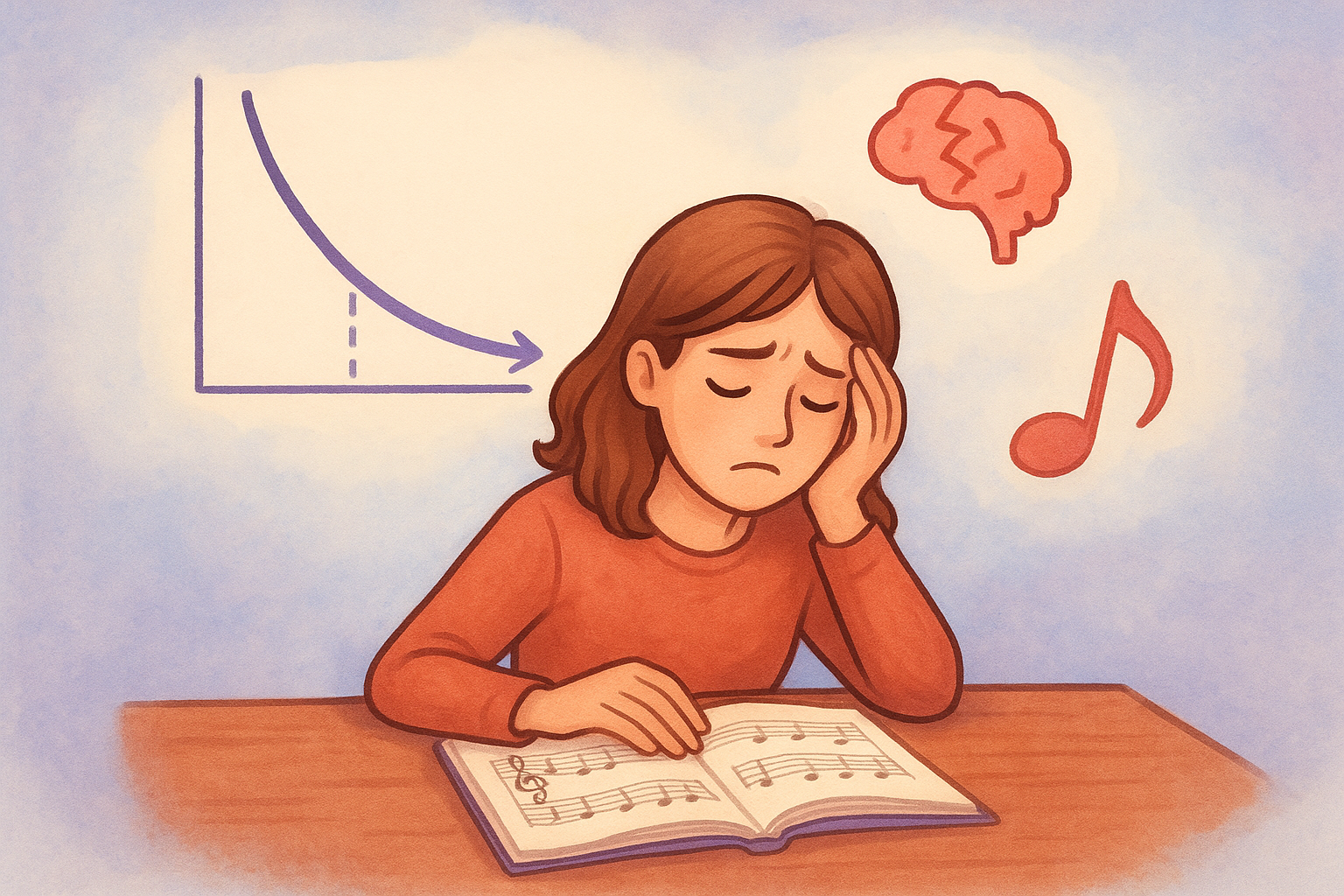
Musicians feel this curve constantly, even if they've never heard the term. You nail a tricky passage on Tuesday, skip it for two weeks because you're focused on a new piece, and by the time you circle back, your fingers have forgotten the fingering entirely. That's not bad luck, that's how memory fades when you stop reviewing, exactly as Ebbinghaus documented. A well-built spaced repetition system tracks this decay for every single skill you're working on and flags the ones approaching the danger zone before you lose them, rather than after.
Why random practice wastes your time
Without a practice routine that sticks, most learners default to one of two bad habits: they either drill whatever feels most urgent that day, or they cycle through everything on a fixed rotation regardless of how well they actually know it. Both approaches waste time. You end up over-practicing skills you've already locked in while neglecting the ones quietly slipping away. This is the decision fatigue problem MemoRep was built to solve: instead of you guessing what needs attention, the algorithm calculates it from your actual performance history.
Consider the difference in a simple side-by-side:
| Approach | How review timing is decided | Typical outcome |
|---|---|---|
| Fixed rotation | Same schedule for every skill, no matter mastery level | Wastes time on skills already solid, misses fading ones |
| Gut-feel practice | Whatever feels urgent that day | Inconsistent, easy to forget rarely-touched skills |
| Spaced repetition algorithm | Interval calculated per skill from past ratings | Reviews land close to the actual forgetting point |
The compounding effect of correctly timed review
Here's what makes this matter beyond a single practice session: timing compounds. Each successful review at the right moment pushes the next required review further out, sometimes from three days to nine, then to twenty, then to two months. Miss the window even once, and that interval collapses back down, forcing you to relearn material you'd already stretched out efficiently. Over months of consistent use, this compounding is what moves material into durable long-term memory, the difference between a repertoire that stays performance-ready and one that quietly erodes every time you get busy with something new.
The practical upside is time saved, not just memory improved. A learner following a properly tuned spaced repetition schedule typically spends less total time reviewing than one relying on habit or memory alone, because every session targets material that's actually at risk. You're not padding your practice with unnecessary repetition of things you already know cold, and you're not accidentally abandoning things until they need to be rebuilt from zero.
This is also why the algorithm matters more for practical skills than for simple fact recall. Forgetting a vocabulary word costs you a few seconds of relearning. Forgetting a fingering pattern, a chord voicing, or a technical drill can cost you weeks of rebuilding muscle memory, because motor skills decay differently than declarative facts. That distinction is exactly why generic flashcard-style spaced repetition tools often fall short for musicians and other skill practitioners, and it's the gap a purpose-built system needs to close. Google's own research summaries on spacing effects, drawn from decades of cognitive science, back this pattern up consistently: distributed practice beats massed practice for long-term retention, across nearly every domain tested.
How spaced repetition algorithms schedule your reviews
Underneath any spaced repetition tool sits a small set of moving parts: an initial interval, an ease factor, and a rating you give after each review. The scheduling algorithm takes those inputs and spits out a single number, the days until this specific card or skill needs to come back. Nothing mystical happens here. It's arithmetic applied consistently, run thousands of times a day across every skill you're tracking, so you never have to hold that math in your head yourself.
The rating scale that drives everything
Every major implementation, from SM-2 to modern variants, relies on you self-rating each attempt from memory after the review. That feedback is the entire engine. Skip it or fudge it, and the algorithm has nothing accurate to work from.
- Again: you failed to recall it, interval resets close to zero
- Hard: you got there, but it was a struggle, interval grows slightly
- Good: solid recall, interval grows at the expected multiplier
- Easy: recall was instant, interval jumps further than usual
How the interval actually grows
After your first successful review, most algorithms set a short interval, often one day. The next successful review multiplies that by an ease factor, typically starting around 2.5, so day one becomes day two or three, then day six or seven, then two to three weeks out. Rate something Hard consistently and the multiplier shrinks over time; rate it Easy repeatedly and it grows faster. This is why two people practicing the identical scale can end up on completely different review intervals within a month, their performance history diverges even if the starting point was the same.
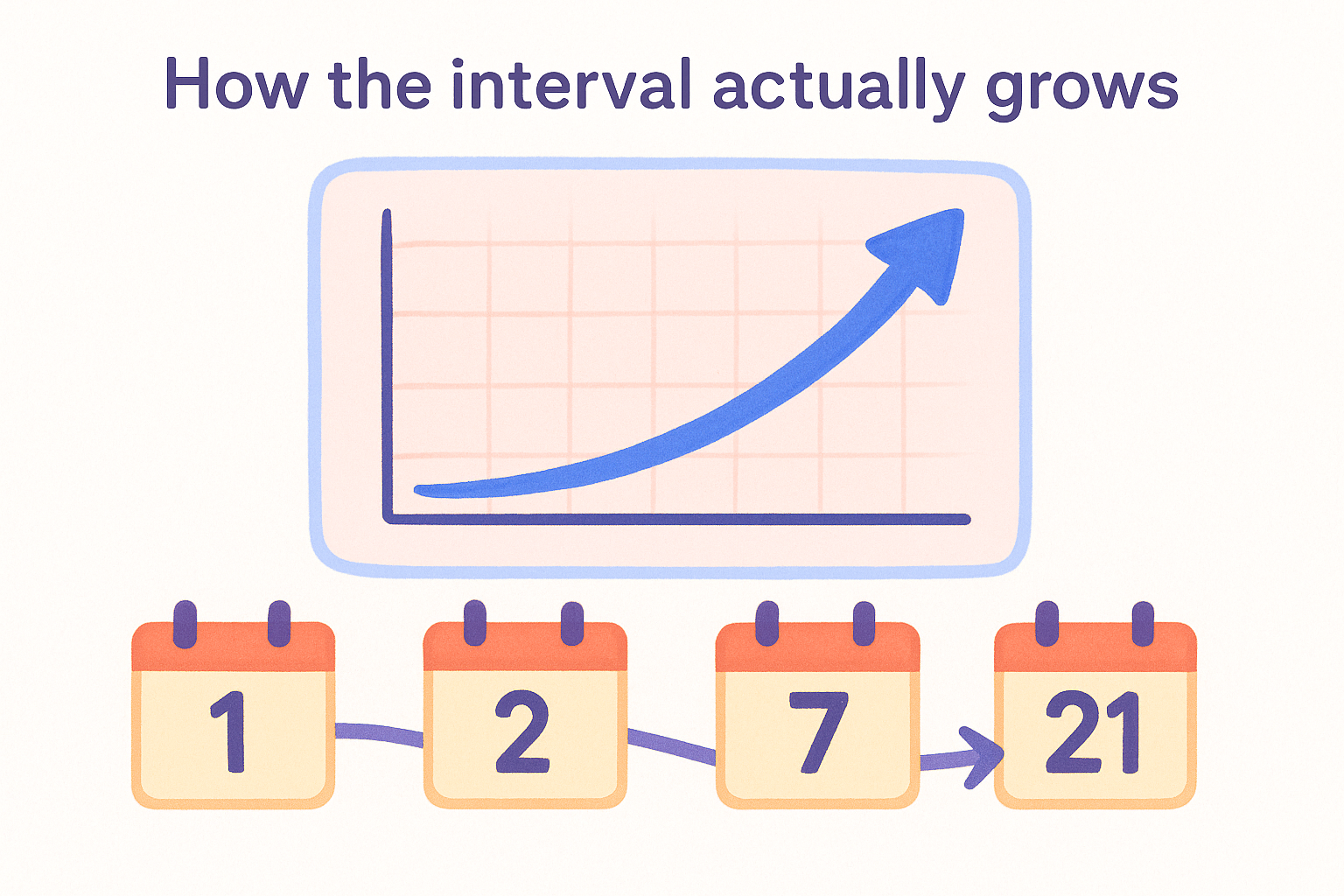
The interval isn't fixed to the skill, it's fixed to your history with that skill.
Why real-time adjustment matters more than the formula
Static formulas were fine in the 1980s when SM-2 first shipped, and the science behind those intervals still holds, but modern implementations go further by recalculating in real time rather than locking in a schedule at the start. Reviewing a piece today doesn't just push tomorrow's date, it can retroactively adjust how the algorithm weighs your entire performance trend for that skill, catching a slow decline before it becomes a full lapse. That's the difference between a scheduling algorithm and a simple calendar reminder, and it's the layer where tools like MemoRep's adaptive scheduling engine differ meaningfully from a basic flashcard app repurposed for practice tracking.
Ratings only work if you're honest with them. Marking something Good when it was actually a struggle corrupts every future interval calculation downstream, so the discipline of accurate self-rating matters as much as the algorithm itself.
Comparing the most popular spaced repetition algorithms
Not every spaced repetition system runs on the same math, and the differences matter more than most users realize. SuperMemo's lineage alone spans SM-2 through SM-18, each version adding more variables to predict forgetting more precisely. Meanwhile, newer entrants like FSRS (Free Spaced Repetition Scheduler) use machine learning trained on millions of real review logs instead of a fixed formula, which lets it adapt to patterns SM-2 was never designed to catch.
SM-2 and why it still shows up everywhere
Despite its age, SM-2 remains the backbone of most consumer apps like Anki and Quizlet because it's simple, predictable, and cheap to compute. It uses three numbers per item: an ease factor, a repetition count, and the previous interval, then applies a straightforward multiplication after each review. The tradeoff is rigidity. SM-2 doesn't account for how long you took to respond, doesn't weigh recent lapses more heavily than old ones, and treats every skill category the same way regardless of how complex it actually is.
FSRS and the shift toward adaptive modeling
FSRS approaches the problem differently by modeling memory as a continuous decay curve rather than a set of discrete steps. It estimates two separate values, difficulty and stability, and updates both after every single review based on actual outcomes across a large dataset. This means FSRS scheduling tends to produce tighter, more personalized intervals than SM-2, especially for learners whose performance is inconsistent from one session to the next.
A formula that adapts to your actual memory beats one that assumes everyone forgets at the same rate.
Leitner boxes and other simplified systems
The Leitner system predates most digital tools and uses physical boxes instead of calculated intervals. Cards move up a box on success and drop back on failure, with each box representing a longer review gap. It's easy to run without software, but it's coarse. There's no fine-tuning based on how easy or hard a specific review felt, just a binary pass or fail.
| Algorithm | Core mechanism | Best suited for |
|---|---|---|
| SM-2 | Fixed multiplier per ease factor | Simple decks, low computation needs |
| SM-15/17/18 | Multi-factor decay modeling | Large-scale fact memorization |
| FSRS | Machine-learned difficulty and stability | Personalized, performance-sensitive scheduling |
| Leitner | Box-based binary pass/fail | Manual or low-tech setups |
Comparing these side by side makes one thing obvious: no single algorithm is objectively best for every use case. The right choice depends on what you're tracking, how much variability exists in your performance, and whether the system can distinguish between a bad day and a genuinely fading skill. That distinction becomes especially important once you move past flat facts and into practical skills, which is where the next comparison really counts.
Choosing an algorithm for practical skills, not just facts
Most spaced repetition algorithms were built for one job: helping you recall discrete facts, like a vocabulary word or a historical date. Musical technique, sports drills, and other practical skills that decay in degrees don't behave the same way in memory. A missed chord change isn't a blank recall, it's a motor pattern that's drifted slightly out of sync, and grading that on a simple pass or fail scale throws away the information you actually need. Choosing the right algorithm means asking whether it can handle graded, physical performance, not just yes-or-no recall.
Why motor memory decays differently than facts
Declarative memory, the kind SM-2 was designed around, tends to fail in a binary way. You either remember the answer or you don't. Motor memory fades in degrees. You might still play a passage today, just slightly stiffer or a beat behind where you were last week. A scheduling algorithm built only around pass or fail misses that gradual slippage entirely, and by the time it registers as a full failure, you're often looking at real reconstruction work rather than a quick refresh.
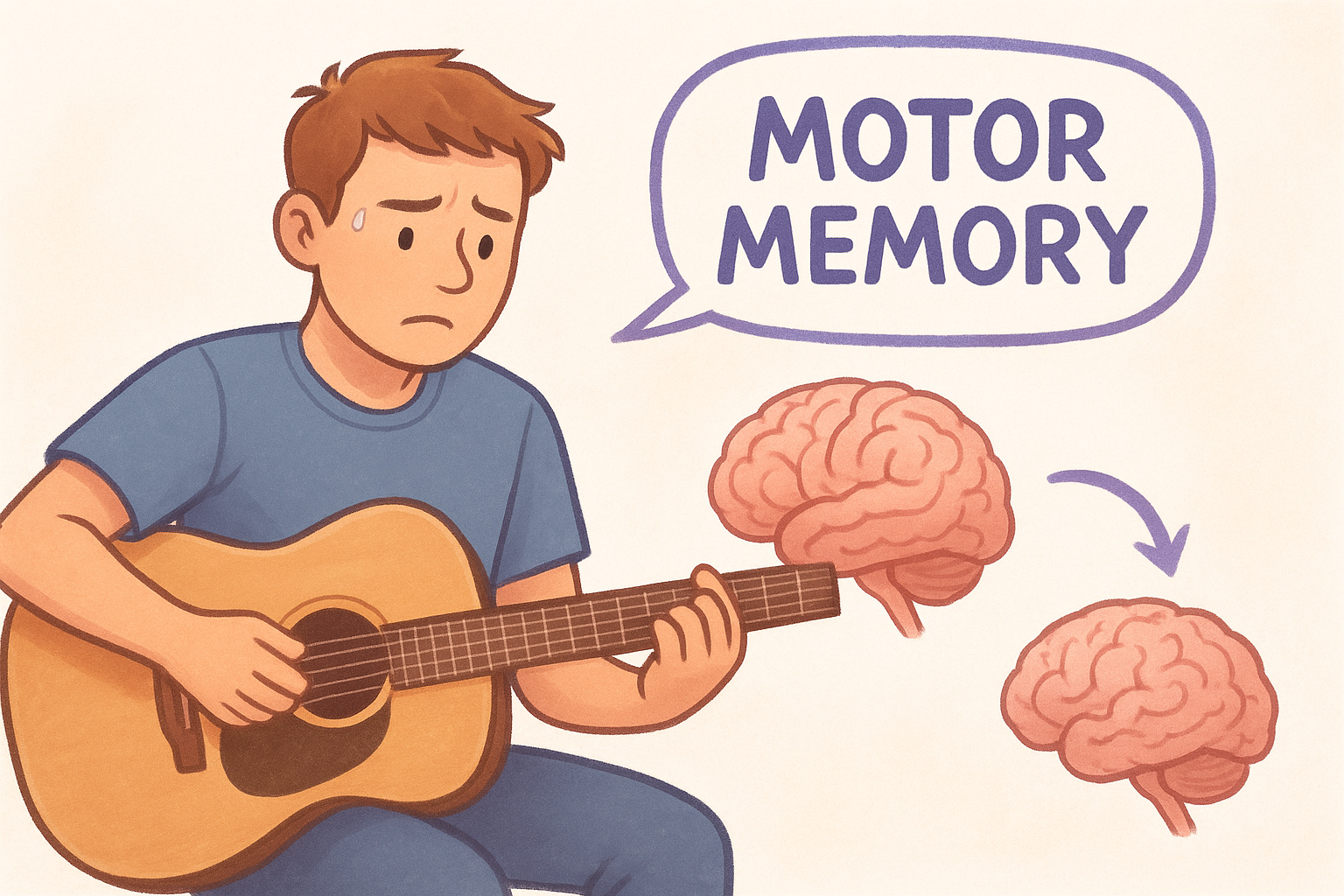
A skill that's 80 percent solid needs a different response than one that's completely gone, and a good algorithm has to see that difference.
What a good implementation needs to track
An algorithm suited to practical skills has to go beyond a single interval number. It needs enough granularity to distinguish a rusty skill from a lost one, and enough flexibility to weigh recent performance more heavily than an old streak of good ratings. Look for these traits when evaluating any tool built for skill practice rather than pure fact recall:
- Graded feedback beyond binary, so a shaky pass doesn't get treated the same as a clean one
- Recency weighting, so a bad session last week matters more than a good one from two months ago
- Per-skill flexibility, since a scale and a full concerto movement shouldn't decay on the same curve
- Project-level organization, so related skills can be grouped and reviewed together instead of scattered
MemoRep's approach leans directly into this gap. Instead of treating every practice item as an isolated flashcard, the platform organizes practice cards into projects, so a technical exercise, a passage, and a full piece can share context while still getting individually calculated intervals based on your Again, Hard, Good, or Easy ratings for that specific skill.
Matching the algorithm to what you're actually practicing
Selecting an algorithm, then, isn't about picking whichever one has the most academic backing. It's about matching the tool to what decays and how. Facts decay in a fairly predictable, uniform way, which is why SM-2 has survived decades of use for language learning. Physical skills decay unevenly, influenced by fatigue, complexity, and how recently you performed under real conditions. If your practice tool doesn't distinguish between those two decay patterns, you'll end up with a schedule that looks scientific but doesn't actually protect the skills that need it most.
Common mistakes that weaken spaced repetition results
Even a well-designed algorithm can't fix bad inputs. Most people who feel like spaced repetition "isn't working" for them are actually undermining the system in one of a handful of predictable ways, not exposing some flaw in the math itself. Fixing these habits usually does more for retention than switching to a fancier algorithm ever would.
Rating what you wish were true, not what happened
Grading yourself Good on a passage you barely stumbled through is the single most common way people sabotage their own spaced repetition algorithms. The algorithm has no way to know you got lucky, it only knows what you told it, so an inflated rating pushes the next review further out than the skill can actually support. By the time the gap catches up with you, the passage feels like it fell apart overnight, when really the schedule was built on bad data from the start.
An algorithm can only protect the skills you're honest about.
Loading too many new skills at once
Adding a dozen new exercises in a single week guarantees a pile-up of reviews a few days later, all landing on the same session. This isn't a flaw in the scheduling logic, it's simple math: every new item spawns its own review timeline, and stacking too many at once compounds into an overwhelming backlog. Spread new material out instead of dumping it in all at once, and let each item earn its own review rhythm before you add the next.
Ignoring reminders until the backlog piles up
A review reminder you dismiss for three days doesn't pause the decay curve, it just lets it run further. Letting reviews stack up defeats the entire premise of spaced practice, since the intervals were calculated assuming you'd act on them close to schedule. If your queue regularly balloons past what feels manageable, that's a signal to slow down on adding new skills, not to blame the tool.
Treating every skill as equally complex
A quick technical drill and a full musical piece don't decay at the same rate, yet plenty of learners feed them into the same generic interval without adjustment. Complex, multi-part skills deserve shorter initial intervals and more conservative ease growth than something simple and isolated. Skipping this distinction is one of the quieter mistakes, because it doesn't cause obvious failure right away, it just slowly erodes trust in the schedule until it stops matching reality.
Watch for these patterns specifically:
- Rating drift: rounding up your actual recall quality
- Batch-adding: introducing too many new items in one sitting
- Notification fatigue: letting the review queue go stale
- Flat difficulty tagging: giving a hard piece the same weight as a simple scale
Catch even two of these and your intervals will start reflecting your real progress again.
Building a smarter practice routine
Understanding spaced repetition algorithms doesn't just satisfy curiosity, it changes how you evaluate any tool you're trusting with your practice time. You now know why SM-2 persists, why FSRS adapts more precisely, and why practical skills need graded feedback that plain flashcard apps were never built to handle. That knowledge is what separates a learner who blindly follows notifications from one who understands why the schedule looks the way it does.
Getting the theory right still means nothing if your ratings are inflated or your queue is buried in a backlog. Pair honest self-assessment with an algorithm designed specifically for skills that decay in degrees, not just pass or fail, and your practice time finally goes toward what actually needs it.
If you want to see this scheduling logic applied to real practice routines, see the algorithm behind MemoRep in action and judge for yourself.