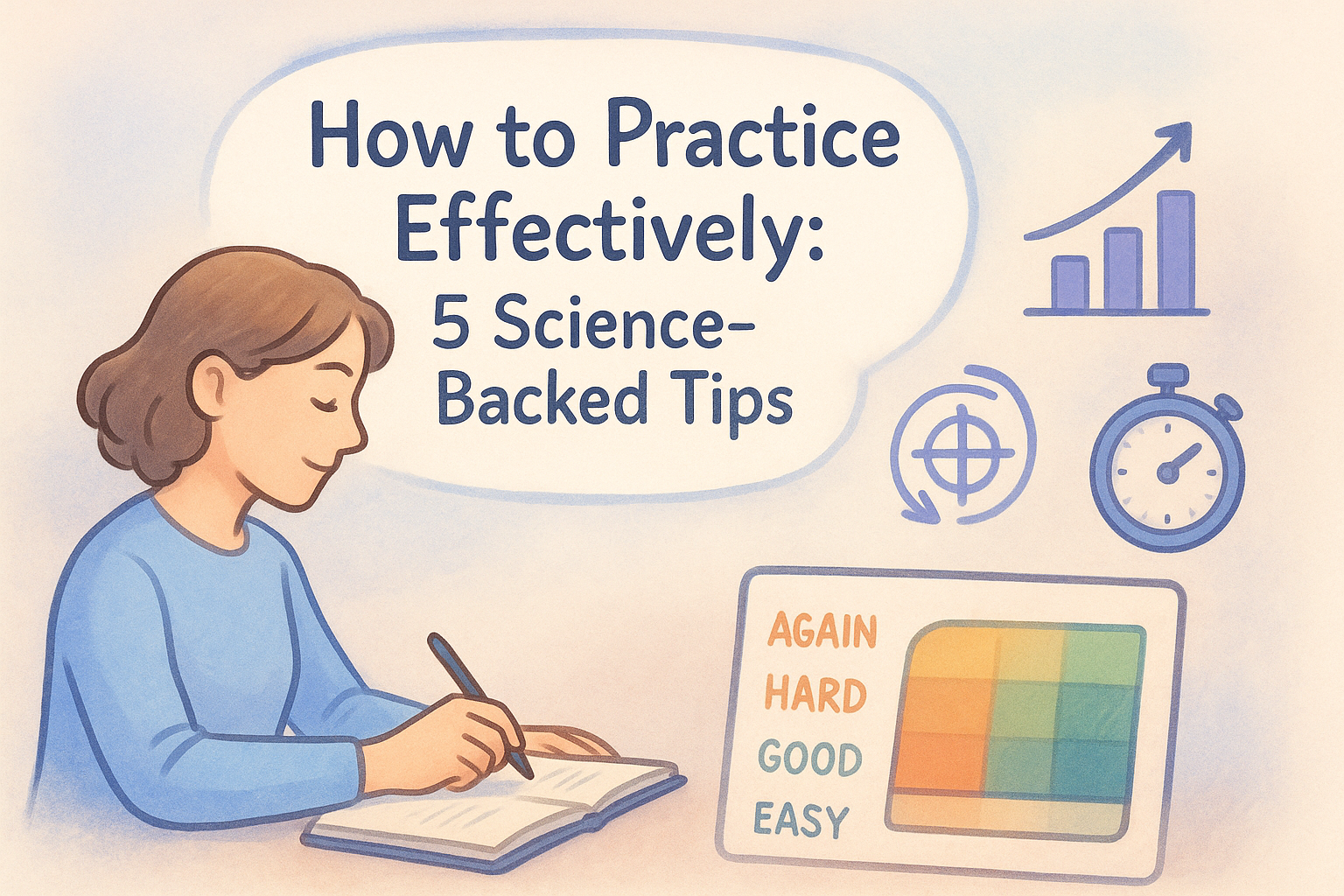
How to Practice Effectively: 5 Science-Backed Tips
You've put in the hours, but your progress still feels random. Some skills stick, others slip away no matter how many times you've drilled them, and you're never quite sure what to work on when you sit down to practice. That frustration usually comes down to method, not effort. Learning how to practice effectively isn't about grinding longer, it's about applying a handful of techniques that research has already validated.
This article gives you five science-backed strategies that actually change how skills stick. You'll see why spacing your sessions beats cramming, how honest self-assessment speeds up learning, and why revisiting a skill right before you forget it is the most efficient moment to practice. These aren't vague tips, they're grounded in memory research like the Ebbinghaus forgetting curve, and they apply whether you're working on scales, a tennis serve, or a technical drill.
Each section breaks down one practical technique you can use starting today, with concrete examples so you're not left guessing how to apply it. If you've ever wondered how to practice something effectively without wasting time on the wrong exercises at the wrong moments, this is where you start.
1. Space out your practice sessions
What it is
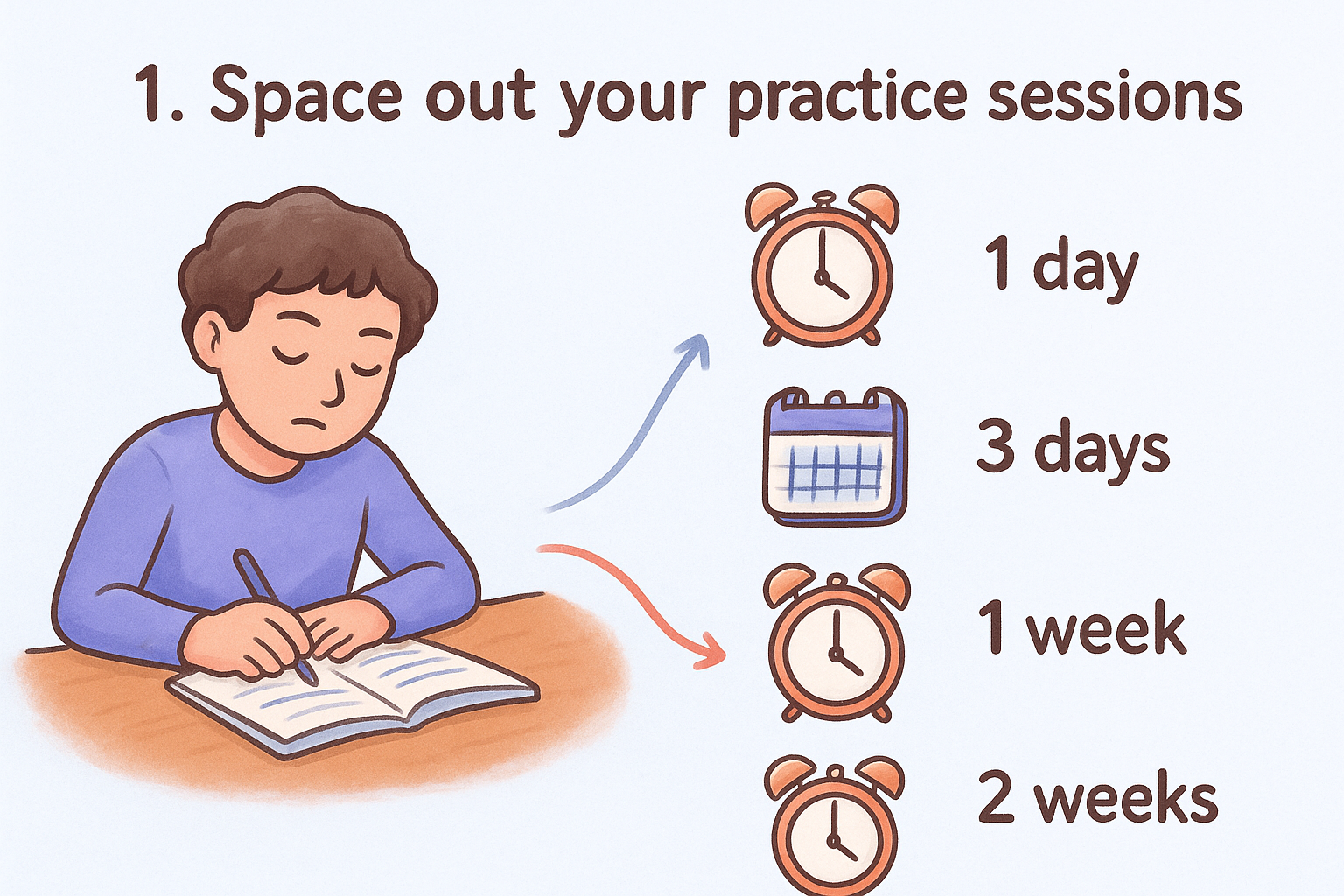
Spaced practice means breaking your work into short sessions separated by rest, instead of drilling the same skill for hours in one sitting. Spaced repetition spreads out your exposure to a skill so your brain has to work a little to retrieve it each time, rather than passively repeating it while it's still fresh, and the benefits of spacing your practice sessions show up in how long the skill lasts. This is the opposite of cramming, where you hammer a passage or drill until it feels solid, only to find it's gone a week later.
Why it works
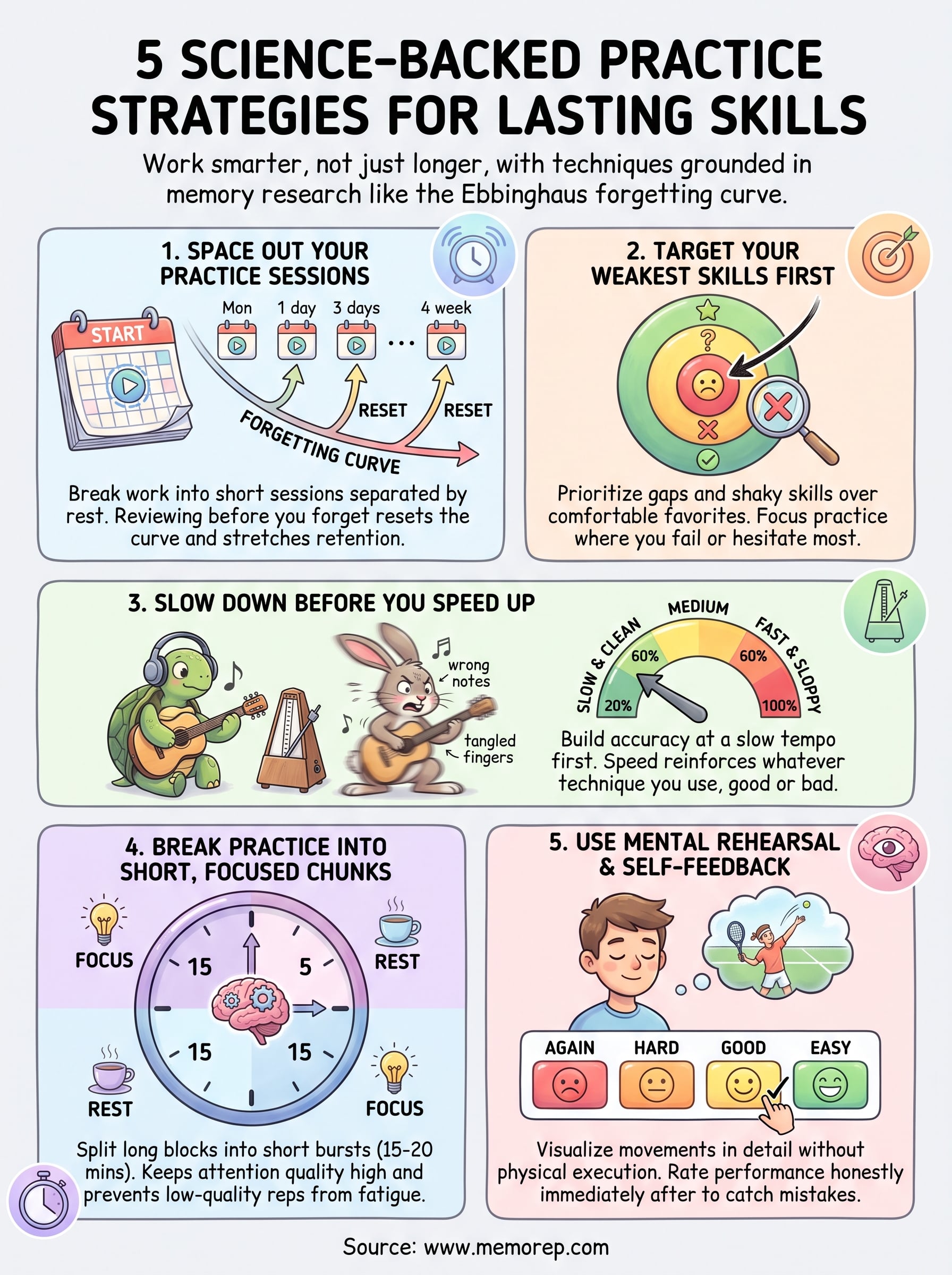
Memory research going back to Hermann Ebbinghaus shows that what you learn fades on a predictable curve, fast at first, then slower over time, which is the core of the Ebbinghaus forgetting curve theory. Each time you retrieve a skill right before you'd forget it, you reset that curve and stretch the interval before the next review. That's the mechanism behind spaced repetition systems, and it's backed by decades of cognitive science on the spacing effect, one of the most replicated findings in learning research.
Reviewing a skill right before you forget it teaches your brain more than reviewing it while it's still fresh.
How to apply it
You don't need a rigid formula to get the benefit, just avoid clustering all your repetition into one session. A workable starting pattern:
- Review a new skill again within 24 hours
- Review it again after 3 days if it held up
- Push the interval to a week, then two weeks, as it gets solid
- Pull it back to daily review if you rated it "hard" or worse
Tracking this by hand across dozens of skills gets messy fast, which is exactly the gap tools like MemoRep are built to close: it schedules each practice card automatically based on how you rated your last attempt, so spacing intervals adjust to your real performance instead of guesswork.
2. Target your weakest skills first
What it is
Targeted practice means spending most of your session on the skills that are actually shaky, not the ones you already play or perform well. Musicians often fall into a trap here: they warm up with a piece they love, run through it a few times because it feels good, and never touch the passage that's actually holding them back. That's comfortable, but it's not how to effectively practice when your goal is real progress, and it's exactly the line between deliberate practice and regular practice.
Why it works
Your weakest skills decay fastest and cost you the most points, matches, or missed notes when they fail under pressure. Prioritizing them means every minute of practice goes toward closing your biggest gaps instead of polishing things that were already solid.
Practicing what you're already good at feels productive, but it rarely moves the needle.
How to apply it
Before each session, rank your skills honestly:
- Skills you fail more than half the time: practice first
- Skills you get right most of the time but hesitate on: practice second
- Skills that feel automatic: review briefly, then move on
MemoRep's rating system after each card naturally surfaces which skills need the most attention, so weak spots don't hide.
3. Slow down before you speed up
What it is
Slow practice means running a skill at a fraction of its target speed until every movement is clean, then gradually increasing pace. Guitarists do this with fast runs, sprinters do it with starting blocks, and surgeons do it with sutures. The instinct to rush toward full speed is strong, but it's rarely how to practice most effectively when accuracy still isn't there.
Why it works
Speed exposes and locks in whatever technique you're actually using, good or bad. Practicing fast before you're ready just means you're repeating mistakes faster, and your brain treats those repetitions as the pattern to keep. Slow repetition lets your nervous system build the correct movement first, so speed later comes from refining something solid instead of untangling something sloppy.
Speed without accuracy just means you're practicing your mistakes faster.
How to apply it
Set a speed threshold for yourself: if you can't do it cleanly at a slower tempo three times in a row, you're not ready to go faster. Increase pace in small increments, maybe 5 to 10 percent at a time, and drop back down the moment errors creep in. This keeps every rep worth something instead of reinforcing bad habits.
4. Break practice into short, focused chunks
What it is
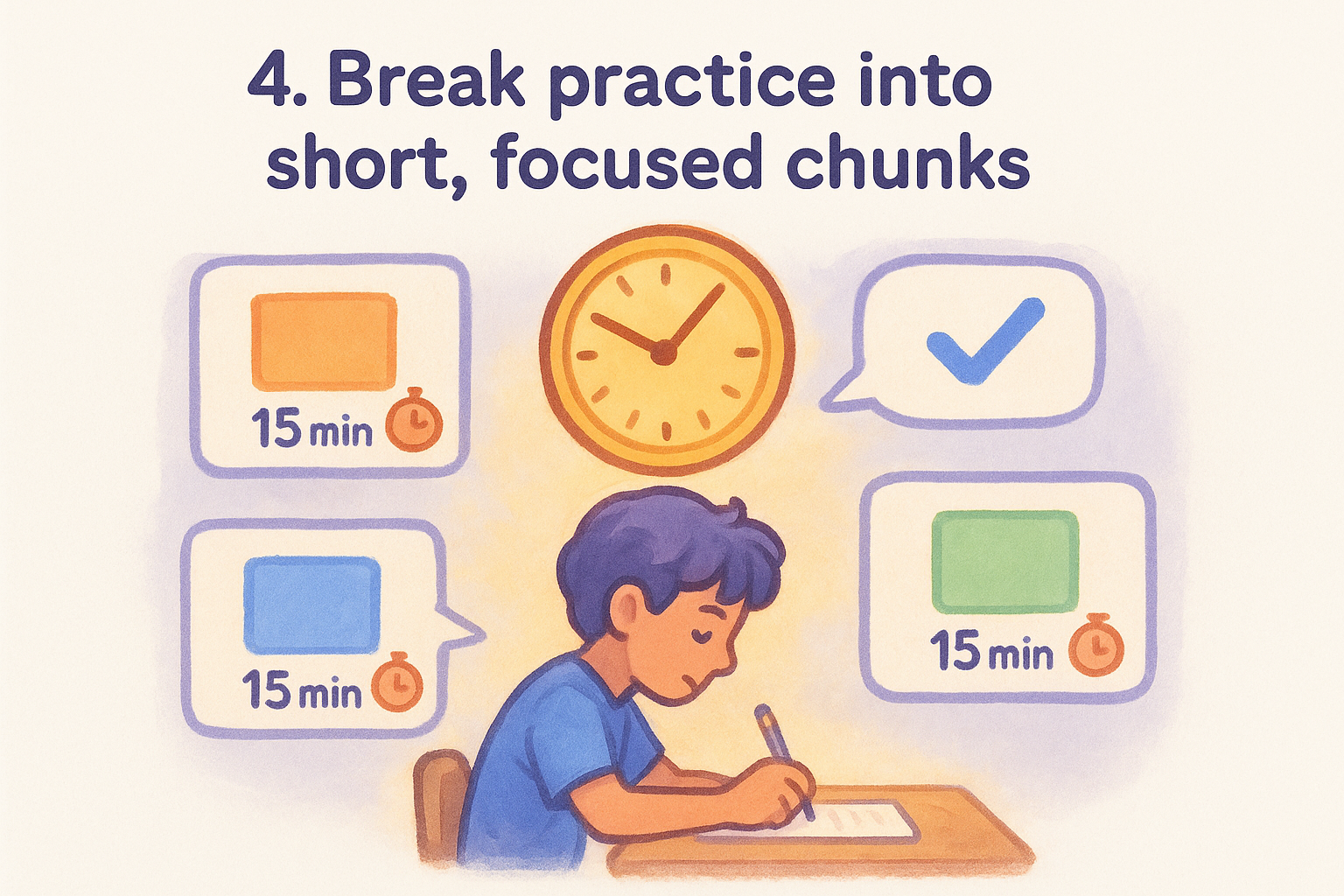
Chunking means splitting a long practice block into short, high-attention bursts instead of one continuous grind, which keeps the mental load of a session manageable. A 90-minute session becomes six 15-minute chunks, each aimed at one specific skill, with a short break between them. This isn't about practicing less, it's about keeping your attention quality high for the entire time you're working instead of coasting through the back half of a marathon session.
Why it works
Attention naturally drops off after 15 to 25 minutes on one task, and once it does, you start logging low-quality reps without noticing. Short focused chunks force you to reset before fatigue sets in, so almost every rep happens while you're still sharp enough to catch mistakes.
A tired, unfocused rep teaches your brain almost nothing.
How to apply it
Try this structure for a session:
- Pick one skill per chunk, not three or four
- Set a timer for 15 to 20 minutes
- Take a 3 to 5 minute break between chunks
- Rate the chunk immediately after (Again/Hard/Good/Easy) while it's fresh
Rating right away, the way MemoRep prompts after each card, keeps your feedback honest instead of blurred by whatever you practiced next.
5. Use mental rehearsal and self-feedback
What it is
Mental rehearsal means running through a skill in your head, visualizing the exact movements or notes, without physically doing them. Pair that with self-feedback, honestly rating how a rep actually went instead of assuming it was fine because it felt familiar. Musicians use this away from their instrument, athletes use it before a competition, and it's just as relevant if you're learning how to practice something effectively without access to your usual setup.
Why it works
Brain imaging research shows mental rehearsal activates many of the same motor pathways as physical execution, reinforcing the pattern without the wear of repetition. Combined with honest self-rating, borrowed from the active recall study method, it closes the gap between what you think you did and what actually happened, which is where most practice plateaus hide.
You can't fix a mistake you never admitted to making.
How to apply it
Spend two or three minutes before a session visualizing the passage or drill in full detail, including where it usually breaks down. Afterward, rate the rep honestly on a simple scale like MemoRep's Again/Hard/Good/Easy system rather than trusting your gut impression.
Making effective practice a habit
None of these five techniques work in isolation, and none of them require talent you don't already have. Spacing your sessions, targeting weak spots, slowing down before speeding up, chunking your attention, and rehearsing mentally all point at the same idea: effective practice is a system, not a mood you wait for. Skills fade on a schedule, so your practice should follow one too.
The hard part isn't understanding these principles, it's applying them consistently across dozens of skills without losing track of what needs attention today. That's the exact gap MemoRep was built to close, using the same spaced repetition science behind these five tips to tell you what to practice and when, automatically. If you want to see the algorithm behind it before you commit, take a look at the science that decides what you practice next, then start your own free-for-life beta account while spots remain.