
Ebbinghaus Forgetting Curve Theory: Origins, Method, Meaning
You practice something today, feel confident, and three days later it's gone. That's not bad luck or a bad memory. It's biology, and a German psychologist mapped it out over a century ago. The ebbinghaus forgetting curve theory explains why new information, and new skills, slip away on a predictable schedule unless you intervene at the right moment.
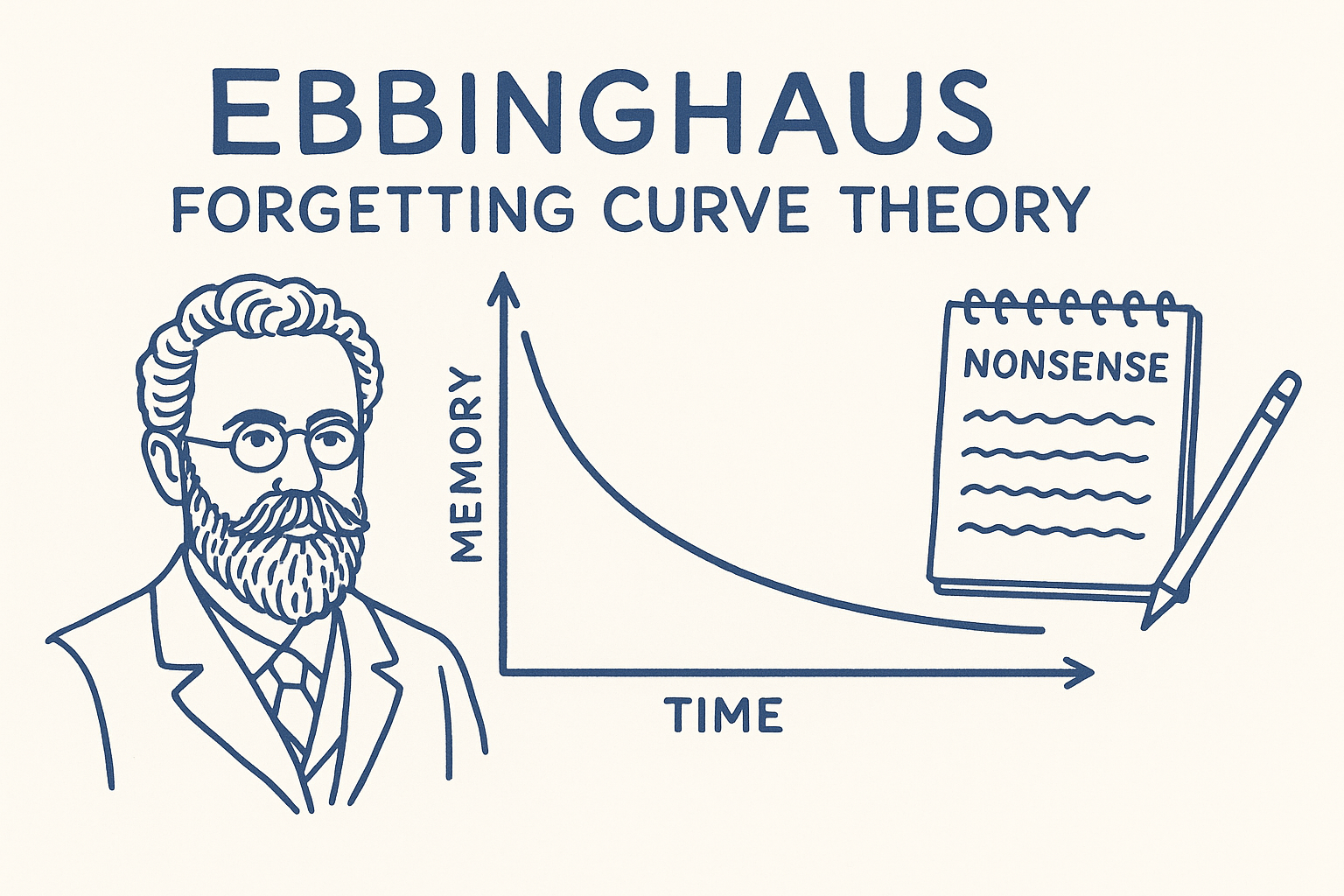
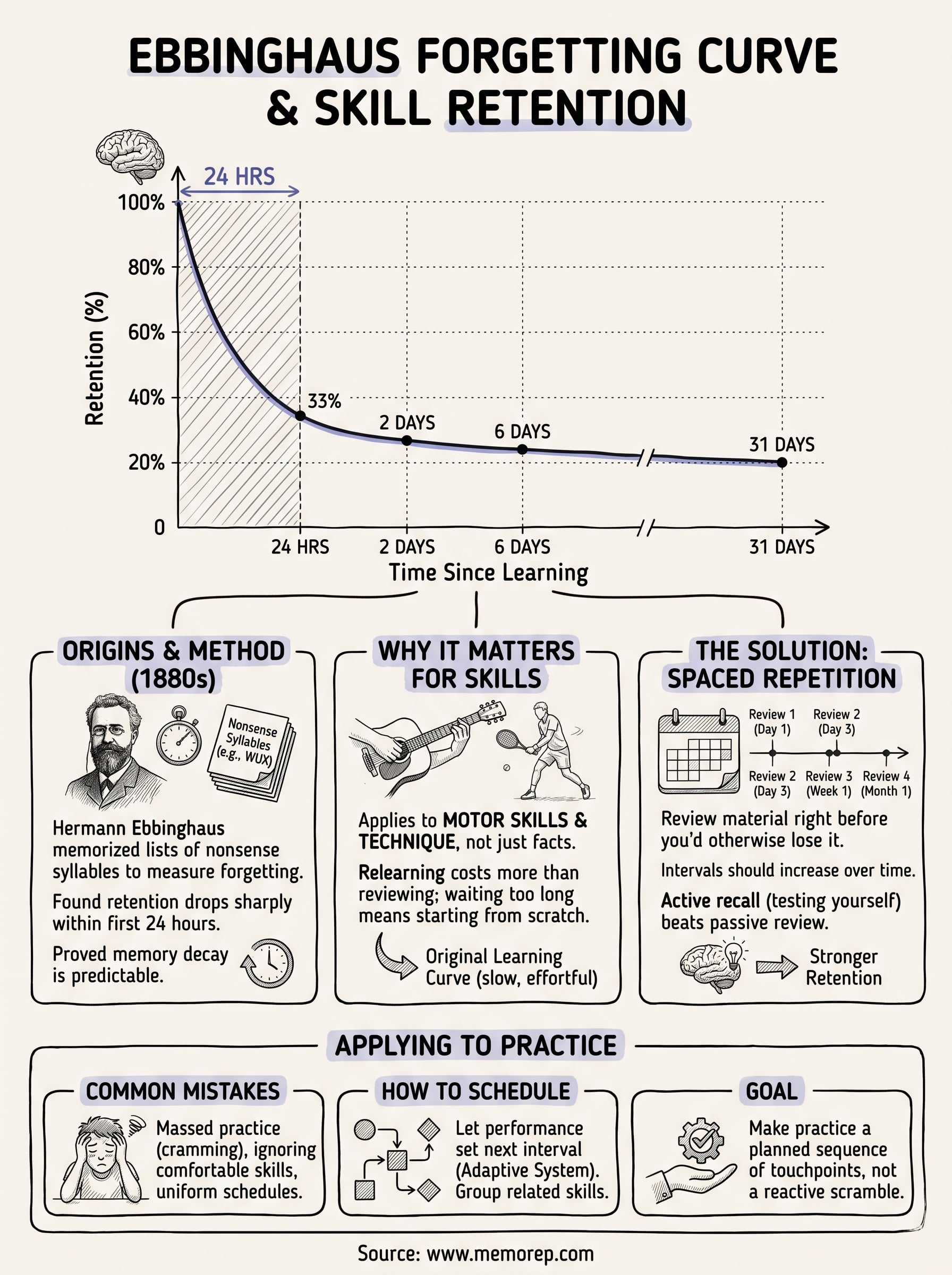
Hermann Ebbinghaus ran a strange, disciplined experiment on himself in the 1880s, memorizing nonsense syllables and timing how fast he forgot them. What he found became one of the most cited results in memory research: retention drops sharply within the first 24 hours, then levels off. His work laid the groundwork for spaced repetition, the practice of reviewing material right before you'd otherwise lose it.
This article walks through where the theory came from, how Ebbinghaus actually measured forgetting, and what his curve means for anyone trying to hold onto a skill instead of relearning it from scratch. If you've ever wondered why your practice routine feels like running in place, this is the science behind it.
Why the forgetting curve matters for skill retention
Most people think of forgetting as something that happens to facts, dates, vocabulary words, the stuff you cram for a test and dump the next day. But Ebbinghaus's curve applies just as much to motor skills and technique, the kind of knowledge you build into your hands, not just your head. A guitarist who nails a new chord voicing on Tuesday and skips practice until the following week will find that voicing sluggish and uncertain again. The same decay curve that erases nonsense syllables also erodes fingerings, scale patterns, and muscle sequences. Skill retention follows the same biological clock as memorization, which is exactly why the theory matters far beyond the psychology lab.
Relearning costs more than reviewing
Here's the part most learners underestimate: waiting too long to revisit a skill doesn't just make it a little rusty, it can mean starting almost from zero. Ebbinghaus measured this directly with what he called "savings," the reduced time needed to relearn material compared to learning it fresh. If you review a passage before it fades, relearning takes seconds. Wait until it's gone, and you're back to the original learning curve, slow, effortful, and frustrating. This is the mechanism that makes inconsistent practice feel so unproductive even when you're putting in hours.
Waiting until a skill feels rusty means you've already paid the price of relearning it from scratch.
Retention loss follows a predictable pattern
Ebbinghaus's original data, later replicated in various forms by memory researchers, showed retention dropping fast at first and then leveling off. The numbers below are approximations based on his classic curve, but the shape holds up across decades of follow-up research, including work summarized by institutions like the National Institutes of Health on memory consolidation.
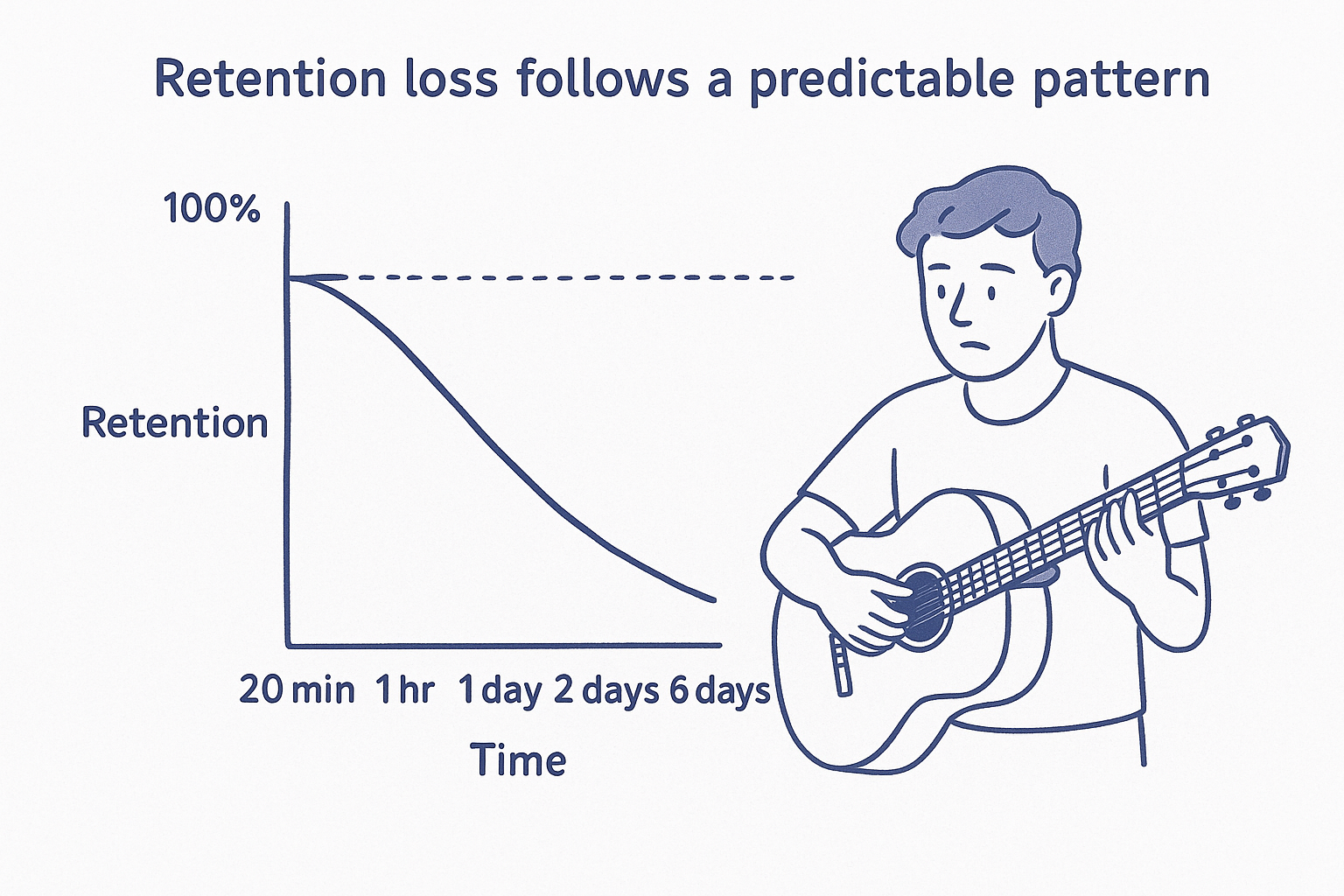
| Time since practice | Approximate retention remaining |
|---|---|
| 20 minutes | 58% |
| 1 hour | 44% |
| 1 day | 33% |
| 2 days | 28% |
| 6 days | 25% |
| 31 days | 21% |
Notice how steep that first drop is. Retention loss happens almost entirely in the first day or two, which is exactly why a single practice session, no matter how focused, isn't enough to lock in a skill. The curve keeps falling after that, just more slowly, which is also why occasional practice still beats no practice at all, even if it's far from ideal.
Why this hits skill learners harder than fact learners
Someone memorizing vocabulary can often re-expose themselves to a word through everyday reading or conversation, giving them accidental review. Musicians, athletes, and other skill practitioners rarely get that luxury. Nobody accidentally rehearses a Chopin etude or a golf swing during their commute. Skills require deliberate, scheduled exposure, and without a system to track what's fading and when, most people default to practicing whatever feels most urgent or most fun that day. That's a recipe for uneven progress: your favorite piece gets polished endlessly while three others quietly slide back down the curve.
Therefore, the forgetting curve isn't just an interesting historical footnote, it's a diagnostic tool. It explains why a piece you played confidently at a recital last month suddenly feels foreign, why a technique your teacher corrected weeks ago has crept back into a bad habit, and why "practicing more" without structure often produces less durable results than a smaller amount of well-timed review. Once you see practice through this lens, random or motivation-driven scheduling starts to look like the real inefficiency, not a lack of effort or talent.
How to apply the forgetting curve to your practice schedule
Knowing the shape of the curve is one thing. Building a practice schedule around it is another. Ebbinghaus's data gives you a rough timeline for when a skill is about to slip, and the goal is simple: review just before that happens, not long after. This turns practice from a reactive scramble into a planned sequence of touchpoints, each one timed to catch a skill right as it starts to fade.
Space your reviews instead of massing them
Cramming a chord change for two hours straight feels productive, but it barely dents the long-term curve. Spaced repetition works because it interrupts forgetting at increasing intervals, so each review costs less time than the last. A practical starting pattern looks like this:
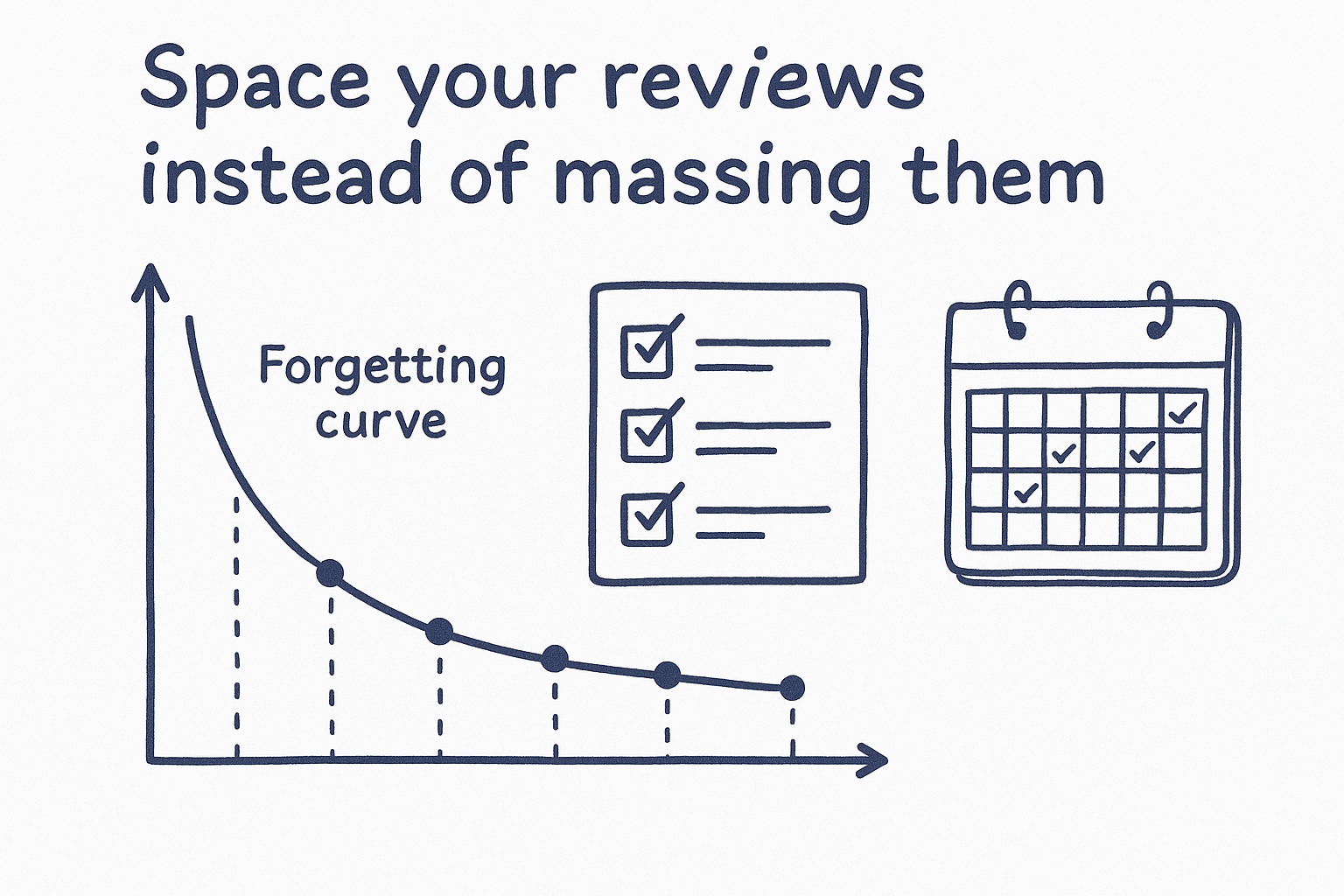
- Review within 24 hours of first learning a skill
- Review again 2 to 3 days later
- Review again after about a week
- Review again after two to three weeks
- Stretch to monthly reviews once the skill feels stable
This isn't a rigid formula, it's a starting scaffold. Adjust the gaps based on how hard the skill is and how quickly you personally forget it.
Reviewing a skill right before you forget it costs minutes. Waiting until it's gone costs the whole session.
Let your performance set the next interval
Modern spaced repetition systems, including the SuperMemo SM-2 algorithm that inspired much of today's software, don't use fixed intervals for everyone. They adjust based on how you actually perform each time you revisit something. Rate a passage as easy, and the next review gets pushed further out. Rate it as hard, and it comes back sooner. This feedback loop matters because two people learning the same scale pattern won't forget it at the same rate, and even the same person will retain different skills differently depending on complexity and prior experience.
| Self-rating after review | Suggested next interval |
|---|---|
| Again (couldn't recall it) | Same day or next day |
| Hard (recalled with effort) | 2 to 3 days |
| Good (recalled smoothly) | About a week |
| Easy (no hesitation at all) | Two weeks or more |
Group skills so review doesn't become a second job
Managing this by memory alone falls apart fast once you're juggling more than a handful of skills. A violinist working through five etudes, three scales, and two performance pieces can't reasonably track six different review dates in their head. Grouping related skills into practice sets, and letting a scheduling system flag what's due, removes the guesswork entirely. Without that structure, most learners default to practicing whatever they remember is overdue, which is exactly the random pattern the forgetting curve predicts will fail.
Ultimately, applying the curve isn't about rigid discipline, it's about timing. Practice less, but practice at the moments when review actually matters, and the same forgetting curve that once worked against you starts working in your favor.
Inside Ebbinghaus's original memory experiments
Hermann Ebbinghaus published his findings in 1885 in a book called Über das Gedächtnis (Memory: A Contribution to Experimental Psychology), and what's striking is how primitive his tools were compared to the claim he was making. No brain scanners, no control groups, no funding committee. Just one man, a stopwatch, and a stack of invented syllables, trying to prove that memory could be studied with the same rigor as physics or chemistry. At the time, most scientists assumed higher mental processes like memory were too subjective to measure. Ebbinghaus disagreed, and he built the first quantitative model of forgetting to prove it.
The nonsense syllable method
Ebbinghaus needed material that carried no prior meaning, otherwise existing associations would skew how fast he learned and forgot it. So he invented nonsense syllables, three-letter combinations like "WUX" or "CAZ" that followed a consonant-vowel-consonant pattern but meant nothing in German or any other language he knew. He generated roughly 2,300 of these syllables and drew random lists from them, memorizing each list by repeating it at a fixed pace until he could recite it perfectly, twice in a row, without error.
Testing himself, again and again
He then waited a set interval, anywhere from twenty minutes to a month, and relearned the same list. Here, he introduced his most important measurement: savings. If a list originally took him 1,000 seconds to memorize, and relearning it after two days took only 600 seconds, that 40 percent reduction was the "savings," a direct stand-in for how much memory had survived. This was clever because it didn't rely on Ebbinghaus simply trying to recall the list from memory, which is a blunt yes-or-no test. Savings gave him a continuous, measurable signal even when conscious recall failed completely.
Ebbinghaus proved forgetting could be measured in seconds saved, not just guessed at from failed recall.
He repeated this process hundreds of times across months, working alone, controlling variables like time of day, fatigue, and list length as tightly as a one-person experiment allows. The resulting data points, plotted against elapsed time, produced the now-famous curve: a steep early drop followed by a long, shallow tail. You can find a modern summary of this original methodology referenced in memory research maintained by institutions like the American Psychological Association.
Why the method still holds up
Critics have pointed out obvious limits, one subject, one culture, one language, no diversity in age or background. Ebbinghaus knew this too, which is part of why he was so obsessive about controlling every other variable he could. Later replications using different subjects, different material, and modern statistical methods have largely confirmed the shape of his curve, even if exact numbers shift. Understanding this original method matters because it's the direct ancestor of every spaced repetition system used today, including the algorithms that decide when a skill in your practice log is about to fade.
What modern research says about memory decay
Neuroscience has spent the last few decades checking Ebbinghaus's math against actual brain activity, and the shape of his curve keeps holding up. Brain imaging studies show that a new memory trace starts in the hippocampus, a fragile, temporary storage site, before slowly migrating to the cortex for long-term storage. That migration, called memory consolidation, takes hours to days, which lines up almost exactly with the steep early drop Ebbinghaus recorded with nothing but a stopwatch. Researchers now have tools he never dreamed of, yet the basic timeline he sketched in 1885 still describes what's happening inside the skull.
Sleep changes the timeline more than anything else
One finding Ebbinghaus couldn't have captured is how much sleep quality shapes the curve. Studies tracked by the National Institute on Aging show that deep sleep stages actively strengthen new memory traces, replaying and reinforcing them while you're unconscious. Skip a night of sleep after learning something new, and the forgetting curve steepens noticeably compared to someone who slept normally. This matters for practice scheduling in a very practical way: cramming a technique late at night right before a short, poor night of sleep undoes some of the benefit of the review itself.
Sleep doesn't just rest the body, it actively rewrites which memories survive the next day.
Retrieval beats review, and the gap is large
Modern cognitive psychology has also refined a detail Ebbinghaus only hinted at: the act of retrieving a memory strengthens it far more than passively re-exposing yourself to it. This is often called the testing effect, and it explains why replaying a piece of music from memory locks it in better than reading through the sheet music one more time. Passive review flattens the curve slightly. Active recall, forcing yourself to reproduce the skill without prompts, resets it much further out.
| Review method | Effect on forgetting curve |
|---|---|
| Re-reading or re-watching | Small, short-lived improvement |
| Passive listening or observation | Minimal effect on long-term retention |
| Active recall without cues | Strong reset, longer retention window |
| Recall under mild difficulty | Strongest long-term effect |
Forgetting rates aren't identical for everyone
Finally, later research has confirmed something Ebbinghaus couldn't test with a sample size of one: individual variability is real. Age, prior expertise, sleep habits, stress levels, and even how emotionally engaging the material is all shift the steepness of the curve. A beginner forgets a new scale faster than an advanced player forgets a piece they've performed for years, because prior expertise creates more retrieval pathways for the brain to fall back on. This is exactly why fixed review schedules eventually break down, and why adaptive systems that adjust intervals based on your actual performance track memory decay more accurately than any one-size-fits-all timetable ever could.
Common practice mistakes that accelerate forgetting
Most practice routines don't fail from lack of effort, they fail from timing errors that speed up the very decay Ebbinghaus mapped out. Common mistakes in scheduling and repetition style push skills down the curve faster than they need to, turning what should be light maintenance into full relearning. Recognizing these patterns is the fastest way to stop wasting practice time on skills that were never actually secure.
Practicing in long, single sessions
Cramming a passage for ninety minutes straight feels thorough, but the brain stops encoding new information efficiently after the first stretch of focused repetition. Massed practice creates the illusion of mastery because performance looks strong at the end of the session, right when fatigue and short-term memory are propping it up. That illusion collapses within a day, which is exactly what the steep drop in Ebbinghaus's curve predicts. Breaking the same ninety minutes into three shorter sessions spread across a week produces stronger, more durable retention than one marathon block ever will.
A skill that only looks solid at the end of a long session usually isn't solid at all.
Ignoring skills that feel comfortable
Confidence is a poor substitute for a review schedule. Once a passage or technique starts feeling easy, most learners quietly stop practicing it and shift attention to whatever feels shaky or new. Comfortable skills still decay on the same curve as everything else, just from a higher starting point, so the drop-off arrives later but hits just as hard. Skipping review because something feels "done" is one of the most reliable ways to guarantee a surprise relapse weeks later.
Treating every skill on the same timetable
Fixed weekly routines, practice everything on Monday, Wednesday, Friday, ignore how differently skills actually decay. A newly learned skill needs review within a day or two, while a skill practiced for months can safely wait weeks between touchpoints. Uniform scheduling forces easy skills into over-review and hard skills into under-review at the same time, wasting effort in one direction while losing ground in the other.
Letting motivation decide what gets practiced
Practicing whatever feels fun or urgent that day, rather than what's actually due for review, is maybe the most common mistake of all. It produces the pattern described earlier: favorite pieces get endless polish while overdue skills fade in the background. A short list of warning signs that a routine has drifted this way:
- You can't remember the last time you reviewed a specific piece or technique
- Certain skills only get attention right before a performance or test
- Your practice log, if you keep one, shows heavy repetition on a few items and gaps everywhere else
- You feel surprised, not just rusty, when revisiting something you learned months ago
Spotting even one of these signs means the schedule, not the effort, needs fixing.
Forgetting curve examples across different skills
The forgetting curve doesn't apply uniformly to every kind of skill. Some abilities fade within hours, others linger for years, and the difference usually comes down to how much physical repetition and neural pathway-building went into learning them in the first place. Looking at concrete examples across different domains makes the abstract curve feel real, and it helps explain why a violinist's bowing technique survives a two-week break while their memorized fingering for a new piece doesn't.
Musical instruments and repertoire
A pianist who learns a new passage can often play it cleanly by the end of a session, but that performance is propped up by short-term memory, not real consolidation. Come back in three days without touching it, and the passage often needs to be relearned almost from scratch, exactly the pattern Ebbinghaus's curve predicts for the first 24 to 48 hours. Muscle memory for scales and technique decays more slowly than memorized passages, because repetitive motor patterns get reinforced across hundreds of prior practice hours, while a brand-new passage has none of that backup.
A new passage forgets fast because it has no history to fall back on.
Sports and physical technique
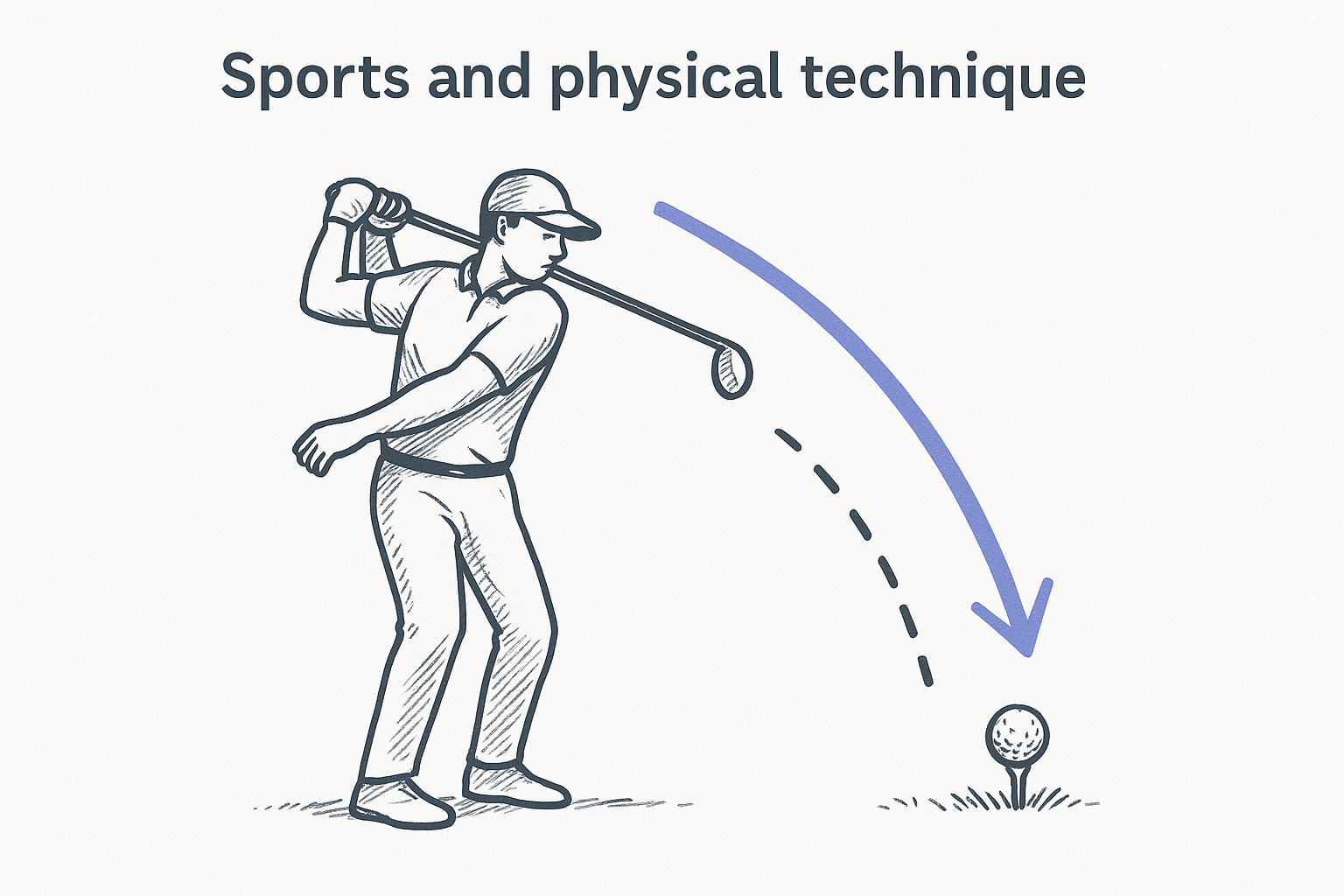
Athletes see the same curve play out with form and timing. A golfer who corrects their swing plane in a lesson will usually lose part of that correction within a few days if they don't reinforce it, slipping back toward old habits that are more deeply grooved. Basketball free-throw form, tennis serve mechanics, and swimming stroke technique all show measurable drop-off after breaks of even a week, which is why coaches build short daily touchpoints into training instead of relying on one big weekly session. Physical technique decays faster than raw strength or conditioning, because timing and coordination are more fragile than muscle tissue.
Technical and professional skills
Public speaking, coding syntax, and complex procedural tasks all follow a similar arc, though the timeline stretches out compared to pure motor skills. A developer who hasn't touched a specific framework in two months often needs to relearn syntax details even though the underlying logic stays intact, showing how procedural knowledge and surface-level detail decay at different rates within the same skill.
| Skill type | Fastest-decaying element | Slower-decaying element |
|---|---|---|
| Music | Newly memorized passages | Core technique and scales |
| Sports | Fine motor timing and form | General strength and conditioning |
| Technical skills | Syntax and specific commands | Underlying logic and problem-solving |
| Public speaking | Word-for-word phrasing | Overall structure and delivery style |
Comparing these examples shows a consistent pattern: the more novel and detail-specific a skill is, the faster it slides down the curve, while broader, well-practiced foundations hold steady much longer. That distinction matters when you're deciding what to review first, since the newest, most detailed layer of any skill is almost always the part closest to disappearing.
Putting the forgetting curve to work
Ebbinghaus proved something over a century ago that still holds up under modern brain scans: forgetting follows a curve, not a coin flip. It drops fast at first, then levels off, and every skill you own, from a chord voicing to a golf swing, obeys that same timeline. Once you see practice through this lens, random repetition stops looking like effort and starts looking like waste. The fix isn't practicing more, it's practicing at the right moment, right before a skill slips past the point of easy recovery.
That timing is exactly what's hard to manage in your head, especially once you're tracking more than a few skills at once. A system built on the same spaced repetition principles Ebbinghaus uncovered can do that tracking for you. If you want to see the mechanics behind that scheduling, check out how memoRep works and put the curve to work for your own practice.