How to Practice Electric Guitar: Routine, Time, and Gear
The most reliable way to practice electric guitar is to break what you want to learn into small items, give every session the same structure, and review each item on a spaced schedule instead of whenever you remember it. Keep sessions short and daily, rate how each item went, and set up a quiet signal chain so that plugging in is never a hassle. That system tells you what to play today, so you spend your time playing instead of deciding.
Most players know the feeling. You sit down with 40 minutes, run through whatever comes to mind, and notice a week later that a riff you had nailed has gone rusty. Or you keep drilling the one piece you like and quietly skip everything else. Reddit threads on this question are full of players with an acoustic background, a new electric, and no idea what a practice session should consist of. The problem is rarely effort. It is a lack of structure.
This guide covers the organization side of practice: what goes into a routine, how long to play, how to schedule reviews, and how to practice at home with or without an amp. It does not teach technique or theory, because that is your teacher's job, or the job of whichever lesson source you follow. Throughout, we use MemoRep, a spaced repetition practice app, as the example of how to run the system.
Why your practice needs a system first
A practice system answers one question before you pick up the guitar: what exactly am I working on today? Without that answer, you default to your comfort zone and forget the rest.
Why unstructured sessions stall
Unstructured practice fails in three ways. Skills fade when you stop revisiting them, which is the pattern Hermann Ebbinghaus described in his forgetting curve research. Sessions get random, because you pick items by mood. And decision fatigue eats your first ten minutes when you have too many songs, exercises, and ideas competing for attention.
A system fixes all three by deciding in advance. Your only job in the session is to work through what is due and rate how it went.
Good practice starts before you plug in, with a decision about what you are working on.
What a routine contains, and what it does not
A routine is a list of items plus a rule for when each one comes back. The items can be song sections, chord changes, licks and solos, exercises from your teacher, or even a pedal setting you want to recall quickly. This guide never tells you which items to pick or how to play them. That choice belongs to your teacher or your lesson course.
Can you teach yourself electric guitar? Many players do, using lessons, tabs, and recordings. Self-taught or not, you still need a place where what you are learning gets organized and revisited. That is the gap this routine fills.
What you need before you start
You need very little to begin:
- A guitar, a cable, and your amp or headphone setup
- A source for your material, such as a teacher's assignments, tabs, or a lesson course
- A place to keep your practice items, such as a notebook, a spreadsheet, or an app like MemoRep
- A short block of time you can protect, even 15 minutes
Step 1. Turn your goals into practice items
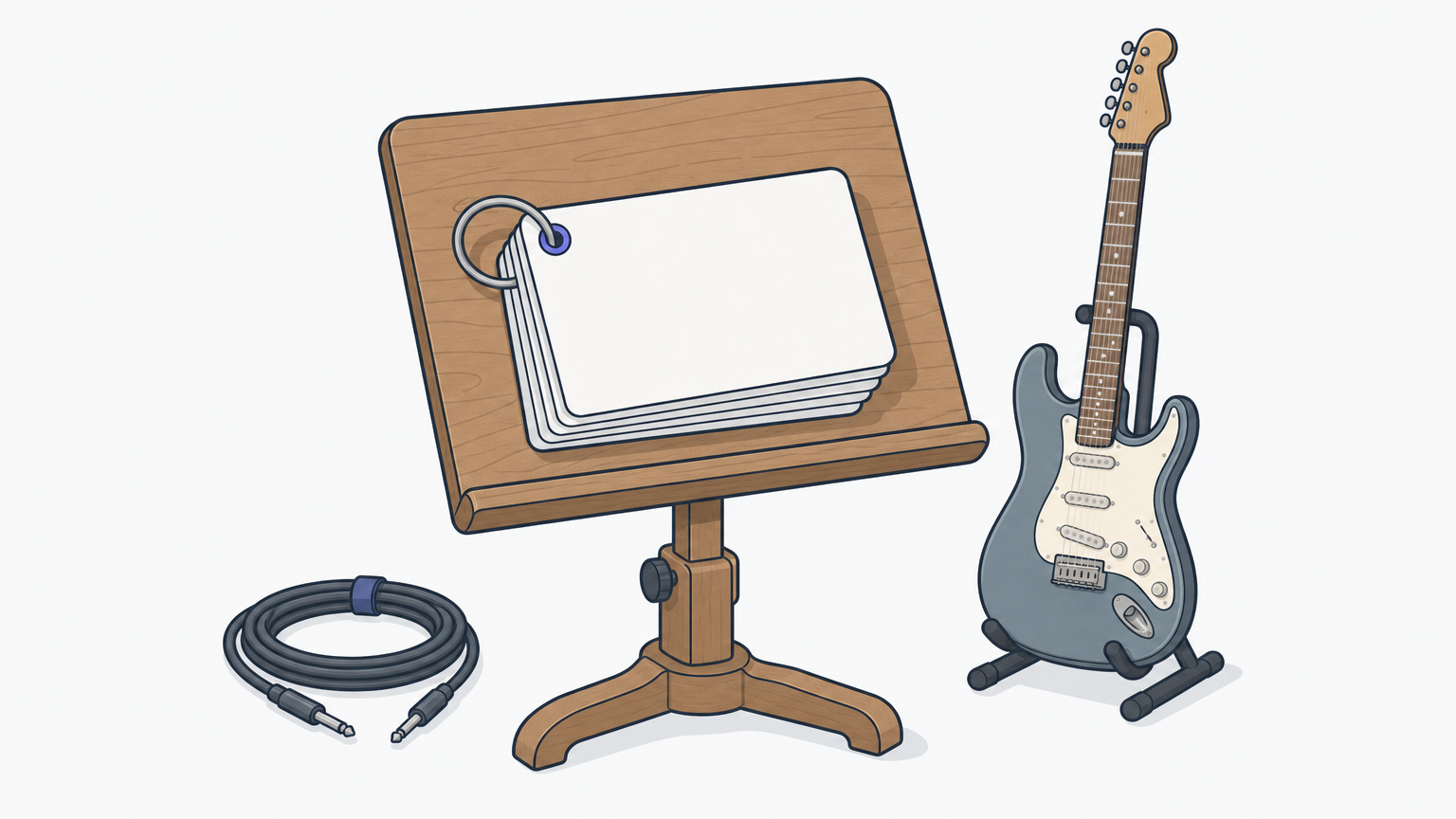
Turn your goals into practice items by splitting every song, exercise, and idea into pieces you can finish and judge in a few minutes. A whole song is a goal. The pre-chorus transition is an item.
Break big goals into small pieces
Take "learn this song" and cut it into sections: intro riff, verse, pre-chorus, solo first half, solo second half. Each piece should be small enough to work on in about 3 to 8 minutes. If an item takes longer than 10 minutes to get through, split it again.
The same goes for exercises. If your teacher gave you five things this week, that is five items, not one. Chord changes can be items too, such as moving between two specific chords in a song. Link your tab or lesson source in the item so you never hunt for it mid-session.
Write each item as a card
A card is a short record you can copy for every item. Here is a template you can paste into a notebook or notes app:
Item: [song or exercise name, section]
Source: [tab link, lesson name, or teacher's assignment]
Done when: [what "good" looks like, in your own words]
Notes: [where it falls apart, what to watch next time]
Last rating: [Again / Hard / Good / Easy]
The "done when" line matters most. It turns a vague wish into something you can rate honestly in the next step. In MemoRep, you create these cards inside a project, such as one project per song or per teacher unit, so related items stay together.
One card should hold one thing you can finish and judge in a single sitting.
Step 2. Set how long and how often
Plan for short daily sessions, and treat 15 to 30 minutes as a solid default. The right length is the one you can repeat five or six days a week without dreading it.
How long to practice electric guitar each day
Is 30 minutes of guitar practice enough? For most players it is, if the time is focused. Ten minutes of attentive work beats thirty minutes of distracted noodling, because attention decides what sticks. Frequency also beats length. Skills fade between sessions, so touching an item every day or two works better than one long weekend marathon.
You may have heard of the 10,000 hours rule. It is a popular idea about mastery, not a schedule for your week. What helps you this month is the number of items you reviewed on time, not the number of hours on a counter.
Split the session into blocks
Give each session the same four blocks so you never have to improvise a plan. Here is how the minutes divide at three common lengths:
| Block | 15 min | 30 min | 60 min |
|---|---|---|---|
| Set up and tune | 2 | 3 | 5 |
| Review items that are due | 8 | 14 | 25 |
| New material | 3 | 8 | 15 |
| Free play | 2 | 5 | 15 |
| Total | 15 | 30 | 60 |
Here is a worked example. You keep 12 items in your routine and play 30 minutes a day. Four are due today, so you spend about 3.5 minutes on each, which fills the 14-minute review block. Then you spend 8 minutes on one new item and 5 minutes playing whatever you enjoy. If seven items are due on a busy day, shorten each one instead of skipping any.
Fix the structure of the session, and let the schedule choose the content.
Step 3. Schedule reviews and rate each one
Schedule each item to come back just before you would forget it, and rate it after every pass so the interval adapts. This is spaced repetition applied to practice, and it is the engine behind how to practice electric guitar without losing last month's progress.
Let spacing decide what is due
The classic SuperMemo SM-2 algorithm, which MemoRep builds on, starts an item at a 1-day interval, then 6 days, then multiplies the gap each time you succeed. With the default ease factor of 2.5, an item rated Good each time returns like this:
| Review | Gap before it | Day number |
|---|---|---|
| 1st | 1 day | Day 1 |
| 2nd | 6 days | Day 7 |
| 3rd | about 15 days | Day 22 |
| 4th | about 38 days | Day 60 |
Those figures show the textbook pattern. An app that adapts to your ratings, as MemoRep does, will give you different intervals as your results change. The point stays the same: items you know well come back rarely, and items you struggle with come back soon. You stop spending time on what is solid and stop neglecting what is slipping.
Rate honestly after each item
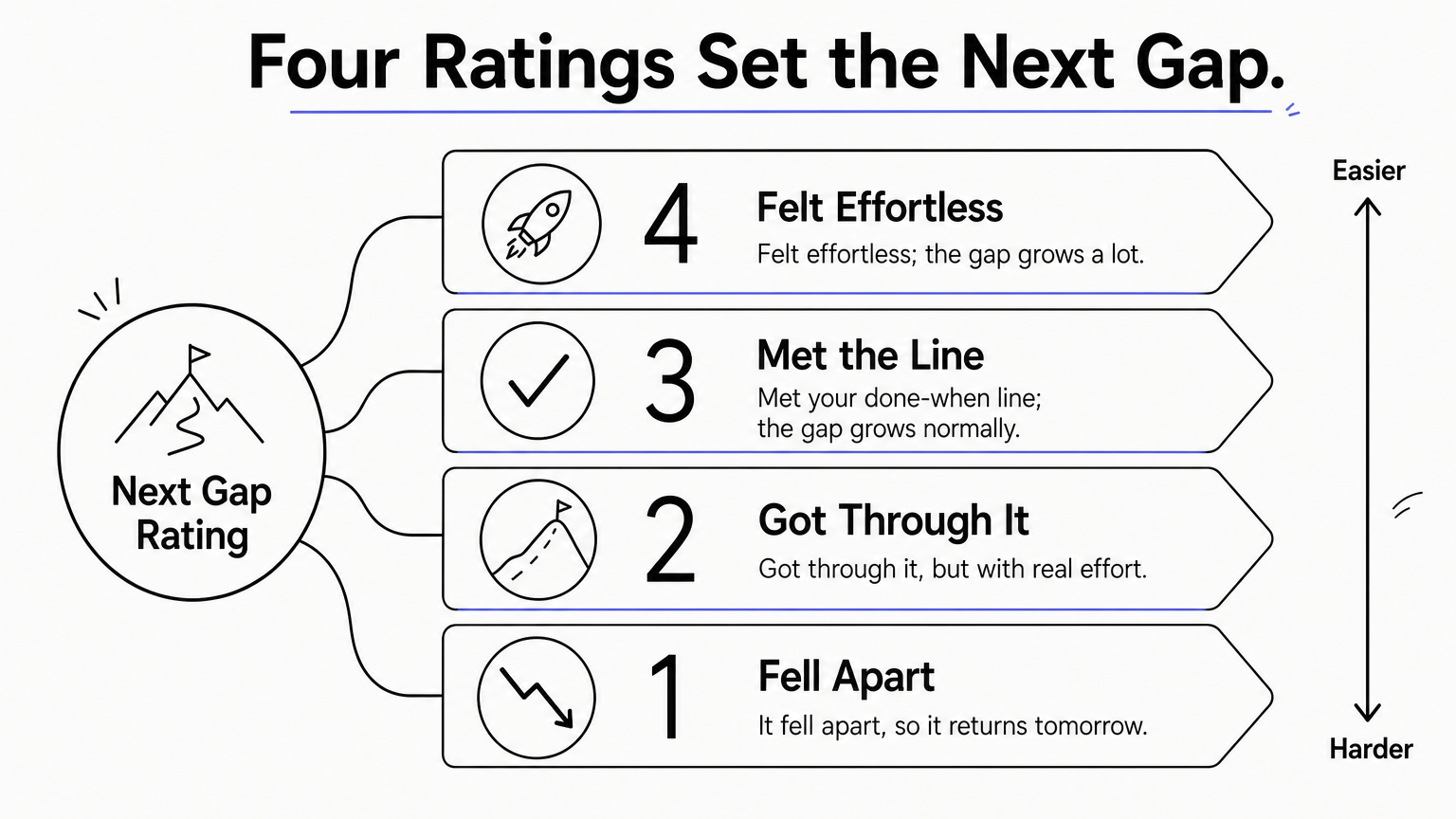
After each item, give it one of four ratings:
- Again: it fell apart. It returns tomorrow.
- Hard: you got through it, but with real effort. The gap grows only a little.
- Good: it met your "done when" line. The gap grows normally.
- Easy: it felt effortless. The gap grows a lot.
Be strict. Rating everything Good keeps your schedule comfortable and your weak spots hidden. Add a line to the card's notes about where it broke down, and record a short clip of the item now and then. Playing it back a month later shows progress that is hard to feel from the inside.
Honest ratings are what make the schedule work, so rate what happened, not what you hoped for.
Step 4. Set up your space to play quietly
Set up so that plugging in takes under a minute and nobody around you has to hear it. Practicing guitar quietly is a gear question, and the options are an amp's headphone output, a small headphone amp, or an amp modeler or audio interface.
Choose a quiet signal chain
Playing unplugged is an option, but you lose the response of the volume and tone knobs, the feel of dynamics, and any chance of testing pedals. These setups keep the electric sound while keeping the volume down:
| Option | How it works | Watch out for |
|---|---|---|
| Amp headphone socket | Plug headphones straight into your amp | Some amps sound poor this way |
| Pocket headphone amp | Guitar into the small amp, headphones into the amp | Fewer sounds than a full rig |
| Modeler or audio interface | Guitar into a modeler or interface, then headphones | Costs more and takes time to set up |
If you use headphones, do not dial in your rehearsal or stage tone through them. As soon as you turn the amp up in a room, the sound changes noticeably. Use headphones for daily practice, and check your real tone through the speaker at the volume you will actually play.
Make the room invite practice
Small habits make practice easier to start. Keep the guitar on a stand in plain view, because out of sight means out of mind. Use a chair without arms, good light on the fretboard, and a comfortable room temperature, which also helps your tuning stay stable. Keep your item list within reach so you can open it and begin.
A guitar on a stand and a ready cable remove the biggest barrier to practice, which is starting.
Ready to stop guessing what to practice?
A good electric guitar routine is simple: small items, a fixed session structure, honest ratings, and a schedule that brings each skill back at the right moment. Set your sessions at 15 to 30 minutes, practice daily, and let a quiet setup remove the excuse to skip. What to learn stays with your teacher or lesson source. The system keeps what you learn from fading.
You can run this with a notebook, but tracking due dates by hand gets tedious once you pass a dozen items. If you want the scheduling handled for you, try MemoRep and claim free premium access during the limited beta.