Arpeggio Practice Routine for Guitar: 6 Steps That Stick
The reliable way to learn how to practice arpeggios on guitar is to treat each arpeggio shape as its own small practice item. Work a few items each day, rate how each pass went, and let a spaced schedule decide when you come back to it. You stop drilling everything every day and start revisiting each shape just before it fades. The six steps below show you how to build that system.
The problem is familiar. You learn a shape on Monday and play it cleanly. By Friday it has slipped, because you spent the week on the two shapes you like. The list also keeps growing: several chord types, several positions, several keys. Soon you spend the first ten minutes of each session deciding what to play, and the shapes you avoid get rustier.
This guide is about organizing your practice, not about how to play. It does not teach fingerings, theory, or technique. Your teacher or your lesson material decides what to play and how to play it. What follows shows you how to list, split, schedule, rate, and review that material so none of it goes stale. I use MemoRep for the examples because it is built on spaced repetition for practical skills, but a notebook and a calendar can run the same method.
Why arpeggios fade without a system
Arpeggios fade because skill memory decays on a predictable curve, and arpeggio work multiplies into dozens of items that daily practice cannot keep equally warm. A system does not make you practice more. It makes you practice the right shape on the right day.
Why arpeggio shapes are easy to lose
The Ebbinghaus forgetting curve describes how memory drops fastest in the first days after you learn something and then flattens out. Each well-timed review pushes the next drop further away. That is the principle behind spaced repetition. It applies to fingers and fretboard maps as much as to facts, because you are recalling a pattern you have to produce on demand.
Arpeggios make this worse through sheer quantity. One jazz-style set covering five common seventh-chord types comes to more than twenty grips to maintain, before you count keys. Add the positions across the neck and the variations your teacher assigns, and you have a maintenance problem, not a learning problem.
Arpeggios rarely fail in the lesson. They fail in the weeks after it, when nobody is scheduling the review.
Are arpeggios hard to learn?
Whether arpeggios feel hard depends on your level and on how your teacher introduces them, and I will leave that question to them. What I can say is that keeping them is the harder part for most players. The easiest path I know is to learn one shape at a time from a teacher or a good method book. Then keep each shape alive on a schedule instead of hoping it sticks.
If you do not yet know which arpeggios you should be playing, or the idea still feels unclear, ask your teacher before building anything. This method organizes material you already have. It does not replace instruction.
What you need before you start
The setup is light. You need five things:
- Arpeggio material from a teacher, a method book, or lesson notes
- Your guitar and a metronome
- A place to store practice items: a MemoRep project, or a notebook with a column for dates
- A daily slot of 15 to 20 minutes
- Willingness to rate your own playing honestly (Step 4 explains how)
Step 1. List every arpeggio you need to keep
Start by writing down every arpeggio your teacher or material has assigned, in every key and position, as a flat list with no order yet. A complete list is what lets the schedule do its job. A shape that is not on the list gets practiced by accident, or not at all.
Collect the material
Go through lesson notes, your method book, and the arpeggio parts of songs you are learning. Write one line per shape, using the same label pattern every time: chord type, root, position. For example: "Cmaj7 arpeggio, position 1" or "Dm7 arpeggio, position 3."
Also list arpeggio work that belongs to a piece, such as "arpeggios for the chord changes in bars 1 to 8." Consistent labels matter because you will scan this list daily, and one line per shape makes it easy to see gaps. If a position or key is missing, you will notice it now rather than six months from now.
Sort the list into three tiers
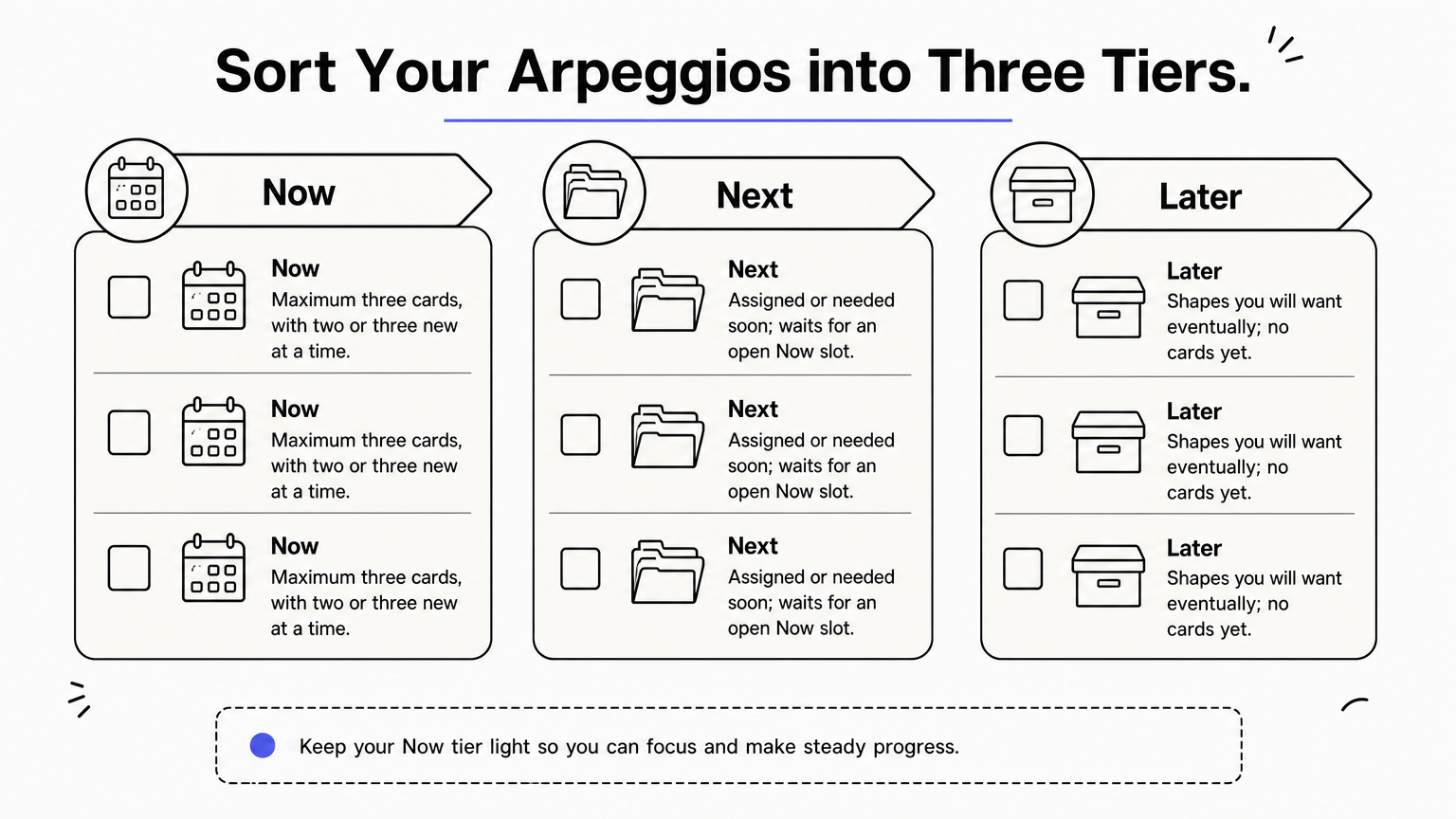
You cannot practice everything at once, and trying to is the main reason players abandon arpeggio routines. Sort the list into three tiers:
| Tier | What goes in | Rule |
|---|---|---|
| Now | Shapes you are actively working on this month | Maximum 3, and only 2 or 3 new ones at a time |
| Next | Shapes your teacher has assigned or you will need soon | Wait here until a Now slot opens |
| Later | Shapes you know you will want eventually | Do not make cards yet |
A worked example: your teacher has given you ten shapes, five major and five minor. Put three in Now, four in Next, and three in Later. Only the three in Now become cards this week. You are not ignoring the other seven. You are deciding when each one enters the rotation.
A short Now list that you finish every day beats a complete list that you resent.
Step 2. Turn each arpeggio into a practice card
A practice card is one arpeggio shape with a clear target and a clear finish line. The rule is one card for one skill, so that when you rate a card you know exactly what you are rating.
One card, one skill
Do not make a card called "minor arpeggios." Make a card for each shape in each position. If you lump five shapes together, a single rating hides which of them is weak. You will rate the group "Good" because three of the five went fine, and the two weak shapes drift out of sight.
In MemoRep, you create cards inside a project, so a project named "Arpeggios" holds every card in this list. The tool is secondary. What matters is that each item can be scheduled and rated on its own.
Write a card you can judge
A card needs a title, a source, a target, and a finish line. The finish line is what keeps your ratings honest later. Copy this template and adapt it:
Title: Am7 arpeggio, position 1
Source: Teacher's notes, lesson of Oct 12
Target: 60 bpm, quarter notes, with the metronome
Done when: played start to finish with no stops, three times in a row
Note to self: (fill in after each pass)
The tempo is a record, not an instruction. It tells you what you rated against last time, so your next rating compares like with like. If you do not use a metronome with a given card, write the condition you do use, such as "slow, no backing track."
Give variations their own cards
When your teacher assigns a new way to play a shape you already have, such as a different rhythm, a longer range, or a different picking pattern, make a new card for it. Keep the original. A shape can be solid in its basic form and shaky in a variation, and two cards let the schedule treat them differently.
The same logic covers playing across the neck. If you want the same arpeggio to be reliable in several positions, make one card per position. Over time, your ratings show you which positions are solid and which need attention, without you having to remember.
One skill per card is the rule that makes every later step work.
Step 3. Build a daily session around what is due
Your daily session should start with the cards that are due, add at most one new card, and stop when the time is up. The point of a schedule is that the day's work is already decided before you pick up the guitar.
The session order
Use the same order each day:
- Due cards first. These are the shapes closest to fading, so they get your freshest attention.
- One new card. Introduce a new shape only after the due cards are done.
- Everything else. Use any time left for repertoire and other assignments from your teacher.
Here is a worked example for a 20-minute slot. You have ten active cards, and three are due today at about 3 minutes each, which is 9 minutes. The new card gets 5 minutes. That leaves 6 minutes for a song or an assignment outside the card list. Total: 9 + 5 + 6 = 20 minutes.
Early on, more cards will be due because you keep adding new ones. As the intervals grow (Step 5), the due list shrinks and the free time grows.
Keep the session small enough to finish every day
A session you finish daily is worth more than an ambitious one you skip. Cap the time per card, and when the time is up, rate the card and move on. If you often run out of time, you have too many cards in Now, so move one back to Next.
MemoRep sends daily practice notifications, which helps because the main failure here is simply forgetting to open the list. With a notebook, put the check-in at the same time as an existing habit, such as before dinner or right after you tune.
Handle missed days without panic
If you miss a day or two, cards pile up as overdue. Do not try to clear every overdue card in one sitting. Work the most overdue cards first, within your normal session length, and let the rest wait a day. Rating the overdue cards honestly after a gap also gives the schedule real information about what slipped.
Step 4. Rate each pass honestly
After each card, give it one of four ratings: Again, Hard, Good, or Easy. The rating is the only input the schedule has, so an honest rating is what makes the whole system work. A generous rating gives you a schedule that looks efficient and fails in practice.
What each rating means for an arpeggio card
Tie each rating to the finish line you wrote on the card, not to how you feel:
| Rating | What happened | Effect on the next review |
|---|---|---|
| Again | You could not meet the finish line, or you lost the shape | Comes back soon |
| Hard | You met it, but with stops, doubt, or only on a late try | Shorter gap than usual |
| Good | You met the finish line cleanly on the first try | Normal gap |
| Easy | It was effortless and you never had to think | Much longer gap |
MemoRep uses this same Again, Hard, Good, Easy scale and adjusts each card's schedule to how you experience it. The exact spacing is the app's job. Your job is to pick the rating that is true.
Rating mistakes that wreck the schedule
Three habits cause most of the damage. The first is rating by the best attempt instead of the first one. If you fumble twice and nail the third pass, the card is Hard, not Good. The second is rating Easy to clear the list. Easy pushes the next review far away, so use it only when you could play the shape half asleep.
The third is rating after you are warm. Your first, cold pass of the day tells you what a shape is really like when you pick it up. Warm passes after that are practice. They are not the test. Rate the first one.
A rating describes what the shape did today, not what you hope it will do tomorrow.
Step 5. Let the schedule space your reviews
Spaced repetition means each successful pass pushes the next review further away, and each failed pass pulls it closer. You do not choose the dates. You rate honestly, and the dates follow. This is how you keep twenty shapes warm on a 20-minute day.
How the intervals grow
The classic SM-2 algorithm, which MemoRep builds on, starts with short gaps and multiplies them by an ease factor after each successful pass. In its textbook form, the first gap is 1 day, the second is 6 days, and each later gap is the previous one times 2.5. The timeline for one card rated Good every time looks like this:
| Pass | Gap since last pass | Day of the pass |
|---|---|---|
| 1 (first learned) | none | Day 0 |
| 2 | 1 day | Day 1 |
| 3 | 6 days | Day 7 |
| 4 | 15 days | Day 22 |
| 5 | about 38 days | About day 60 |
Five passes in 60 days, compared with about sixty if you drilled the shape daily. That is the saving. Your own dates will differ, because MemoRep adapts the schedule to your ratings rather than following the textbook numbers exactly. The pattern is what to remember: gaps grow while the shape holds.
What to do when a card slips
When you rate a card Again, its interval shrinks and it returns soon. That is not a failure. It is the schedule catching a shape right when it started to fade, which is exactly its job. One Again is information.
If the same card gets Again twice in a row, treat that as a signal to stop repeating it blindly. Bring the card to your next lesson and ask your teacher whether it should be broken into a smaller piece or practiced differently. The scheduling tells you which card is the problem. Your teacher tells you what to do about it.
Why this covers the whole neck
Because each position and each key is its own card, the schedule rotates them for you. You will not spend a month on one position and discover a gap in another. Weak shapes come up more often, strong shapes come up less often, and the overall effect is a more even command of the fretboard without anyone having to plan it.
Spacing is the difference between practicing every shape a little and practicing every shape often.
Step 6. Review progress and add new shapes
Once a week, spend five minutes looking at your cards as a whole and decide what to add, hold, or ask your teacher. The daily session keeps shapes alive. The weekly review keeps the list itself healthy.
A five-minute weekly review
Run through these questions with your card list in front of you:
- Which cards received Again this week, and was it the same ones as last week?
- Which cards now have gaps of a week or more?
- Is any Now card stuck, with the same rating several passes in a row?
- Is there room in Now to promote something from Next?
MemoRep tracks and visualizes your progress, so you can see this without counting. In a notebook, add a tally mark beside any card that got Again. The goal is to notice patterns that single sessions hide.
Promote new shapes gradually
Move a shape from Next to Now only when a slot is open. A reasonable rule is that most of your Now cards should be rated Good with gaps of at least a week before you add another. This rule is my own rule of thumb, not a law. Adjust it to your schedule and your teacher's pace.
Work this way and a ten-shape assignment takes about five weeks at two new cards per week. If your teacher then adds positions or keys, the new items go into Later or Next, never straight into your daily session. The list grows without the session growing.
Take your data to your lesson
Your card history is something concrete to show a teacher. Instead of saying "I think I'm weak in the higher positions," you can say that three cards in the upper positions got Again twice this month. That lets the lesson time go to what actually needs correction, and it keeps technique decisions where they belong, with the person who can hear you play.
Start with ten cards and one week
The method is short. List the arpeggios your teacher has assigned, sort them into Now, Next, and Later, and turn the Now items into cards with a clear finish line. Do the due cards each day, add one new card, rate your first cold pass honestly, and let the intervals grow. Review the list once a week and bring slipping cards to your teacher.
Start small. Three cards and a 20-minute slot are enough to see how spacing changes your sessions within a week or two. If you want the scheduling handled for you, set up your arpeggio project in MemoRep. It currently offers a free-for-life subscription for a limited time.