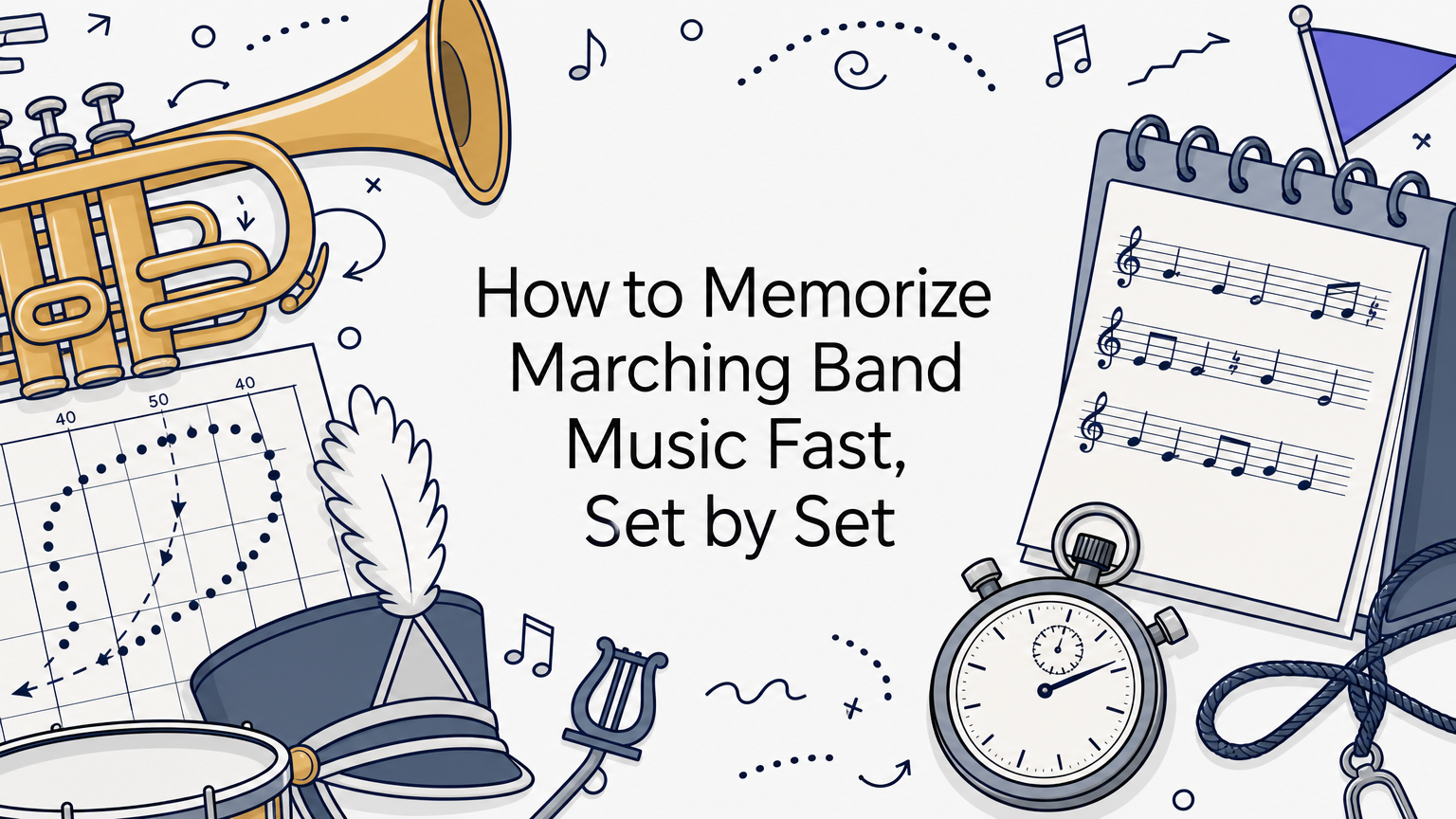
How to Memorize Marching Band Music Fast, Set by Set
The fastest way to memorize marching band music is to cut the show into small chunks, tie each chunk to a spot in your drill, test yourself without the page, and review each chunk on a spaced schedule instead of cramming. Short daily sessions beat one long night before the memory check, because anything you learn fades quickly unless you recall it again a day or two later.
Marching band asks you to hold two things at once: the notes and where your feet go. Rehearsal time is limited, the show keeps changing, and memory checks arrive on a deadline. So you run the show until midnight, feel confident, and find half of it gone by the next rehearsal. Rereading the page does not fix that, because reading only trains you to recognize the music, not to produce it.
This guide starts with what you are really memorizing, then walks through four steps: chunk the show, build a visual map, memorize and test each chunk, and review on a schedule. It covers how to organize memorization, not how to play. Questions about technique or theory belong with your section leader and director. MemoRep, a spaced repetition practice app, is built around the same review idea, so you will see how to run these steps on paper or in the app.
What you are memorizing and what you need
You are memorizing a sequence of sets, and each set pairs a piece of music with a position and a count. That is why memorizing sheet music for marching band feels different from memorizing a solo.

Music, drill, and cues travel together
Most field shows are performed from memory, because you cannot hold a stand while moving through drill. Parade bands often use lyres and flip folders, so ask your director what the expectation is and when the memory check happens. Once you know the deadline, work backward from it and leave a buffer of at least a week.
Cramming fails because rereading feels like learning while only active recall, testing yourself, builds recall. "Fast" here means frequent, short, focused sessions, not marathon runs.
You memorize faster when you test yourself without the page, not when you read it again.
What to gather before you start
Collect these before your first session:
- Your part and a copy of the drill chart or dot book
- A recording of the show or a rehearsal run, if your director provides one
- A phone to record yourself
- A pencil, a highlighter, and a few sheets of blank paper
- A timer set to 15 minutes
Step 1. Cut the show into chunks
Cut the show into chunks of about four to eight measures, and let the phrases and the drill sets decide where each one ends. Small chunks give you quick wins and make it obvious which spots are weak.
Use sets and phrases as your boundaries
Start from your drill chart. Each set change is a natural cut, and a long set can be split again by phrase. Work through the show in order and put a pencil mark at every boundary.
A worked example: a 64-measure opener cut into 8-measure chunks gives you 8 chunks. Learn one new chunk per day and review the earlier ones, and you have the opener memorized in about eight days. That is why starting early matters more than any single trick.
Name every chunk
Give each chunk a label such as 1A, 1B, 1C for the opener and 2A, 2B for the next movement. Write the label above the chunk in your part. Labels let you say "1C is shaky" in a rehearsal or a log, which is far more useful than "somewhere in the middle."
Small chunks turn one huge show into a short list of jobs you can finish.
Step 2. Build a visual map of the show
A visual map is a one-page overview that links every chunk to its measures, its set in the drill, and a landmark you will see or feel at that moment. It gives your memory several hooks instead of one.
Put the music next to the drill
Many band members shrink their part and tape it into the dot book beside each set, so the notes and the position are learned together. If your band allows it, do the same. Otherwise, write the measure numbers beside each set on a printed chart.
Make a one-page show map
Copy this template onto paper or a note and fill in one row per chunk:
Show map: [show name]
Chunk | Measures | Set / page | Landmark cue | Status
1A    | 1-8      | Set 1      | Start on the front sideline | Learning
1B    | 9-16     | Set 2      | First turn toward the press box | New
A good landmark is something outside the notes: a yard line, a formation shape, or the moment a section joins you. Update the Status column after every session. Your map shows you what to practice next without any guessing.
If you cannot name the landmark for a chunk, you do not know where that chunk lives yet.
Step 3. Memorize each chunk and test it cold
Memorize one chunk at a time with a simple loop: use the page, hide the page, recall, check. Never move on until a chunk survives a test with no page in sight.
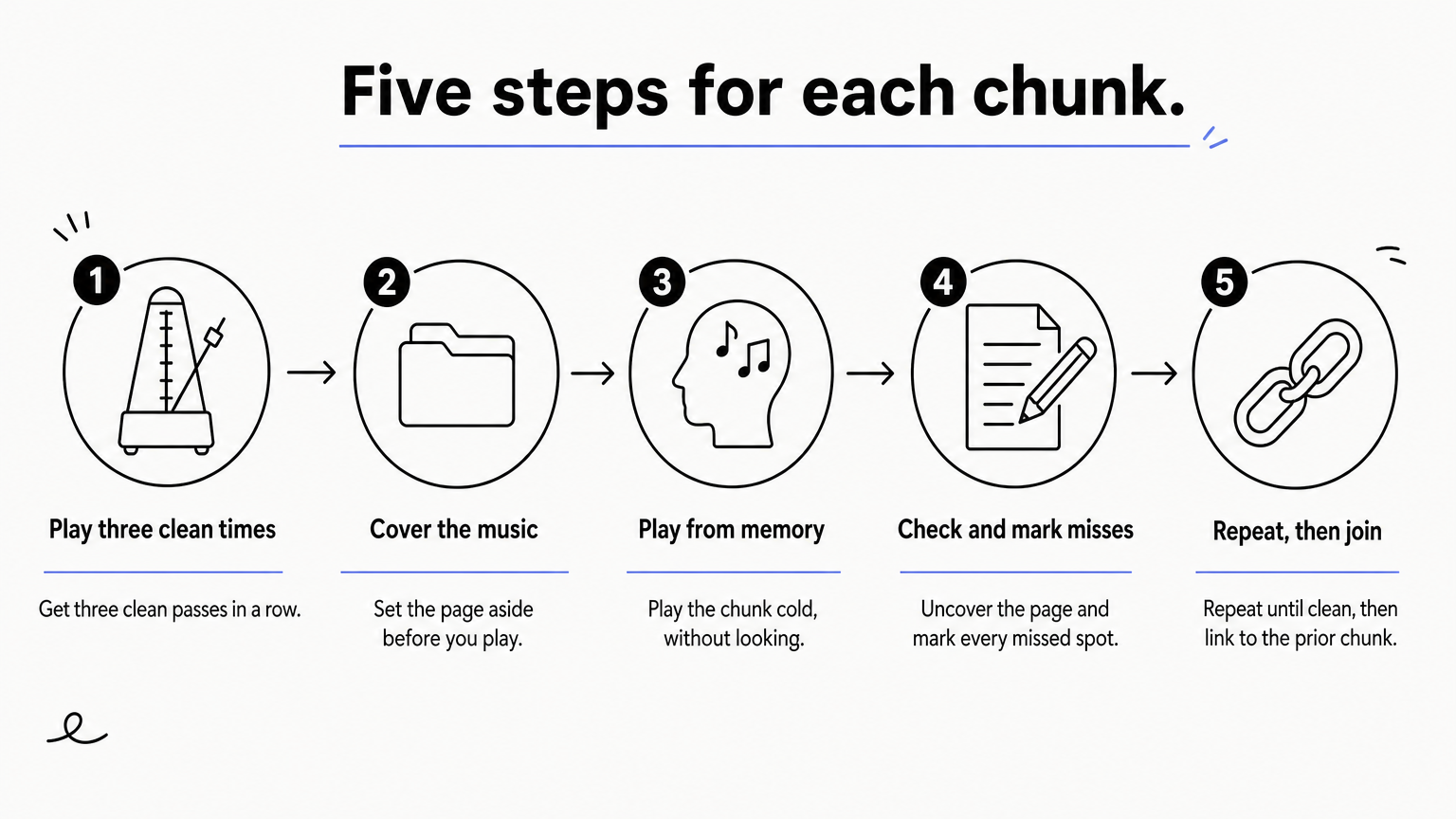
The loop for each chunk
- Play the chunk with the music until you get it three times in a row without mistakes.
- Cover the music or put it aside.
- Play the chunk from memory.
- Uncover the music and mark any spot you missed.
- Repeat until it comes out clean from memory, then join it with the chunk before it.
Keep each session to 15 minutes of focused work, with no phone or TV, then take a break. Away from your instrument, sing or hum your part while you walk through the set. That builds the link between the sound and the position without using up your energy for the real run.
Record it and make a trouble-spot list
Record yourself playing a finished page from memory. Play the recording back while following the music, and write the measure numbers of every slip on a cue sheet. Better still, have a friend or section mate follow along with a copy of the music and mark each miss. Fix only the marked spots, then retest.
A memorized chunk is one you can play cold, so test it cold.
Step 4. Review on a spaced schedule
Review each chunk on a spaced repetition schedule that widens, such as the next day, three days later, and a week later, and bring it back sooner whenever you miss it. This is what turns a chunk you can play today into one you can still play at the performance.
A review schedule you can copy
Here is a simple schedule for a chunk you learn on Monday:
| Day | What you do |
|---|---|
| Monday | Learn the chunk and pass a cold test |
| Tuesday | Play it from memory first, then check |
| Friday | Play it from memory first, then check |
| Following Friday | Play it from memory first, then check |
If you miss it on any review, mark it "Hard" and see it again the next day. With eight chunks in the opener, you will review several chunks each day, so the schedule gets crowded fast. That is where tracking becomes the real work.
Let the schedule run itself
MemoRep handles that bookkeeping. You create a practice card for each chunk, rate it Again, Hard, Good, or Easy after each pass, and the app uses the SM-2 spaced repetition algorithm to decide when the card comes back and sends a daily reminder. It never tells you how to play, only what to revisit and when.
As the memory check gets closer, raise the pressure on purpose. Play the full page for a friend first, then for your section, then in a full-band rehearsal. Aim to have the whole show memorized a week or more before the check, so the last days are for polish rather than panic.
Spacing your reviews matters more than adding more hours.
Start with one set
To memorize marching band music fast, break the show into chunks, tie each one to the drill, test it without the page, and review it at growing intervals. Do not skip the cold test, and do not leave the review to the night before. Your first move today is small: pick the opening set, cut it into chunks, and run one 15-minute session.
If you would rather not track a dozen chunks by hand, try MemoRep during the free beta and let it schedule each review for you.