How to Practice Chords on Guitar So the Changes Stick
The best way to approach how to practice chords on guitar is to treat each chord and each chord change as its own small card. Run a short timed rep on every card that is due, rate how it went, and let a spacing schedule decide when each card comes back. Weak changes show up often, solid ones step aside, and you stop spending practice time deciding what to play.
Most beginners practice differently. They play through the same chord list in the same order every day. The easy chords get most of the attention, the one awkward change gets skipped, and after a week off everything feels rusty. That is a scheduling problem, not a talent problem. It is also why searches for how to practice changing guitar chords return dozens of exercises but no way to know which one you need today.
This guide gives you a four-step routine: build cards, time your reps, rate them, and space your reviews. It covers the structure of practice, not technique. How to finger a chord or fix a buzzing string is a job for your teacher or method book. MemoRep, the practice scheduler we build, deliberately never gives that kind of instruction. You bring the chords, and this routine decides what to practice and when.
Why chord practice stalls without a system
The problem with playing everything every day
Chord practice stalls when you replay the same list daily, because comfort decides your priorities instead of results. You drift toward the chords that already sound good. The change you dread gets one rushed attempt, and then you move on.
Memory makes this worse. Hermann Ebbinghaus's forgetting curve shows that a newly learned skill fades fastest soon after you stop, then more slowly. Reviewing a skill just before it fades strengthens it more than reviewing it while it is still fresh. Spaced repetition systems, including the SuperMemo SM-2 algorithm that MemoRep builds on, schedule reviews around that idea.
Practice time should go to what is about to fade, not to what already feels good.
What you need before you start
The setup is small. Gather these before step 1:
- A chord list from your teacher, your method book, or the songs you want to play
- A timer, such as your phone's
- A metronome, either an app or a physical one
- A place to log results: a notebook, a spreadsheet, or MemoRep
Keep the active list short. A handful of chords, around four to six, is enough to start. You add more only when the current set is scheduled far enough out that it no longer needs daily attention.
Step 1. Turn your chords into practice cards
A practice card is one specific thing you can attempt, time, and rate. Make one card per chord and one card per chord change, and write the change cards in both directions, because going from A to B is often harder than going from B to A.
Pick the chords from a trusted source
Choose chords that your teacher assigned, that appear in your method book's current lesson, or that appear in a song you are learning. Do not choose by internet lists of "the easiest chords." Whoever guides your learning decides what to learn next. The routine here only decides how often you revisit it.
Then keep only the changes you will actually play. If your song moves from Am to C and from G to D, those are your cards. Changes that never appear in your music do not need slots in your schedule.
Write each card so you know when it is done
A card needs a clear finish line. Here is an example set built from four chords. The chords are placeholders, not a recommendation.
| Card | What you do | Done when |
|---|---|---|
| Am | Form the chord from rest and play it once | You hit your clean-play target |
| C | Form the chord from rest and play it once | You hit your clean-play target |
| Am to C | Alternate between the two for 60 seconds | You reach your target count of clean changes |
| C to Am | Alternate between the two for 60 seconds | You reach your target count of clean changes |
| G to D | Alternate between the two for 60 seconds | You reach your target count of clean changes |
Define "clean" once and stick to it. For example, every string you meant to play rings out and the change lands on the beat. Ask your teacher if you are unsure what clean sounds like.
A card without a finish line cannot be rated, and a card you cannot rate cannot be scheduled.
Step 2. Run a one-minute timed rep
A timed rep means working one card for a fixed block, counting the result, and writing it down. Sixty seconds per change card is long enough to produce a meaningful number and short enough to repeat across several cards in one sitting.
How to run the rep
Follow the same sequence every time so the numbers are comparable:
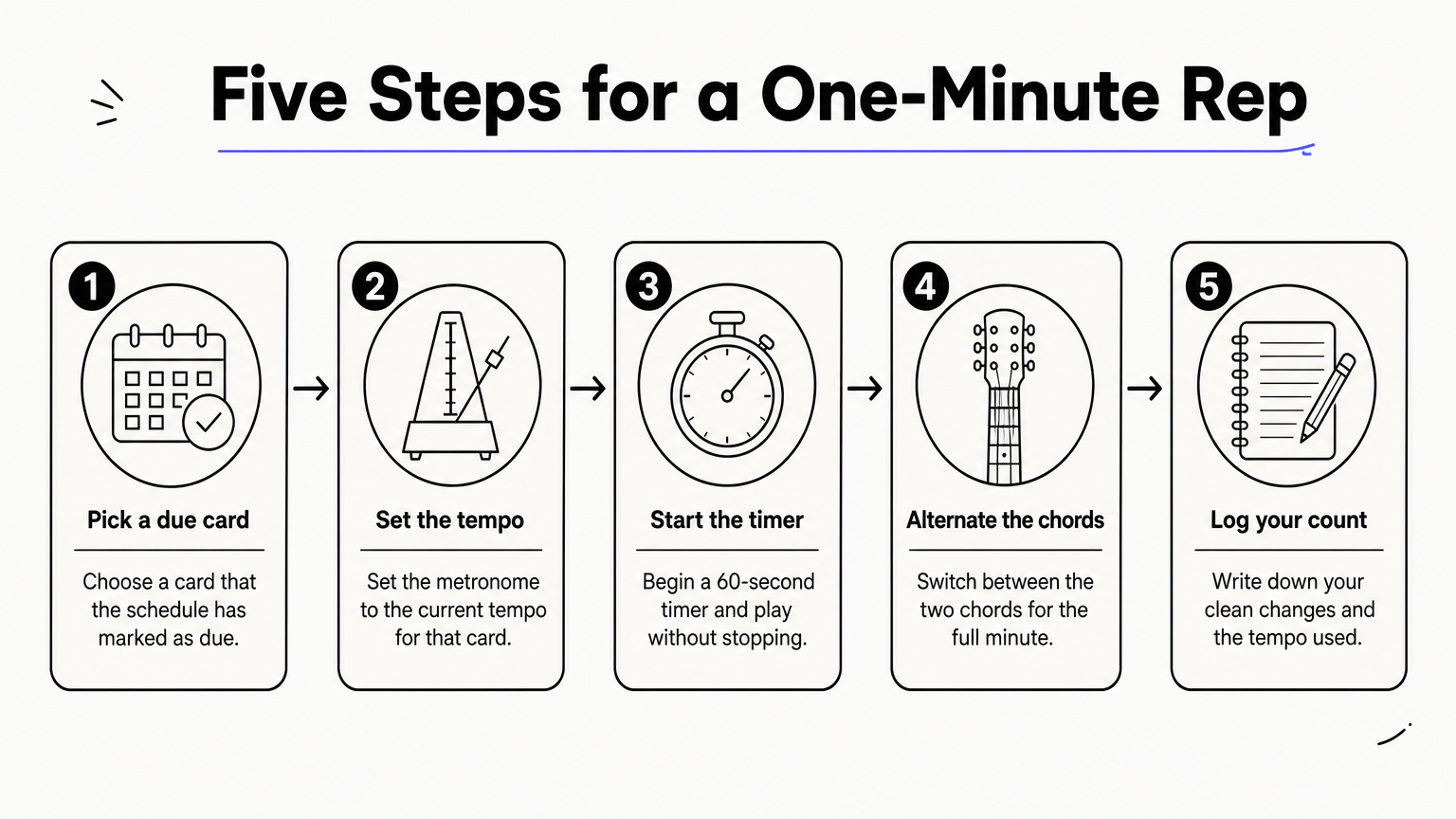
- Pick a card that is due.
- Set the metronome to your current tempo for that card.
- Start a 60-second timer.
- Alternate between the two chords for the full minute.
- Count your clean changes and log the number.
Keep consecutive reps inside that minute. Playing one change, stopping, and then wandering off to the next chord wastes most of your time. A teacher in Melbourne makes the same point with a gym comparison: one rep per machine is not a workout.
For tempo, start at a speed where you can finish each change before the next click. Once a card feels comfortable, raise the metronome in small steps such as 3 to 5 BPM. Log the tempo with the count so you can see your progress.
Write the number down after every rep. Your memory of how it went is less reliable than the log.
Keep the whole session short
A session does not need to be long. Say three cards are due. You give each one two one-minute rounds, which is six minutes of playing. Add about a minute to log and rate, and you are done in roughly seven minutes. Short, frequent sessions are easier to keep up than a long block you dread.
Here is a log format you can copy into a notes app:
Date | Card | Tempo (BPM) | Clean changes in 60s | Rating
Step 3. Rate each card honestly
After each card, give it one of four ratings: Again, Hard, Good, or Easy. Tie each rating to your logged number, not to your mood, because the rating decides when the card returns.
Set a target before you start
Pick a target count of clean changes for each card. If you are unsure what is reasonable, ask your teacher. As a placeholder, you could use 20 clean changes in a minute at your current tempo. Raise it as the card gets easier. Write the target on the card so you cannot move the goalposts mid-rep.
Use a fixed rating scale
| Rating | What it means | What happens next |
|---|---|---|
| Again | You could not finish the minute cleanly, or you fell well short of the target | The card returns soon, usually the next session |
| Hard | You hit the target, but only with strain | The card returns after a short gap |
| Good | You hit the target comfortably | The card moves out to the next interval |
| Easy | You beat the target with room to spare | The card moves out further |
The common mistake is rating Easy to feel good. That pushes a shaky change days away, and by the time it returns the progress is gone. When in doubt, pick the lower rating. An extra review costs a minute, while a skipped one costs you the change.
An honest "Again" today saves you from a frustrating week later.
MemoRep uses this exact four-button scale and adjusts each card to how you rate it. You can run the same scale by hand with a notebook.
Step 4. Let spacing set your next review
Spacing means each card returns at a growing interval, and a card you struggle with goes back to a short one. A good rating pushes the next review further out, and a poor rating pulls it back in. This is what keeps your practice focused on weak spots without you tracking anything.
How intervals grow
In the classic SM-2 algorithm, a new card is reviewed after 1 day, then after 6 days. After that, each interval is multiplied by an ease factor that starts at 2.5 and shifts with your ratings. A card rated Good every time looks like this:
| Review | Interval | Day of review |
|---|---|---|
| First | 1 day | Day 1 |
| Second | 6 days | Day 7 |
| Third | About 15 days (6 x 2.5) | Day 22 |
Rate it Again and the card drops back to a 1-day interval. This is only an illustration of the principle. Tools adapt the numbers, and MemoRep adjusts scheduling in real time to how you perform.
Put your time where it hurts
Each day, open the cards that are due and nothing else. The hard changes come up often, so they take most of your minutes. That matches the old advice to put roughly 80 percent of practice time into your weak spots rather than replaying what you already do well.
Consistency matters more than session length. Daily reminders help here, and MemoRep sends daily practice notifications. If you miss a day, nothing breaks. The due cards simply wait, and you pick up where you left off. For anyone wondering about the easiest way to learn chords, this is it: a small set, a short daily session, and reviews timed to your results.
Spacing turns "what should I practice?" into a question you never have to answer yourself.
Start with a week of cards
To practice chords well, keep the set small, time each change, rate it honestly, and let spacing bring the weak ones back. That routine works with a notebook and a timer, and it works for any chords your teacher gives you. Seven minutes a day, aimed at the right cards, beats an hour of replaying the same list.
If you would rather not track intervals by hand, try MemoRep during the limited beta. It turns your chords and changes into cards, schedules them by your ratings, and tells you what is due each day. Your teacher still decides what you learn. MemoRep decides when you practice it.