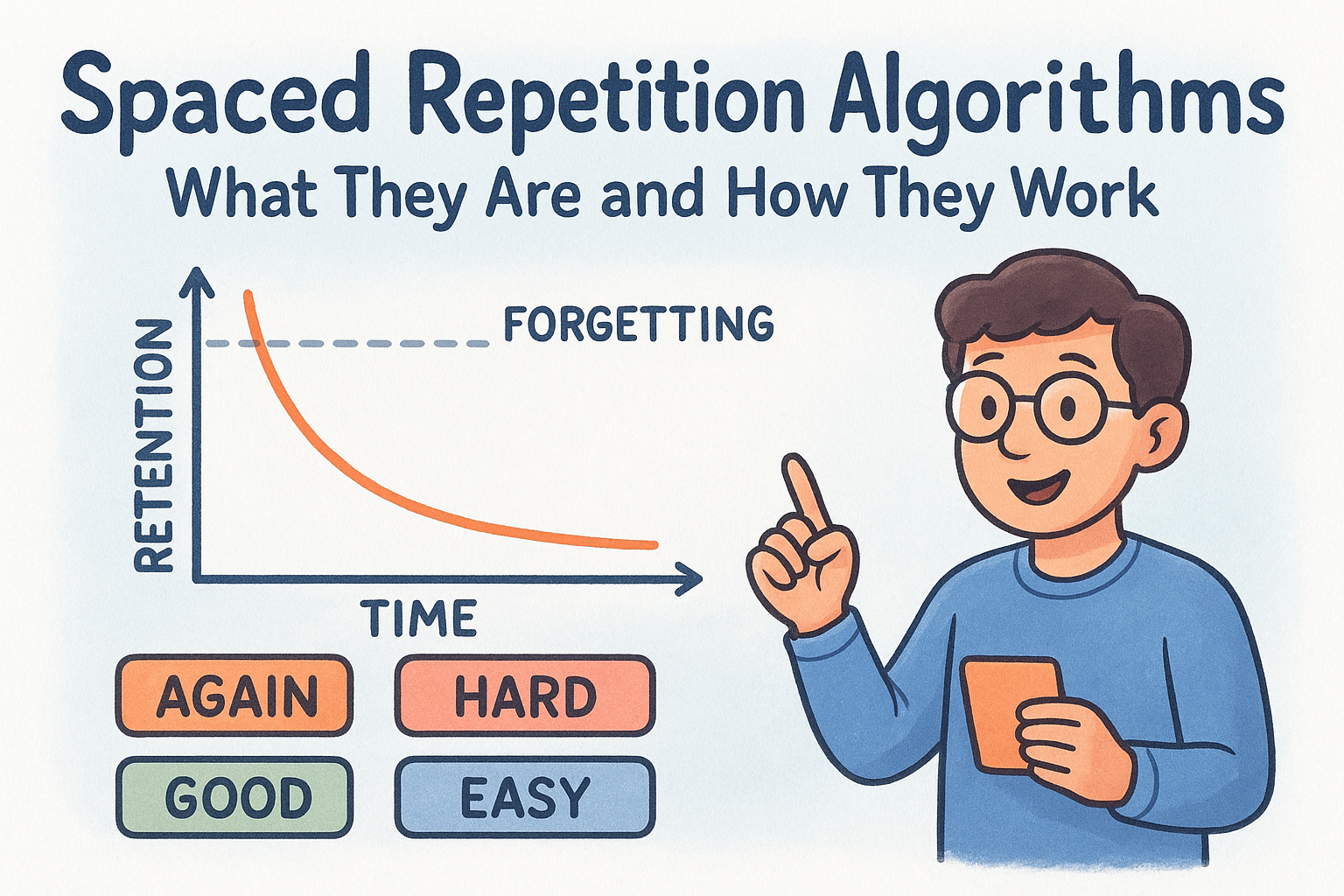
Free Spaced Repetition Scheduler: What FSRS Is and How It Works
You've probably heard that Anki's default algorithm, SM-2, feels either too easy or too hard depending on the material. That mismatch is exactly what the free spaced repetition scheduler, better known as FSRS, was built to fix. It's an open-source algorithm that models your memory more precisely than older methods, and it's now baked into Anki and several other review apps that run spaced repetition.
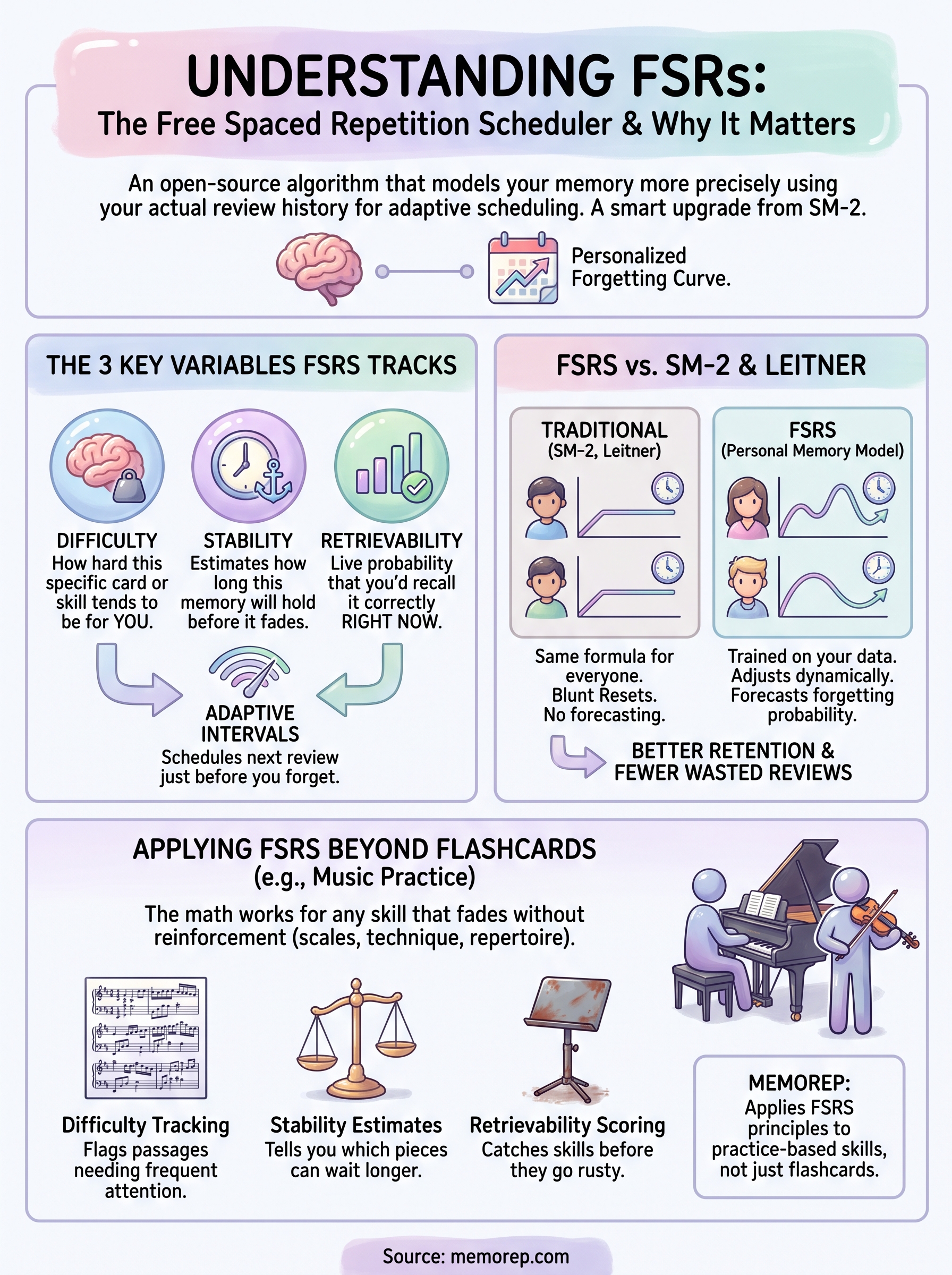
FSRS works by tracking three variables for every card you study: difficulty, stability, and retrievability. Instead of applying a flat rule like "double the interval on a correct answer," it uses your actual review history to predict when you're about to forget something, then schedules the next review right before that happens. The result is fewer wasted reviews on things you already know cold, and better timing on the stuff that's slipping.
In this article, you'll get a clear breakdown of how FSRS calculates those intervals, why it consistently outperforms SM-2 in retention studies, and practical steps to enable it in Anki. If you're a musician or skill learner curious about the science behind spaced repetition, this is the algorithm worth understanding, even if your practice involves more than flashcards.
Why FSRS matters for how you learn and retain skills
Traditional spaced repetition algorithms like SM-2 treat every learner the same way. They assume a correct answer always means "wait longer" and a wrong answer always means "reset the clock," regardless of how hard the material actually is for you. FSRS throws that assumption out. It builds a personal memory model from your review history, so two people studying the same scale or the same chord progression can end up on completely different schedules based on how their brains actually retain it. That's the core reason a free spaced repetition scheduler built on real data outperforms a one-size-fits-all formula.
The three variables that drive every prediction
FSRS tracks difficulty, stability, and retrievability for each item you're practicing. Difficulty reflects how hard a specific card or skill tends to be for you specifically, not for the average user. Stability estimates how long that memory will hold before it fades. Retrievability is the live probability that you'd recall it correctly right now, at this exact moment. Every review updates all three numbers, which is why the schedule tightens or loosens automatically as your performance changes.

FSRS doesn't guess when you'll forget, it calculates it from your own review data.
What this means for retention in practice
Because the algorithm predicts your personal forgetting curve instead of applying a generic one, you spend less time on reviews you don't need and more time on the ones that actually matter. This shows up in a few concrete ways:
- Fewer wasted reviews on material you've already mastered
- Earlier intervention on items that are quietly slipping from memory
- Adaptive scheduling that responds to a bad week or a rough practice session instead of ignoring it
For musicians juggling scales, repertoire, and technique drills inside one music practice routine, that precision matters more than it does for simple fact recall. A missed review on a language flashcard costs you a wrong answer. A missed review on a piece you're performing next month costs you stage time.
How to set up and use FSRS for your reviews
Getting FSRS running in Anki takes about five minutes, and you don't need to touch a formula. Anki added native support for the algorithm starting in version 23.10, so if you're on a recent build, the option is already sitting in your deck settings.
Turning it on inside Anki
Open the deck options for any deck, scroll to the Advanced section, and toggle on "FSRS." Anki will ask you to optimize parameters, which uses your existing review history to fit the algorithm to your personal memory patterns. Here's the full sequence:
- Update Anki to the latest version.
- Open Deck Options for the deck you want to convert.
- Scroll to the FSRS toggle and enable it.
- Click Optimize to generate parameters from your review logs.
- Set your desired retention target, usually between 85% and 95%.
- Save and let the new intervals apply on your next review session.
The retention slider is the one setting that actually changes your workload, so don't skip it.
Choosing the right retention target
A higher retention target means shorter intervals and more reviews, which suits high-stakes material like an upcoming recital piece. A lower target stretches intervals further apart, trading a bit of recall risk for less daily review time. Most users start around 90% and adjust after a few weeks once they see how the review load feels against their actual practice schedule.
FSRS vs traditional spaced repetition algorithms
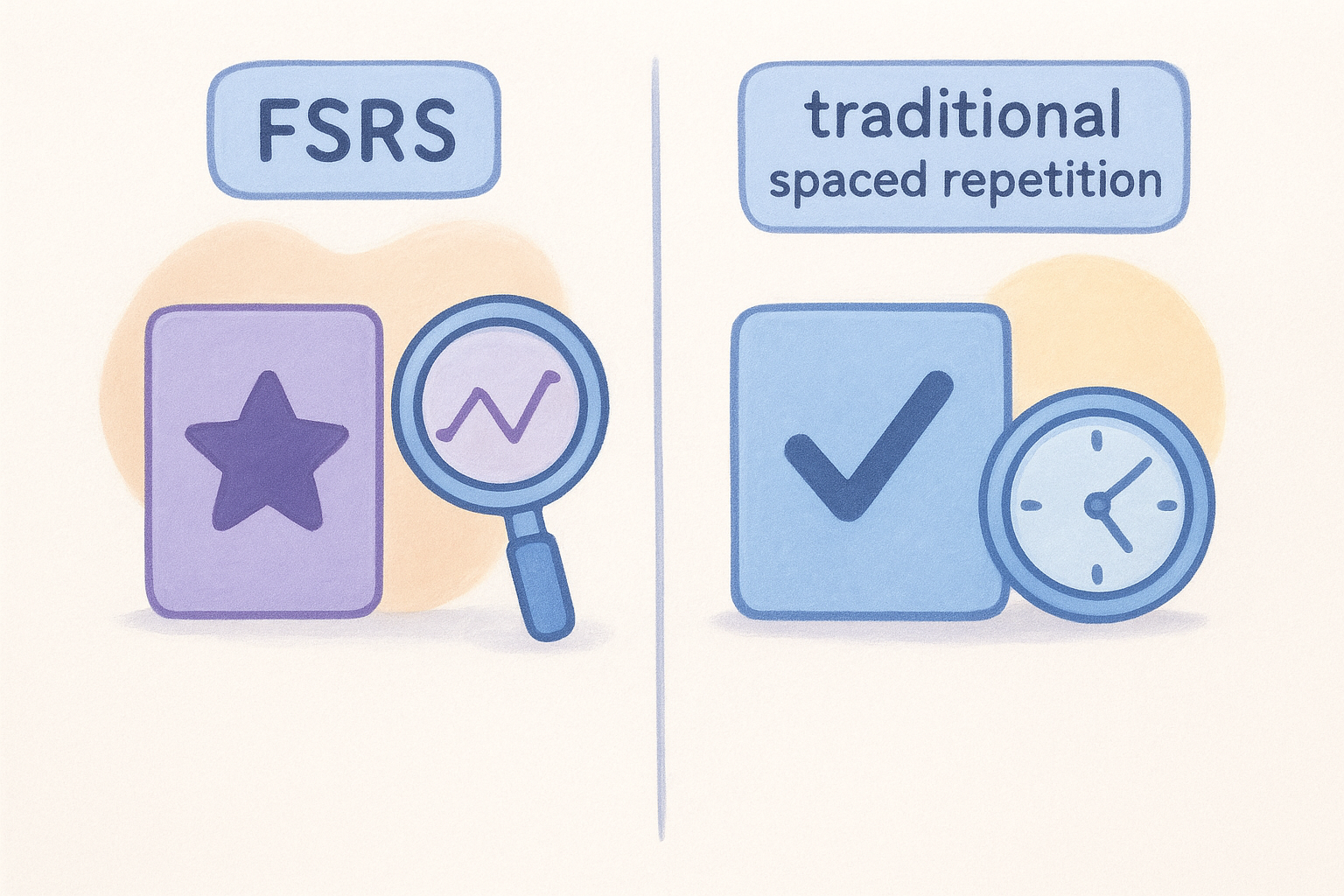
SM-2 has powered Anki and countless other apps since the late 1980s, and it works on a simple premise: multiply the interval by an easiness factor every time you answer correctly. That formula never looks at how difficult a specific card actually is for you, and it never adjusts based on patterns across your whole deck. FSRS replaces that fixed multiplier with a model trained on your review logs, which is why a spaced repetition algorithm built this way adapts instead of just accumulating.
Where the two approaches diverge
Comparing them side by side makes the gap obvious:
| Factor | SM-2 | FSRS |
|---|---|---|
| Personalization | Same formula for everyone | Trained on your own review history |
| Variables tracked | Easiness factor only | Difficulty, stability, retrievability |
| Handles inconsistent practice | Poorly, resets bluntly | Adjusts intervals dynamically |
| Retention control | Not adjustable | Set a target percentage directly |
| Predictive accuracy | Fixed rule, no forecasting | Forecasts forgetting probability |
Leitner-style box systems sit even further behind. They group cards into buckets and move them up or down a shelf, which is easy to understand but ignores difficulty entirely.
A formula that never looks at your data can't outperform one that learns from it.
Studies published by the FSRS development team, and independently reproduced by Anki users comparing retention logs, consistently show fewer total reviews for the same recall rate. That efficiency gain compounds fast once you're managing hundreds of cards across multiple instruments or skill areas.
Applying FSRS principles beyond flashcards
FSRS was built for card-based review, but the underlying logic applies to any skill that fades without reinforcement. A scale you nailed last month, a chord voicing you drilled last week, a tricky passage you finally cleaned up, all of these decay the same way a vocabulary word does. The forgetting curve doesn't care whether you're recalling a fact or executing a technique, it just tracks how long a memory holds before it needs reinforcement.
The math behind FSRS doesn't care if you're reviewing a word or a fingering pattern, decay works the same way.
Why musicians need this more than flashcard users do
Specifically, practice routines fail for the same reasons flashcard decks used to fail before FSRS existed: too many items competing for attention, no clear signal about what's slipping, and a schedule that's either guesswork or nonexistent. That's the gap MemoRep was built to close. It applies spaced repetition scheduling to practice cards you create for scales, repertoire, technique drills, or any skill that needs revisiting at the right interval, rather than forcing musicians to adapt flashcard software to a job it wasn't designed for.
What this looks like in daily practice
Consider how the same principles translate directly:
- Difficulty tracking flags which passages need more frequent attention
- Stability estimates tell you which pieces can safely wait longer
- Retrievability scoring catches skills before they've actually gone rusty
Understanding FSRS this way turns an abstract algorithm into a practical decision-making tool for anyone managing more than a handful of skills at once.
Making spaced repetition work for you
FSRS isn't just an upgrade to Anki's math, it's proof that a free spaced repetition scheduler built on real data beats a fixed formula every time. You now know how difficulty, stability, and retrievability drive each interval, why that beats SM-2's flat multiplier, and how the same logic applies to scales, passages, and technique drills that have nothing to do with flashcards.
Getting this right matters more once you're juggling repertoire alongside technique work, where a missed review costs you stage-ready skill, not just a wrong answer. That's the exact problem practice-focused scheduling solves, whether you're using Anki for facts or something purpose-built for physical skills.
Curious how this science translates into daily practice sessions? See how MemoRep applies FSRS-style scheduling to practice for scales, repertoire, and drills, and start scheduling practice that actually sticks.