
Leitner System Spaced Repetition: What It Is and How It Works
You've probably seen a box of flashcards divided into compartments and wondered why anyone would bother sorting index cards instead of just flipping through the whole deck. That system has a name: leitner system spaced repetition, a method German scientist Sebastian Leitner built in the 1970s to solve a simple problem. Your brain forgets things on a predictable schedule, and reviewing everything equally wastes time on stuff you already know cold.
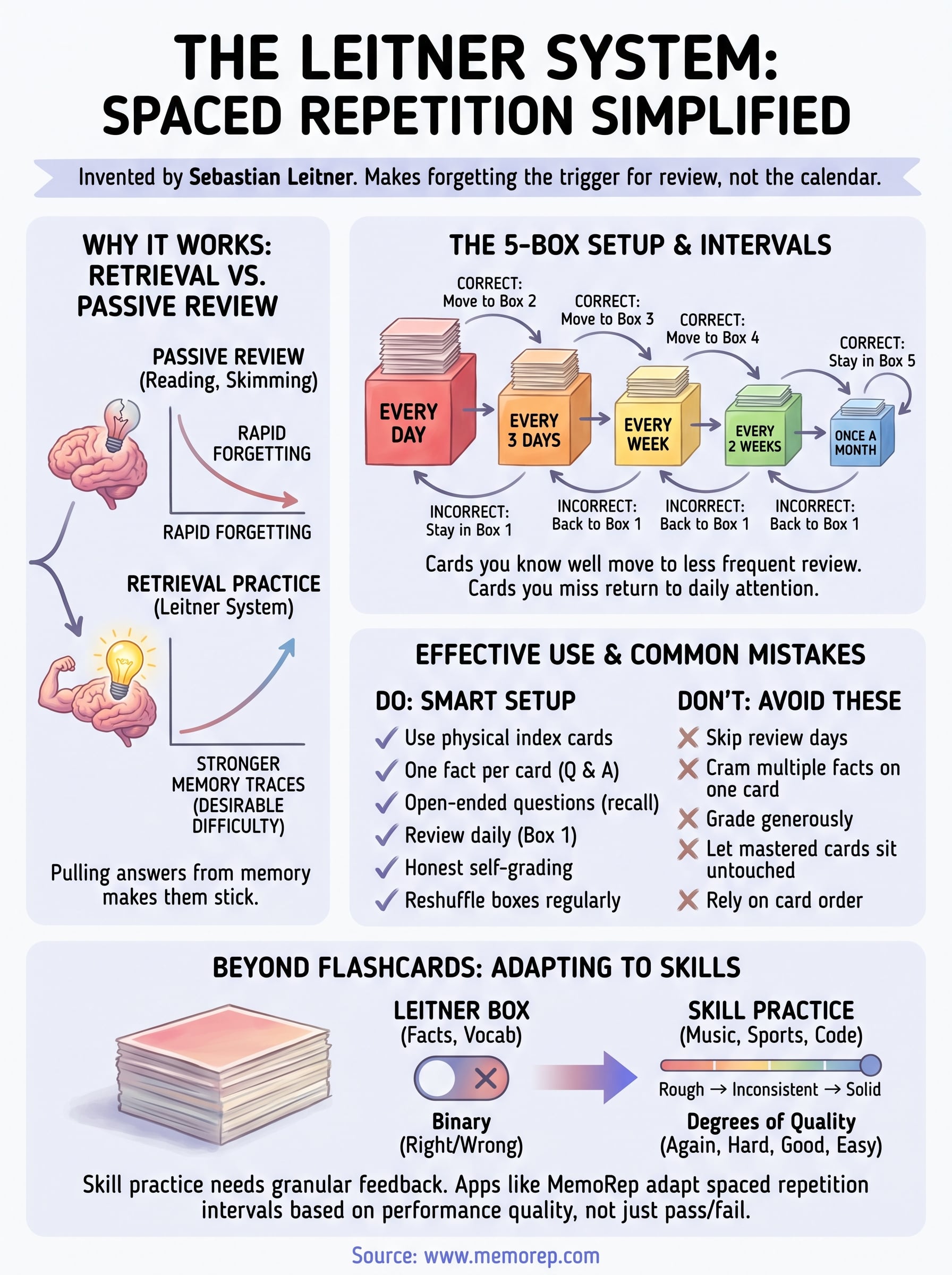
Here's the short answer: cards you get right move to boxes you review less often, cards you miss drop back to daily review, and the system automatically concentrates your effort where it's needed. It's a manual version of spaced repetition, no algorithm required, just a box, some dividers, and a review schedule you stick to.
This article walks through exactly how the boxes work, how to set up your own Leitner box system with index cards, and how the interval schedule compares to more modern approaches. If you're studying vocabulary or facts, this is a great low-tech starting point. If you're practicing something physical, like an instrument or a technique, you'll see later why card-based memorization hits a wall that skill practice doesn't.
Why the Leitner system works for long-term memory
Memory researchers have known since the 1880s that forgetting isn't random. Hermann Ebbinghaus mapped this out with what's now called the forgetting curve, and its origins are worth understanding, showing that people lose roughly half of new information within a day if they never review it, and the rate of loss slows down each time they successfully recall it again. Sebastian Leitner built his box system almost a century later around that exact insight. Instead of reviewing every flashcard on a fixed calendar regardless of how well you know it, the Leitner method ties review frequency to how often you actually get a card wrong, which is a much better predictor of when you'll forget it next.
Retrieval practice beats passive review
Getting a card right forces your brain to do something rereading a textbook never does: pull the answer out of memory without a prompt. Cognitive scientists call this retrieval practice, and dozens of studies back how retrieval-based studying works as one of the most reliable ways to make information stick. The Leitner system builds retrieval practice into its structure automatically. Every time you flip a card, you're testing yourself, not just skimming an answer. Hard-to-answer questions surface more often because incorrect answers send the card back to Box 1, which means you're forced to retrieve the same fact repeatedly until it actually holds.
The Leitner system works because it makes forgetting, not the calendar, the trigger for your next review.
Unequal intervals stop wasted effort
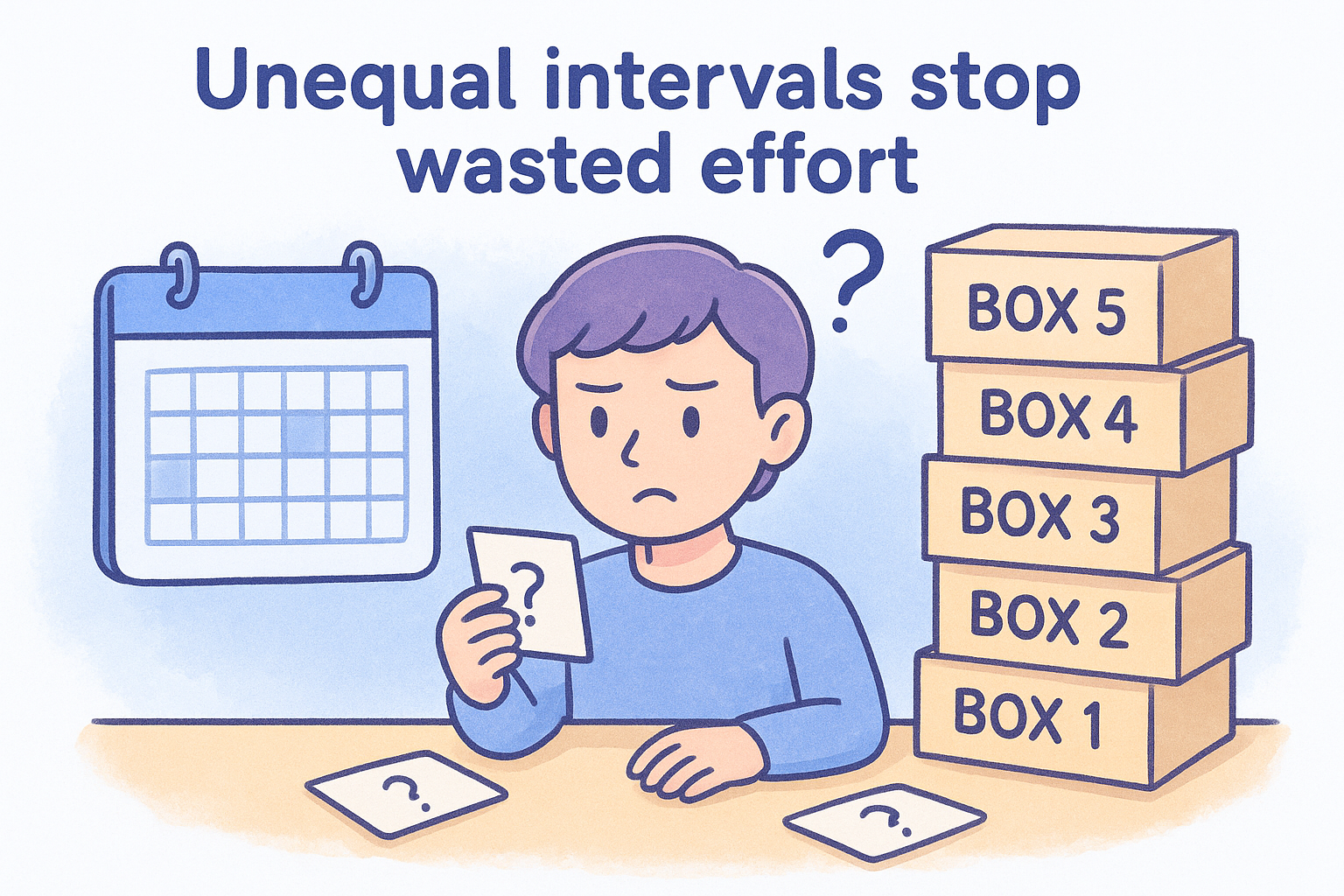
Just reviewing a flat deck of 200 cards every single day sounds thorough, but it's actually inefficient. You'll spend just as much time on the 150 cards you already know cold as the 50 you keep missing. A basic technique like Leitner's fixes this by spreading review intervals unevenly based on performance, which is what spaced repetition is at its core. Here's what that typically looks like in a standard five-box setup:
| Box | Review Frequency | If You Get It Right | If You Get It Wrong |
|---|---|---|---|
| Box 1 | Every day | Moves to Box 2 | Stays in Box 1 |
| Box 2 | Every 3 days | Moves to Box 3 | Back to Box 1 |
| Box 3 | Every week | Moves to Box 4 | Back to Box 1 |
| Box 4 | Every 2 weeks | Moves to Box 5 | Back to Box 1 |
| Box 5 | Once a month | Stays in Box 5 | Back to Box 1 |
Notice how a card you know well drifts toward monthly review, freeing up your daily session for the cards that actually need attention. A card you keep missing never escapes the frequent-review boxes, so you're guaranteed to see it again before you've had a chance to forget it entirely.
Struggle is part of the design, not a flaw
Something counterintuitive happens with this setup: the cards that feel the most frustrating, the ones that keep bouncing back to Box 1, are exactly the ones doing the most work for your long-term memory. Psychologists refer to this as desirable difficulty. Answers that come too easily don't strengthen memory much, while answers you have to work for, especially ones you got wrong recently and are now recalling correctly, create stronger and more durable memory traces. Leitner's box mechanism essentially guarantees you'll keep facing your weak spots at exactly the frequency needed to convert them into long-term memory, without you having to manually track which cards are struggling.
Why this matters more the longer you study
Over weeks and months, this compounding effect is where the Leitner system really separates itself from cramming or simple review. A student cramming for a test the night before might retain information for a few days, but that knowledge decays fast because it was never spaced out. Someone using a Leitner box, by contrast, is reviewing the same material at expanding intervals that roughly track how memory actually consolidates. Each successful recall pushes the next review further out, which means the total number of reviews needed to keep a fact permanently accessible keeps shrinking over time. That's the mathematical payoff of using spaced repetition for long-term memory: less total review time for better retention, as long as you stay consistent with the schedule. The system rewards discipline in the setup rather than raw study hours, which is exactly why it has survived, largely unchanged, for fifty years.
How to set up your own Leitner box system
Building a working Leitner system takes about twenty minutes and costs less than ten dollars if you're starting from scratch. You don't need a fancy app or a printed template, just a container that holds index cards in separate compartments and a stack of blank cards to write on. Physical index cards work better than digital ones for this method because the act of writing a question by hand forces you to think through the material before you even start reviewing, which is its own small form of retrieval practice.
Gathering your materials
Start simple. Here's the full list of what you actually need:
- A recipe box, shoebox, or accordion file with at least five dividers
- Index cards, either 3x5 or 4x6 depending on how much text each card needs
- A pen (avoid pencil, it smudges after repeated handling)
- Sticky labels or tape for marking each compartment with its box number
Skip anything more elaborate than this. People who buy pre-printed Leitner system flashcards kits often end up with rigid categories that don't match their subject, and the whole point of the system is flexibility.
Building the compartments
Label your dividers Box 1 through Box 5, or however many boxes your interval plan uses (more on choosing that in the next section). Box 1 should be the largest compartment, since that's where new cards and missed cards pile up, and it's also the one you'll open every single day. Boxes further down the line get progressively smaller because fewer cards live there at any given time.

Every card starts in Box 1. There are no shortcuts to earning your way into the slower review boxes.
Writing cards that actually test recall
Put one question on the front of each card and one answer on the back, writing cards that actually test recall instead of cramming multiple facts onto a single card. A card that asks three things at once is nearly impossible to grade honestly with a simple right-or-wrong call, and grading honesty is what keeps the whole system accurate. Questions should require you to produce an answer from memory, not recognize it from a list, so favor open-ended prompts over multiple choice whenever the subject allows it.
Running your first review session
Questions come up fast once the deck starts moving, so here's the basic loop to follow every day:
- Pull every card due for review that day (check your interval schedule for which boxes are active)
- Answer each card from memory before flipping it over
- Move correct answers forward one box; send incorrect answers straight back to Box 1
- Add new cards to Box 1 as you learn new material
- Reshuffle each box occasionally so you're not just memorizing card order
Running this loop consistently, even for just ten minutes a day, matters more than any single study marathon. The Leitner system rewards small, repeated effort over sporadic cramming, and that daily habit is what actually produces the retention gains the research promises. Once this rhythm feels automatic, the next question is how many boxes and what intervals actually fit your subject best.
Choosing the right number of boxes and intervals
Five boxes work fine for most subjects, but that number isn't a rule carved in stone. Leitner's original design used five, and it's still the right starting point for beginners because it's easy to track and gives enough spacing to separate "barely learned" from "permanently known." Still, the right box count depends on how much material you're studying and how long you plan to keep reviewing it. A student cramming for a test in three weeks needs a tighter, shorter cycle than someone building vocabulary for a language they'll use for years.
The classic five-box setup
Stick with five boxes if you're new to the method or studying a moderate amount of material, somewhere under a few hundred cards. This setup balances daily review load against how quickly cards graduate to less frequent boxes. Below is a quick reference for how the standard version scales:
| Boxes | Best For | Time to Reach Longest Interval |
|---|---|---|
| 3 boxes | Short-term cramming (exam in 1-2 weeks) | About 1 week |
| 5 boxes | General study, moderate card volume | 4-6 weeks |
| 7+ boxes | Large decks, long-term retention goals | 3+ months |
Notice that adding boxes doesn't just add review sessions, it stretches out the total timeline before a card reaches its slowest interval. That's useful if you're planning to retain the material for years, but it's overkill if your only goal is passing a test next Friday.
When to add more boxes
Expanding beyond five boxes makes sense once your deck grows past a few hundred cards or once you notice Box 5 filling up with cards you haven't missed in months. At that point, a monthly review is still more frequent than necessary, and a sixth or seventh box stretching to every two or three months keeps your review sessions from becoming clogged with material you've clearly locked in. Language learners studying vocabulary for years, or musicians relying on spacing to keep a repertoire sharp over a long career, often end up with seven or eight boxes precisely because the horizon for "permanently known" keeps extending.
More boxes only help if your material needs longer retention. Otherwise, you're just adding steps between you and confirming what you already know.
Matching intervals to how hard the material is
Not every subject deserves the same spacing. Dense, interconnected material, like anatomy terms or music theory concepts that build on each other, benefits from tighter early intervals because forgetting one piece often breaks your understanding of the next. Looser material, like isolated vocabulary words with no dependency on each other, tolerates wider gaps sooner. If you're studying something conceptually heavy, consider shrinking your Box 2 and Box 3 intervals (say, every 2 days instead of every 3) even if it means more frequent handling of the deck overall.
Question difficulty also matters more than most people account for when setting up their box system. A card that took you three tries to memorize the first time deserves closer monitoring than one you nailed instantly, even after both technically reach Box 3. Some practitioners solve this by splitting Box 1 into two tiers, brand-new cards and repeat offenders, so genuinely stubborn material gets flagged for extra attention rather than blending in with cards that are simply new. Whatever interval structure you land on, write it down somewhere visible near your box. Memory for the schedule itself fades just like memory for the cards, and an inconsistent review cadence undoes most of the benefit the whole system is built to deliver.
Common mistakes that undermine the Leitner system
Even a well-built box system falls apart if you handle it carelessly day to day. Most people who quit on leitner system spaced repetition don't fail because the method is flawed, they fail because they drift into habits that quietly cancel out its benefits. Here are the mistakes that show up most often, and why each one matters more than it seems.
Skipping days breaks the whole schedule
Missing a single review day feels harmless, but the Leitner system runs on the assumption that every box gets opened on its assigned day. Skip Box 1 for three days and you're not just delayed, you've let cards sit past the point where they'd naturally start fading, which defeats the entire premise of catching forgetting before it happens. Consistent daily review matters more than the size of any single session, so a rushed five-minute pass through Box 1 beats a skipped day every time, and a reminder app that nudges you on schedule can carry that habit. If a day gets missed, don't try to double up the next session to compensate. Just resume the schedule and let the natural drift sort itself out over the following week.
Missing review days doesn't pause the forgetting curve, it just lets it run unchecked.
Cramming too much onto one card
A card that asks "define X, list its three subtypes, and explain why it matters" isn't testing recall, it's testing patience. When a card holds multiple facts, you end up grading it right if you remember two out of three points, which quietly corrupts the whole feedback loop the system depends on. Single-fact cards keep grading honest because there's no partial credit to fudge, which is one reason the 30-second card rule holds up so well. If you catch yourself writing a card with "and" in the question, split it into two cards instead.
Grading yourself too generously
It's tempting to call a fuzzy, half-right answer a win just to watch a card move forward. But every card you push ahead before you've actually mastered it is a card that will resurface later, at a longer interval, exactly when you're least prepared to relearn it from scratch. Honest self-grading is the mechanism that makes the whole schedule accurate, and bending it even occasionally undoes weeks of otherwise disciplined review.
Letting mastered cards sit untouched
Box 5 can turn into a graveyard if you assume once-a-month review means "basically done forever." Skills and facts alike still decay eventually, just slower, and a card that's been sitting untouched for six months because you forgot to check that box isn't actually locked in anymore. Rotate through even your slowest boxes on schedule, without exception.
Relying on card order instead of recall
Finally, watch out for positional memory. If your cards always sit in the same order inside each box, you'll start recognizing the third card in the stack rather than actually recalling the answer. Reshuffling regularly, mentioned earlier as part of the basic setup, is what keeps this from happening, and it's one of the most overlooked steps in an otherwise solid spaced repetition technique.
Leitner system vs other spaced repetition methods
The Leitner system isn't the only game in town, and once you've run a physical box for a few weeks, you'll naturally start wondering how it stacks up against the algorithms baked into modern apps. The short answer: Leitner is the simplest and most transparent version of spaced repetition, while apps that run the algorithm for you trade that simplicity for precision. Both rely on the same underlying idea from Ebbinghaus, but they calculate your next review very differently.
Fixed intervals vs adaptive algorithms
Leitner boxes use fixed jumps. A card in Box 2 always waits three days, whether you answered it instantly or barely scraped by. The SM-2 algorithm, which powers most software built to automate review intervals, calculates a unique interval for every single card based on how easy or hard you rated it, how many times you've seen it, and how long you waited last time. That's a meaningfully different level of granularity, and it's the main reason software-based spaced repetition tends to outperform paper boxes for large decks.
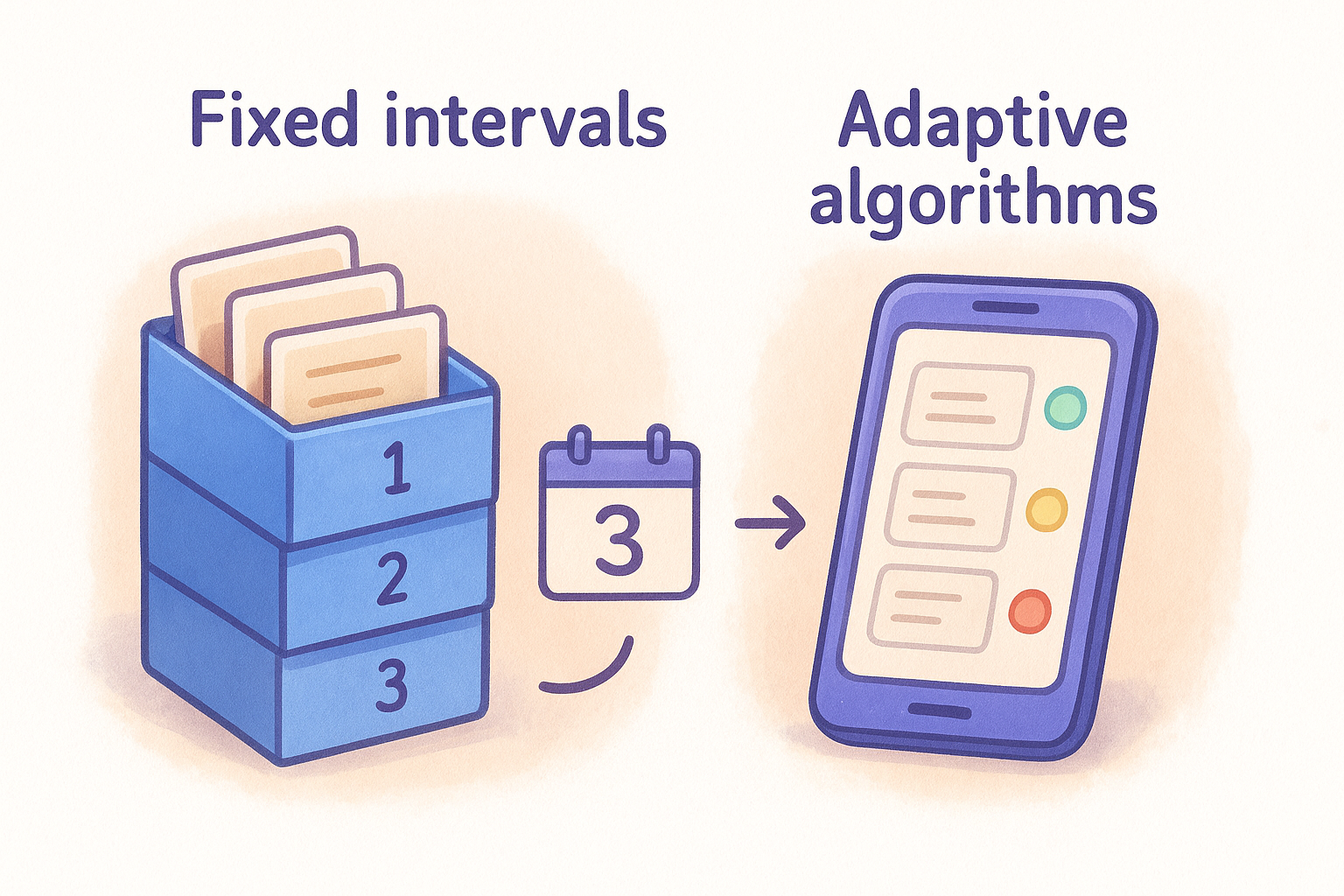
A physical box sorts cards into five buckets. An algorithm calculates a different interval for every single card.
Comparing the two side by side
| Factor | Leitner Box System | Algorithm-Based (SM-2 style) |
|---|---|---|
| Interval precision | Fixed, per box | Calculated per card |
| Setup cost | Index cards, a box, dividers | An app or account |
| Grading scale | Right or wrong | Again/Hard/Good/Easy |
| Scales to thousands of cards | Poorly, boxes get unwieldy | Well, no physical limit |
| Transparency | You see the whole system at a glance | Runs in the background |
| Best for | Small decks, low-tech learners | Large decks, long-term tracking |
Where the four-point grading scale wins
One practical limitation of the classic Leitner method is its binary grading: right or wrong, nothing in between. That's fine for simple facts, but it flattens out the difference between a card you nailed instantly and one you scraped through after a long pause. Apps built on SM-2 fix this with an Again/Hard/Good/Easy rating system, which feeds more information into the next interval calculation, as a comparison of Anki, Quizlet, and MemoRep makes clear. A card you rate Hard gets a shorter bump than one you rate Easy, even if both are technically correct, so the schedule reflects your actual confidence rather than a flat pass-fail check.
Why the comparison matters beyond flashcards
Here's where the comparison gets more interesting for anyone practicing a physical or performance-based skill rather than memorizing facts. Both Leitner boxes and SM-2 apps were designed around discrete question-and-answer pairs, the real difference between flashcards and active recall, which works fine for vocabulary or historical dates but breaks down fast for something like a musical passage, a technique, or a physical drill. Skills don't have a clean right-or-wrong answer the way flashcards do, they have degrees of quality that unfold over repeated attempts. That gap is exactly why a platform like MemoRep was built specifically for practical skill practice, applying the same underlying spaced repetition science with an interval system closer to SM-2's adaptive precision, but structured around practice sessions and performance feedback instead of card flips. If you've outgrown index cards or you're practicing something that was never really a flashcard problem to begin with, that's the direction worth exploring next.
Adapting the Leitner system beyond flashcards
Nothing about Leitner's core logic actually requires an index card. The real invention isn't the box, it's the rule: things you handle well move to less frequent review, things you struggle with come back sooner. That rule applies just as well to a golf swing, a coding pattern, or a piece of sheet music as it does to a vocabulary word. Practicing a skill deliberately just needs a different way to track the "card" and a different way to grade the outcome, since you can't flip a guitar solo over and check the back for the right answer.
Turning practice items into trackable units
Start by treating each discrete skill or exercise as its own unit, the same way a flashcard holds one question. A drummer might track a specific fill, a rock climber a particular move sequence, a public speaker a transition between talking points. Each of these units gets logged with a rough sense of when you last worked on it and how it went, which is exactly the information a Leitner box normally stores in which compartment a card sits in. The mechanics change, but the underlying question stays the same: is this good enough to leave alone for a while, or does it need attention again soon?
Why binary grading breaks down fast
Here's where skills diverge sharply from facts. A vocabulary card is either recalled correctly or it isn't, but a musical passage played through can be mostly right with a few sloppy transitions, or technically correct but rushed and tense. Grading that on a strict right-or-wrong scale throws away most of the useful information. Performance-based feedback needs more granularity, something closer to a scale that captures degrees of quality rather than a single pass-fail checkbox.
A flashcard is either remembered or forgotten. A skill is played well, played roughly, or barely holds together, and your review schedule needs to know the difference.
Building a rough skill-based system by hand
You can approximate this with a notebook or spreadsheet instead of a physical box. List each exercise, note the date of your last attempt, and rate it on a simple scale after each session:

- Rough: barely got through it, revisit within a day or two
- Inconsistent: got it right once but not reliably, revisit within a week
- Solid: nailed it cleanly, push the next review out two to three weeks
This manual version works, but it puts the entire scheduling burden back on you, the exact decision fatigue the original Leitner box was built to eliminate. Keeping dozens of exercises straight by hand, each on its own interval, starts to resemble a part-time bookkeeping job rather than a practice routine.
Where a purpose-built tool takes over
That gap between flashcard logic and real skill practice is precisely what led to building MemoRep, a platform that keeps the spaced repetition math Leitner pioneered but swaps rigid boxes for an adaptive scheduler built around practice sessions instead of card flips. Rating a passage Again, Hard, Good, or Easy feeds the same kind of interval calculation SM-2 apps use for facts, except it's applied to a musical run-through, a technique, or a drill, and it tracks every exercise across your whole practice routine automatically. If you've been trying to bend an index card system to fit skill practice, this is the tool built for the job instead.
Making spaced repetition a lasting habit
What you've read here boils down to one idea: leitner system spaced repetition works because it forces review at the exact moment forgetting starts, not on some arbitrary calendar. A shoebox with five dividers can absolutely deliver that for vocabulary lists, historical dates, or anything with a clean right-or-wrong answer. The discipline matters more than the tool, and a well-run paper system will outperform a neglected app every time.
But once you're practicing something with degrees of quality instead of a binary answer, a scale, a solo, a serve, the boxes stop fitting. Skill-based practice needs the same spacing logic applied to performance feedback, not flashcard recall. If that's where you've landed, stop forcing an index card to do a job it wasn't built for. See how MemoRep turns spaced repetition into a practice schedule and get your routine actually organized.