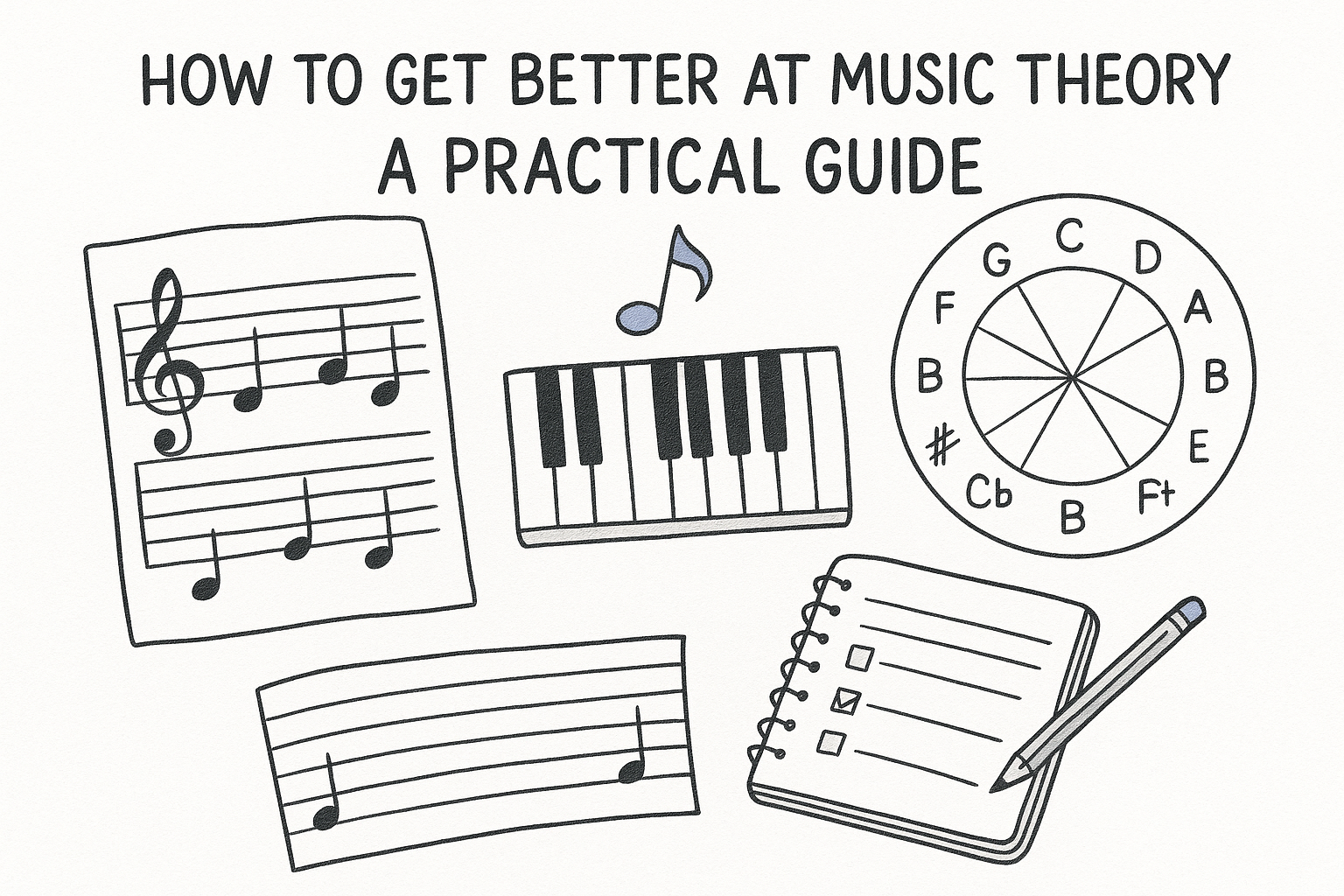
How to Get Better at Music Theory: A Practical Guide
You can name every chord in a Real Book chart but still freeze when someone asks you to explain why a ii-V-I works. That gap between recognizing theory terms and actually using them is where most musicians get stuck. Learning how to get better at music theory isn't about memorizing another rulebook, it's about building the kind of understanding you can hear and apply on your instrument in real time.
The fastest path forward combines focused study with deliberate, repeated practice, not passive reading. You need to drill intervals, chord qualities, and key signatures until they become instinct, then apply that knowledge directly to your playing so it sticks. Random review sessions won't get you there. What works is spaced repetition, revisiting concepts right before you'd otherwise forget them.
This guide walks you through the specific study methods, ear training drills, and practice structures that actually move the needle on your theory knowledge. You'll get a concrete practice framework you can start using today, plus tips on tracking what needs review and when, so theory stops feeling like an abstract subject and starts feeling like a tool you actually own.
What you need before you start learning theory
A keyboard, even without piano skills
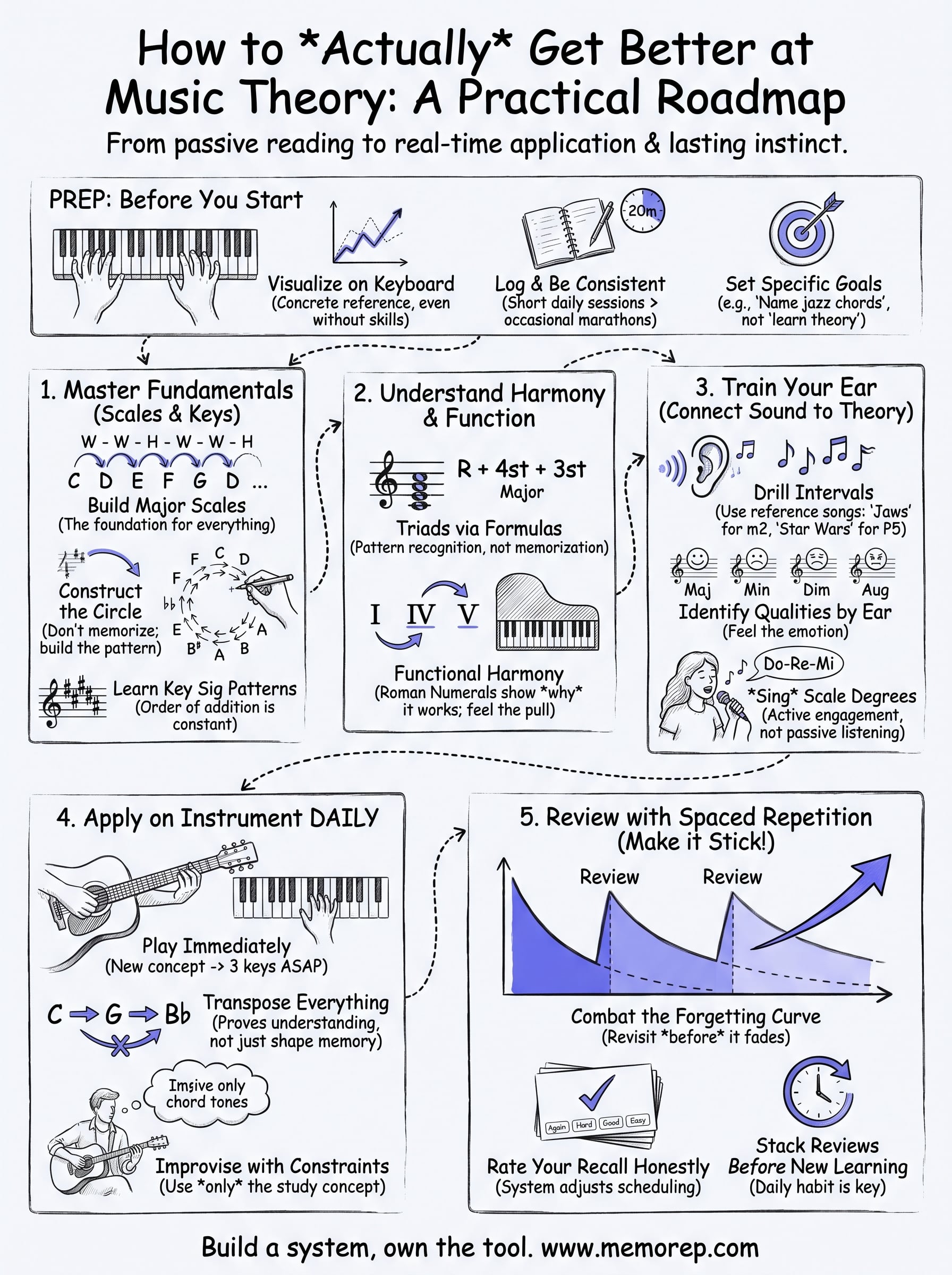
Grab access to a piano or keyboard before you open a single theory book. Visualizing intervals and chords on a keyboard makes abstract concepts concrete in a way that staring at notation never will. You don't need to play piano well, you just need to see the whole and half steps laid out in a line so your brain has a physical reference for what an interval or a chord shape actually looks like. A free app or a $30 MIDI keyboard works fine for this.
Basic reading skills you should already have
Before diving into scales and harmony, make sure you can read music at a beginner level. If you can already identify note names on the staff and clap out simple rhythms, you're ready to move faster through the steps ahead. If not, spend a week on this first, because everything else in this guide assumes you can read a lead sheet or a simple score without stopping to decode every note.
- Note names on the staff you play (treble, bass, or both)
- Basic rhythm values: whole, half, quarter, eighth notes
- Time signature basics (4/4, 3/4, 6/8)
- How to find middle C and orient yourself on your instrument
A notebook or app to log what you learn
Getting better at theory fails most often not from lack of information but from lack of tracking. You'll learn a concept, feel good about it, then forget it three weeks later because nothing prompted you to revisit it. Set up a simple system now, even a plain notebook, where you log every new concept with the date you learned it. This single habit separates people who actually retain theory from people who keep re-reading the same introductory chapters every few months.
If you don't track what you've learned, you'll relearn the same concepts over and over instead of building on them.
Twenty minutes a day, not two hours on Sunday
Consistency beats intensity here. Short daily sessions cement theory far better than one marathon session a week, because your brain needs spaced exposure to move concepts from short-term to long-term memory. Block off 15 to 20 minutes daily rather than carving out a single two-hour block once a week. Musicians who try to cram theory into weekend sessions almost always report the same thing: they forget most of it by the following Saturday.
A goal that's specific, not vague
Lastly, decide what "better at theory" actually means for you before you start. "I want to understand music theory" is too vague to act on. Instead, pick something specific: "I want to be able to name every chord in a jazz standard" or "I want to write a chord progression without guessing." A specific target tells you which chapters to prioritize and gives you a way to measure progress instead of just accumulating facts with no clear direction.
Step 1. Master notation, scales, and key signatures
Start with the major scale, because everything else in theory branches off from it. Learn to build a major scale from any root note using the whole-half step pattern (W-W-H-W-W-W-H), then practice writing out all twelve major scales by hand. This single exercise teaches you why certain keys have sharps and others have flats, and it removes the guesswork that trips up so many self-taught musicians later on.
Learn the circle of fifths by building it, not memorizing it
Don't just stare at a circle of fifths diagram and try to memorize it. Build it yourself by starting on C and stacking perfect fifths upward (C, G, D, A, E...), then track which sharps get added at each step. Do the same going the other direction with flats. Once you've constructed it once with your own hand, the pattern sticks in a way that flashcards never manage.
Memorizing a diagram fades fast, but building the pattern yourself makes it permanent.
Get key signatures down cold
Key signatures are where a lot of players stall out, mostly because they try to memorize twelve separate lists instead of one repeating pattern. Use this reference while you drill, and quiz yourself daily until you can name any key's signature in under three seconds:
| Key | Sharps/Flats | Order Added |
|---|---|---|
| G major | 1 sharp | F# |
| D major | 2 sharps | F#, C# |
| A major | 3 sharps | F#, C#, G# |
| F major | 1 flat | Bb |
| Bb major | 2 flats | Bb, Eb |
| Eb major | 3 flats | Bb, Eb, Ab |
Notice the sharps always add in the same order (F, C, G, D, A, E, B) and flats add in the reverse order. Recognizing this pattern cuts your memorization workload by more than half.
Add minor scales once major feels automatic
Once major keys feel automatic, move to natural, harmonic, and melodic minor. Focus on the relative minor relationship first (every major key shares a key signature with a minor key a third below it), since that connection alone explains a huge chunk of the notation you'll see in real scores. Skip ahead to chords only once you can write out a scale and its key signature from memory without checking a reference.
Step 2. Learn how chords and harmony work
Chords are just stacked intervals, so once you've got your scales down, building chords becomes pattern recognition instead of memorization. Grasp triads first (major, minor, diminished, augmented), then move to seventh chords, since nearly every progression you'll encounter in real music uses one of these basic chord types. Treat harmony as a system of relationships between chords, not a list of isolated shapes you memorize one by one.
A chord means almost nothing on its own, it only makes sense in relation to the chords around it.
Build every triad from the same formula
Apply one interval formula to every root note instead of memorizing twelve separate chord shapes. Once this table is automatic, you can spell any triad in seconds:
| Triad Type | Formula (from root) | Example (C root) |
|---|---|---|
| Major | Root, +4 half steps, +3 half steps | C, E, G |
| Minor | Root, +3 half steps, +4 half steps | C, Eb, G |
| Diminished | Root, +3 half steps, +3 half steps | C, Eb, Gb |
| Augmented | Root, +4 half steps, +4 half steps | C, E, G# |
Drill this daily, picking a random root note and spelling all four qualities from memory before you check your work.
Learn functional harmony through roman numerals
Go beyond spelling chords and learn how they function inside a key, since roman numeral analysis is what actually lets you understand why progressions work. Take any major key and label the triads built on each scale degree: I, ii, iii, IV, V, vi, vii°. Then study the three progressions that show up constantly in real music: I-IV-V-I, I-vi-IV-V, and ii-V-I. Play each one on your instrument and notice how the V chord pulls back toward I, that pull is the entire engine behind most Western harmony.
Add seventh chords once triads feel automatic
Only move to seventh chords (maj7, min7, dom7, half-diminished) once triads feel instinctive, since sevenths are triads with one extra note stacked on top. Spelling a dominant seventh chord correctly, and recognizing why it wants to resolve, sets you up perfectly for the ear training work in the next step.
Step 3. Train your ear to recognize what you learn
Knowing a chord formula on paper means nothing if you can't recognize that same chord when it plays through your speakers. Ear training closes the gap between theory knowledge and real musical instinct, turning abstract labels into sounds you recognize instantly. Skip this step and you'll keep needing to look up what you already "know," because your brain never linked the concept to an actual sound.
Theory you can't hear isn't theory you can use.
Drill intervals with reference songs
Associate each interval with a familiar song so you have an instant reference point instead of guessing from scratch. Use a simple tool like a free ear-training app or just your instrument, and drill five minutes daily:
- Minor 2nd: Jaws theme
- Major 3rd: Kumbaya
- Perfect 4th: Here Comes the Bride
- Perfect 5th: Star Wars main theme
- Octave: Somewhere Over the Rainbow
Play two random notes, guess the interval, then check yourself on an instrument. Consistent daily reps beat occasional long sessions here just as much as they do with scales.
Identify chord qualities by sound, not sight
Once intervals feel automatic, move to full chords. Play a major, minor, diminished, and augmented triad back to back and notice how each one feels emotionally, bright, sad, unstable, tense. Add seventh chords once triads click, since recognizing chord quality by ear is what lets you transcribe songs and follow progressions in real time instead of hunting for sheet music every time you want to learn something new.
Sing scale degrees, don't just listen passively
Singing forces active engagement in a way passive listening never does. Practice solfege (do, re, mi) or scale-degree numbers against a drone note, singing the tonic, then the third, then the fifth, until you can find any scale degree on command. This single habit trains your brain to hear function, not just pitch, so when you hear a V chord resolve to I in a real song, you recognize the motion instead of just the notes. Fifteen minutes of this daily does more for your ear than an hour of passive listening ever will.
Step 4. Apply theory on your instrument every day
Reading about a ii-V-I progression and playing one are two completely different skills, and only one of them counts as theory you can use. Every concept from Steps 1 through 3 needs to move onto your instrument the same day you learn it, otherwise it stays trapped as trivia. Set a rule for yourself: no new theory concept gets logged in your notebook until you've physically played it at least ten times.
Theory that never touches your instrument is just information, not skill.
Play every new concept before you write it down
Whenever you learn a scale, chord, or progression, grab your instrument immediately and play it in at least three keys before moving on. This forces your hands to internalize the shape instead of just your eyes recognizing the pattern on paper. A simple daily checklist keeps this consistent:
- Play today's new scale or chord in 3 different keys
- Play yesterday's concept once from memory, no reference
- Apply one concept inside a song you already know
Transpose everything you learn
Transposing is the single fastest way to prove you actually understand a concept rather than memorized one example of it. Take whatever progression you studied that day, say I-vi-IV-V in C major, and play the exact same progression in G, D, and F. Transposing on the spot exposes gaps immediately: if you can play a progression in C but freeze in F, you've memorized shapes instead of relationships, and that gap is exactly what daily transposition closes.
Improvise using only the concept you're studying
Once you've drilled a concept in multiple keys, spend five minutes improvising over a simple backing track using only that concept. If you're working on dominant seventh chords, restrict yourself to outlining that chord's notes while soloing, ignoring everything else you know. This constraint sounds limiting but it's exactly what makes the concept stick, because improvising with constraints forces your ear and your hands to work together in real time instead of relying on notation as a crutch.
Step 5. Review with spaced repetition to make it stick
All the drilling in Steps 1 through 4 builds knowledge, but knowledge fades on a predictable schedule unless you interrupt it. The Ebbinghaus forgetting curve shows that you lose most new information within days unless you revisit it at the right moment, not too early, not too late. This is why re-reading a chapter you already "know" feels useless, and why cramming key signatures the night before a lesson never survives past the weekend. Spaced repetition fixes this by scheduling review right before a concept would otherwise slip away.
Reviewing too early wastes time, reviewing too late means relearning from scratch, spaced repetition finds the point in between.
Turn every concept into a reviewable card
Break each theory concept from Steps 1 through 4 into a single testable question instead of a vague topic. "What's the key signature for Eb major" beats "review key signatures" because you can grade yourself instantly and honestly. Build a card for every scale, chord formula, roman numeral progression, and interval you drill, so nothing depends on your memory of what you meant to review.
Rate yourself honestly after every review
Use a simple four-point scale after each review so the system knows when to bring a concept back:
- Again: you blanked, review it tomorrow
- Hard: you got there slowly, review in a few days
- Good: you answered correctly, push it out a week or two
- Easy: instant recall, push it out a month or more
This feedback loop is exactly what an app like MemoRep automates for practical skills, adjusting your next review date based on how you actually performed instead of a fixed calendar.
Stack reviews on top of new learning, don't replace it
Spaced repetition works alongside Steps 1 through 4, not instead of them. Spend your first 15 minutes daily reviewing due concepts, then move into new material or instrument practice. Consistent daily review sessions keep old material fresh while you keep building forward, so you're never choosing between learning something new and losing something you already earned.
Making theory a habit, not a hurdle
Getting better at music theory comes down to a simple loop: learn a concept, play it on your instrument, hear it, then review it before you forget it. Skip any one of those four pieces and progress stalls, no matter how many books you read. The musicians who actually retain theory aren't smarter, they just built a system for daily review instead of relying on willpower to remember what they studied last month.
You don't need to build that system from scratch or track everything in a notebook forever. Spaced repetition software does the scheduling math for you, telling you exactly which scale, chord, or progression is about to fade and needs a five-minute review today. If you want to see how that scheduling actually works before you commit to it, check out the science behind memoRep's algorithm and start turning today's practice into knowledge that actually sticks.