How to Practice Intervals on Guitar and Make Them Stick
The best way to learn how to practice intervals on guitar is to treat them as a set of small, separate drills and review each one on a spaced schedule, instead of grinding through all of them in one sitting. Split your interval work into cards, rate how each pass went, and let the gap between reviews grow as a drill gets easier. That way the intervals stay under your fingers for months, not days.
Most players know the pattern. You spend a week on thirds, feel good, move on to sixths, and a month later the thirds feel foreign again. Or you sit down with twenty possible exercises and burn ten minutes deciding which one to play. Rusty skills, random sessions and decision fatigue are scheduling problems, not talent problems.
This guide covers the scheduling side only. It does not teach theory or technique, because what to play and how to play it belongs to your teacher, course or book. What you get here is a four-step system for organizing that material: choose a small set, turn each drill into a card, rate every pass honestly, and review on a rhythm. The examples use MemoRep, a spaced repetition practice app, but the method works on paper too.
Why intervals fade without a schedule
Intervals fade because skills you stop revisiting decay on a predictable curve, and a spaced schedule brings each drill back just before it slips.
What the forgetting curve means for your fretboard work
Hermann Ebbinghaus's forgetting curve research showed that memory drops fastest right after learning and flattens out with each well-timed review. Algorithms like SuperMemo SM-2 turn that into a schedule: review soon after first learning, then wait longer each time the review goes well.

Interval work suits this well. It is a pile of similar drills, each with its own string pair, key and direction. Similar drills are easy to blur together, and the ones you skip quietly decay. A schedule decides for you which drill is due, so no drill gets dropped by accident.
What you need before you start
Gather four things first:
- A source of exercises from your teacher, a book or a course
- Your guitar, plus a metronome if your material uses one
- 15 to 25 minutes a day
- A place to track cards, either MemoRep or a notebook
The source matters most. If you do not have one yet, ask your teacher which interval exercises to work on before you build any cards.
A schedule does not teach you the interval. It makes sure the interval you learned does not quietly disappear.
Step 1. Pick a small interval set
Start with a small active set, roughly five to ten drills, taken from the material your teacher or course assigned. A short list gets reviewed often enough to stick, while a long one gets skimmed.
Choose material, not method
Write down only what your source tells you to practice. If your teacher assigns minor and major thirds on two string pairs, that is four drills. If your course covers every interval in one chapter, take the first few, not the whole chapter.
Do not invent exercises to fill gaps. Anything you add becomes one more thing to schedule, and a wrong exercise reviewed on a perfect schedule is still wrong.
Size the set to your time
Match the number of drills to your daily minutes. Here is how that works out:
| Daily time | Active drills | Time per drill |
|---|---|---|
| 15 minutes | 5 | 3 minutes |
| 20 minutes | 6 to 7 | About 3 minutes |
| 25 minutes | 8 | About 3 minutes |
Not every drill is due every day. Spaced scheduling means only some come up, so a set of eight usually leaves room in a 20-minute session. Keep the rest of the set in the queue and add new drills later, in Step 4.
Five drills that you review on time beat twenty that you review when you remember.
Step 2. Turn each drill into a practice card
A practice card is one drill with one clear finish line. If a card holds two drills, you cannot rate it honestly, because one half may be easy while the other is not.
Write the card so you cannot misread it
Every card needs a name, a source, its setup, and a "done when" line. Copy this template:
Title: [interval] on [string pair], [key]
Source: [teacher, book, or course, with page or lesson]
Setup: [tempo, key, fretboard area]
Done when: [e.g., one clean pass, no stops, at target tempo]
The "done when" line is what separates a card from a vague intention. "Clean pass at the target tempo" can be rated. "Work on thirds" cannot.
Example cards
These example labels show the format only. The content of each drill comes from your own source.

| Title | Setup | Done when |
|---|---|---|
| Minor 3rds, strings 3-2 | Key of C, 60 bpm | One clean pass, no stops |
| Major 3rds, strings 3-2 | Key of C, 60 bpm | One clean pass, no stops |
| Minor 3rds, strings 4-3 | Key of G, 60 bpm | One clean pass, no stops |
| Major 6ths, strings 4-2 | Key of C, 50 bpm | Two clean passes in a row |
Create the cards inside one project, such as "Interval drills," so your interval work stays separate from songs and other exercises.
A card with a clear finish line is a card you can rate honestly.
Step 3. Practice due cards and rate each pass
Each day, open only the cards that are due, play each one, and rate it right after. The rating is the data that tells the schedule what to do next.
Run the session
Work through the cards that are due. Spend a few minutes per card, stop when you meet the "done when" line, and rate before you move on. Rating later means rating from memory, and memory is generous.
A worked example: six cards due, three minutes each, is 18 minutes. Add two minutes between cards for rating and resetting and you land near 20. If you have only 15 minutes, do the cards that are most overdue first and let the rest roll to tomorrow. MemoRep sends a daily practice notification so the session does not depend on your memory.
Use the four ratings consistently
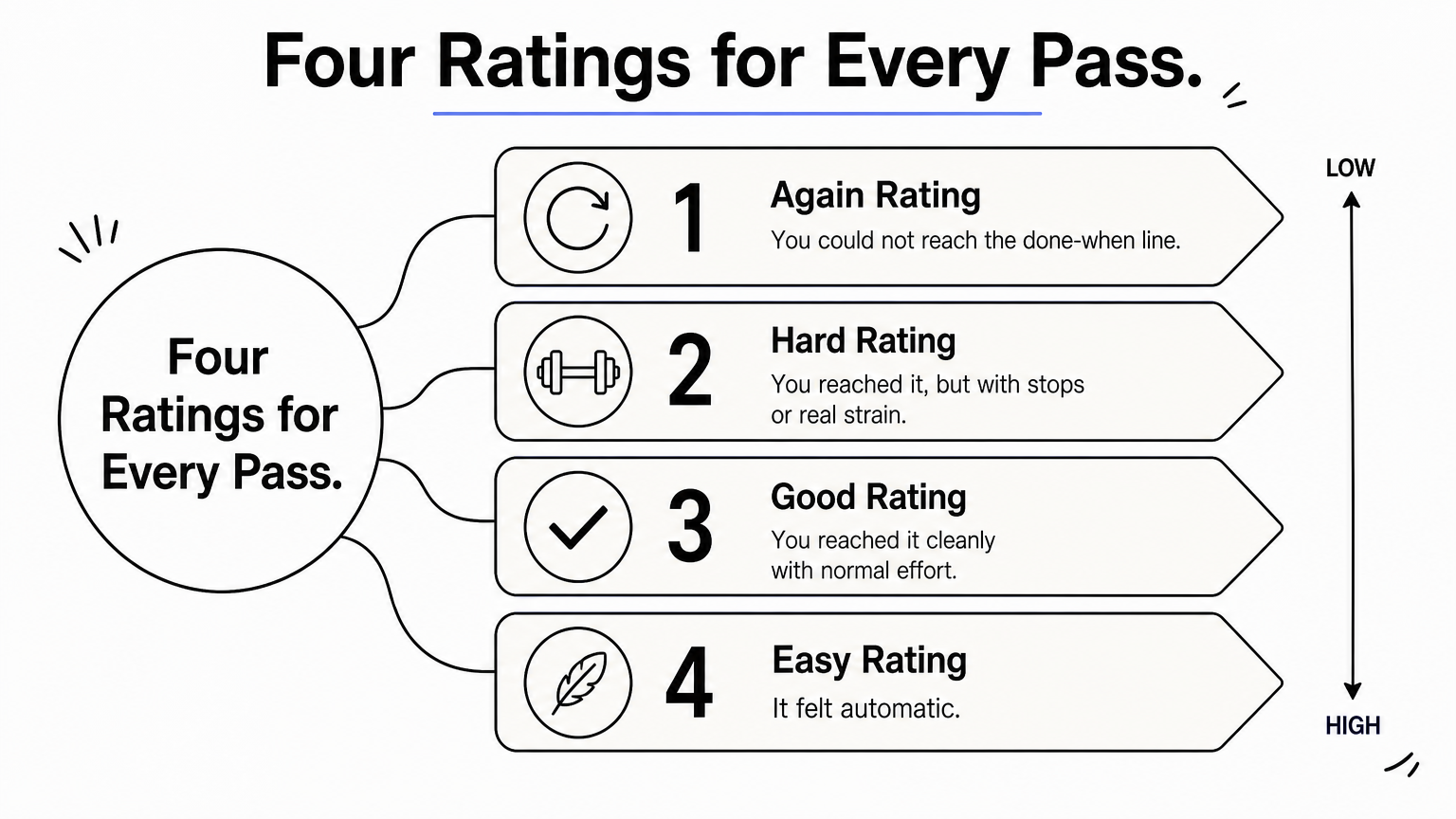
MemoRep uses an Again, Hard, Good, Easy scale. Use the same standard every day:
| Rating | Use it when |
|---|---|
| Again | You could not reach the "done when" line |
| Hard | You reached it, but with stops or real strain |
| Good | You reached it cleanly with normal effort |
| Easy | It felt automatic |
Be strict. Rating Good when it was really Hard pushes the next review too far out, and the card fades. Rate Again without guilt. It simply brings the drill back sooner.
Honest ratings are the only thing that makes the schedule work.
Step 4. Review progress and add cards slowly
Check your progress once a week and add new cards only when the daily queue feels light. Growing the set too fast is the most common way this system collapses.
Do a weekly check
Once a week, look at your progress view and ask three questions:
- Which cards keep getting Again or Hard?
- Are any cards rated Easy several times in a row?
- Did you miss days, and if so, what got in the way?
A card that keeps failing is a question for your teacher, not a reason to grind harder. Bring it to your next lesson. Cards that are consistently Easy are fine and will space out on their own.
Add new drills at a steady pace
Add one or two new cards at a time, and only when the due queue fits your session with a few minutes to spare. A sensible pace looks like this:
| Week | New cards added | What to watch |
|---|---|---|
| 1 | Starting set of 5 | Rate every card honestly |
| 2 | 1 or 2 | Does the session still fit your time? |
| 3 | 1 or 2 | Bring any stuck cards to your teacher |
| 4 | Pause or add 1 | Review the weekly check |
If the session starts running long, stop adding and let the queue settle. Because the scheduler adjusts each card to how you rate it, a steady routine usually evens out on its own.
Add cards only when the queue feels light, and the routine will survive a busy week.
Keep the routine small and let it run
Practicing intervals well comes down to structure. Pick a small set from your teacher's material, write each drill as a card with a clear finish line, rate every pass honestly, and add new cards only when the queue is manageable. The schedule handles the rest, so you never have to decide what to practice next.
If you want that structure without the bookkeeping, try MemoRep during the free beta. It turns your drills into cards, schedules them, and sends a daily reminder. You can also read how MemoRep works before you sign up. Either way, start this week with five cards and one honest rating at a time.