5 Ways to Memorize Violin Music Without Sheet Music
Pro tip: It works for any instrument and vocals
The most reliable way to learn how to memorize violin music is to shrink the job. Cut the piece into short sections, play each one without the page, and revisit those sections on a schedule. A good method trains recall, not recognition. Scheduled reviews suit players juggling several pieces. Self-testing suits anyone who blanks the moment the stand disappears. Mental rehearsal suits short practice days, and performance run-throughs suit anyone with a recital date.
Most players memorize by repeating a piece until the notes stick. It feels productive. Then a week later a passage has faded, or one small slip on stage derails everything. Playing along with the page is recognition. Playing without it is recall, and recall is the skill you need in front of an audience.
This article gives five methods in the order you can stack them into a routine, whether you are a beginner or an advanced student looking up how to memorize music on the violin. One boundary: MemoRep does not teach violin technique or theory, and neither does this article. Your teacher decides fingerings, bowings, and how to study the piece. What follows is about memory, and about organizing your practice so that nothing fades.
1. Schedule short reviews with spaced repetition
Spaced repetition means you revisit a section just as you are about to forget it, and the gaps grow each time you recall it correctly. It is the method that keeps a memorized piece from slipping away between lessons.
How it works
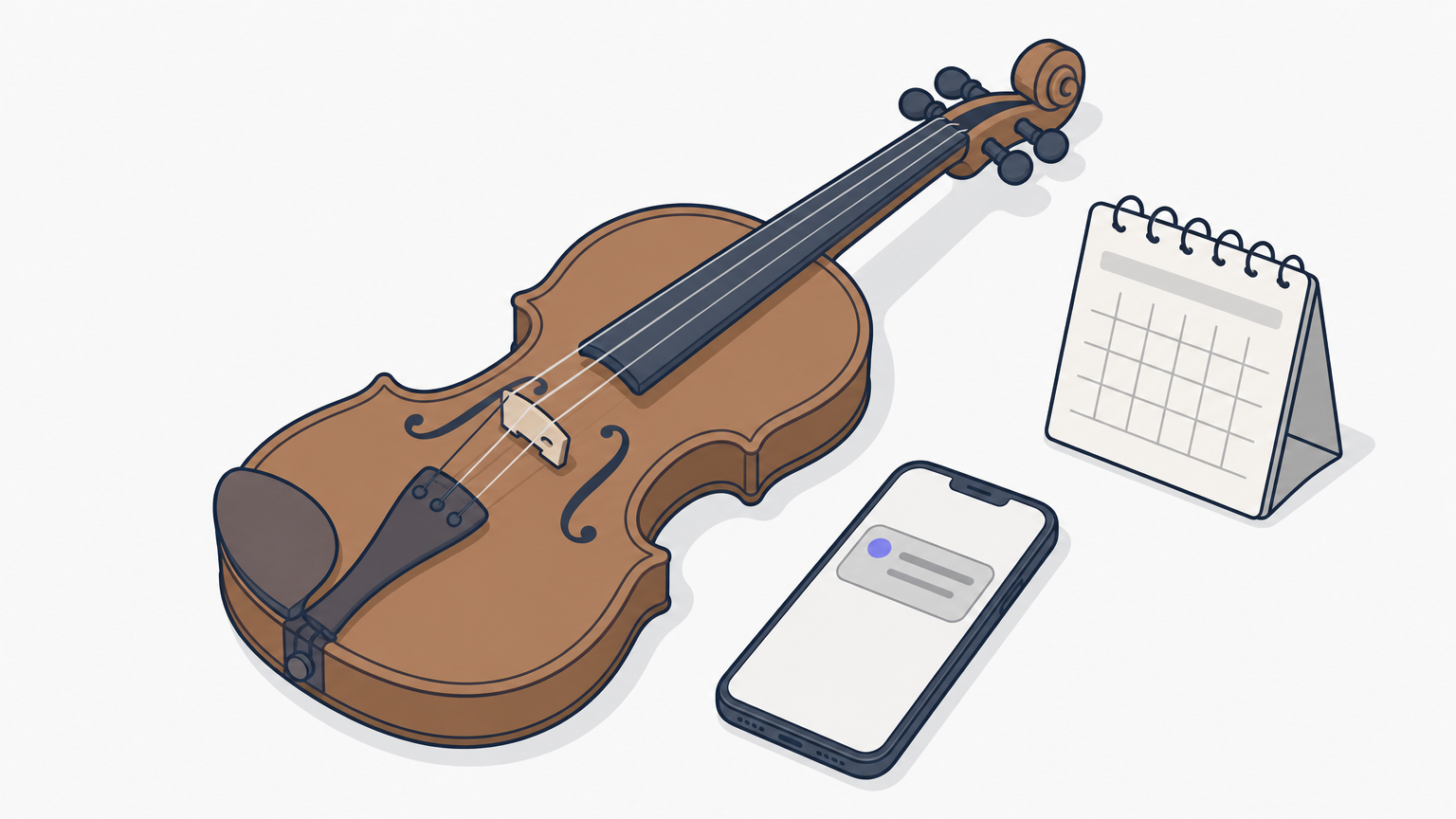
The idea comes from Ebbinghaus's forgetting curve, which shows that memory fades fast at first and then more slowly. Scheduling algorithms such as SuperMemo's SM-2 use that curve to time your next review. For violin, a "card" is not a question. It is one short section of the piece that you play from memory. In MemoRep you create practice cards inside a project, rate each pass, and the app schedules the next pass and sends a daily practice notification.
Here is a worked example. A four-minute piece cut into 12 sections gives you 12 cards. Add three new cards a day and all 12 are in rotation by day four, while earlier cards return as they come due.
| Rating | What it tells the scheduler |
|---|---|
| Again | You could not play the section from memory |
| Hard | You recalled it, but with effort or hesitation |
| Good | You played it from memory without trouble |
| Easy | It felt automatic |
Memory fades on a curve, so review each section just before it fades instead of when it already has.
Who it suits
Scheduled reviews suit players with more than one piece in progress, or anyone who has learned a piece, put it down for a month, and found it gone. They also remove the daily question of what to work on, which is a quiet drain on practice time.
The schedule decides when a section returns. It does not decide how you work on it. That part stays with your teacher.
2. Test yourself from memory before checking the score
Self-testing means playing a section without the page first, then opening the score to check. It is the closest thing to a shortcut here, because effortful recall builds memory faster than playing along with the music.
How to do it
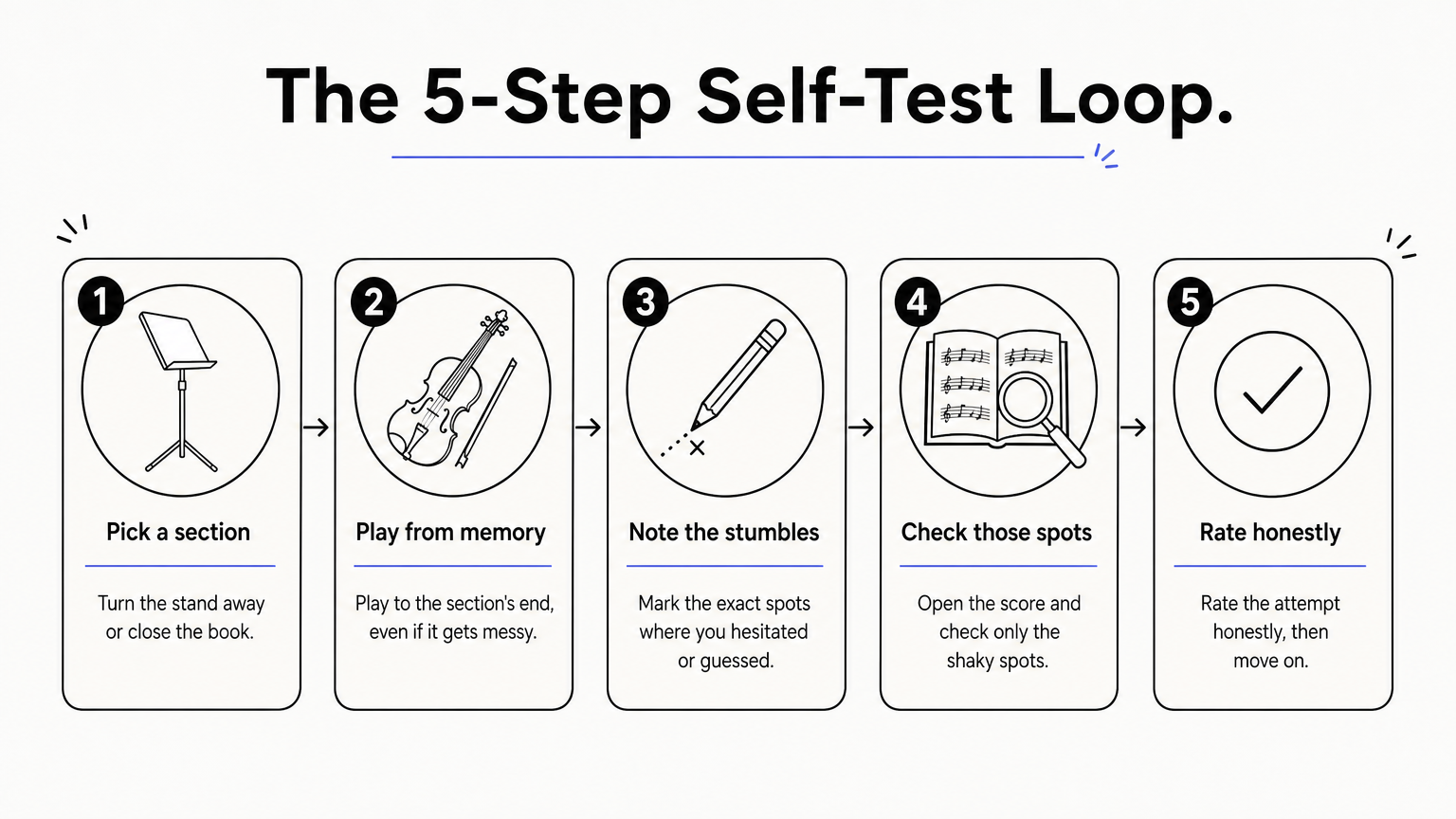
The fastest way to memorize music is rarely more repetitions. It is short, honest recall attempts. Use this loop on one section at a time:
- Pick one section and turn the stand away or close the book.
- Play it from memory to the end of the section, even if it gets messy.
- Note the exact spots where you hesitated or guessed.
- Open the score and check only those spots.
- Rate the attempt honestly, then move on.
Step 4 is the one players skip. Checking the whole page again turns a test into a read-through and hides what you do not know.
A section you cannot play without the page is not memorized yet, no matter how many times you have played it with it.
Who it suits
Self-testing suits players who feel they know a piece at home but lose it under pressure. The gap between those two states is usually recognition standing in for recall.
Expect this to feel worse than playing along. That discomfort is the signal that the method is working. If you peek after two seconds, you are back to recognition.
3. Hear the piece in your head away from the violin
Mental rehearsal is running the piece in your mind, with no instrument in your hands. It gives you extra memory repetitions on days when you cannot play, and it tests whether you really hold the music.
How to do it
Start with the sound. Listen to a recording of the piece a few times a day so the order of the sections becomes familiar. Then, in a quiet moment, go through it without the recording:
- Hum or sing the melody from the first note to the last.
- Picture the page, or picture where each section sits in the piece.
- Stop when you lose the thread and note which phrase did it.
- Check the score afterward and mark that phrase for a card.
If you cannot hum the next phrase, it is not secure yet. Learning that on a walk costs you nothing. Learning it on stage costs a lot.
If you can hear the next phrase before you play it, you are recalling the music and not just following your fingers.
Who it suits
This method suits players with short or broken practice days, shared practice rooms, or a body that needs a rest. Commutes and waiting rooms become useful.
It does not replace playing from memory. Treat it as a way to find weak sections, then hand those sections back to your regular practice.
4. Start from different places in the piece
Starting from random points breaks the habit of memorizing a piece as one long chain. A chain has a weakness: lose one link and you cannot continue. Several entry points give you ways back in after a slip.
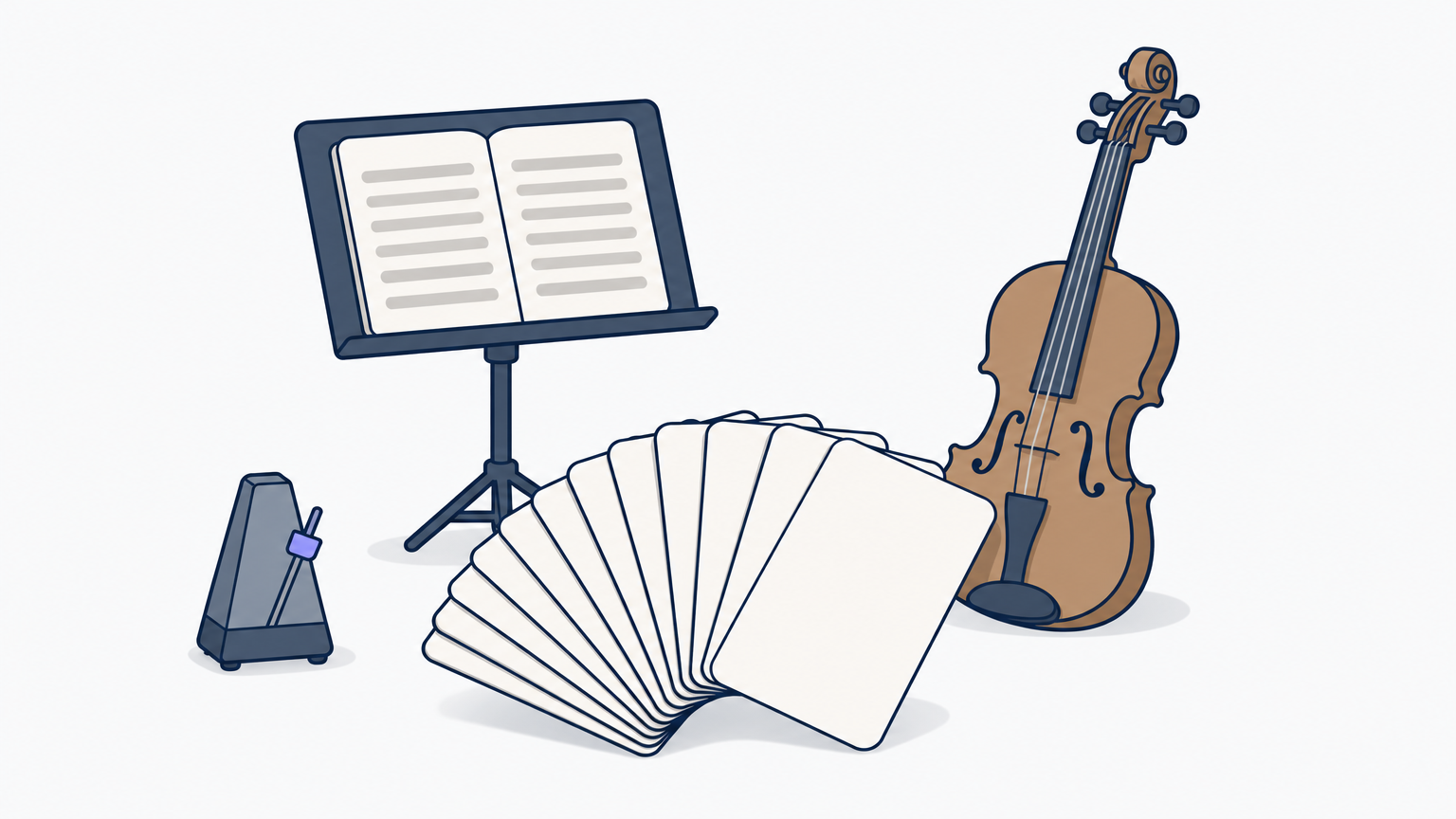
How to do it
Most players always start at bar one, so the opening is solid and the middle is shaky. Change the entry point on purpose:
- Random start: shuffle your cards, pick one, and play from there to the next section break.
- Backward order: begin with the last section, then the one before it, so the ending is as secure as the beginning.
- Cold jump: after a session, ask yourself to start at a section you have not touched that day.
Each start should be unrehearsed. Do not hum it first or find your place in the score.
A piece you can enter anywhere is a piece you can recover in the middle of a performance.
Who it suits
Players who restart from the top after every slip benefit most. So do students who know the first page cold and are vague on the third.
If you use a card system, this comes free. The schedule hands you whichever section is due, not whichever is next in line.
5. Rehearse performances and keep the piece alive
Performance rehearsal means playing the whole piece from memory without stopping. Maintenance means keeping finished pieces on a review schedule so they stay in your fingers after the concert.
How to do it
Once the sections hold up, play the complete piece from memory once or twice a session and treat it as a real performance. Do not stop for mistakes. Record audio or video on your phone, or play for a friend or family member. Afterward, mark the sections that wobbled and send them back to your cards as Again or Hard.
Do not run the full piece every day. Repeated whole run-throughs rehearse your mistakes along with everything else. Test the weak parts in small sections, and keep the full run for once or twice a week.
When a piece is learned, keep it alive with occasional reviews. If it has faded, treat the faded sections as new Again cards and rebuild from there. It comes back faster than the first time.
Run the whole piece to find the weak sections, then fix them in small sections, not by running the whole piece again.
Who it suits
This final step suits anyone with a recital, audition, or exam coming up, and anyone who keeps a repertoire for playing at gatherings. It also suits players who dread forgetting, because a recording shows how steady your memory really is.
Build a routine you can repeat
Memorizing violin music is not a talent. It is a loop: split the piece into sections, recall each one without the page, rehearse it away from the instrument, enter it from different places, and review on a schedule so nothing fades. Stack the five methods and you have a routine you can repeat daily without deciding what to do next.
If you want the scheduling handled for you, try MemoRep during the limited beta. Premium access is free for the first 200 users. You create the cards, rate each session, and MemoRep tells you what to practice and when. Your teacher still decides how to play and study the piece.