5 Ways to Practice Rhythm on Guitar and Keep Time Steady
The best way to practice rhythm on guitar is to rotate a few short, repeatable drills instead of grinding one exercise for an hour. A good pick is specific, measurable, and easy to repeat every day. Spaced scheduling suits you if you never know what to work on next. Metronome work suits you if your tempo drifts. Recording yourself suits you if you feel steady but the playback says otherwise.
Most players know rhythm matters. The trouble is that rhythm practice feels vague. You play along for ten minutes, feel fine, and cannot say whether your timing improved. Below are five ways to practice, each broken down the same way so you can compare them and build a routine that fits your week.
One note on scope. MemoRep is a practice scheduling platform, so this article covers how to organize and repeat rhythm work, not how to play it. Your teacher decides which technique, counting system, or strumming pattern you should study. The methods below help you revisit that material at the right time.
1. Schedule rhythm drills with spaced repetition
Spaced repetition is the method that holds the other four together. It decides when each drill returns, so nothing you have learned quietly fades.

What it is and who it suits
Spaced repetition means you revisit a drill right before the skill gets rusty, not on a fixed loop. For how to practice rhythm on guitar, every drill becomes its own practice card, and a scheduler shows you what is due today. MemoRep does this with the Ebbinghaus forgetting curve and the SuperMemo SM-2 algorithm, so you skip the decision of what to play.
This suits you if you carry several rhythm exercises and drop half of them by week three. It also suits you if your timing feels solid on Monday and sloppy by Friday. If you have exactly one drill and one hour, you can skip the scheduler for now.
How to run it
Setup takes about ten minutes, and after that the system runs itself. A 15-minute session of three due cards beats an hour of unplanned playing.
- Create one card per drill, such as a metronome drill at a set tempo, a pattern your teacher assigned, or a play-along song.
- Finish each session by rating the card Again, Hard, Good, or Easy.
- Let strong cards return less often and weak ones come back sooner.
- Open your daily reminder and do only what is due.
Rhythm fades when you skip it, so schedule the revisit instead of trusting your memory.
2. Work with a metronome on a tempo ladder
A metronome gives your timing an outside judge. Used on a ladder, it also gives you a number to beat.
What it is and who it suits
Metronome work means playing against a steady click so a machine, not your own feel, measures your timing. The click never forgives drift, and that is the point. It is the first tool to add if you rush or drag, and it suits every level, from first-year students to gigging players.
Your teacher decides what you play over the click. You decide how the sessions are structured. That structure is what turns a metronome from background noise into a measuring stick for how to practice guitar rhythm.
How to run it
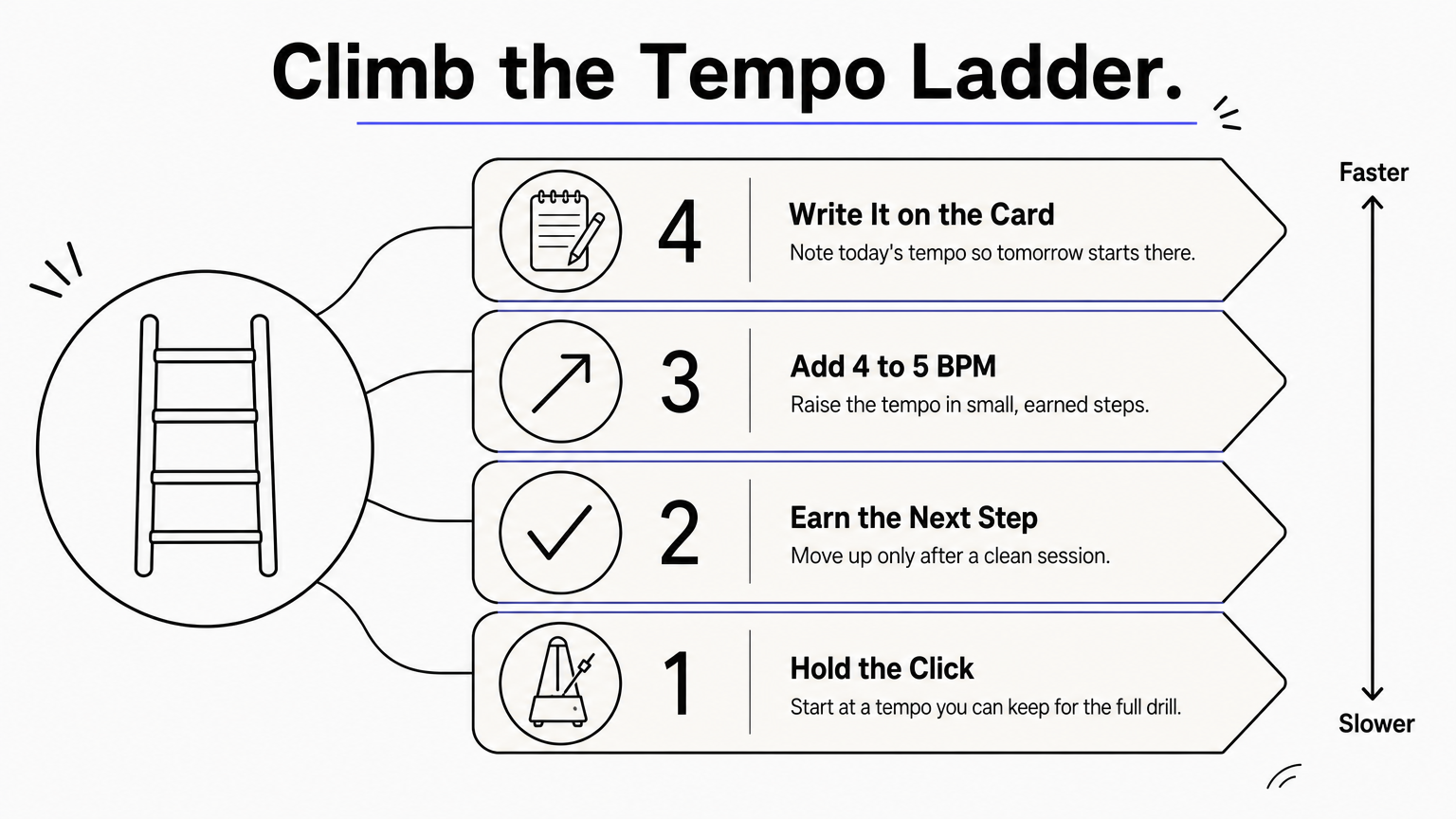
A tempo ladder gives you steps instead of guesses. Start where you can stay with the click for the whole drill, and move up only when a session earns it.
- Pick a starting tempo you can hold for the full drill.
- Set a fixed time, such as four minutes, and keep going when you slip so you practice finding the click again.
- Raise the tempo by 4 to 5 BPM only after a clean session.
- Write the tempo on the card so tomorrow starts where today ended.
A tempo you cannot repeat tomorrow is not a tempo you own yet.
3. Count the beat away from the guitar
Counting practice trains your sense of the pulse with no instrument in your hands. It is the cheapest drill on this list.
What it is and who it suits
Counting practice means saying the beat out loud and tapping your foot while the guitar stays in its case. It separates timing from fretting and picking, so you hear the pulse itself. This is the clearest way to practice rhythm guitar when you have no instrument nearby.
It suits players whose timing falls apart once their hands get busy. It also suits anyone with spare minutes on a commute or a couch. Ask your teacher which counting system they use, and stick with that one.
How to run it
Short sessions work best here. Three to five minutes is enough, because the goal is a steady inner clock, not endurance.
- Count aloud with your teacher's counting system.
- Tap your foot against a metronome or a favorite recording.
- Rate the session honestly, and let a Hard rating bring the card back soon.
- Pair it with a guitar drill later the same day so the counting carries over.
If you can't keep the beat without the guitar, the guitar won't fix it.
4. Rotate a small set of strumming patterns
Patterns are where rhythm turns into music. The risk is polishing one pattern while the others quietly disappear.
What it is and who it suits
A strumming pattern drill is one rhythm figure, usually from your teacher or a song you are learning, repeated until it sits comfortably. Rotating three to five patterns beats perfecting one, because each pattern is revisited before it fades. You also learn to switch between them cleanly.
This suits song learners, band players, and anyone who nails a pattern on Tuesday and cannot recall it on Thursday. It is the most direct answer to how to practice rhythm on guitar when you have repertoire to cover. If your set is longer than five, the extras go in a queue.
How to run it
Give each pattern a card and keep the notes short. A few fields make the card useful on the day it comes due.
| Card field | Example note |
|---|---|
| Pattern name | Verse pattern from song A |
| Working tempo | 80 BPM |
| Where it breaks | Falls apart when the chord changes |
| Next goal | Clean at 84 BPM |
Review the "where it breaks" note before each session. That line tells you what to repeat and saves you from replaying the parts that already work.
Five patterns you revisit on schedule beat one pattern you play every day.
5. Play along with recordings and record yourself
The first four methods build timing in a controlled setting. This one tests whether it holds up in music.
What it is and who it suits
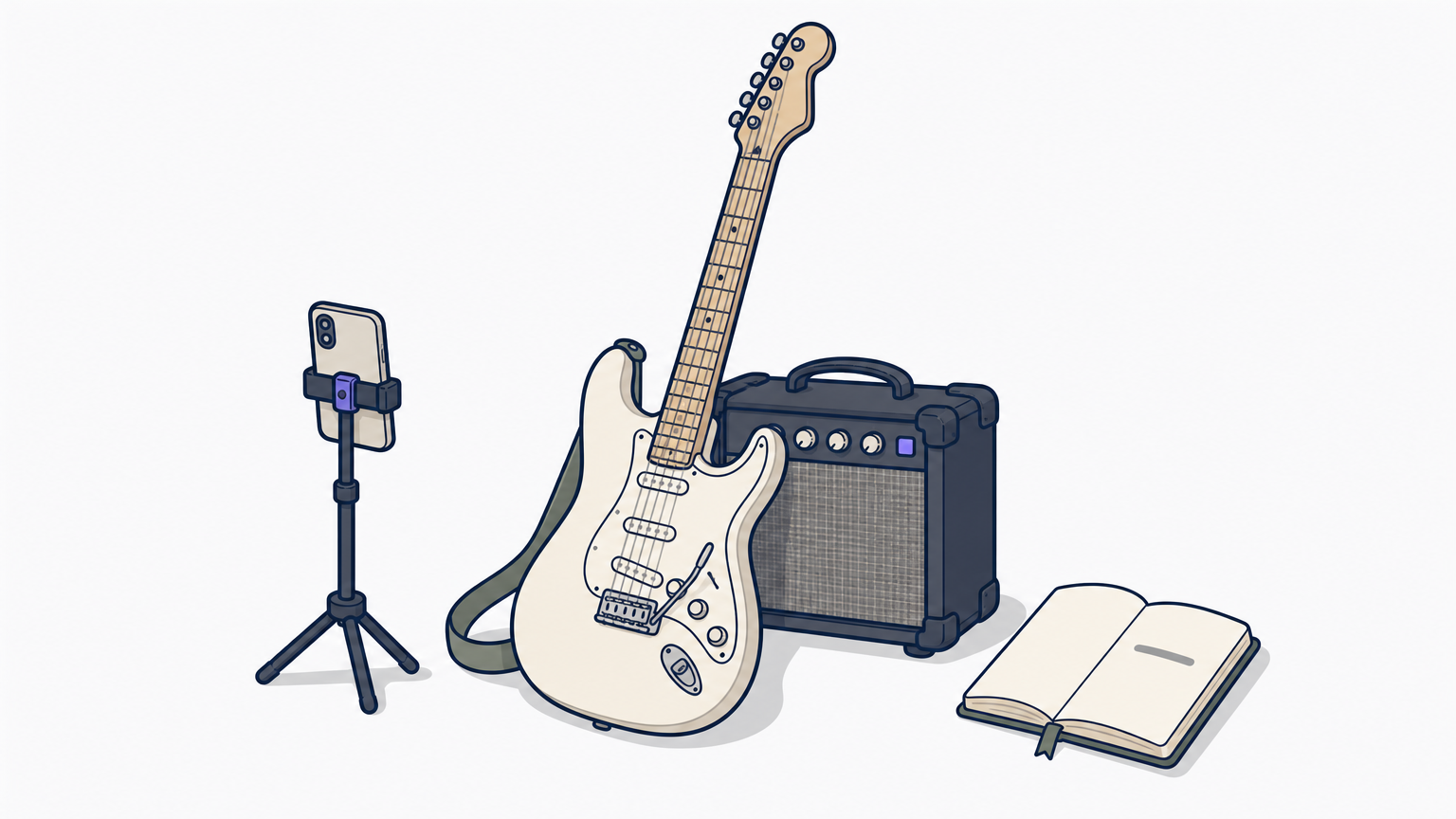
Playing along with a recording tests your timing against drums and bass that will not wait for you. Recording yourself tests whether you hear your own drift. Together they are the honest check on everything else. They suit players who sound steady alone but shaky with others, and anyone about to join a band or jam.
Choose tracks your teacher approves for your level. Treat the playback as data, not as a verdict on you. One uncomfortable listen teaches more than ten comfortable run-throughs.
How to run it
Once a week is enough. The value comes from what you do after the take.
- Play along with one track, then record one clean take of the same section.
- Listen back and note a single spot where your timing slipped.
- Turn that spot into a card with a tempo and a short note.
- Re-record the same section next week and compare the two takes.
Recording yourself turns a feeling about your timing into evidence you can use.
Pick one drill and schedule it
Steady time comes from short, repeatable drills that return at the right moment, not from one heroic session. Metronome ladders, counting, a small set of patterns, and weekly recordings each train a different part of your timing. Spaced scheduling makes sure none of them gets forgotten.
Start small. Choose two drills your teacher has already given you, set a tempo for each, and write down where they break. Rate them after every session and let the schedule decide what comes next. In a few weeks you will have a record of your progress instead of a vague impression.
If you want the scheduling handled for you, see how MemoRep schedules rhythm drills and claim the limited free-for-life subscription. Add your rhythm drills as cards, and the app will tell you what to practice each day.