How to Memorize Music Intervals: A 4-Step Review Plan
The best way to memorize music intervals is to stop treating them as one long list and turn each one into a small recall task that you review on a spaced schedule. Split the set into small batches, test yourself from memory instead of rereading, rate how each attempt felt, and let the gaps between reviews grow as an interval gets easier. Ten minutes a day beats one long session on Sunday.
Most learners start with a chart, a PDF cheat sheet, or a list of reference songs. Everything feels solid on day one. A week later, the sixths and sevenths blur together and the intervals you already know get all your attention. Rereading feels productive, but it doesn't build recall, and random drilling doesn't tell you what is actually fading.
This guide covers the memory side only. It doesn't teach what intervals are or how to hear them. Your teacher or course does that, and whatever method they give you, whether reference songs, half-step counting, or singing, plugs into this plan. At MemoRep we build spaced repetition practice routines, so the four steps below show the plan in general and how it looks in the app.
Why intervals fade and what you need first
Intervals fade because memory decays fast after a single study session, and a cheat sheet only gives you something to reread. To keep them, you have to pull them out of memory again and again, at widening gaps. Set that up before you start.
Why rereading a chart fails
Hermann Ebbinghaus's forgetting curve shows that most forgetting happens soon after you learn something, then the loss slows down. A chart or PDF lets you recognize the answer in front of you, which feels like knowing but isn't recall. Spaced reviews work because each one lands just before the interval would fade, and that strengthens the memory for longer.
Recognizing an interval on a chart is not remembering it, and only retrieval builds recall.
What to have ready
You need four things before step 1:
- A method from your teacher or course. This plan works with any of them.
- A way to hear intervals played, such as a piano, your instrument, or an ear-training source.
- A timer set for 10 minutes.
- A place to track cards: index cards, a spreadsheet, or an app like MemoRep.
Step 1. Split the set into small cards
Make one card per interval and per direction, then introduce only a few cards at a time. A card is a single task you can finish in under 30 seconds, so you can tell right away whether you got it.
Write cards you can answer from memory
Each card should ask for retrieval, not recognition. Good examples are "Name the interval I just played," "Sing the interval above this note," or "Name the anchor that goes with this interval." The anchor is whatever your teacher gave you. Keep each card to one interval and one direction, so a miss tells you exactly what to fix.

Say your teacher assigns 12 intervals, ascending and descending. That is 24 cards.
Add six cards per week
Adding all 24 cards at once buries you in reviews. Six new cards a week keeps each session short.
| Week | New cards | Total in rotation |
|---|---|---|
| 1 | 6 | 6 |
| 2 | 6 | 12 |
| 3 | 6 | 18 |
| 4 | 6 | 24 |
By week 4, you are reviewing the full set, and the week 1 cards are already coming back at longer gaps.
Six new cards a week is slow enough to stick and fast enough to finish in a month.
Step 2. Space your reviews
Review each card after a short gap first, then stretch the gap every time you answer correctly. The usual SuperMemo SM-2 defaults start at 1 day, then 6 days, then multiply the previous gap by about 2.5. MemoRep schedules cards with SM-2, so you never have to work out these dates yourself.
How the gaps should grow
Here is what a card looks like if you answer it correctly every time:
| Review | Gap since last review | Day since first learned |
|---|---|---|
| 1 | 1 day | Day 1 |
| 2 | 6 days | Day 7 |
| 3 | 15 days | Day 22 |
| 4 | About 38 days | About day 60 |
Your own dates will differ, because the scheduler adjusts to your ratings. The point is the shape. Early reviews come close together, and later ones spread out. After four clean reviews, a card needs attention only about once every five or six weeks.
What happens when you miss
A missed card drops back to a short gap, usually the next day, and then climbs again. That isn't a failure. It shows you which intervals are shaky. Don't skip a miss and hope it sorts itself out, because the card that fades quietly is the one you will fumble in front of your teacher.
Widening gaps are the whole trick, so review a card right when it starts to slip.
Step 3. Rate every attempt honestly
After each card, rate how it felt, not whether you eventually got it. The rating tells the scheduler when to bring the card back, so an inflated rating means a card disappears before you are ready.
Use four ratings
MemoRep uses the Again, Hard, Good, Easy scale, and it works on paper too:
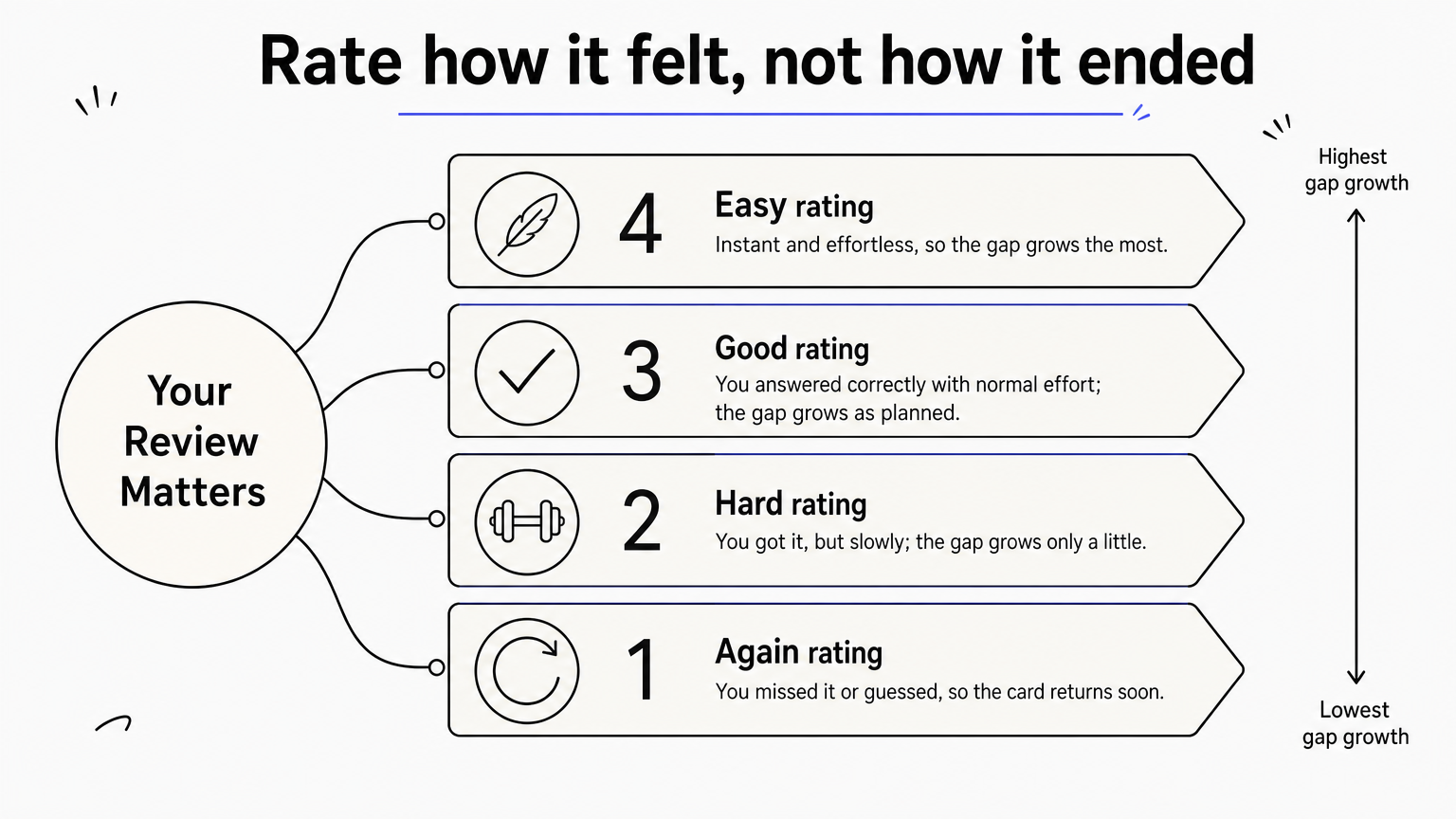
- Again: you missed it or had to guess. The card comes back soon.
- Hard: you got it, but slowly or with doubt. The gap grows only a little.
- Good: you answered correctly with normal effort. The gap grows as planned.
- Easy: instant and effortless. The gap grows the most.
When you hesitate, choose Hard, not Good. Honest ratings keep your reviews short, because only the cards that need work come back often.
Take repeated misses to your teacher
If one card keeps getting Again, or two intervals keep swapping places in your head, note which pair it is. Then bring that pair to your teacher. They decide how to fix it, whether that means a different anchor or a different approach. Your job is to supply the evidence, and the ratings give you exactly that.
A pattern of Again ratings tells you what to ask your teacher.
Step 4. Build a 10-minute daily routine
A short session every day beats a long one twice a week, because spaced scheduling depends on showing up when cards are due. Aim for 10 minutes a day, at the same time, tied to something you already do.
Make the habit automatic
Practice right after coffee, before you pick up your instrument, or at the start of your usual session. A daily reminder helps, and MemoRep sends daily practice notifications for this reason. Do only the cards that are due. When the timer ends, stop, even if a few remain. They will return tomorrow.

On most days only a handful of cards are due. A day with new cards and several reviews is the exception, not the norm.
Track progress by card age
Measuring by minutes practiced tells you little. Measure by how old your cards are. Count how many have reached a gap of 6 days or longer, then 15 days or longer. In the 12-interval example, a card that is answered correctly every time reaches its 38-day gap around day 60. By then, most of the set should be coming back only a few times a month. That is what memorized looks like.
Progress means more cards at longer gaps, not more minutes at the desk.
Keep the plan simple and keep showing up
To memorize music intervals, give each one its own small card, add six new cards a week, review at widening gaps, rate yourself honestly, and spend 10 minutes a day. Use the method your teacher gave you, and bring them any pair that keeps tripping you up. The plan only handles remembering, and that is the part most learners leave to chance.
You can run this with index cards or a spreadsheet, but tracking due dates by hand gets old fast. If you would rather have the schedule and the daily reminders handled for you, try MemoRep during the limited free beta and put your intervals on a calm, steady review routine.