How to Memorize Music Faster: A Step-by-Step Guide
You've played the same eight measures twenty times and you still stumble at the same spot. That's not a talent problem, it's a technique problem. Most musicians memorize by brute repetition, which feels productive but wastes hours and leaves gaps that show up right when you're on stage. Learning how to memorize music faster means replacing blind repetition with a method that targets exactly what your brain forgets and when.
The fastest path to solid memorization combines chunking passages into small units, active recall away from your instrument, and revisiting each chunk right before you'd naturally forget it. This isn't guesswork. It's built on how memory actually works, and it cuts practice time dramatically once you apply it correctly.
Below you'll find a step-by-step guide you can start using in your next session, from breaking down a piece into manageable sections to testing yourself without the sheet music. We'll also cover why timing your review sessions matters as much as the technique itself, and how tracking what needs revisiting (something tools like spaced repetition scheduling handle automatically) keeps skills from going rusty between practices.
How memory actually works when you learn music
Musicians who understand memory science stop guessing why some passages stick and others slip in performance. Once you see what's happening under the hood, the six-step method that follows makes a lot more sense, and you'll stop wasting hours on repetition that doesn't actually build lasting memory.
The forgetting curve explains why review timing matters
Herman Ebbinghaus ran memory experiments in the 1880s and found something that still holds up today: information fades on a predictable curve, sharply at first, then more slowly over time. The Ebbinghaus forgetting curve shows that without any review, you lose the majority of new material within a day or two. Music isn't exempt from this. A phrase you nailed in Tuesday's session can feel like a stranger by Thursday if you never revisited it, because your brain treats unused information as low priority and lets it decay.
Musicians often fight this the wrong way, by repeating a passage twenty times in a single sitting and calling it memorized. That approach mostly builds short-term familiarity, not durable retention. The fix isn't more repetition packed into one session, it's spaced review timed to catch the memory right before it fades, one of several proven strategies for beating the forgetting curve. Reviewing a phrase once the day after you learned it, then a few days later, then a week later, does more for long-term recall than five extra run-throughs today.
Repetition in one sitting feels productive, but spaced review is what actually makes memory last.
Working memory can only hold a few chunks at once
Your brain's working memory, the mental workspace you use while sight-reading or running a passage, holds roughly three to four distinct units at a time. Try to memorize sixteen bars as one block and you'll overload it every time, which is exactly why long unbroken passages feel harder to lock in than short ones. Breaking a piece into smaller units respects this limit instead of fighting it, which is why chunking shows up in every list of science-backed ways to practice effectively.

Effective chunking groups notes around musical logic rather than arbitrary bar counts. A useful chunk might be:
- A single melodic phrase (often two to four measures)
- A recurring scale or arpeggio pattern
- A chord progression that repeats with variation
- A rhythmic figure that shows up throughout the piece
Each chunk becomes its own small memory task, easier to encode and easier to review independently later on. This is the foundation Step 2 of this guide builds on directly.
Recall builds stronger memory traces than recognition
Recognizing a passage when you see the sheet music again feels like memorization, but it isn't the same skill as producing that passage from nothing. Cognitive research on the testing effect, documented by institutions like the National Institutes of Health, consistently shows that actively retrieving information strengthens memory far more than passively reviewing it. Looking at a page and nodding along creates a shallow trace. Closing the book and trying to play or sing the passage from memory creates a deep one, even when you get it wrong at first.
Applying this to your instrument means building in moments where you can't lean on the score. Every time you force your brain to retrieve the next note or fingering instead of glancing at the page, you're reinforcing the exact pathway you'll need on stage when there's no sheet music to fall back on. That's the mechanism behind active recall learning, and it's the core of Step 4 in this guide.
Step 1. Play and listen before you memorize
Before you touch a single measure, get the whole piece into your ears and hands. Musicians who skip this step often memorize note-by-note without ever hearing how the phrases connect, which makes recall shakier later. Listening first gives your brain a map of where the piece is headed, so when you start chunking sections in Step 2, you already know how they fit together.
Listen for structure, not just melody
Play a recording, or your own sight-read version, all the way through at least twice before you try to memorize anything. On the first pass, just absorb the sound. On the second, listen for the architecture: where the theme returns, where the harmony shifts, where the piece builds tension and releases it. Composers repeat and vary material constantly, and spotting that structure now saves you from treating every measure as brand new information later.
You can't memorize what you haven't actually heard yet.
Play through without stopping
Once you've listened, sit down and play the piece from start to finish, even badly, without stopping to fix mistakes. This isn't performance practice, it's reconnaissance. You're identifying which passages already feel comfortable and which ones will need the most work. Musicians who stop and correct every wrong note during this pass waste time perfecting sections they haven't even decided are worth memorizing yet.
Keep a quick log as you go, and if you want structure for it, start from a music practice log template. It doesn't need to be fancy, a notebook or a notes app works fine:
- Passages that felt automatic
- Spots where your fingers hesitated
- Sections with unfamiliar rhythms or fingerings
- Places where the harmony surprised you
This list becomes your roadmap for the next steps. Music memorization goes faster when you already know where the trouble spots live instead of discovering them mid-performance.
Why this step gets skipped and shouldn't
Many players jump straight to slow, measure-by-measure drilling because it feels more productive than listening and playing through. But without this overview, you end up memorizing isolated fragments with no sense of how they relate, and stitching them together later takes far longer than it should. Ten minutes of focused listening and one honest play-through can save you an entire practice session down the road. Treat it as setup, not a detour.
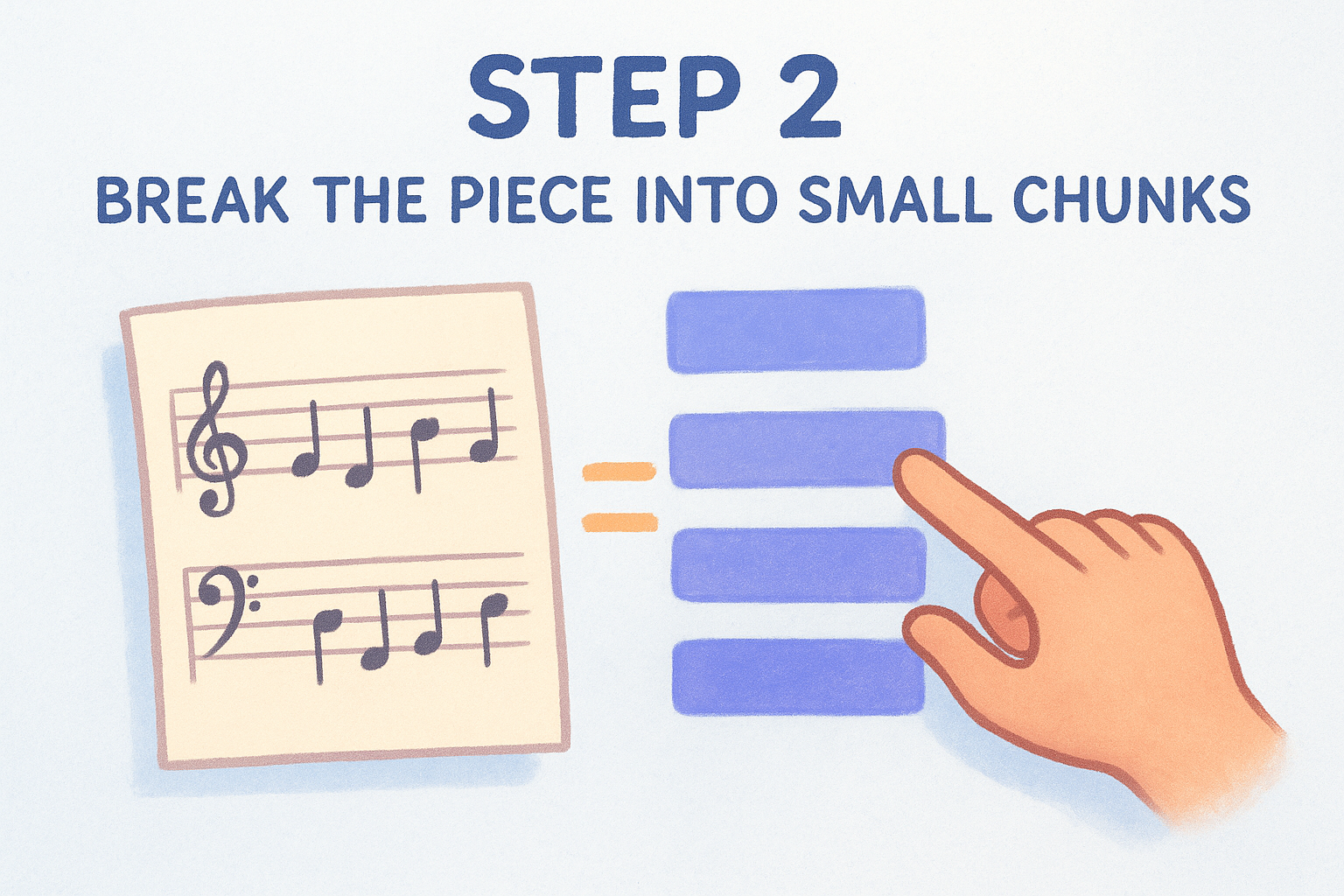
Step 2. Break the piece into small chunks
Now that you've heard the whole piece and played through it once, it's time to cut it into pieces small enough for your brain to actually hold. Chunking is the single biggest lever for memorizing music faster, because it turns one overwhelming task into a series of small, winnable ones. Skip this step and you'll spend your practice time drilling arbitrary four-bar blocks that don't match how the music actually works, which is why so many memorization attempts stall out halfway through a piece.
Find natural break points, not bar lines
Use the log you built in Step 1 to decide where each chunk starts and ends. Good chunks follow musical logic instead of measure numbers:
- End a chunk where a phrase resolves, not mid-phrase
- Split at a clear harmonic change, like a new key area or cadence
- Isolate a repeated rhythmic figure as its own chunk, even if it's short
- Separate technically tricky passages from the surrounding material so they get dedicated attention
A chunk can be two measures or eight. Length matters less than whether it forms a complete musical idea you can start and stop cleanly.
A chunk isn't a fixed number of bars, it's a complete musical idea you can start and stop cleanly.
Match chunk size to difficulty
Harder material needs smaller chunks. A fast technical run might need to be broken into two-note groups at first, while a slow lyrical phrase might work fine as a full eight-bar unit. Here's a rough guide:
| Passage type | Suggested chunk size |
|---|---|
| Fast technical passage | 1-2 beats or a single gesture |
| Lyrical melodic phrase | 2-4 measures |
| Repeated accompaniment pattern | One full repetition |
| Transition or modulation | Isolate the transition alone |
Adjust as you go. If a chunk still feels shaky after a few passes, cut it in half again.
Label and organize your chunks
Give each chunk a short, memorable name, like "opening theme," "bridge run," or "tricky left-hand jump," rather than just a measure range. Names stick in memory better than numbers do, and they make it easier to talk yourself through the piece mentally when you're away from your instrument. This labeling also sets you up for later steps, since each named chunk becomes its own item to test with active recall and schedule for review, which is exactly the kind of organization spaced repetition tools are built to track automatically.
Step 3. Spot the patterns hiding in the music
Once your chunks are set, look inside each one for repetition. Composers rarely invent new material for every measure. They repeat motifs, transpose them, invert them, or vary the rhythm slightly and reuse the same shape. Spotting these hidden patterns means you're not memorizing forty measures of unique information, you're memorizing five or six ideas and learning where they reappear. This is where music memorization speeds up dramatically, because your brain stores one pattern instead of relearning it every time it shows up in a new key or register.
Why patterns cut memorization time in half
Pattern recognition works because it reduces the total amount of new information your brain has to encode. A scale run that appears four times in a piece, even transposed or reharmonized, is still one shape your hands already know. Treating each occurrence as brand new material wastes practice time you don't need to spend.
Find the repeated shape once, and you've memorized it everywhere it hides in the piece.
What to look for in your chunks
Go back through the chunks from Step 2 and scan for these common patterns:
- Sequences: the same melodic or rhythmic shape repeated at a different pitch level
- Transposed phrases: identical material moved to a new key or register
- Chord progressions: familiar harmonic movement, like a ii-V-I, reused throughout
- Rhythmic motifs: a distinctive rhythm that recurs even when the notes change
- Call-and-response shapes: a phrase that gets answered or echoed later
Mark each pattern directly on your score, or note it in the log you started in Step 1, so you can see at a glance which chunks share material.
Link chunks through shared patterns
Once you've flagged a pattern, treat every instance of it as one memory item instead of several. If the opening theme reappears transposed in the recapitulation, don't relearn it from scratch, just note the transposition and let the original memory do the work. This linking also makes recall more reliable under pressure, since triggering one instance of a pattern often jolts your memory for the others. It's a small shift in how you look at the score, but it's one of the fastest ways to memorize music faster without adding a single extra hour of practice.
Step 4. Test yourself with active recall
With your chunks identified and their patterns mapped, it's time to stop reading the score and start testing your memory against it. Active recall means retrieving a chunk from memory before you check whether you got it right, not glancing at the page while your fingers move on autopilot, and there's a step-by-step method for pairing recall with spaced review once you get comfortable with it. This single shift, moving from playing-with-the-score to playing-from-memory-then-checking, is what separates musicians who memorize fast from those who spend months on the same piece.
Close the score and play from memory
Pick one chunk from your Step 2 list, cover the sheet music, and play it through from start to finish. Don't peek if you stumble. Push through to the end of the chunk, then open the score and check what you got wrong. This struggle is the point: research on the testing effect shows that the effort of retrieval, even when it produces errors, builds a stronger memory trace than simply rereading correct information.
The moment you close the score and try to play from memory, you're doing the real work of memorization.
Vary how you test yourself
Don't rely on one testing method. Rotate through a few formats so your recall isn't tied to a single trigger, like always starting from the first note of the chunk:
- Play the chunk starting from a random note inside it, not just the beginning
- Sing or hum the melody away from your instrument
- Write out the notes or fingerings from memory on paper
- Name the next chord or interval before you play it
- Recall the chunk's label from Step 2 and mentally rehearse it with no instrument in hand
Each format forces a slightly different retrieval path, which makes the memory more flexible and less dependent on context, exactly what you need when the performance setting doesn't match your practice room.
Rate your recall honestly
After each attempt, rate how it went instead of moving on automatically. A simple four-point scale works well: Again if you couldn't produce it, Hard if you got there but struggled, Good if it came out solid, Easy if it felt automatic. Recording this rating for every chunk is exactly the kind of decision spaced repetition scheduling handles for you, since your next review interval should depend on how that recall actually felt, not on a fixed practice calendar.
Step 5. Lock it in with spaced repetition
You've tested each chunk with active recall and rated how it went. Now you need a system that decides when to bring that chunk back, before it fades but not so soon that you're wasting time on something already solid. This is where spaced repetition for long-term memory takes over from guesswork, turning your Step 4 ratings into an actual review schedule instead of a vague intention to "practice it again sometime."
Schedule reviews before you forget
Remember the forgetting curve from earlier: a chunk you rated Good today will likely fade within a few days without review, and one you rated Again might need revisiting tomorrow. Spaced review means timing your next look at a chunk to land right before that fade happens, not on a fixed weekly schedule that ignores how each chunk actually performed. A chunk rated Easy might not need review for a week or two. One rated Hard might need a second look tomorrow.
Review timed to the forgetting curve beats review timed to the calendar.
Use the SM-2 algorithm instead of guessing
The SuperMemo SM-2 algorithm calculates review intervals based on your recall rating, expanding the gap between reviews every time you succeed and shrinking it every time you struggle. Applied to music, it looks something like this:
| Your rating | Next review interval |
|---|---|
| Again | Later the same day or next session |
| Hard | 1-2 days |
| Good | 3-5 days, then expanding |
| Easy | 1-2 weeks, then expanding further |
Tracking this by hand across dozens of chunks in a real piece gets unmanageable fast, which is exactly the decision fatigue that software built around spaced repetition is meant to eliminate.
Let software handle the scheduling
Manually logging every chunk's last review date, rating, and next due date in a notebook works for a handful of passages, but it falls apart once you're juggling multiple pieces or a full repertoire, which is why most players end up comparing spaced repetition apps. This is the exact gap MemoRep was built to fill: you log each chunk as a practice card, rate it Again, Hard, Good, or Easy after testing yourself, and the platform's scheduling algorithm calculates the next review date automatically using the same principles behind SM-2. Instead of wondering whether you should revisit the bridge section today or wait until Thursday, you open the app and it tells you exactly what's due. That's the difference between memorizing music faster on paper and actually doing it in your practice room.
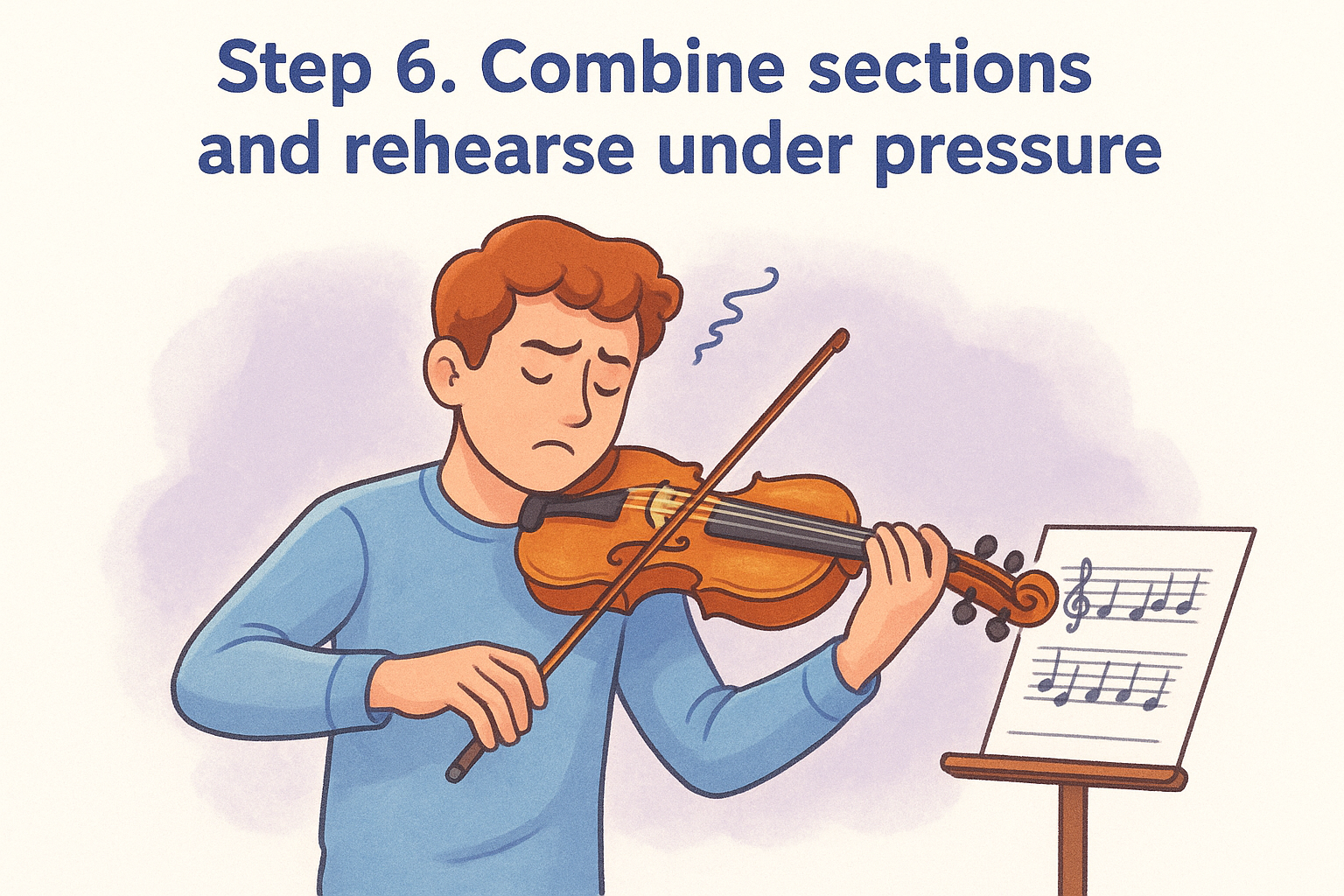
Step 6. Combine sections and rehearse under pressure
Once individual chunks feel solid under active recall, you're not done. Combining chunks into longer passages is its own skill, separate from memorizing each piece alone, and skipping it is why some musicians can nail every section in isolation but fall apart the moment they string them together. This step closes that gap and gets you ready for the one environment that actually matters: performance.
Stitch chunks together in growing groups
Start by joining two adjacent chunks and playing them as one unit, then check the transition specifically, since that's where memory lapses usually happen. Once that pair feels automatic, add a third chunk, then a fourth, building larger sections gradually instead of jumping straight to the whole piece. Pay close attention to the seams between chunks rather than the middle of each one; the middle was already tested in Step 4, but the join is brand new territory for your memory.
Chunks memorized in isolation don't guarantee a smooth transition between them, so test the seams, not just the sections.
Rehearse under conditions that mimic performance
Quiet, unhurried practice room drilling doesn't prepare you for a shaking hand or an audience cough at the wrong moment. Performance pressure exposes weak memory fast, so build it into practice deliberately before it catches you off guard on stage. Try a few of these before you consider a passage performance-ready:
- Play the full combined section once, start to finish, with no stopping to fix errors
- Record yourself on video and watch it back immediately after
- Play for a friend, family member, or even an empty chair, out loud, as if it were the real thing
- Introduce a mild distraction, like background noise, and push through it
- Start from an unexpected point in the middle, not just the beginning, to confirm the memory isn't just chained to what comes before it
Recheck weak spots after the pressure test
After each pressure run, note which specific spots broke down, not just "the middle got shaky." Those exact spots go back into your active recall rotation from Step 4 and get a fresh rating, which then resets their spaced repetition schedule. This keeps your review system honest: a section that held up perfectly in a calm run-through but crumbled under simulated pressure needs more attention than its earlier rating suggested.
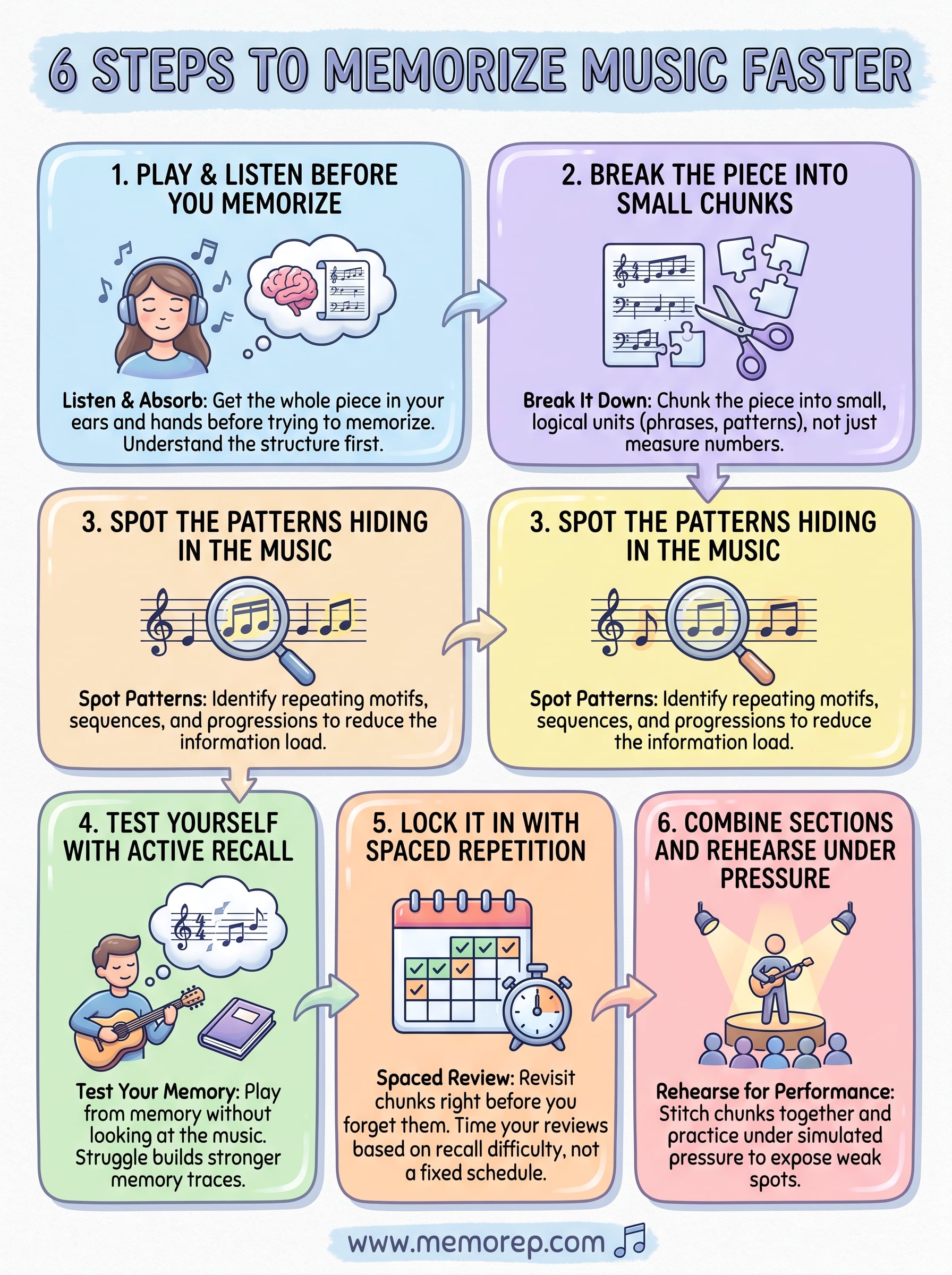
Making fast memorization part of your practice
Six steps, one goal: stop guessing what to practice and start targeting exactly what your memory needs. Listening first, chunking, spotting patterns, testing with active recall, spacing your reviews, and rehearsing under pressure aren't separate tricks, they're one system, and each step feeds the next. Skip the spacing and you're back to cramming. Skip the pressure test and you're back to falling apart on stage.
Knowing how to memorize music faster matters less than actually applying it session after session, and that's where most musicians drop the ball, not because the method fails but because tracking dozens of chunks by hand gets exhausting fast. You don't need another notebook full of due dates you'll forget to check. Take a look at the memory science powering memoRep's review scheduling, then claim your free beta access and let it tell you what's due before you even open your instrument case.