How to Memorize a Song on Guitar (Chords to Solos)
You can play a song clean with the tab in front of you, but the second it disappears, you freeze. That gap between reading and truly knowing a piece is where most guitarists get stuck, and it's exactly what you're trying to close if you're searching for how to memorize a song on guitar. The good news is that memorization isn't a talent some players have and others don't. It's a process, and it breaks down into chunks: chord shapes, lyrics, melody, and the trickier solo sections that usually fall apart first under pressure.
This guide walks through practical techniques for locking in each layer of a song, from rhythm patterns to fretboard-specific solo licks, so you can eventually put the sheet music away entirely and just play. You'll find methods for chunking sections, testing yourself honestly, and figuring out which parts of a song need more repetition than others.
What you won't get here is technique coaching or theory lessons, that's your teacher's job. What you will get is a clear system for spaced, deliberate review, the same principle MemoRep is built around, so the songs you learn actually stay learned instead of fading a week later.
What memorizing a song on guitar really involves
Most players think memorization means one thing: knowing the notes. It's actually four separate skills stacked on top of each other, and treating them as one blob is why memorization attempts stall out. Chord shapes and rhythm form the foundation, the left-hand and right-hand patterns that keep the song moving, which is why reading guitar strumming patterns confidently pays off before you try to memorize anything. Layered on top are lyrics or vocal phrasing if you're singing, then the melody line itself, and finally the solo or lead sections, which demand precise fretboard knowledge under time pressure. Each layer has its own failure point, and lumping them together is exactly why a song that felt solid in practice falls apart the moment you try to play it from memory in front of someone.
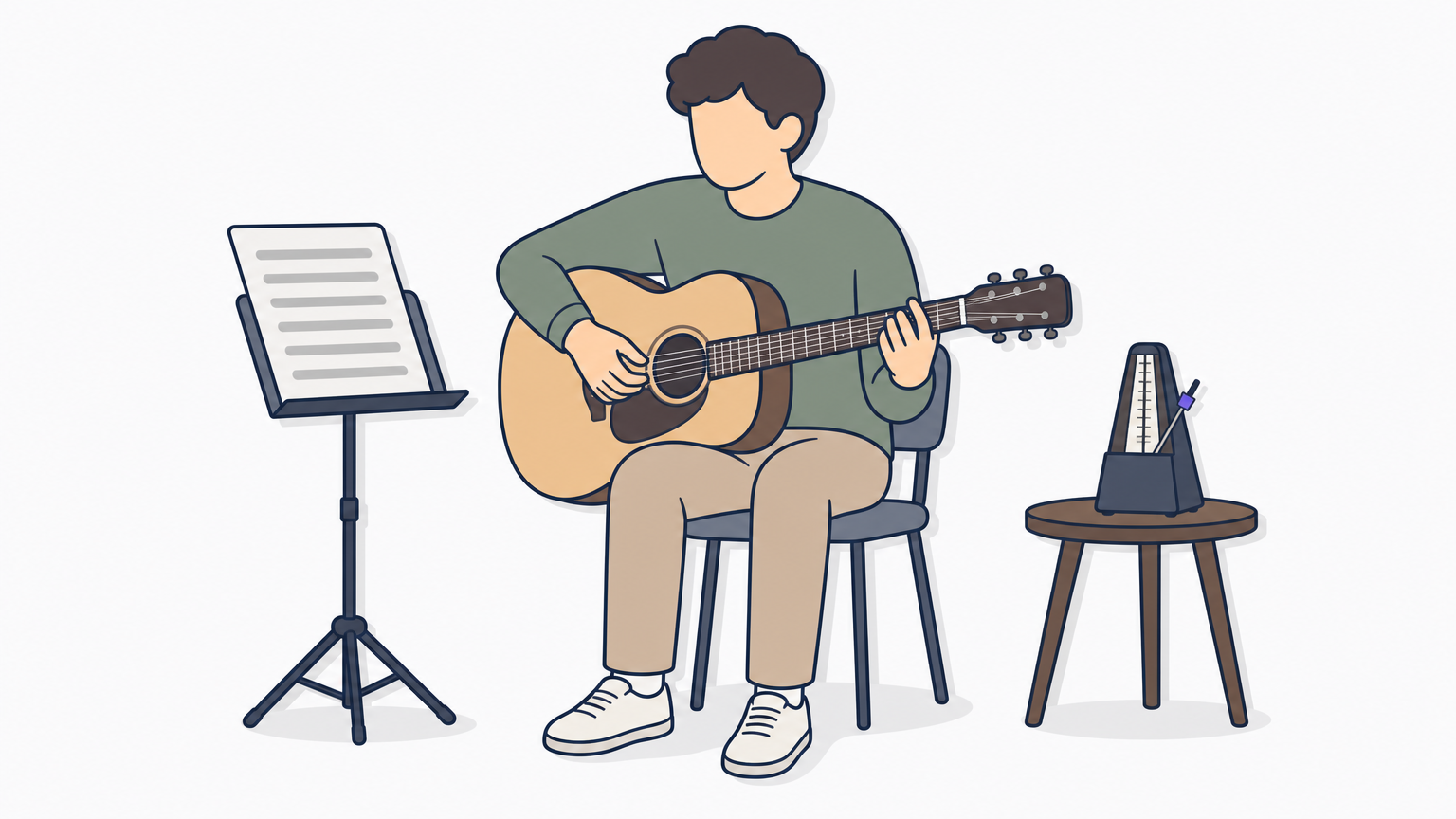
The four layers, broken down
Here's how the layers typically differ in difficulty and what locking each one in actually requires:
| Layer | What it demands | Common failure point |
|---|---|---|
| Chords/rhythm | Muscle memory, timing | Losing the strum pattern under tempo |
| Lyrics/vocal | Sequencing, phrasing | Blanking mid-verse |
| Melody | Pitch relative to chords | Drifting off-key without a reference |
| Solos/leads | Exact fretboard positions | Losing the run halfway through |
Notice that solos sit at the bottom of that table for a reason. They require the most precise recall because there's no room for approximation, you either hit the note or you don't. That's why solo sections need more repetitions and more isolated review than the rest of the song combined.
Why sequencing matters more than repetition
Repetition alone doesn't build memory, sequencing does. Playing a song start to finish fifty times teaches you to rely on momentum, so when you lose your place at bar 24, you have no way back in except starting over. That's a fragile kind of knowledge. True memorization means you can drop into any section on command, chorus, bridge, solo, without needing the run-up.
A song you can only play start to finish isn't memorized, it's just rehearsed.
So when you're figuring out how to memorize guitar music for real, the goal isn't more run-throughs. It's breaking the song into pieces small enough that each one can be recalled independently, then rebuilding them into the whole. Speed comes later. Accuracy under isolation comes first, and it's the piece almost everyone skips because playing the whole song feels more like progress than working on four measures on repeat.
Step 1. Break the song into small sections
Start by mapping the song's structure before you touch memorization at all. Grab the tab or chart and mark where each section begins: intro, verse, pre-chorus, chorus, bridge, solo, outro. Most songs run 4 to 8 bars per section, and that's your natural chunk size. Trying to memorize a full verse in one pass forces your brain to juggle too much at once, a clear case of intrinsic vs extraneous cognitive load working against you, and that's when details slip.
Why smaller chunks beat whole sections
Splitting further helps even more. Take a chorus and cut it into two-bar phrases, then memorize each phrase in isolation before connecting it to the next. This matters most in solo sections, where a single wrong note breaks the whole run. A 16-bar solo memorized as one block will collapse under pressure, but four separate 4-bar phrases, each drilled until it's automatic, rebuild into something solid.
The smaller the chunk, the faster it becomes reliable.
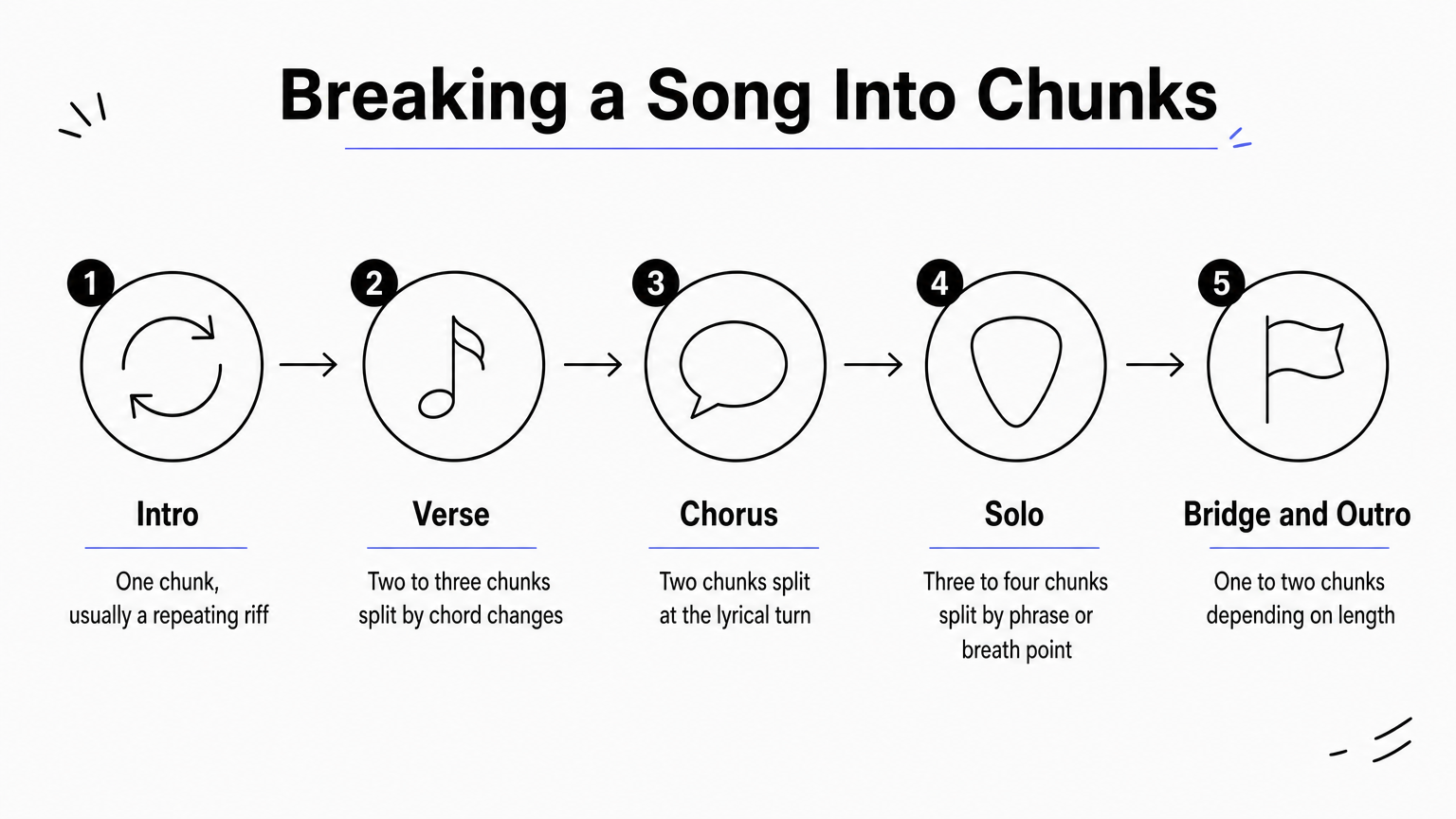
Guitarists learning how to memorize music guitar style often skip this step because chunking feels slower than just playing through, even though it's the core of a step-by-step system for memorizing music. It isn't. A typical breakdown looks like this:
- Intro: 1 chunk, usually a repeating riff
- Verse: 2-3 chunks, split by chord changes
- Chorus: 2 chunks, split at the lyrical turn
- Solo: 3-4 chunks, split by phrase or breath point
- Bridge/outro: 1-2 chunks depending on length
Organizing chunks this way also gives you a built-in structure for review later, since each one becomes a discrete unit you can drill on its own schedule rather than re-running the whole song every time. If you're tracking practice digitally, this is exactly the kind of breakdown that works well as individual practice cards, one per chunk, so you can rate your recall on each piece separately instead of guessing how the whole song is going.
Step 2. Memorize one layer at a time
Once a chunk is defined, resist the urge to memorize everything about it at once. Layer separation is what makes this step different from just practicing the song again. Play through the chunk focusing only on the chord shapes and rhythm, ignoring the melody or lyrics entirely. Get that layer solid before adding the next one on top. Trying to nail chords, melody, and lyrics simultaneously is exactly how a chunk that felt secure a minute ago suddenly falls apart, because your brain is splitting attention across three tasks instead of mastering one.
Working through the stack
Go in this order for each chunk, and don't move to the next layer until the current one feels automatic without thinking:
- Chords and rhythm, get the hand shapes and strum or picking pattern locked in first, leaning on guitar chord switching exercises if the changes are what slow you down
- Melody or lead line, add the notes on top of the rhythm you already trust
- Lyrics or phrasing, layer in words last, since they anchor to the melody you just built
- Combine and drop the tab, only now try the chunk from memory, all layers together
Solos deserve their own pass here. Isolate the fretboard positions completely from timing at first, playing the notes slowly and out of tempo just to confirm your fingers know where to go. Speed and rhythm come back in once the positions are reliable, not before.
Stack layers one at a time, or you'll spend twice as long fixing a chunk that never got solid in the first place.
Rushing this step is the single biggest reason players searching for how to memorize a song on guitar feel stuck after weeks of practice. They're reviewing whole chunks repeatedly without isolating what's actually failing, chords, melody, or lyrics, so the same mistake keeps resurfacing in a slightly different form each time.
Step 3. Test yourself without looking
Covering the tab and hoping for the best isn't testing, it's guessing with extra steps. Real testing means putting the chart away entirely and playing a chunk cold, then honestly rating what happened. Blind recall, the heart of the active recall study method, exposes exactly which chunks are actually memorized versus which ones you've just gotten used to seeing. If you hesitate, guess, or peek even once, that chunk isn't done yet, no matter how many times you've played it with the tab in sight.
A simple self-test routine
Build the habit around a short, repeatable check for every chunk you've worked on:
- Cover the source, tab, chart, or notation, before you play a single note
- Play the chunk once at a comfortable tempo, no stopping to fix mistakes mid-way
- Rate the result honestly: nailed it, hesitated, or blanked
- Isolate the failure point if you blanked, don't just replay the whole chunk again
That rating step matters more than it sounds. Grading your own recall on a simple scale, something close to the Again, Hard, Good, Easy system MemoRep uses for practice cards, forces you to notice patterns instead of vaguely feeling like "it's getting better." A solo phrase that keeps landing on "hesitated" three sessions running needs different treatment than one that jumps straight to "easy."
If you can't play it without looking, you haven't memorized it, you've just gotten comfortable with the page.
Underneath this whole process is a truth most guitarists resist: testing feels slower than practicing, but it's the only way to know how to memorize music guitar techniques actually stick instead of just feeling familiar in the moment. Skipping the honest self-check is how players end up convinced a song is locked in, right up until they're asked to play it without the sheet in front of them.
Step 4. Space out your practice over several days
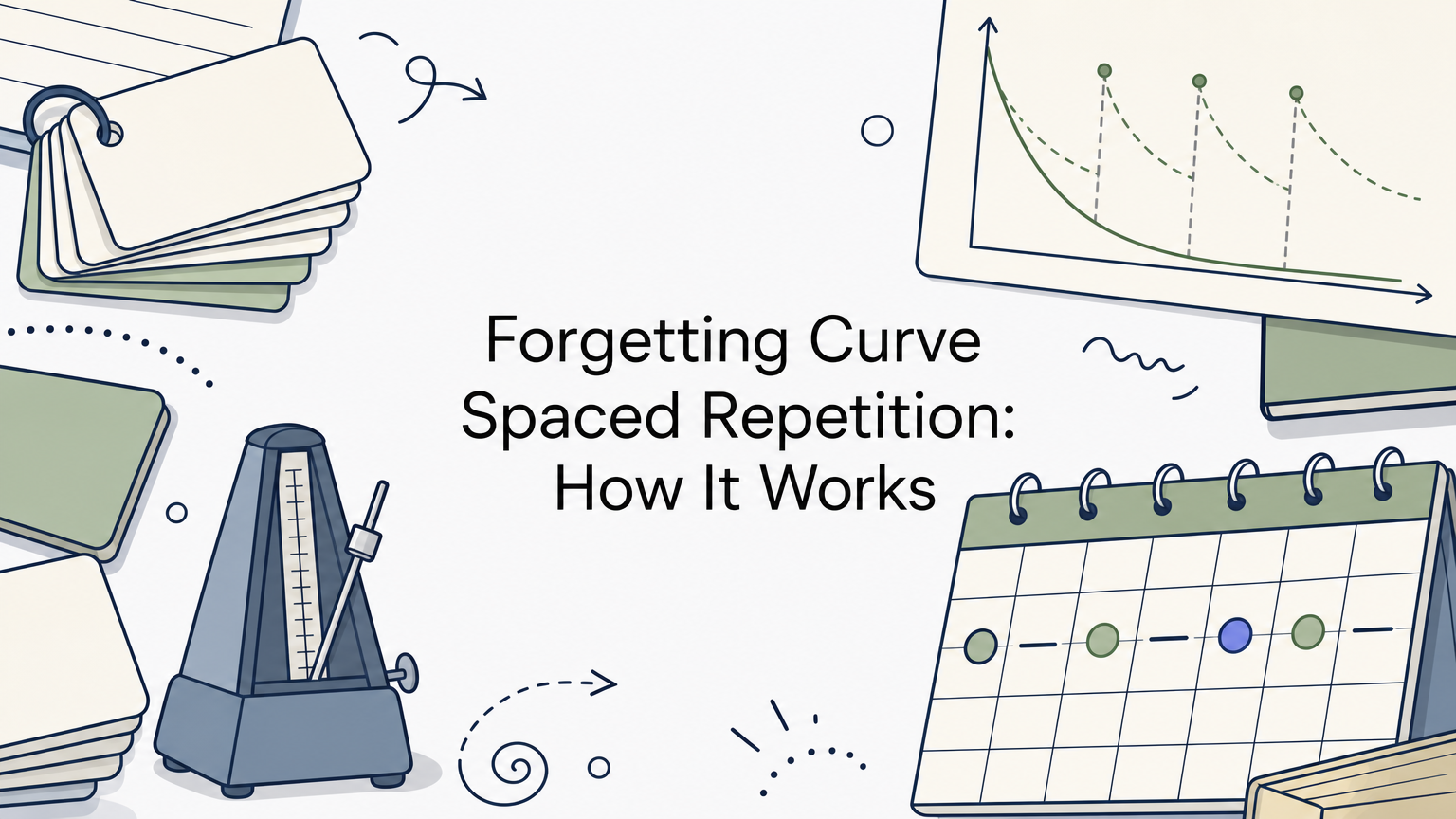
Cramming a chunk for twenty minutes straight feels productive, but it's mostly building short-term familiarity that evaporates by tomorrow. How spaced repetition builds durable memory is simple: your brain strengthens a memory most when you retrieve it right before you'd naturally forget it, not while it's still fresh. That's the Ebbinghaus forgetting curve in action: memory decays fast at first, then slower each time you successfully recall it, so the gaps between reviews should stretch out as a chunk gets more solid.
A basic spacing schedule
You don't need a complicated system to start, just a pattern you actually follow, and spaced practice for guitarists can be as simple as this. Try this for any newly memorized chunk:
- Day 1: Learn and test the chunk cold, right after you first drill it
- Day 2: Retest, if it's solid, push the next review out further
- Day 4: Retest again, a clean recall here means the gap doubles next time
- Day 8+: Retest occasionally, just enough to keep it from fading
Going over the tab in front of you again the next day undoes the point. Cold recall days are non-negotiable, since reviewing while looking at the chart teaches recognition, not retrieval, and those are different skills entirely.
Reviewing too soon wastes time, reviewing too late loses the chunk. Spacing is the difference between the two.
Manually tracking review dates for every chunk of every song gets messy fast, especially once you're juggling a full setlist. This is the exact problem MemoRep's scheduling algorithm handles for you: rate a chunk Again, Hard, Good, or Easy after each cold test, and the system adjusts the next review date automatically, so solos that keep slipping get retested sooner while solid verses drift further apart on their own.
Making memorization stick for good
Memorizing a song on guitar isn't about talent, it's about process: break it into chunks, isolate each layer, test yourself honestly, and space out your reviews so the memory has time to strengthen instead of fading. Skip any one of those steps and you'll end up right back where you started, staring at a tab you thought you'd already learned.
Consistency beats intensity here. A few honest cold-recall sessions spread across a week will lock in a solo faster than an hour of straight repetition ever could. The hard part isn't understanding the method, it's tracking which chunk needs review and when, across every song you're working on.
That's the exact gap MemoRep was built to close. If you want to see the algorithm behind this spacing approach in action, see how MemoRep schedules every chunk of a song and put your next song on a review schedule that actually works.