How Long to Practice Violin Daily by Skill Level
You picked up your violin today and stared at the clock, wondering if 20 minutes counts as real practice or if you need a full hour to make progress. That question, how long to practice violin daily, doesn't have one answer, because a beginner and an advancing player are solving completely different problems with their time.
The honest answer depends on your skill level, and this article breaks down realistic ranges for each stage, from absolute beginners building basic bow control to advanced players preparing repertoire for performance. You'll get specific time targets you can actually use this week, not vague advice about "practicing more," plus separate guidance on how to practice violin effectively once you're in the room. The goal is matching your daily minutes to what your hands and ears can actually absorb at your current stage.
What matters more than raw hours is consistency over cramming, and knowing when a skill needs revisiting before it gets rusty. That's where keeping every session in one practice tracker makes the difference between wasted repetition and real progress, and it's exactly the kind of practice organization problem MemoRep was built to solve for musicians juggling multiple pieces and techniques at once.
Why your ideal practice time isn't one-size-fits-all
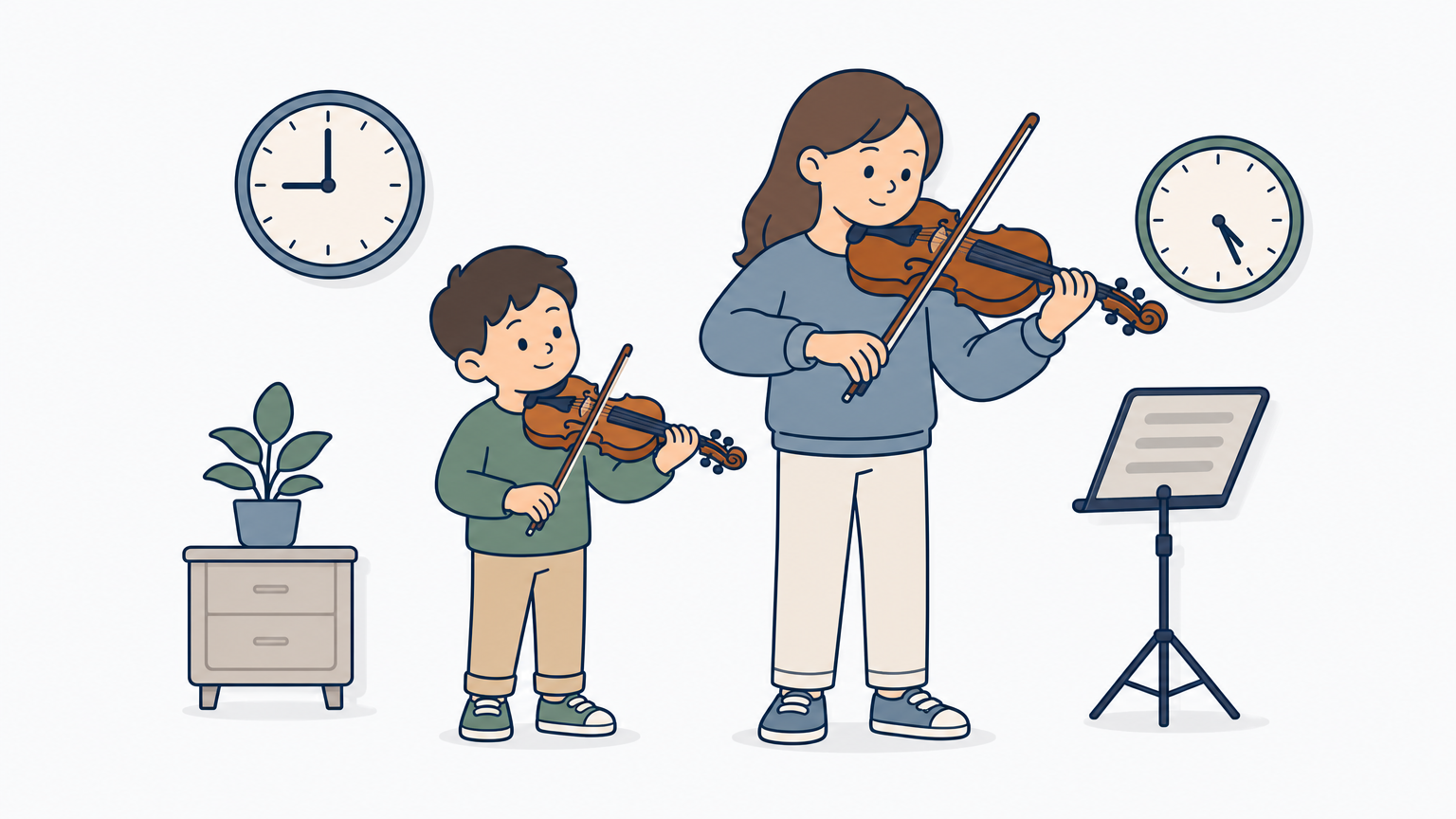
Ask five violin teachers how long to practice violin daily and you'll get five different answers, because the real number depends on variables that have nothing to do with a universal clock. A ten-year-old starting Suzuki Book 1 and a conservatory-bound teenager working through advanced repertoire aren't solving the same problem, even if they both pick up a violin at the same time every afternoon. Skill level changes everything about what a given block of minutes can actually accomplish.
Skill level determines what your minutes buy you
Beginners spend early sessions teaching their hands entirely new physical patterns: holding the bow correctly, finding first position without looking down, keeping the instrument level against the shoulder. That kind of motor learning happens best in short, frequent bursts, because the nervous system needs rest to lock in a movement, not more repetitions of a movement done wrong, which is where a guide to improving any skill through deliberate practice pays off more than extra minutes. Intermediate and advanced players use their time differently, refining intonation, building stamina for longer pieces, and layering several techniques into a single passage, which genuinely requires more clock time to execute well.
More practice time only helps once your body already knows what it's trying to repeat.
Physical endurance changes with experience
A new player's shoulder, wrist, and jaw haven't built the same endurance as a five-year player's, so pushing a beginner to match an advanced student's schedule risks bad habits forming faster than good ones, sometimes even strain injuries. Fatigue is the real enemy here: once posture breaks down, every extra minute reinforces sloppy technique instead of correcting it. This is why violin practice duration for beginners should stay short and frequent rather than long and occasional, even if the daily total looks small on paper.
Goals and repertoire shape the number too
Someone preparing for a youth orchestra audition next month needs a different daily target than someone maintaining skills for relaxed weekend playing with friends. Repertoire complexity, an approaching performance date, and how many pieces sit in active rotation all push your ideal number up or down independent of how long you've played. A few factors worth weighing before you settle on a daily target:
- Number of active pieces or techniques you're rotating through right now
- Upcoming deadlines, like a recital, audition, or exam
- Physical stamina, including any hand, wrist, or jaw fatigue from other activities
- Quality of focus available, since 20 distracted minutes teach less than 15 focused ones
- Teacher assignments, if you're studying formally and have specific homework
Each of these can shift your realistic daily number by 15 minutes or more in either direction, which is exactly why blanket advice like "practice one hour a day" misses so many players. The sections ahead give you concrete ranges by stage, but treat them as starting points you adjust against your own schedule, energy, and goals rather than fixed rules carved in stone.
How to calculate your ideal daily practice time
Instead of guessing, treat your daily target like a formula built from three inputs: your current skill level, the number of pieces or techniques you're actively working, and how much focused attention you can realistically bring to a session. Calculating practice time this way turns a vague guideline into a number tailored to your week, not someone else's, and it beats trying to answer how long to practice violin daily with a single borrowed rule.
Start with an experience-based baseline
Begin with the general range for your stage, covered in detail in the next section, then adjust up or down using the modifiers below. A beginner might start at 20 minutes, an intermediate player at 45, an advanced player at 90, but none of those numbers should be treated as fixed.
- Add 10-15 minutes if you're preparing for a specific performance or audition within six weeks
- Subtract 10 minutes if you're mentally or physically fatigued from work, school, or other physical activities
- Add 5-10 minutes for each additional piece beyond your first that's in active rotation
- Subtract time if your focus consistently drops before the session ends anyway
A number that ignores your actual focus and fatigue is just a guess dressed up as a plan.
Split the total into shorter blocks
Rather than committing to one uninterrupted block, most players get more from splitting their calculated total across two shorter sessions, especially once that number climbs past 30 minutes. Concentration for fine motor skills like intonation and bow control tends to drop sharply after 20 to 25 minutes of focused work, which is one of the science-backed reasons short segments beat long ones, so a 40-minute total often works better as two 20-minute sessions than one continuous sit. Splitting also gives your hands recovery time between sessions, which matters more than most players expect when building daily violin practice time into a sustainable weekly practice plan rather than a single grinding block.
Tracking what you actually did against what you planned matters just as much as the initial math, because your calculated number should shift over weeks as stamina and repertoire change. Logging each session as it actually happened, not as you intended it, is the only reliable way to catch the gap between your plan and your habits before it hardens into a pattern that stalls progress.
Recommended practice times for each skill level
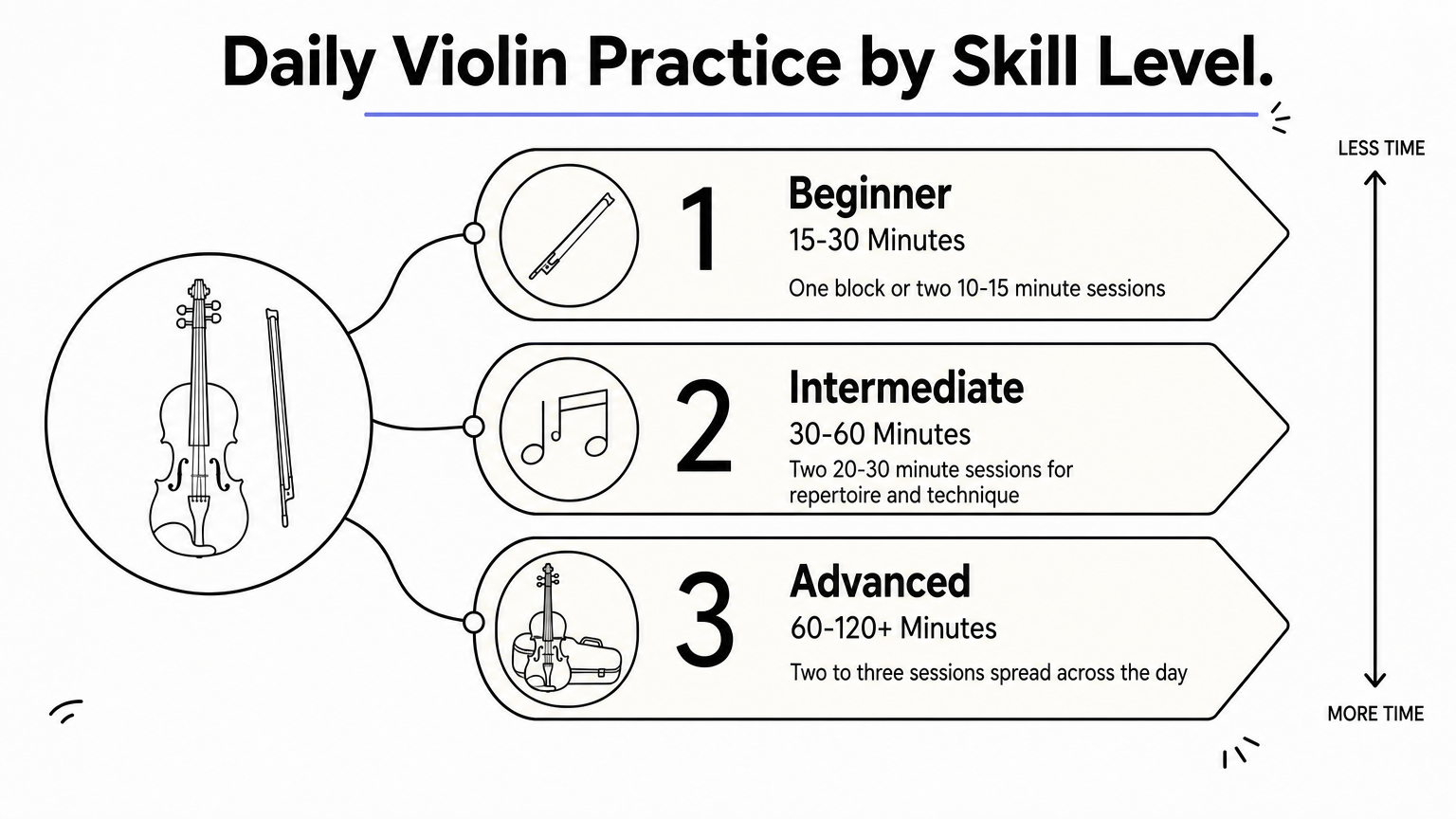
Numbers work better than vague ranges, so here's a table you can act on today, followed by the reasoning behind each stage. These figures answer how long to practice violin daily for most players, but treat them as a starting range rather than a hard rule, especially in your first few weeks of testing them out.
| Skill Level | Daily Range | Session Structure |
|---|---|---|
| Beginner (0-1 year) | 15-30 minutes | One block, or two 10-15 minute sessions |
| Intermediate (1-4 years) | 30-60 minutes | Two 20-30 minute sessions |
| Advanced (4+ years) | 60-120 minutes | Two to three sessions across the day |
Beginner: 15 to 30 minutes
Beginners get more from short daily sessions than from occasional long ones, because new players are still building the basic physical vocabulary of holding the bow, finding position, and reading rhythm at the same time. Twenty minutes of focused work on posture and open strings beats an hour that collapses into fatigue and bad habits by minute 30, because quality of attention outweighs hours logged. Keep sessions under 30 minutes unless a teacher has specifically assigned more, and split that time into two shorter blocks if attention starts wandering past the ten-minute mark.
Intermediate: 30 to 60 minutes
Once basic technique is reliable, intermediate practice time shifts toward repertoire, scales, and correcting intonation issues that only show up under sustained attention. This is usually the stage where players start juggling two or three pieces at once, which is exactly the kind of scheduling problem that benefits from tracking what needs revisiting instead of guessing. A 45-minute session split into a 25-minute technical block and a 20-minute repertoire block tends to outperform one continuous sit at this level.
The right number for an intermediate player is whatever keeps every piece in rotation from going stale.
Advanced: 60 to 120+ minutes
Advanced players carry heavier repertoire loads, often preparing for auditions, recitals, or ensemble work that demands real stamina, so daily minutes for advancing players climb accordingly. Splitting a two-hour total across morning and evening sessions protects both concentration and physical endurance far better than one marathon block, and it mirrors how most conservatory-track students structure their week.
Signs it's time to adjust your practice schedule
Your daily number isn't permanent. Skill level changes over months, repertoire shifts, and life gets busier or calmer, so the schedule that worked in January can quietly stop working by summer. Watching for a few specific signals keeps you from either coasting on too little time or grinding through sessions that do more harm than good.
When your current time isn't enough
Stalled progress on a passage you've drilled for weeks is usually the clearest sign your daily practice time needs to grow, especially if you're rushing through material to fit everything into one short block. If you notice these patterns, add 10 to 15 minutes before assuming the piece itself is the problem:
- Pieces that haven't improved in three or more consecutive sessions
- Constantly cutting technical work short to "get to the fun parts"
- A teacher noting the same correction week after week
- Feeling rushed before you've even started your last piece
When you're overdoing it
Soreness in your wrist, shoulder, or jaw that shows up mid-session is a physical red flag, not a sign you need to push through it. Overtraining signs also show up mentally: irritation with the instrument, dreading practice time, or noticing your intonation actually gets worse the longer a session runs. When focus and tone both decline before your planned time is up, that's your body telling you the session is too long, not too short.
If practice starts feeling worse the longer it goes, more minutes are making things worse, not better.
When the structure itself is the problem
Sometimes the daily total is fine, but the way you're splitting attention across pieces isn't, and you find yourself spending five minutes deciding what to practice before you've played a single note. That decision fatigue is exactly what a spaced repetition system solves, since the forgetting curve sets your review timing and tells you which piece or technique is due instead of leaving that call to guesswork every day. Reassessing every few weeks, using apps built for learning violin like MemoRep to flag what's about to go stale, keeps your schedule matched to where your playing actually stands rather than where it stood a month ago.
Building a practice routine you can sustain
Getting how long to practice violin daily right isn't about finding a magic number and repeating it forever. It's about matching your daily minutes to your actual skill level, then adjusting as your stamina, repertoire, and goals shift week to week. A beginner grinding through 90 minutes and an advanced player coasting on 20 are both fighting their own schedule instead of using it.
What separates players who improve from players who just show up is tracking, not raw hours. Knowing which piece is about to go stale, which technique needs revisiting today, removes the guesswork that eats into your actual practice time. That's the gap MemoRep was built to close for musicians juggling more than one piece at a time. If decision fatigue is quietly shrinking your sessions, see how MemoRep times each piece for review and let the algorithm handle what to practice next.