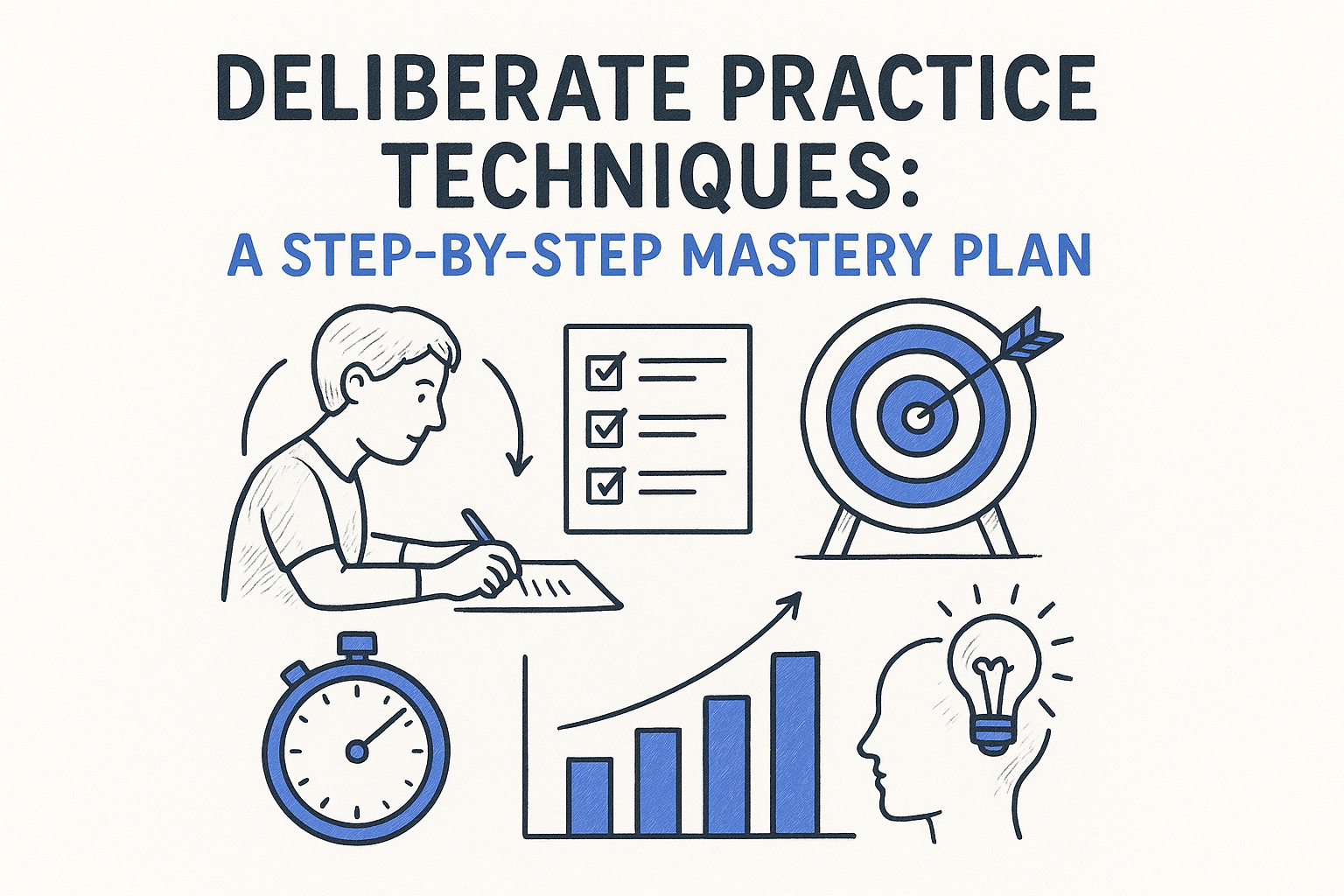
Deliberate Practice Techniques: A Step-by-Step Mastery Plan
Most people who pick up a guitar, sit down at a piano, or commit to any skill spend hundreds of hours practicing without a clear system. They repeat what feels comfortable, skip what's hard, and wonder why progress stalls. The difference between someone who improves steadily and someone who plateaus for years often comes down to one thing: deliberate practice techniques. These aren't vague "practice more" suggestions, they're specific, structured methods backed by decades of cognitive science research, originally formalized by psychologist Anders Ericsson.
This guide breaks down what deliberate practice actually means, how it differs from mindless repetition, and, most importantly, how to apply it step by step to whatever skill you're building. You'll get concrete frameworks for setting goals, structuring sessions, using feedback loops, and scheduling reviews at the right intervals so skills stick instead of fade. Whether you're working through a difficult passage on your instrument or drilling a complex physical technique, every method here is designed for practical application, not theory for theory's sake.
That focus on practical skill-building is exactly why we built MemoRep. Our platform uses spaced repetition algorithms to automate the scheduling side of deliberate practice, telling you what to revisit and when, based on your actual performance. Think of this article as the strategy, and MemoRep as the tool that removes the guesswork from executing it day after day. Compare that workflow with timers, journals, and streak tools in our guide to choosing a music practice app or habit tracker.
Why deliberate practice beats regular practice
When most people practice, they run through material they already know reasonably well, fix obvious mistakes when they notice them, and call it done for the day. That approach feels productive because time is being logged and effort is being spent, but it rarely produces the kind of improvement serious learners are after. Anders Ericsson spent decades studying expert performers across music, chess, sports, and medicine, and his findings were consistent: the volume of practice matters far less than how that practice is structured.
The research behind the difference
Ericsson's landmark work on expert performance, summarized in his book "Peak," showed that elite performers don't simply put in more hours than everyone else. They put in qualitatively different hours. Beginners and intermediates who plateau for years often practice at their comfort level, reinforcing what they already know without pushing into areas of genuine difficulty. Expert performers, by contrast, consistently work at the edge of their current ability, a zone that produces cognitive strain but also rapid skill acquisition.
The defining characteristic of expert practice isn't volume. It's the deliberate targeting of specific weaknesses under conditions that force adaptation.
Studies on musicians found that top performers at conservatories didn't just log more hours. They spent a significantly higher share of their time on focused solo practice, targeting the hardest passages specifically, breaking them into smaller units, and repeating those units with full attention on the problem until it resolved.
Why repetition alone won't get you there
Your brain consolidates familiar movement and thought patterns efficiently, which sounds like a good thing until you realize it also means that repeating what you already do well produces diminishing returns fast. When you run through a piece you've already mastered, your nervous system isn't building new pathways. It's maintaining existing ones, and maintenance is not the same as growth.
Real skill acquisition happens when you push past the automatic and into the effortful. Deliberate practice techniques are specifically designed to put you in that uncomfortable zone consistently, rather than occasionally when you happen to stumble across a hard section. Learners who practice this way reach performance benchmarks in far fewer total hours than those who simply log time without structure.
The feedback loop that changes everything
Regular practice gives you limited and delayed feedback. You play something, it sounds roughly right or it doesn't, and you move on. That's a slow and unreliable signal for improvement. Deliberate practice builds tight feedback loops directly into the session structure, so you know immediately whether a specific attempt at a skill succeeded or failed against a measurable standard.
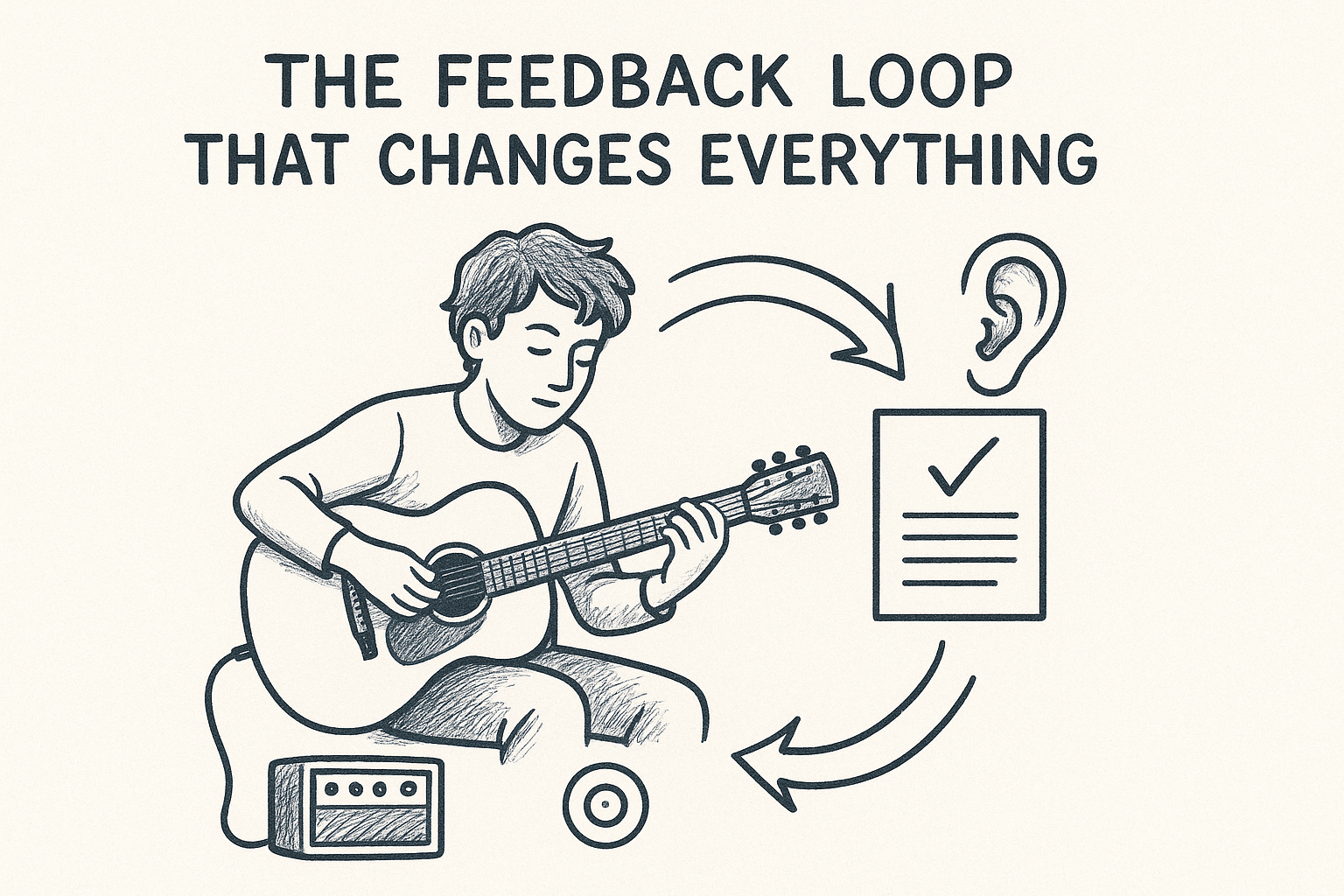
This feedback doesn't have to come from a teacher, though expert coaching accelerates the process significantly. It can come from a recording, a metronome, a target tempo, or a structured self-evaluation after each attempt. What matters is that every repetition produces data you can act on in the moment, not vague impressions you half-remember at the end of a session. Without that tight loop, you're reinforcing your mistakes at exactly the same rate you're reinforcing correct execution, and the two cancel each other out.
What deliberate practice is and what it is not
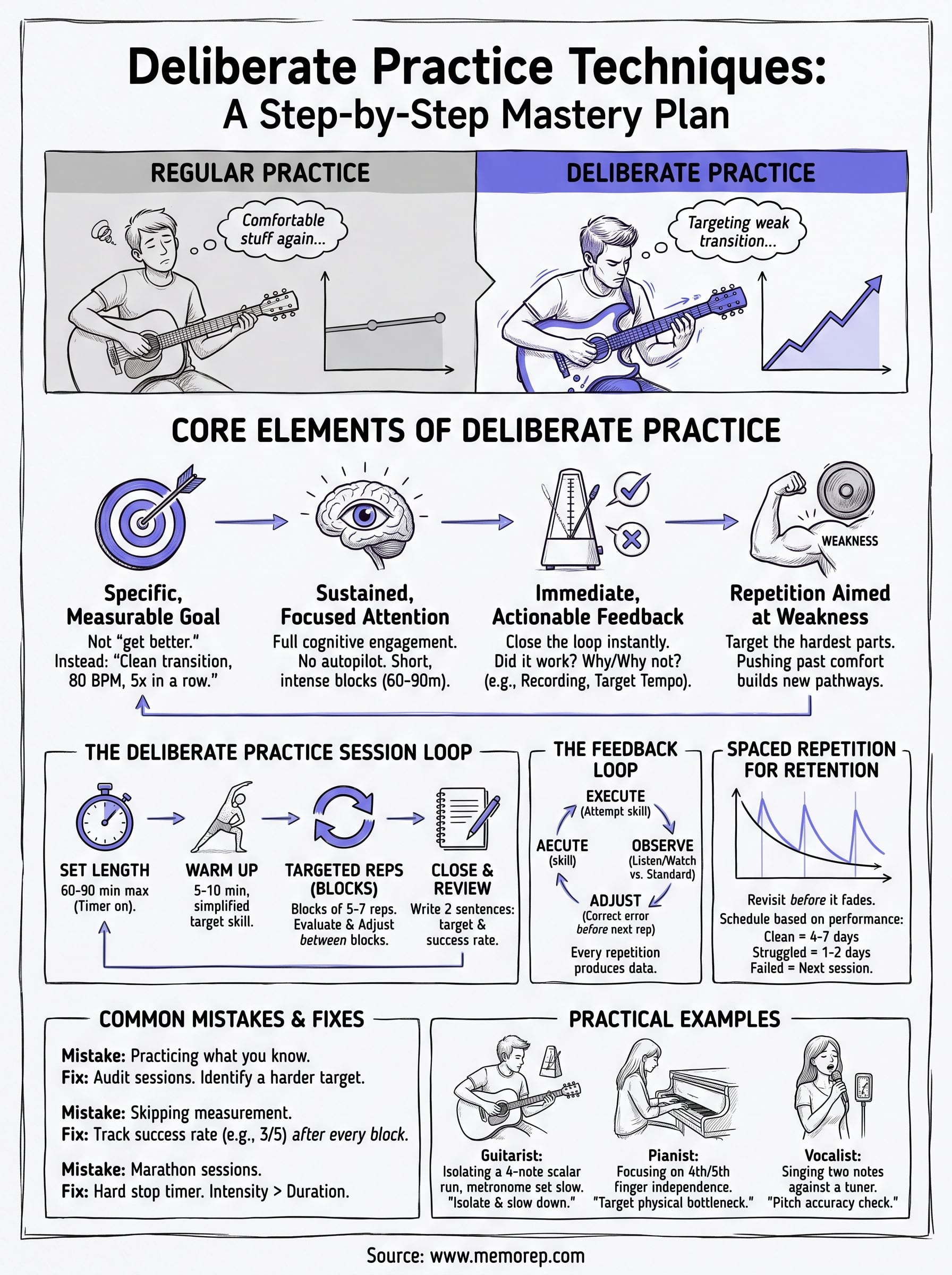
Deliberate practice is a specific, structured approach to skill development that requires focused effort directed at a clear performance target. It's not a mindset or a motivational framework. It's a methodology with identifiable components: a specific goal, concentrated attention, immediate feedback, and repetition that targets weakness rather than strength. Understanding the boundaries of that definition matters because people often think they're using deliberate practice techniques when they're doing something far less effective.
What deliberate practice actually is
At its core, deliberate practice is goal-directed activity that operates at the edge of your current ability. You identify a specific sub-skill you can't yet execute reliably, design an exercise that isolates it, and repeat it with full attention until your success rate improves against a measurable standard. A guitarist practicing this way doesn't sit down to "work on the solo." They sit down to execute the first four bars at 90% of target tempo with clean fretting on a specific position stretch they keep missing.
Deliberate practice is defined by the specificity of the target, not the intensity of the effort.
The structure also requires active cognitive engagement throughout every repetition. You're not running on autopilot. Each attempt is an experiment: "If I adjust my hand position here, the note will ring clean." You observe the result, update your approach, and repeat. That continuous loop of hypothesis and immediate feedback is what drives real adaptation, not just the act of putting in time.
What deliberate practice is not
Deliberate practice is not the same as repetition. Running through material you already play well, even with concentration, is maintenance practice. It keeps a skill from fading, but it won't push your ability forward. Similarly, playing for enjoyment is valuable, but it belongs in a different category. When you play for pleasure, you make choices based on what feels good. Deliberate practice makes choices based on what's currently broken.
Hard work in the generic sense also falls short of the definition. You can drain yourself physically and mentally in a practice session without making progress if the effort isn't aimed at a specific, isolated target. Hours logged without structure produce fatigue. They don't produce mastery.
The core elements of deliberate practice
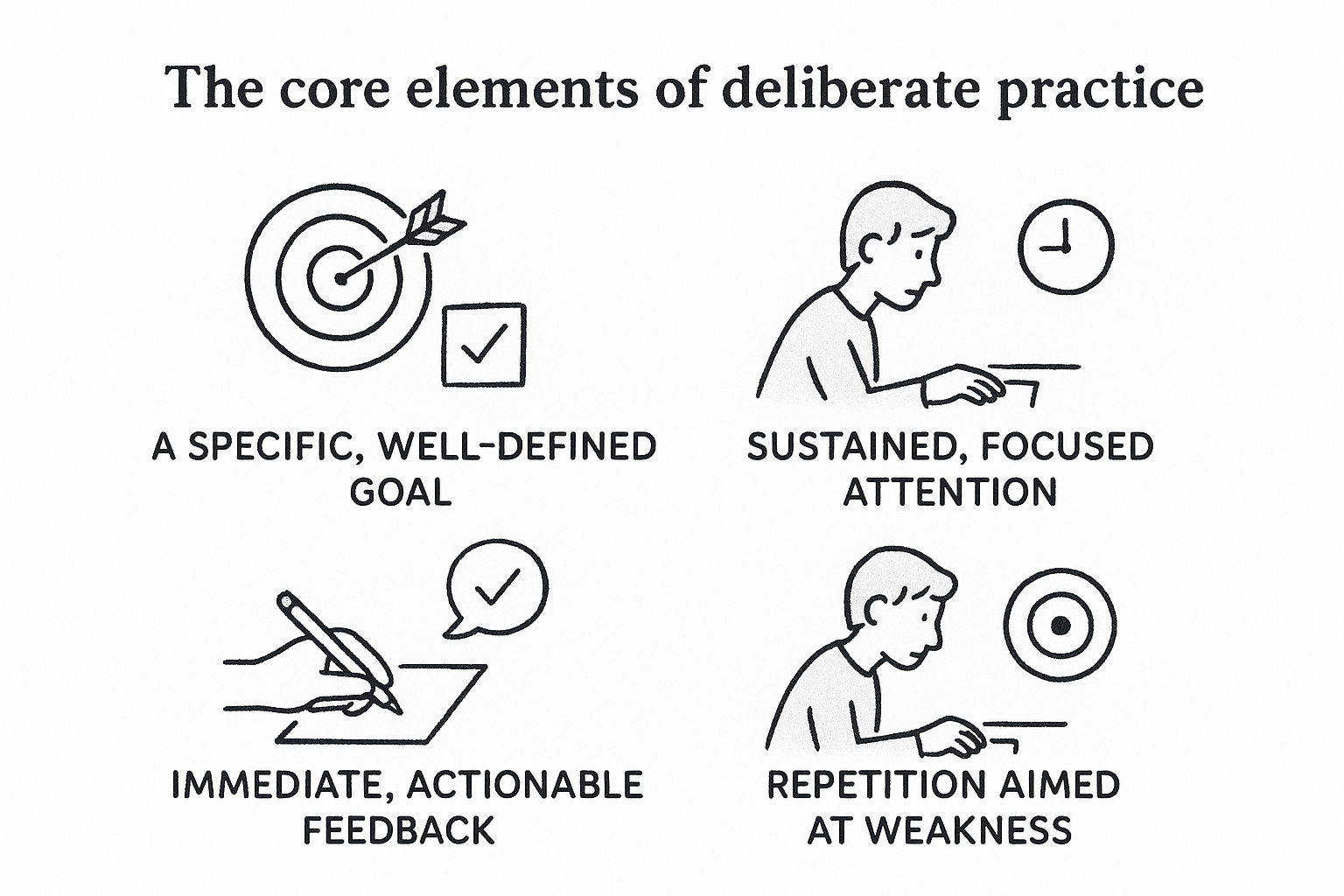
Every effective deliberate practice techniques framework shares the same structural components. Knowing what those components are lets you evaluate any practice session and identify exactly where it's falling short. Strip away the field-specific details, and four elements appear consistently in every form of high-quality skill practice documented in the research literature.
A specific, well-defined goal
The practice session starts with a target narrow enough that you can tell, in real time, whether you hit it or missed it. "Get better at transitions" is too vague to drive improvement. "Play the transition from measure 12 to 13 cleanly at 80 BPM five times in a row" is a goal you can measure during the session itself.
Writing your goal down before you start does something concrete: it forces you to articulate exactly what success looks like, which exposes vague intentions before they waste your practice time. A clear goal also tells you when to stop, so you finish with a defined result rather than a vague sense that you practiced.
Sustained, focused attention
Deliberate practice requires your full cognitive engagement for the entire session, not just some of it. You're not running through movements while your mind wanders. Each repetition is an intentional act: you set your target, execute, observe the result, and adjust. Distracted repetition produces reinforced errors, not improvement. This is also why shorter, fully-focused sessions consistently outperform long, half-present ones.
The quality of your attention during each repetition determines whether you're building a skill or just logging time.
Immediate, actionable feedback
Feedback needs to close the loop before the next repetition, not at the end of the session. That means setting up conditions where you can evaluate each attempt on the spot: a target tempo you either hit or didn't, a clean note you either produced or didn't, a correct position your body either held or dropped. Delayed feedback is better than none, but it dramatically slows the rate at which your nervous system can adapt to corrections.
Repetition aimed at weakness
The last element is where most people abandon the process, because it's the least comfortable. You identify what you can't do reliably and you repeat that specific thing until your success rate moves. This is the opposite of playing to your strengths. Targeting your weakest sub-skills produces the fastest measurable gains and separates deliberate practice from enjoyable but low-yield run-through sessions.
How to build a deliberate practice session
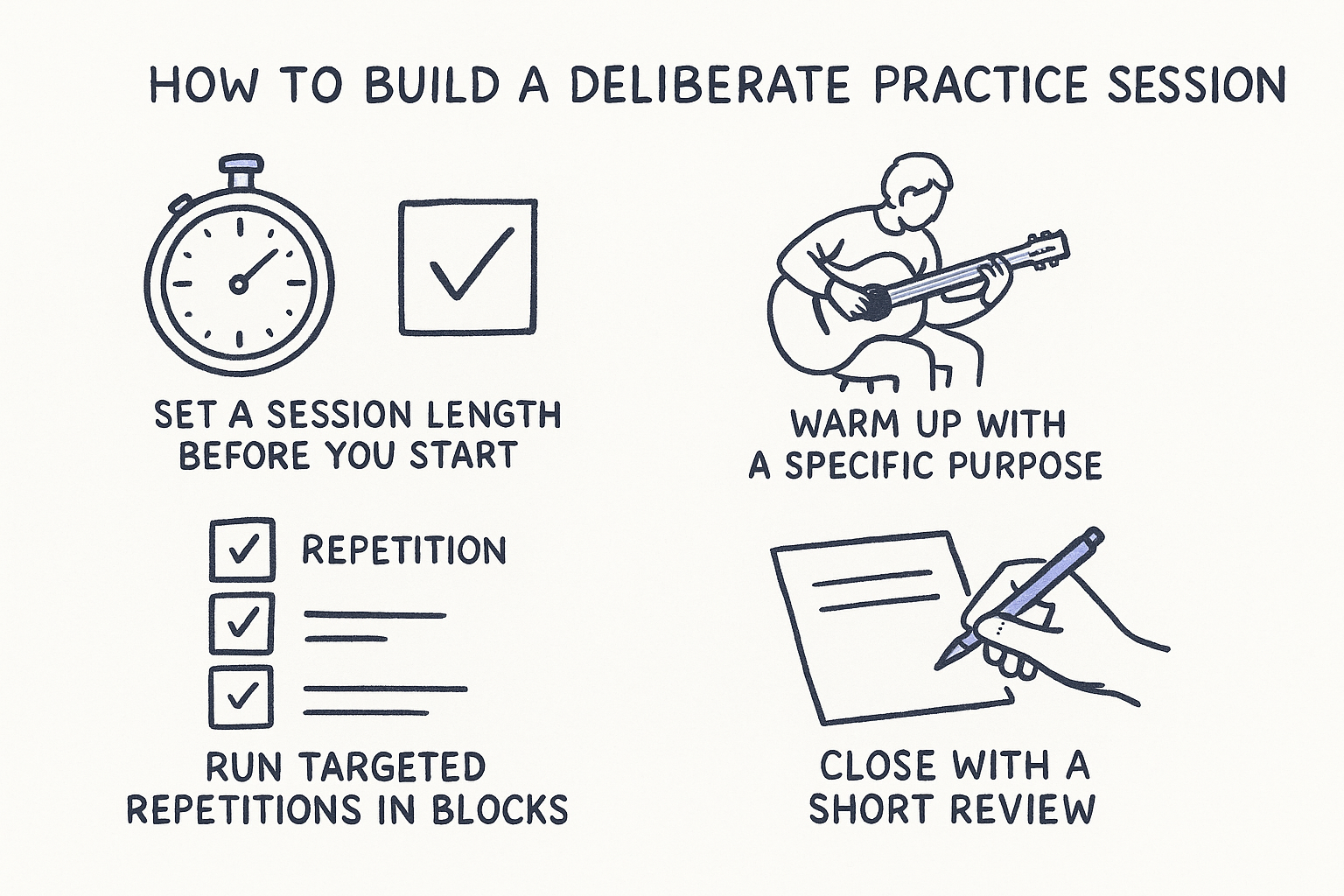
A productive session doesn't happen by accident. Every effective deliberate practice session has a predictable architecture that keeps your effort aimed at the right targets from the moment you sit down to the moment you stop. Knowing that structure in advance removes the decision-making that burns time and attention at the start of each session.
Set a session length before you start
The first decision you make is how long you will practice, and you make it before you open your instrument case or pull up your materials. Research on expert performers consistently shows that focused practice of 60 to 90 minutes exhausts most people's capacity for sustained concentration, after which the quality of attention drops sharply. Set a timer. When it goes off, the session ends.
Short sessions with full attention compound faster than long sessions with divided attention.
Warm up with a specific purpose
Your warm-up should connect directly to the skill you're targeting that day, not just get your fingers moving. Spend five to ten minutes on a simplified version of the technique you're about to drill at full difficulty, using a reduced tempo or lower complexity. This primes the specific neural pathways you're about to tax without burning your best concentration on generic exercises unrelated to your goal.
Run targeted repetitions in blocks
This is the core of your session and where deliberate practice techniques produce their results. Pick one target skill and work on it in blocks of five to seven repetitions. After each block, pause briefly and evaluate: did your success rate improve, stay flat, or decline? If it declined, simplify the exercise slightly. If you hit your target standard five times in a row, increase the difficulty by one small increment and continue.
Running the session this way keeps the difficulty calibrated to your actual ability in real time, which is the condition that drives the fastest measurable adaptation.
Close with a short review
End every session by writing two sentences: what you targeted and what your success rate looked like by the final block. You don't need a detailed journal entry. You need enough information to pick up exactly where you left off at the start of your next session without reconstructing context from memory, which wastes the first ten minutes of every session for learners who skip this step.
How to pick high-leverage skills and drills
Most practice time gets wasted on skills that don't move the needle because learners default to what feels comfortable or what seems productive. Picking the right target isn't about finding what's hardest in some abstract sense. It's about identifying the specific sub-skills where your current weakness creates the biggest bottleneck to your overall performance. Those are the high-leverage targets, and they're where deliberate practice techniques produce their sharpest returns.
Identify your actual bottlenecks
The fastest way to find a high-leverage skill is to work backward from a performance failure. Pick a piece, a drill, or a task you can't execute at your target standard and ask: what's the smallest component that keeps breaking down? If a musical passage falls apart, it's rarely the whole passage. It's one transition, one position shift, or one rhythmic figure that triggers a cascade of errors when it fails. That's the unit you drill, not the surrounding material.
Drilling the symptom wastes repetitions. Drilling the cause drives improvement.
You can also map your skill set against a clear performance standard you're trying to reach, such as a target tempo, a technique benchmark, or a specific accuracy rate. List the components that fall short of that standard. The highest-leverage target is the one whose failure affects the most other skills downstream. Work on that before touching anything else on the list.
Design drills that isolate one variable
Once you've identified the bottleneck, you need a drill that targets it without the noise of surrounding complexity. Strip the context down to the smallest unit that still contains the problem. If your fretting hand breaks down during a fast run, practice that specific finger movement in isolation at a reduced tempo before reintegrating it into the full passage. Isolating a single variable lets your nervous system adapt to the correct pattern without competing errors clouding the signal.
A useful test for any drill you design: can you evaluate success or failure within five repetitions? If the answer is no, the drill is still too broad. Keep narrowing the scope until each attempt produces a clear, immediate result you can use to adjust your next repetition on the spot. That tight loop is what converts drills from busywork into actual skill acquisition.
How to get feedback and measure progress
Feedback is what separates deliberate practice techniques from motivated repetition that goes nowhere. Without a clear signal telling you whether each attempt succeeded or failed, your nervous system has no reliable information to adapt to. The good news is that you don't need a coach in the room to run a tight feedback loop. You need a measurable standard defined before you start and a system for comparing each attempt against it in real time.
Build feedback into the drill itself
The most effective feedback is built into the drill's design, not added as an afterthought at the end of a session. Before you start a repetition block, define your success criterion in concrete terms: a specific tempo you either hit or didn't, a note that rings clean or buzzes, a position your body held or dropped. Setting that standard in advance forces you to evaluate each attempt against the same fixed target rather than your vague sense of how things felt.
If you can't describe what success looks like before you start, you're not ready to practice that skill yet.
Recording yourself is one of the most underused feedback tools available. A short audio or video clip of a repetition block reveals errors you miss in real time because your attention is split between executing and monitoring. Play it back immediately, identify the specific point where the execution broke down, and adjust your next block accordingly. That loop of execute, observe, and adjust is the engine of real skill acquisition.
Track your numbers, not your feelings
Perceived progress and actual progress diverge constantly, which is why tracking your performance data separately from how the session felt matters. After each block, write down your success rate: how many attempts out of five or seven hit your target standard. That number tells you whether your difficulty calibration is correct and whether your skill is actually moving, independent of whether the session felt hard or easy.
Over time, a simple log of your success rates across sessions reveals patterns that single-session perception never captures. You'll see which drills produce fast gains and which ones plateau, and that data tells you exactly when to advance the difficulty or revisit a technique you thought you had already locked in.
How to use spaced repetition for skill practice
Spaced repetition is the most underutilized deliberate practice technique for skill retention. The idea is straightforward: you review a skill at increasing intervals based on how well you executed it last time. Skills you nail get scheduled further out. Skills that fall apart get brought back sooner. This keeps your practice time weighted toward what actually needs work rather than what you already do well, which is exactly where most learners waste the most hours.
Why timing your reviews matters
Skills decay when you don't revisit them, and the rate of that decay follows a predictable pattern. Hermann Ebbinghaus documented the forgetting curve in the 19th century, and the core finding still holds: the sharpest drop in retention happens in the first 24 to 72 hours after initial learning, then the curve flattens. If you wait too long to revisit a skill, you spend your next session re-learning instead of advancing.
Reviewing a skill just before it starts to fade produces a stronger retention effect than reviewing it when it's already solid.
Reviewing too early is also a problem. If you drill a skill you already execute reliably, you're spending focused practice time on maintenance when you could be pushing into new difficulty. The goal is to revisit each skill at exactly the right moment, not too soon and not too late, which is a scheduling problem most learners solve poorly by guessing.
How to schedule your reviews
You don't need complex software to apply spaced repetition to skill practice, though tools that automate the scheduling remove significant cognitive load. At a basic level, rate each skill after every session using a simple scale: you either executed it cleanly, struggled but got there, or failed to meet your target standard. Use that rating to decide when to bring it back.
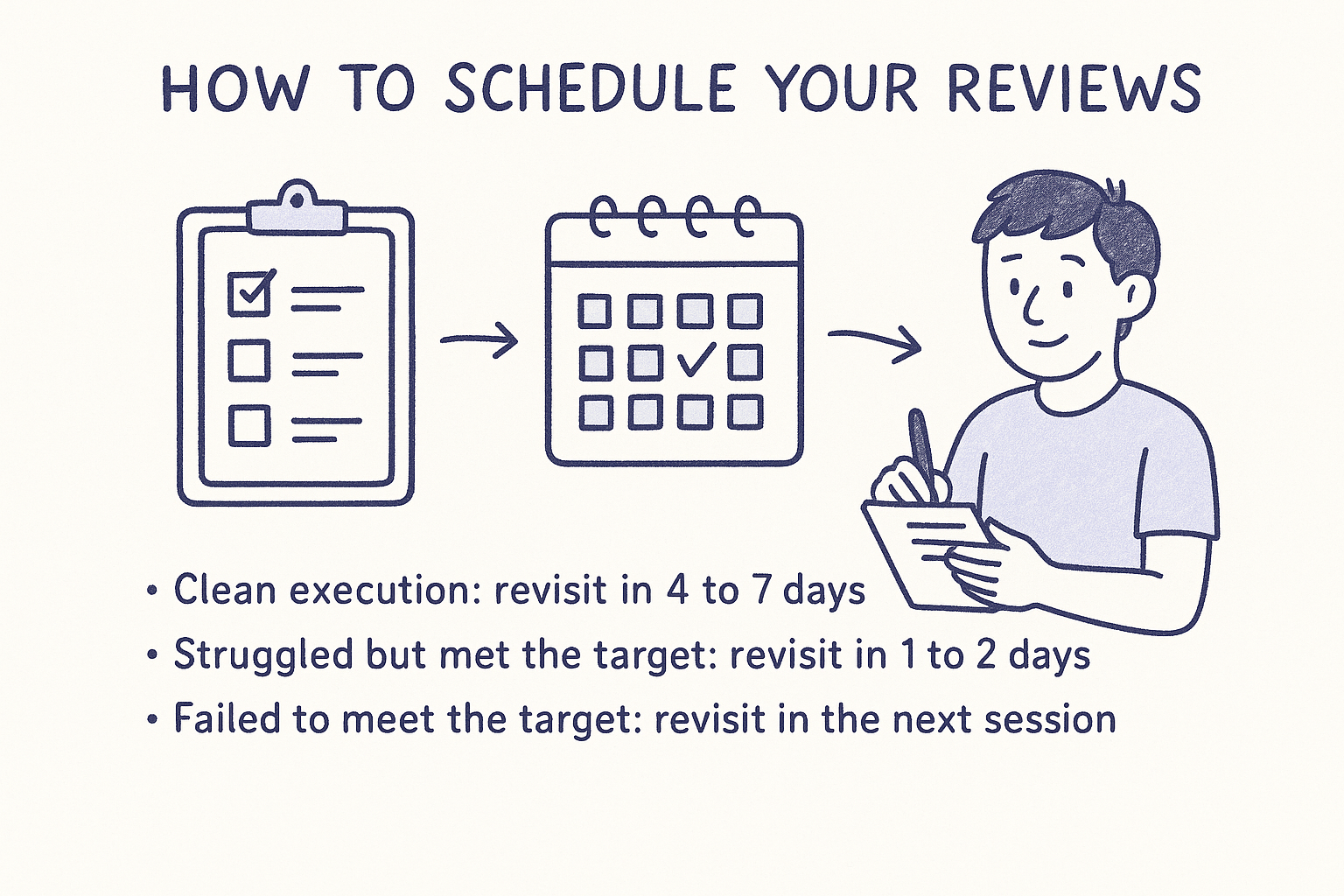
A simple scheduling approach for skill review looks like this:
- Clean execution: revisit in 4 to 7 days
- Struggled but met the target: revisit in 1 to 2 days
- Failed to meet the target: revisit in the next session
Keeping a short list of your skills with their last rating and next review date takes fewer than five minutes to maintain. That list becomes the backbone of your session planning, replacing the guesswork of "what should I work on today" with a concrete, data-driven answer every time you sit down to practice.
How to balance intensity, rest, and consistency
Pushing hard in every session sounds like the right approach, but it's one of the fastest ways to stall your progress. Deliberate practice techniques work best when intensity, rest, and consistency operate together as a system, not as competing priorities. Understanding how each one interacts with the others lets you sustain progress over months and years instead of burning out in weeks.
Why intensity has a ceiling
Every deliberate practice session draws on the same cognitive resources: focused attention, working memory, and the capacity to monitor and adjust your execution in real time. Those resources deplete faster than most learners expect, which is why elite performers across Ericsson's research rarely exceeded four hours of deliberate practice per day, and many peaked at two. Pushing beyond your concentration limit doesn't add productive practice time. It adds repetitions where your attention has already dropped, which means you're reinforcing errors at the same rate as correct execution.
Practicing past your cognitive limit doesn't make you tougher. It makes your mistakes more durable.
Your physical state also sets a ceiling on intensity. Fatigue degrades fine motor control and decision-making simultaneously, so the last twenty minutes of a session you've extended too far often undo some of what the first forty produced. When your execution quality starts dropping noticeably mid-session, that's your signal to stop, not to push through.
How to structure rest between sessions
Rest isn't time lost to practice. Rest is when your nervous system consolidates the patterns you worked on, converting short-term motor attempts into more durable skill. Scheduling rest between sessions isn't optional if you want deliberate practice to produce lasting gains. A simple structure that works for most skill learners:
- Daily focused sessions of 60 to 90 minutes with full attention
- At least one full rest day per week for consolidation
- Shorter sessions on low-energy days rather than skipping entirely
Build consistency as your primary habit
Consistency compounds faster than any single intense session. A shorter, focused practice block done five days a week outperforms a marathon session done once because your nervous system gets repeated consolidation cycles instead of one large, infrequent signal. The goal is to make each session short enough that showing up feels achievable even on low-energy days.
That removal of friction is what separates learners who improve steadily from those who practice intensely for two weeks and then stop for a month. Missed sessions become missed weeks when your sessions feel like a burden rather than a contained, manageable commitment.
Common mistakes and how to fix them
Most learners applying deliberate practice techniques for the first time hit the same predictable walls. The mistakes aren't random, they follow a pattern, and once you can recognize them in your own sessions, fixing them is straightforward. Each problem below has a direct corrective action you can apply immediately.
Practicing what you already know
The most common mistake is spending the majority of your session on material you can already execute reliably. It feels productive because things go smoothly, but smooth repetitions aren't what drive adaptation. You're maintaining a skill, not building one.
The moment a skill feels easy, it stops being a deliberate practice target and becomes a warm-up tool.
Fix this by auditing your last three sessions. List the specific skills you drilled. For each one, ask whether you hit your success target within the first two repetition blocks. If yes, that skill wasn't challenging enough to qualify as deliberate practice. Identify one harder target to replace it with in your next session.
Skipping the measurement step
Many learners set a goal at the start of a session and then never actually track whether they hit it. They finish with a general sense that things went well or poorly, but no concrete data to act on. Without that data, you can't make accurate decisions about when to advance difficulty or revisit a skill.
The fix is to record your success rate after every repetition block, not at the end of the session. Use a simple tally: how many attempts out of five met your defined standard. That number removes guesswork from your next session's planning and tells you whether your difficulty calibration is actually working.
Treating sessions like marathons
Extending your session when things are going well feels logical, but cognitive fatigue sets in well before most learners notice it. Your execution quality drops, your error rate climbs, and you end up reinforcing mistakes in the final stretch of a session that was productive in the first half.
The fix here is a hard stop rule. Set your timer before you start and commit to ending when it goes off, regardless of momentum. A 60-minute session with full attention produces better results than a 90-minute session where the last 30 minutes run on autopilot. Shorter sessions done consistently are how real skill accumulation happens.
Deliberate practice examples for musicians and more
Abstract frameworks only get you so far. Seeing deliberate practice techniques applied to a concrete skill shows you exactly how the structure translates into a real session. The examples below cover musicians first, then extend to other practical skills, so you can map the same logic onto whatever you're building.
Musicians and instrumentalists
A guitarist working on speed in a scalar run doesn't start at target tempo. They isolate a four-note grouping within the run, set a metronome at 60% of their goal, and drill that grouping until they hit a clean success rate five times consecutively. Then they bump the tempo by two BPM and repeat. The full run never appears until every isolated segment meets the target standard on its own.
Drilling the full piece before its components are solid just trains you to execute the mistakes consistently.
A pianist working on evenness between their weaker fourth and fifth fingers uses a different approach. They play a short pattern built specifically around those two fingers, rate each attempt by whether the volume between notes was audible and even, and track their success rate per block. The goal isn't to play musically, it's to build the physical independence that will make musical playing possible later.
A vocalist targeting pitch accuracy on a specific interval follows the same logic. They sing just the two target notes repeatedly, compare each attempt against a tuner or reference tone, and adjust their approach based on the immediate result rather than a vague feeling of whether it sounded right.
Other practical skills
The same structure applies well outside music. A rock climber drilling footwork isolates one type of foot placement on a single hold, repeats it on that hold ten times with full attention on body position, and rates each placement against a clear standard before moving to the next hold.
A martial artist drilling a specific counter-technique works on one movement trigger in isolation, not the full combination. They repeat the counter from a static starting position until execution becomes reliable, then introduce a slow live feed to add realistic variation gradually.
The common thread across every example is the same: one isolated target, a measurable standard, immediate feedback on each attempt, and repetition that advances only when the current standard is met. The field changes, but the deliberate practice structure does not.
Next steps for your practice
You now have everything you need to apply deliberate practice techniques to your skill work starting with your next session. The framework is straightforward: pick one specific target, set a measurable standard, run focused repetition blocks, and track your results. None of that requires perfect conditions or unlimited time, just a clear goal and enough attention to evaluate each attempt honestly before moving to the next one.
The part most learners struggle with long-term is the scheduling side. Knowing what to practice matters, but knowing when to revisit each skill before it fades is what keeps your progress from stalling between sessions. That's exactly the problem MemoRep solves. The platform uses spaced repetition algorithms to tell you what to practice and when, based on your actual performance ratings after each session. Try MemoRep free and take the guesswork out of your practice schedule before the limited beta spots are gone.