7 Ways to Memorize Music Lyrics Fast Before Your Show
The quickest way to learn how to memorize music lyrics fast is to combine four habits: hear and read the words together, learn the song in small chunks built from the first line, test yourself from a blank page, and space your reviews over several days. Which method you lean on depends on your situation. If your show is tomorrow, use methods 2 to 4. If you have a setlist and a few weeks, start with spaced repetition (method 1). If you know the song but go blank under pressure, focus on methods 4 and 6.
Most singers do the opposite. They replay the track until the words feel familiar, then lose them the moment the backing music stops or the adrenaline hits. Familiarity is not recall, and recall that nobody revisits fades within days.
This guide gives you seven methods. Each one explains how it works, who it suits, and how to use it, and the last one includes a table for planning around your show date. MemoRep, a spaced repetition practice platform, leads the list because scheduling reviews is exactly what it does. This article covers memory and scheduling only. How to sing the song is a question for your teacher.
1. Spaced repetition with MemoRep
Reviewing lyrics just before you would forget them is the most reliable way to keep them for weeks, and MemoRep schedules those reviews for you.
How it works
Memory fades along a curve, described by Hermann Ebbinghaus in the 1880s. Each review flattens the curve, so the next gap can be longer. MemoRep builds on the SuperMemo SM-2 algorithm. You create a practice card for each song or section inside a project, and after every session you rate it Again, Hard, Good, or Easy.
The scheduler then adjusts when that card comes back, based on how the pass actually felt. You stop deciding what to rehearse and simply follow the daily notification.
Cramming puts lyrics in your head tonight, but spaced reviews keep them there on show night.
Who it suits
- Good fit: singers with a setlist of ten or more songs, cover bands, choir and musical theater members, and anyone with at least two weeks.
- Weaker fit: a show tomorrow. Use methods 2 to 4 first, then add this later.
How to use it
- Create one project per show or setlist.
- Add one card per song. Split long songs into verse and chorus cards.
- Run the song from memory, then rate it honestly. "Again" is a useful answer.
- Keep your own lyric sheet as the reference, and follow the daily reminders.
MemoRep is in a limited beta with free premium access for early users, so you can test it on a real setlist at no cost.
2. Listen, read, then do both together
Learn a new song through your ears first, your eyes second, and both at once third. That order builds two kinds of familiarity before you ask your memory to do any work.
How it works
Start with several plain listens, such as on a commute or while cooking. Next, read the lyrics aloud with no music, which fixes the word order and rhyme pattern in your head. Then play the track while you follow the printed words.
This last pass is also a safety check. Many singers learn misheard lyrics from the recording and only find out later. Following a written sheet catches those errors before they harden into habit.
Misheard words learned early are the hardest ones to unlearn, so check the sheet against the recording first.
Who it suits
- Good fit: anyone starting a song from scratch, and singers learning covers by ear.
- Weaker fit: songs you already know well. Skip to method 3.
How to use it
- Listen three to five times without the lyrics.
- Read the sheet aloud once, with no music.
- Play the track and follow the words with your finger.
- Sing along while reading, three times in a row.
For songs in another language, write a phonetic spelling and a plain translation beside each line.
3. Chunk the song and build from the start
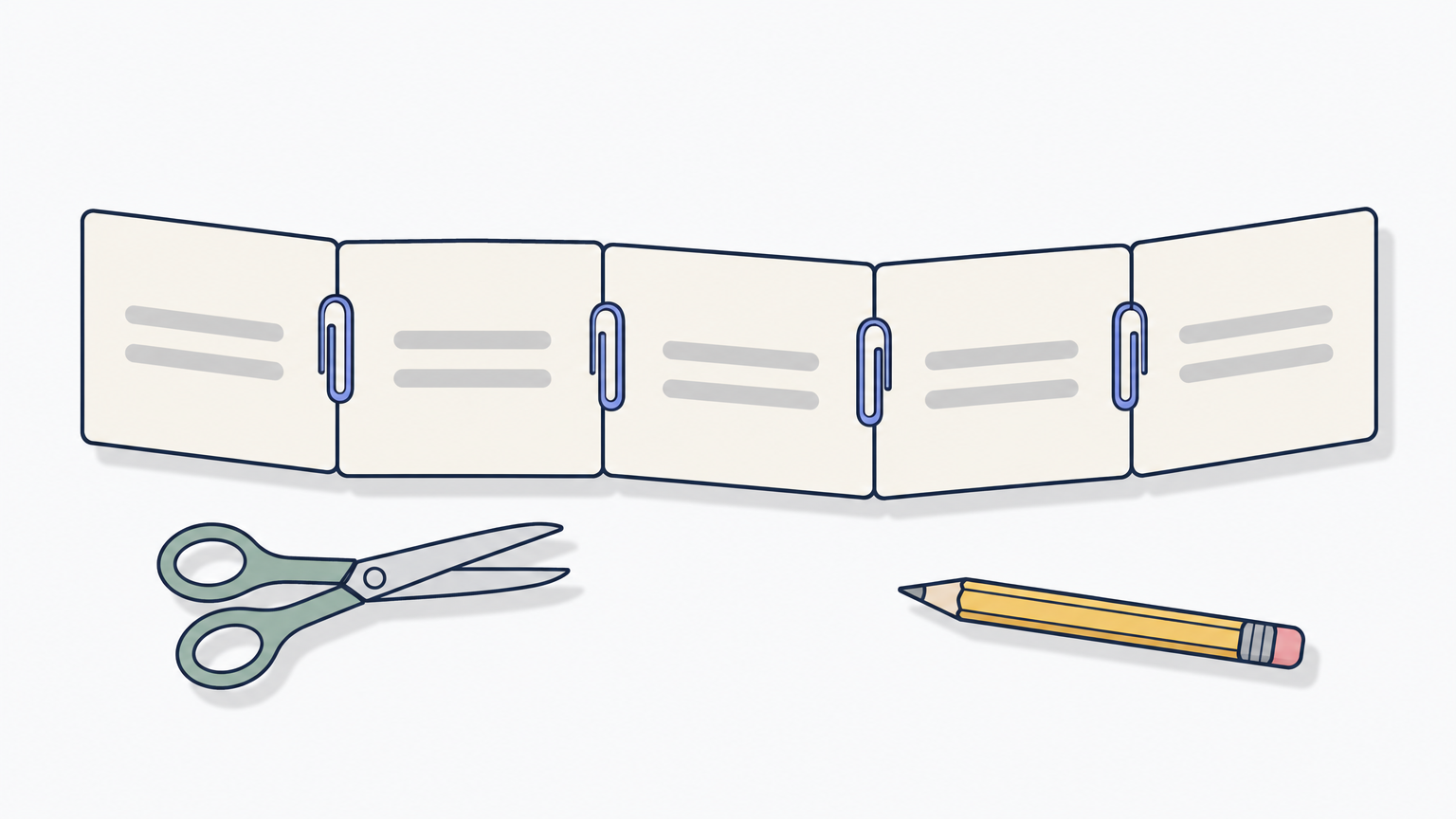
Break the song into small pieces, then chain them from line one every time. This is the core of any fast learning plan, because it keeps the verses in the right order.
How it works
Choose a chunk small enough to master in a few minutes: two lines if they are long, a full verse if they are short. Learn it until it comes out without hesitation. Then learn the next chunk, and always restart from the beginning of the song and run up to the newest piece.
Learning chunks in isolation is how singers end up swapping verse two and verse three. Chaining from the top teaches the transitions, which are the places where you actually get lost.
| Pass | What you run from memory |
|---|---|
| 1 | Verse 1 |
| 2 | Verse 1, chorus |
| 3 | Verse 1, chorus, verse 2 |
| 4 | Verse 1, chorus, verse 2, chorus |
| 5 | Everything up to the bridge |
Chain every new chunk back to line one, and the order of the song learns itself.
Who it suits
- Good fit: long songs, and songs where a repeated chorus changes a line or two.
- Weaker fit: very short songs that fit in a single chunk.
How to use it
- Mark the spots where repeated sections differ, such as a changed chorus line.
- Set a chunk size, then do not move on until you get it clean twice in a row.
- Take a break after a long session. Sleeping before the next one helps the words settle.
4. Write the lyrics out from memory
Writing the lyrics from a blank page shows you what you really know. It forces recall, which is the skill you need on stage.
How it works
Recognition is easy. You hear the track and the next line feels obvious. Recall is harder, because nothing prompts you. Writing from memory, with no music playing, trains recall directly and exposes the lines that only exist when the recording supplies them.
Compare your page with the sheet, ideally in a different color. Circle every miss. Those circled lines are your priority list for the next session.
If you can only sing the song with the track on, you do not know it yet.
Who it suits
- Good fit: singers who feel confident at home but blank when the backing stops.
- Weaker fit: the first day with a new song, when you have little to write yet.
How to use it
- Write the whole song from memory, or one verse at a time if the song is long.
- Check against the sheet and circle the gaps.
- Rewrite only the circled lines, then recite them aloud.
- For a quicker version, write just the first word of every line.
5. Attach meaning, images, and emotion
Words you understand stick better than words you only repeat. Giving each verse a clear meaning, a picture, and a feeling creates extra routes back to the line.
How it works
Turn every verse into a short scene, and say it in one sentence. When a line makes no sense, look it up or decide what it means to you. Your version does not need to be the songwriter's. It only needs to be consistent.
Then add the emotion the narrator feels. Words and feeling cue each other, so when the feeling arrives, the next line tends to follow.
A song you can picture is a song you can find your way through when you lose your place.
Who it suits
- Good fit: abstract or poetic lyrics, songs in a language you do not speak, and songs with near-identical verses.
- Weaker fit: lyrics built mostly from repeated phrases.
How to use it
- Write one sentence per verse about what happens.
- Pick one strong image per verse.
- Note the emotion for each section, such as anger, relief, or longing.
- Run the song while you picture the scenes in order.
6. Stress-test with a cappella, fast, and instrumental runs
Remove the supports you rely on and see what survives. The goal is lyrics so automatic that you do not think about them once you are performing.
How it works
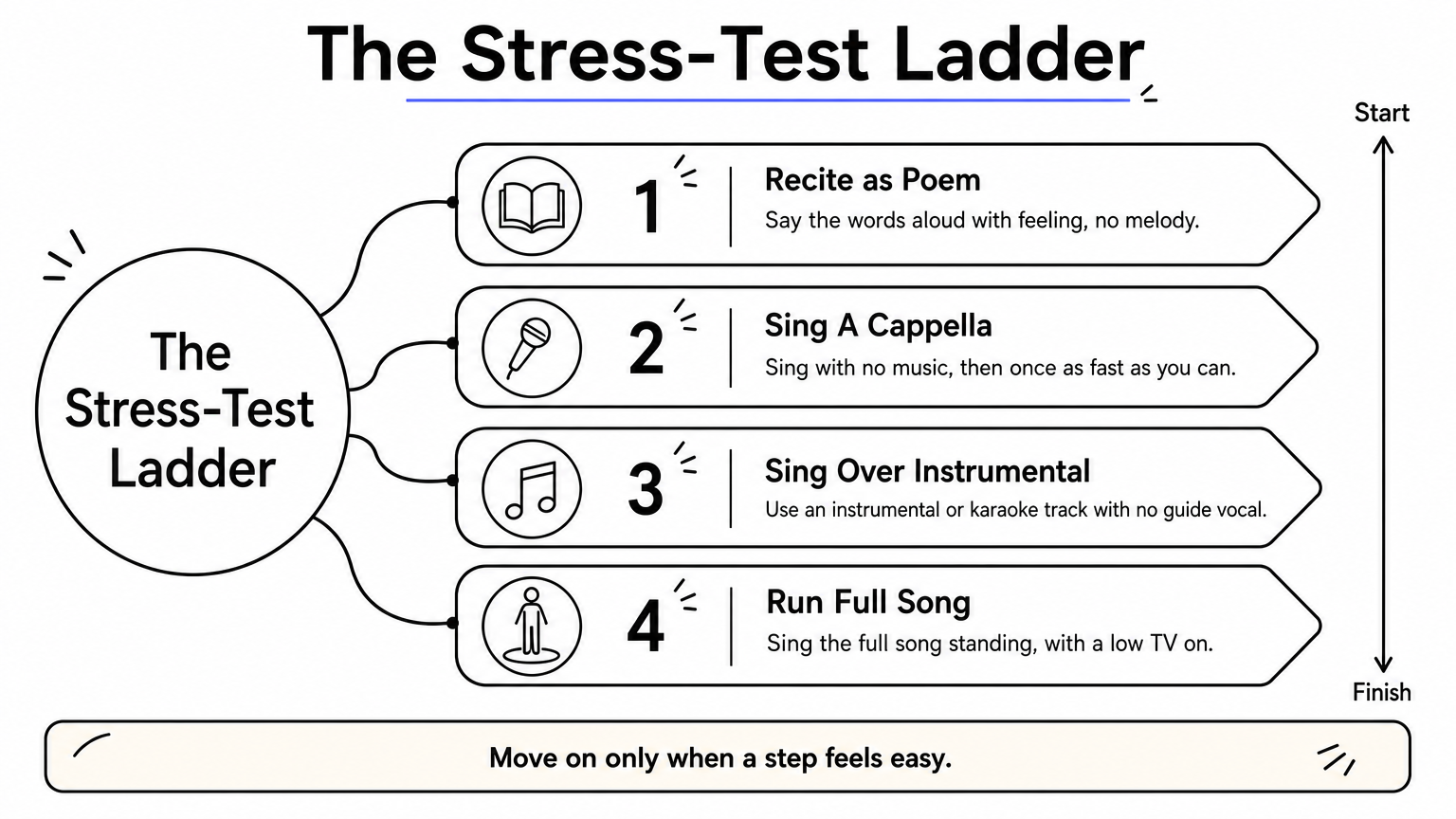
Each test strips away a different crutch. Reciting the lyrics as a poem removes the melody. Singing without any music removes the recording. Running the song quickly removes your thinking time, which shows where the words truly flow and where you hesitate. Singing over an instrumental or karaoke version removes the guide vocal.
Hesitations are useful information. Mark each one and send it back through methods 3 and 4.
Where you hesitate in a stress test is where you will stumble in front of people.
Who it suits
- Good fit: anyone within a week of a performance, and anyone prone to stage nerves.
- Weaker fit: the early days of learning. Run it after methods 2 to 4.
How to use it
Work up this ladder, and move on only when a step feels easy:
- Recite the lyrics aloud as a poem, with the feeling you plan to give them.
- Sing a cappella, then once as fast as you can manage.
- Sing over an instrumental track.
- Run the full song standing up, with a mild distraction such as a TV on low.
7. Work backward from your show date
How fast you can memorize depends on how much time you have, so build the plan from the date and pick methods to match it.
How it works
No method will lock a full song into long-term memory in five minutes. In that time you can learn a chorus, not a song. With an hour you can get a shaky first pass. Sleep between sessions and spaced reviews are what make recall dependable.
| Time before the show | Plan | Realistic result |
|---|---|---|
| 1 hour | Methods 2, 3, and 4 once each, in that order | Fragile recall, fine for one short song |
| 1 day | Two or three sessions with a night's sleep between, then method 6 | Reliable for one or two songs |
| 1 week | One session per day, starting each with a blank-page test | Reliable for a short set |
| 2+ weeks | Spaced reviews (method 1), plus the method 6 ladder in the last three days | Reliable for a full setlist |
Fast is a schedule, not a trick, and the earlier you start, the less you have to cram.
Who it suits
- Good fit: anyone with a fixed date, such as a recital, open mic, wedding, or tour.
- Weaker fit: casual learners with no deadline, who can simply use method 1.
How to use it
- Count the days to the show and find your row in the table.
- List your songs from weakest to strongest and give the weakest the earliest sessions.
- Reserve the last two days for run-throughs only, not new material.
Start with one song today
Fast lyric memory comes from a few simple moves: learn through ears and eyes, work in chunks chained from the top, test from a blank page, give the words meaning, and stress-test before the show. The thing that makes it last is spacing your reviews so each one lands just before you would forget.
Pick one song and run methods 2 to 4 on it today. Then let a schedule carry the rest. If you want that schedule handled for you, you can try MemoRep and set up your first practice cards while the limited beta offer is open.