Active Recall and Feynman Technique: How They Work Together
Active recall and the Feynman Technique are two study methods that make you produce knowledge instead of rereading it. Active recall means pulling information out of memory with your notes closed, using questions, blank-page recall, or practice tests. The Feynman Technique means explaining an idea in plain language, as if to a beginner, until the gaps in your understanding show. They are not the same method, but they fit together. Recall tests what you remember, and explanation tests what you understand.
This article covers why both methods work, how they differ and overlap, and a routine for using them together, with a worked example. It also covers how spacing your reviews keeps the results from fading. It is written for anyone studying concepts, terms, or ideas, from a college course to a certification exam.
We build MemoRep, a spaced repetition app for musicians and practical-skill learners, so the timing of memory is our daily concern. We will not tell you how to play or what to practice on an instrument. That is a teacher's job. What we can explain is how memory behaves, and these two methods use it well.
Why active recall and the Feynman Technique work
Both methods work because they replace the feeling of knowing with proof of knowing. Rereading feels productive since the material looks familiar. Familiarity is not the same as being able to retrieve or explain something, and these two methods test exactly that.
What active recall does to memory
Retrieving a memory strengthens it more than seeing the material again. Researchers call this the testing effect. In a well-known 2006 study by Roediger and Karpicke, students who took recall tests on a passage remembered more a week later than students who simply restudied it. The restudy group felt more confident. A large 2013 review by Dunlosky and colleagues rated practice testing as high utility and rereading and highlighting as low utility.
Common forms of active recall include:
- Writing down everything you remember on a blank page
- Answering questions you wrote earlier
- Taking practice tests under exam conditions
- Covering your notes and reciting from memory
What the Feynman Technique exposes
The Feynman Technique works because plain explanation shows where you only recognize words. It is named after physicist Richard Feynman, who was known for explaining hard ideas simply. The usual steps are to choose a concept, explain it in simple language as if teaching a beginner, mark where you stumble or fall back on jargon, then return to the source and simplify again.
Be honest about the evidence. The routine as a package has less direct research behind it than retrieval practice does. Its support comes from related findings, such as the benefits of self-explanation and learning by teaching. Treat it as a well-grounded idea, not a proven formula.
Recall shows you what you can retrieve, and explanation shows you what you actually understand.
Active recall vs the Feynman Technique: key differences
No, active recall and the Feynman Technique are not the same thing. Active recall is a principle: test yourself instead of rereading. The Feynman Technique is a specific routine that uses that principle and adds a demand for plain-language explanation.
Where the two methods overlap
Both methods ask you to close the book and work from memory, and both expose the illusion of fluency. A Feynman session done without notes is active recall in action. The reverse does not hold. Quizzing yourself on dates or definitions is recall, but it never asks you to explain why anything is true, so it is not the Feynman Technique.
Side-by-side comparison
The comparison below also answers the question of Feynman Technique vs active recall: which one to reach for depends on what you need to know.
| Active recall | Feynman Technique | |
|---|---|---|
| Core question | Can I retrieve this? | Can I explain this simply? |
| What you do | Quiz yourself with notes closed | Teach the idea in plain language |
| Best for | Facts, terms, definitions, formulas | Concepts, cause and effect, connections |
| What it reveals | Missing or weak memories | Shallow understanding hidden by jargon |
| Main weakness | You can recite an answer without understanding it | A fluent explanation can still be wrong |
| What you need | Questions or a blank page | A listener or an imagined beginner |
If you need to recall a fact, use active recall. If you need to reason with an idea, use the Feynman Technique. Most subjects need both, which is why combining them beats choosing one.
Active recall checks the memory, and the Feynman Technique checks the understanding built on top of it.
How to combine active recall and the Feynman Technique
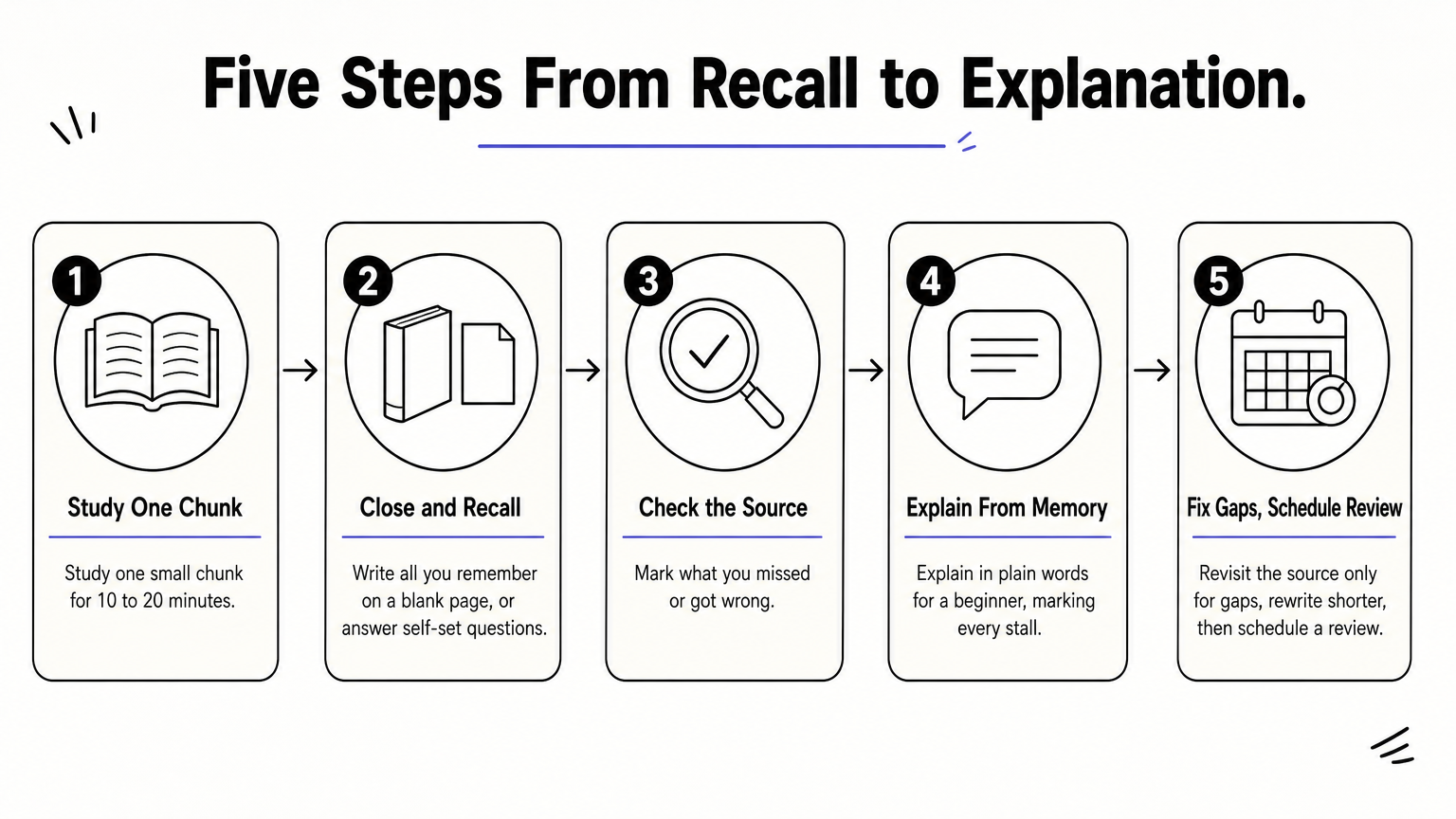
Run them in sequence: recall first, then explain, then fix the gaps. The classic three-step version of active recall is to study a chunk, close it, and write what you remember. Steps 1 to 3 below are exactly that. Steps 4 and 5 add the Feynman layer.
A five-step routine
- Study one small chunk for 10 to 20 minutes.
- Close everything. Write all you remember on a blank page, or answer questions you set yourself.
- Check against the source. Mark what you missed or got wrong.
- Explain the idea from memory, aloud or in writing, in plain words for a beginner. Mark every place you stall or lean on a term you cannot define.
- Return to the source only for those gaps. Rewrite your explanation shorter, then schedule a review.
The order matters. Explaining with your notes open is just reading aloud, and it hides the gaps you are trying to find.
A worked example
Say you are learning supply and demand. In step 2 you list "price, supply, demand, equilibrium" but cannot say why prices rise. In step 4 you explain that when many people want something and little of it exists, buyers compete and sellers can charge more. When plenty exists, sellers cut prices to attract buyers. Then you stall on equilibrium, because you only know the word.
In step 5 you check the source and fix it: equilibrium is the price at which the amount buyers want equals the amount sellers offer. One concept like this takes roughly half an hour, and you leave with a gap closed instead of a page highlighted.
Recall first, explain second, and go back to the source only for what you could not do.
How spaced repetition keeps the learning from fading
Spacing your reviews decides how long the result lasts. Even a perfect session fades if you never return to it, because memory drops quickly after learning and slowly after repeated retrieval. This is the forgetting curve described by Hermann Ebbinghaus.
Spacing the reviews
Spaced repetition schedules each recall just before you would forget. The SuperMemo SM-2 algorithm starts with a one-day gap, then a six-day gap, then multiplies each later gap by an ease factor based on how the last recall went. As a simple manual start, you could review the next day, then after 3 days, a week, and two weeks.
MemoRep applies this same logic to practical skills. You rate each practice card Again, Hard, Good, or Easy, and the schedule adjusts. It decides when a card returns, not how to do the work. Technique and instruction stay with your teacher.
Recall builds the memory, and spacing decides how long it lasts.
Mistakes that weaken both methods
Most failures come from making the methods easier than they should be:
- Peeking at notes before you have really tried to retrieve
- Calling a jargon-filled answer an explanation
- Skipping the check step, so wrong answers get reinforced
- Cramming every review into one night
Is active recall good for ADHD? Evidence specific to ADHD is limited, so no result can be promised. Active methods do give constant feedback and break reading into short tasks, which many people find easier to stay with than long passive study. Keep sessions short, and ask a clinician or learning specialist for individual advice.
Putting the two methods to work
Active recall and the Feynman Technique answer two different questions. Recall asks whether you can retrieve something. Explanation asks whether you understand it. Run recall first, explain from memory second, patch only the gaps, and come back on a schedule so the work lasts.
You do not need to master everything at once. Pick one small topic this week, run the five steps, and put your first review on the calendar for tomorrow. If you want the timing handled automatically for the skills you practice, see how memoRep works.