Changing Chords on Guitar: How to Practice with a Schedule
The best way to approach how to practice changing chords on guitar is to treat every chord change as its own practice item, work three or four of them in a daily session of about 10 minutes, rate each one honestly afterward, and let a spaced schedule decide when it comes back. Short, frequent, targeted passes beat one long session of random strumming.
If you are a beginner, you probably know the frustration. You spend 30 minutes on whatever change feels worst, feel a little better, and find it sloppy again three days later. Or you keep drilling the two chords you already like because they feel good. Without a system, you are guessing what to practice, and guessing wastes the limited time you have.
This guide gives you that system in four steps: one card per chord change, a clear finish line, a 10-minute daily session, and a rating and review habit. One boundary up front. It does not teach finger technique or theory. How you shape and move between chords is a job for your teacher or method book. This guide covers everything around that work, which is what to practice, when, and how to tell it is working.
Why chord changes need a schedule, not more minutes
Chord changes improve fastest when you practice each one in short sessions spread across many days, because skills fade between sessions and a schedule brings each change back just before it does.
Each change is its own skill
A change from G to C and a change from C to G are different jobs, even though they use the same two chords. A change you play without strumming is a different job from the same change inside a song. When you lump them together as "chords," you cannot see which one is holding you back.
Splitting them up also fixes the "I drilled for an hour and nothing moved" feeling. You can see that G to C is solid, C to D is shaky, and D to G has not been touched in a week.
What you need and what your teacher covers
You do not need much for this plan. Gather these before Step 1:
- Your guitar and a timer
- A list of chord changes from your teacher, method book, or the first songs you want to play
- A teacher's or book's instructions for how to play each change
- A place to track cards, such as a notebook or MemoRep
The same system works on a ukulele or any other chorded instrument, since it organizes practice and does not depend on the instrument.
A chord change is not "a chord." Every transition is a separate item that deserves its own schedule.
Step 1. Turn each chord change into one practice card
One card should hold exactly one chord change in one direction and one condition. Name the change precisely, so you always know what you are practicing and can rate it on its own.
Write one card per transition
Use the same four fields for every card. This is a copyable template:
Card: G to C
Variant: no strumming
Source: Lesson 2 from my teacher
Finish line: (added in Step 2)
Make "C to G" a separate card. If you also want the change inside a strumming pattern, make that a third card with the variant "while strumming." That way each version gets its own rating and its own schedule, instead of one blurry score for "G and C."
Start with a small first batch
Begin with two to four cards, taken from the first song you want to play. More cards means more decisions, and the point of a schedule is to remove decisions. A first week might look like this:
| Card | Variant | Source |
|---|---|---|
| G to C | no strumming | Teacher, lesson 2 |
| C to D | no strumming | Teacher, lesson 2 |
| D to G | no strumming | Teacher, lesson 3 |
| G to C | while strumming | Song you are learning |
Add new cards only when an existing one reaches its finish line, which Step 2 defines.
One card, one change, one condition. If you cannot name it in four words, split it.
Step 2. Set a finish line for every card
A finish line is a short, checkable statement of "good enough for now" that you write before you practice. Without one, every session ends on a feeling, and feelings are unreliable.
Write the finish line before you play
Ask your teacher for the standard. The exact numbers are theirs to set, so the examples below only show the format:
| Vague | Checkable |
|---|---|
| "Change G to C smoothly" | "G to C on the beat, four times in a row, with no pause" |
| "Get faster" | "Same change at the next tempo my teacher assigns" |
| "Play the song chords" | "Verse chords with no stops, start to finish, twice" |
Put the finish line on the card. Now when you finish a pass, you are checking a statement instead of asking yourself how it felt.
Use four ratings to report the result
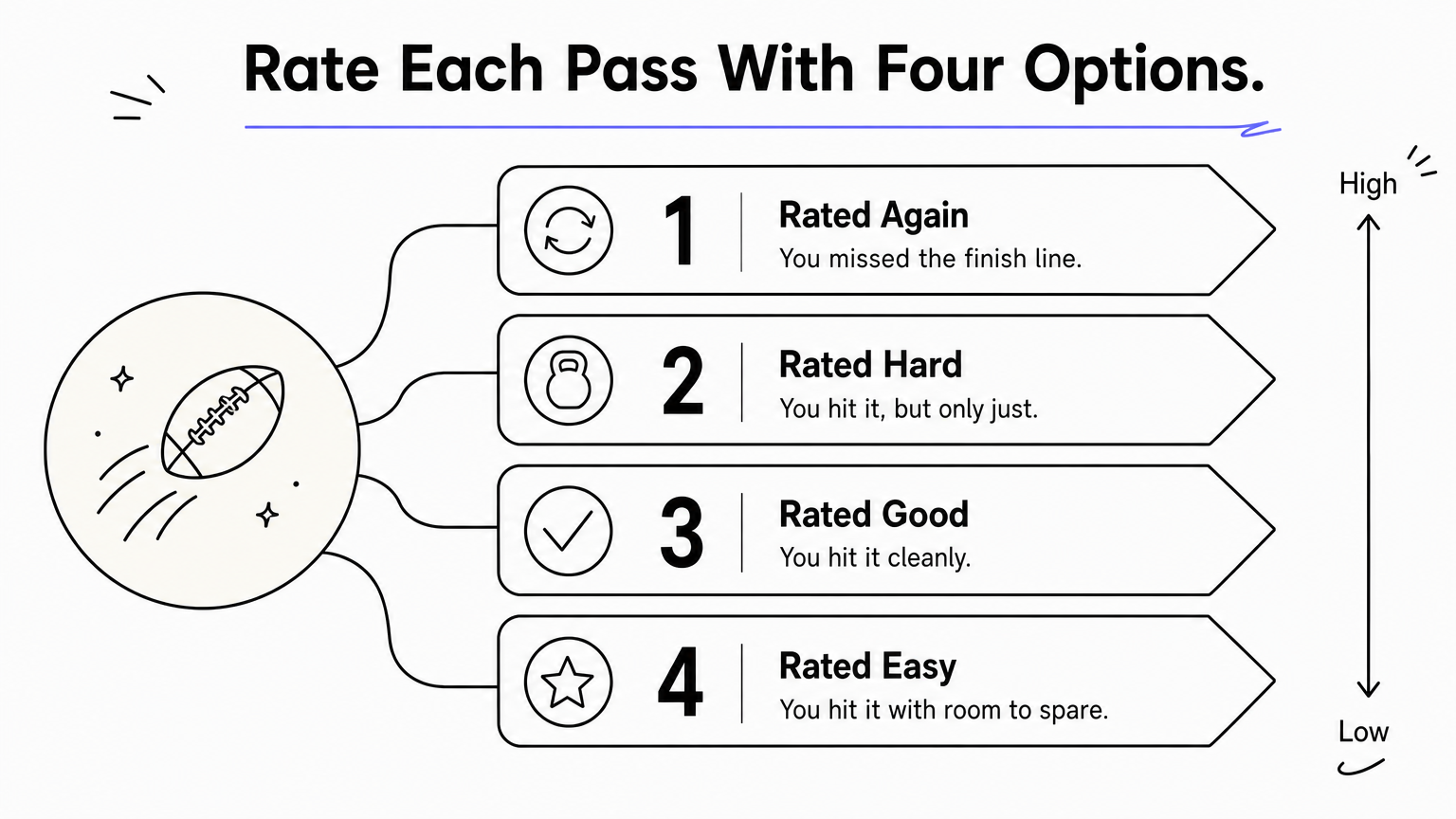
After each pass, rate the card with the same four options every time. This is the Again, Hard, Good, Easy scale that MemoRep uses to adapt the schedule:
| Rating | What it means |
|---|---|
| Again | You missed the finish line. |
| Hard | You hit it, but only just, or with obvious effort. |
| Good | You hit it cleanly. |
| Easy | You hit it with room to spare. |
Rate the pass you actually played, not the one you hoped for. A generous rating pushes the card out too far, and you meet it again after it has already faded.
Decide what "done" means before you pick up the guitar, and rating becomes a fact instead of a mood.
Step 3. Run a 10-minute daily session
A good daily session has a fixed length, a short list, and a rating at the end. Ten minutes and three or four cards is enough for most beginners to feel steady progress.
Build the 10 minutes
Spend the time on the cards that are due or weakest first. Here is a sample session with four cards:
| Minutes | What you do |
|---|---|
| 0 to 1 | Open the list and see which cards are due |
| 1 to 4 | Weakest card, the one last rated Again or Hard |
| 4 to 6 | Second due card |
| 6 to 8 | Third due card |
| 8 to 10 | Fourth card, then rate and log every card |
This is also the answer to the 80/20 question that guitarists ask. Put most of your time on your weak spots, not on changes you already own. Practicing what you can already do feels productive and moves nothing.
Why short and daily beats long and rare
Take 70 minutes of practice in a week. You can play one 70-minute session on Sunday, or seven 10-minute sessions. The minutes are identical, but the second plan touches every card seven times, and each touch interrupts forgetting. That is the idea behind the Ebbinghaus forgetting curve: what you have not revisited fades, and a timely revisit costs far less than relearning.
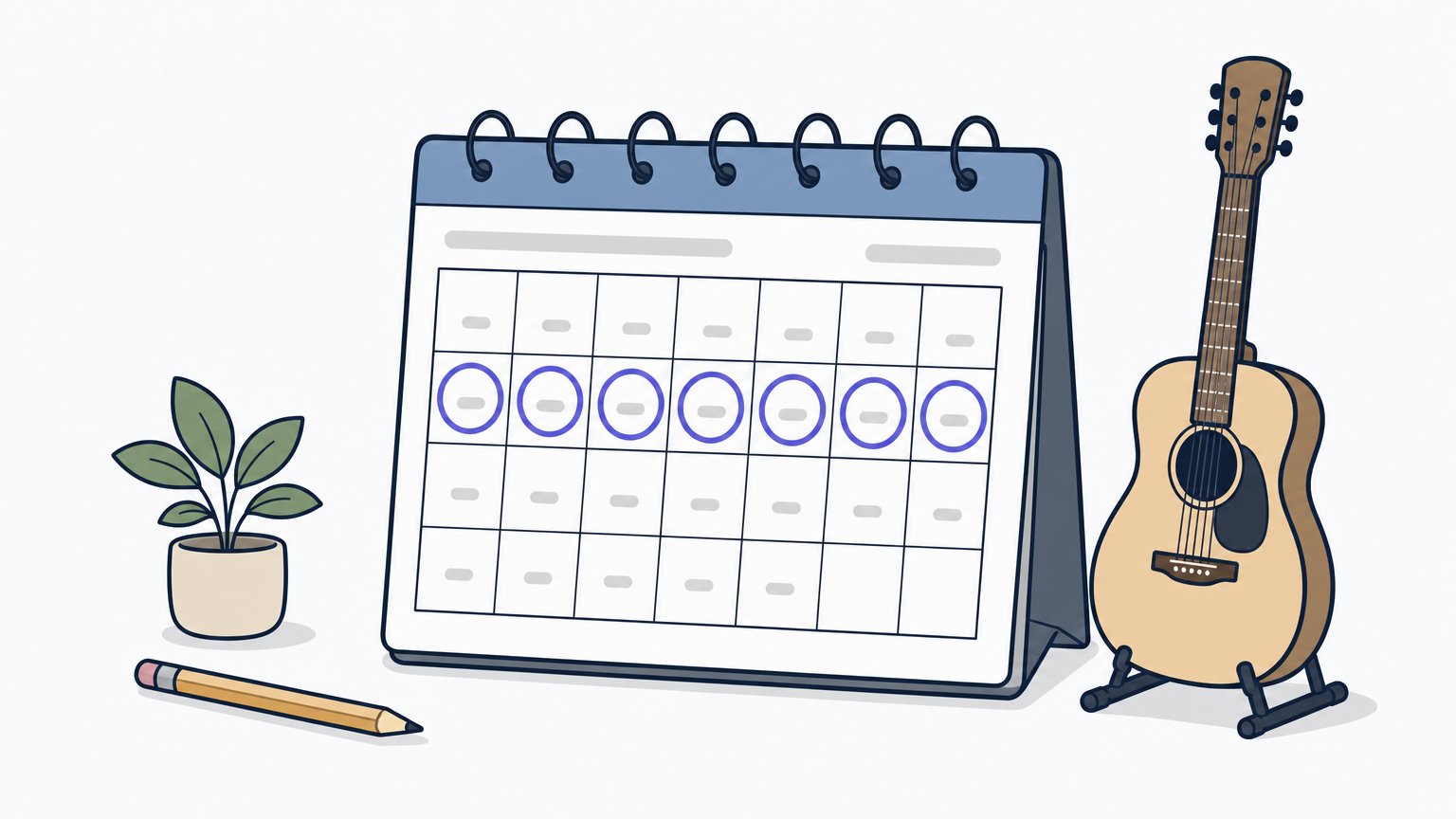
A daily reminder helps here. MemoRep sends a daily practice notification, so the habit does not depend on your memory or willpower.
Seven 10-minute sessions beat one 70-minute session, because the gaps between visits are where skills fade.
Step 4. Rate honestly and review weekly
The schedule only works if your ratings are honest, because each rating sets the gap before the card returns. A weekly review then keeps the card list matched to where you are.
How ratings set the next date
Classic SM-2, the algorithm MemoRep builds on, starts with short gaps and grows them as you succeed. A first success brings the card back in 1 day, the next in 6 days, and later gaps multiply by an ease factor that starts at 2.5. Here is a card rated Good every time under those default numbers:
| Review | Gap | Day of review |
|---|---|---|
| First | 1 day | Day 1 |
| Second | 6 days | Day 7 |
| Third | about 15 days | Day 22 |
A rating of Again resets the gap to one day. MemoRep adapts to how you rate each card, so your own dates will differ from this textbook example. The pattern holds, though: easy cards drift away and troublesome ones stay close.
Run a five-minute weekly review
Once a week, look at your cards and ask three questions:
- Which cards reached their finish line and can be raised or retired?
- Which card was rated Again in several sessions in a row?
- Which new change does my next song need?
If a card keeps getting Again, do not grind on it alone. Take it to your teacher and ask what to change. A stalled card usually points to a problem the schedule cannot solve, and it deserves a human answer.
Honest ratings are the only input the schedule has, so give it the truth.
Start with three cards and one timer
Chord changes get smoother when you practice them as separate items, check them against a clear finish line, and return to them on a spaced schedule. Ten focused minutes a day, spent mostly on your weakest changes, will serve you better than a long session once a week. Your teacher decides how each change is played. The system above decides when you practice it and how you know it is working.
If you want that system to run itself, you can set up your first chord-change cards in MemoRep. It schedules each card and tells you what to practice today, so you can spend your ten minutes playing.