How to Practice Guitar Chords with a Spaced Routine
The best way to practice guitar chords is to turn each chord and each chord change into a small practice card. Review a few cards every day for 10 to 15 minutes and rate how each one went. Then let a spaced schedule bring each card back just before you would forget it. You stop deciding what to practice and simply work the cards that are due.
Most beginners practice the other way. You pick the chords you like, repeat them until your hand tires, and quietly skip the ones that feel bad. A week later, G to C is shaky again, and it feels like your chord changes will never get faster. That is not a talent problem. It is a scheduling problem.
This guide walks you through the routine in four steps: build your cards, run a short daily session, rate each card honestly, and let spacing plan the rest. It does not teach finger placement, theory or technique. Your teacher or method book decides what to play and how to play it. MemoRep handles the part that is left, which is deciding what to practice next and when.
Why a schedule beats more practice time
Chord changes stick when you revisit them at growing intervals, not when you cram them into one long sitting. Short, spread-out sessions give your memory repeated chances to retrieve the chord, and that repetition is what builds lasting muscle memory.
What the forgetting curve means for chords
Hermann Ebbinghaus's forgetting curve shows that new memories fade quickly without review, and that each well-timed review slows the fading. Practice research on distributed versus massed practice points the same way. Thirty minutes on one chord feels productive, but tomorrow you often start from zero.
A schedule fixes this by reviewing a chord right before it fades. You spend less time on cards you already own and more time on the ones that slip.
Time between practice sessions is not wasted time. It is what makes the next session count.
What you need before you start
You need very little to follow this routine:
- A guitar and the chords your teacher or method book gave you
- 10 to 15 minutes a day
- A place to track cards, such as paper, a spreadsheet or an app like MemoRep
If a chord hurts, buzzes or sounds wrong, that is a question for your teacher. This routine only organizes the practice.
Step 1. Split your chords into practice cards
A practice card is one small, checkable target. Instead of a vague goal like "work on chords," you get a list of cards you can pass or fail in a minute or two. This also replaces the chord charts, PDFs and printed exercise sheets that many beginners hunt for. Your list of cards is the practice plan.
Make one card per target
Use three kinds of cards:

| Card type | Example | What counts as a pass |
|---|---|---|
| Single chord | G | You play it cleanly on the first try |
| Chord change | G to C | You switch without stopping |
| Chord in a song | Verse of your current song | You play the section through |
Write your own pass rule for each card before you start. A rule you can check beats a feeling.
Keep the list short at first
Start with five to eight cards. A beginner set might be G, C, D, Em, G to C, C to D, D to Em and one verse of a song. Add a new card only when the cards you already have are coming back without trouble. A long list creates the decision fatigue you are trying to avoid.
One card, one target, one clear pass rule.
Step 2. Run a short daily session
A short daily session of 10 to 15 minutes beats a long weekly one for learning chords. Put a fixed number of due cards in each session, give each card a time box, and stop when the box is empty.
Build a session you can repeat
Here is a worked example for a 12-minute session:
| Part | Cards | Minutes |
|---|---|---|
| Due cards | 4 cards at 2 minutes each | 8 |
| One new card | 1 card | 3 |
| Rating and notes | All 5 cards | 1 |
| Total | 12 |
If more cards are due than fit, do the ones that came back as Again or Hard first. The rest wait a day.
Make showing up automatic
Consistency matters more than session length. A daily reminder helps, and MemoRep sends daily practice notifications for exactly this reason. Pick a fixed time, such as right after dinner, and tie the session to it. You can also use the same method to practice songs once their chord changes are on your cards.
A 12-minute session you actually do beats a 45-minute session you keep postponing.
Step 3. Rate each card honestly
After each card, rate how it went. The rating is the signal that tells the schedule when to bring the card back. Honest ratings give you a better schedule, and inflated ratings push cards too far out.
Use four ratings
MemoRep uses an Again, Hard, Good and Easy scale. Here is how to read it for chord cards:
| Rating | When to pick it | What happens next |
|---|---|---|
| Again | You could not meet your pass rule | The card returns very soon |
| Hard | You passed, but only just | A short interval |
| Good | You met your pass rule | A normal, longer interval |
| Easy | It felt effortless | A much longer interval |
Rate the result, not the effort you put in. A card you passed after three tries is a Hard, even if you are proud of it.
Resist the urge to inflate
Choosing Good for a card that wobbled feels kind, but it hides the weak spot until it fails in a real song. The schedule is only as accurate as your feedback. MemoRep adjusts each card to how you experience it, so each honest rating helps it fit the schedule to you.
Rate what happened, not what you hoped would happen.
Step 4. Let spacing and tracking plan what's next
Spacing means each successful review pushes the next one further out, while a failed review brings the card back quickly. You do not plan this by hand. Your job is to show up, rate honestly, and glance at your progress now and then.
See how intervals grow
MemoRep uses the SuperMemo SM-2 algorithm. In its original form, the first review comes after 1 day and the second after 6 days. After that, each interval is multiplied by an ease factor that starts at 2.5. This table shows the pattern for a card you keep passing, assuming the ease factor stays at 2.5. Real intervals shift with your ratings.
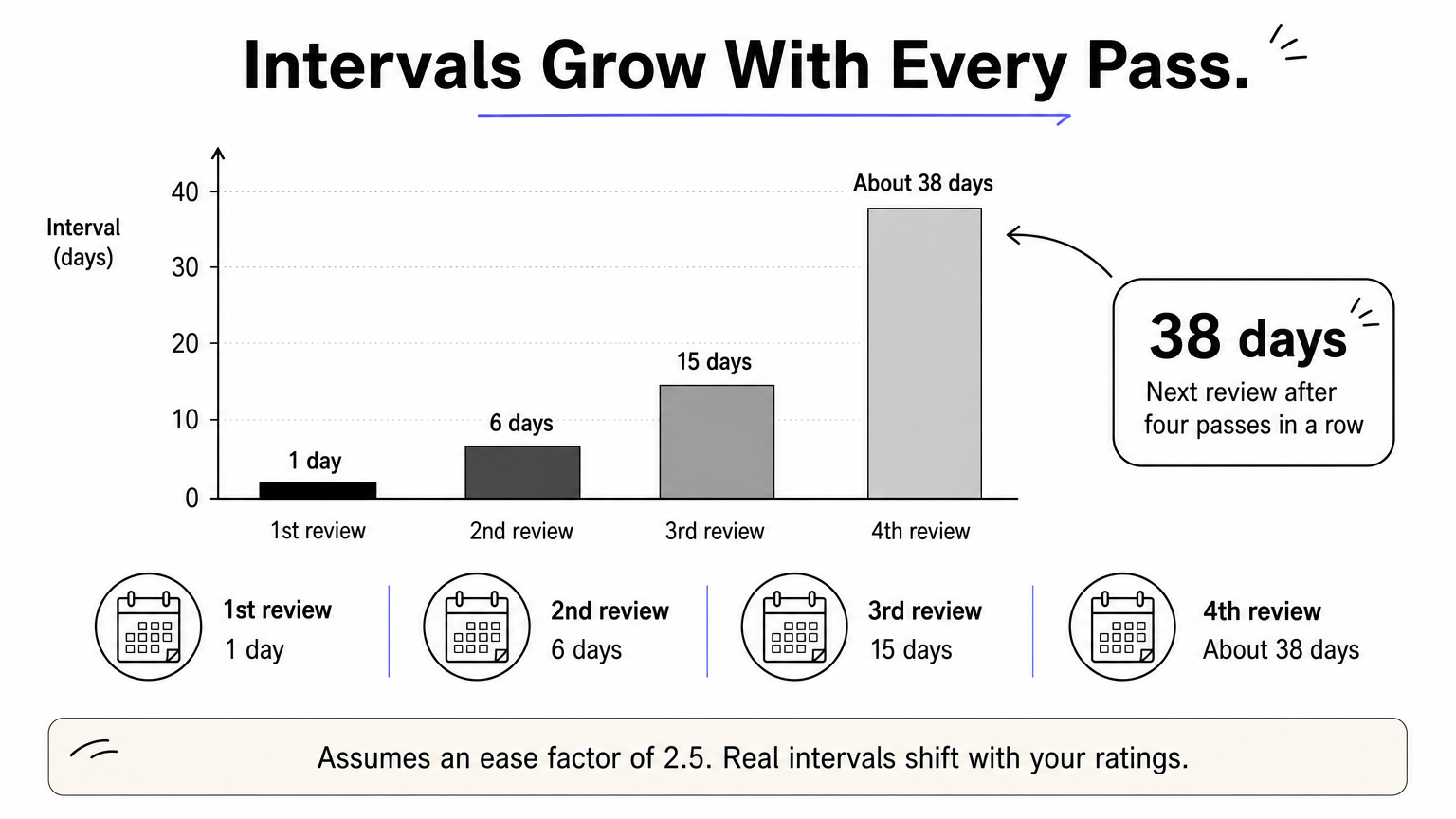
| Successful review | Next review in |
|---|---|
| 1st | 1 day |
| 2nd | 6 days |
| 3rd | 15 days |
| 4th | about 38 days |
A failed card drops back to a 1-day interval. A chord change you keep passing needs less of your time, and a stubborn one gets more.
Track progress and add cards
Check your progress weekly. Cards moving to longer intervals show the routine is working. Once most of your due list feels calm, add one new card. If a card keeps coming back as Again after a couple of weeks, take it to your teacher instead of grinding on it alone. The schedule can flag the weak spot, but only a teacher can tell you how to fix it.
Cards that keep returning are information. Bring them to your teacher.
Start with a small set of cards today
Learning how to practice guitar chords comes down to a simple loop. Break your chords into cards, practice the due ones for a few minutes each day, rate them honestly, and let spacing decide when each card returns. Your teacher decides what to play and how. The routine decides when to practice it.
If you want the scheduling handled for you, you can try MemoRep during the free beta. It turns your chords, changes and songs into cards, schedules them, and sends a daily reminder. Start with five cards and one 12-minute session tomorrow.