Memorize Music Without Your Instrument: 7 Methods That Work
If you wonder how to memorize music without your instrument, the short answer is to recall the piece actively, in short sessions spread over several days. Rereading the score or playing along with a recording does not do this. The best methods make your brain produce the music with nothing in front of you: you see it, hear it, sing it, or write it out. The seven methods below fit different readers. A spaced schedule suits anyone with a busy week. Mental rehearsal and tabletop playing suit players who learn through their hands. Singing and listening suit ear-driven learners. Writing it out and memory maps suit visual thinkers and performers.
Most of us cannot sit at an instrument whenever we want. Travel, a shared apartment, a sore wrist, or a long workday can keep you away for days. Practicing at the instrument can also hide weak spots, because your hands carry you through passages you do not truly know. Away from the instrument, those gaps show up fast, which is why this kind of work is so useful.
MemoRep is a spaced repetition practice app, so the first method is about scheduling your recall sessions. This article covers memory habits only. Decisions about fingering, theory, or technique belong to your teacher, and none of the methods here replace that guidance.
1. Schedule recall sessions with spaced repetition
Spaced repetition decides when you rehearse a piece, so that every session lands just before the memory fades. It works with any method in this list.
How it works
Memory drops quickly after you learn something, a pattern known as the Ebbinghaus forgetting curve. A review timed just before you forget flattens that drop. MemoRep builds on the SuperMemo SM-2 algorithm. You create one practice card per section of a piece, the app tells you when a card is ready for another pass, and you rate each pass Again, Hard, Good, or Easy. Your rating moves the next review closer or further away.
- Split the piece into sections small enough to hold in your head, such as a few bars or a verse.
- Create one card per section.
- When a card comes due, run one away-from-instrument method from this list.
- Rate the pass honestly. "Again" is a useful answer.
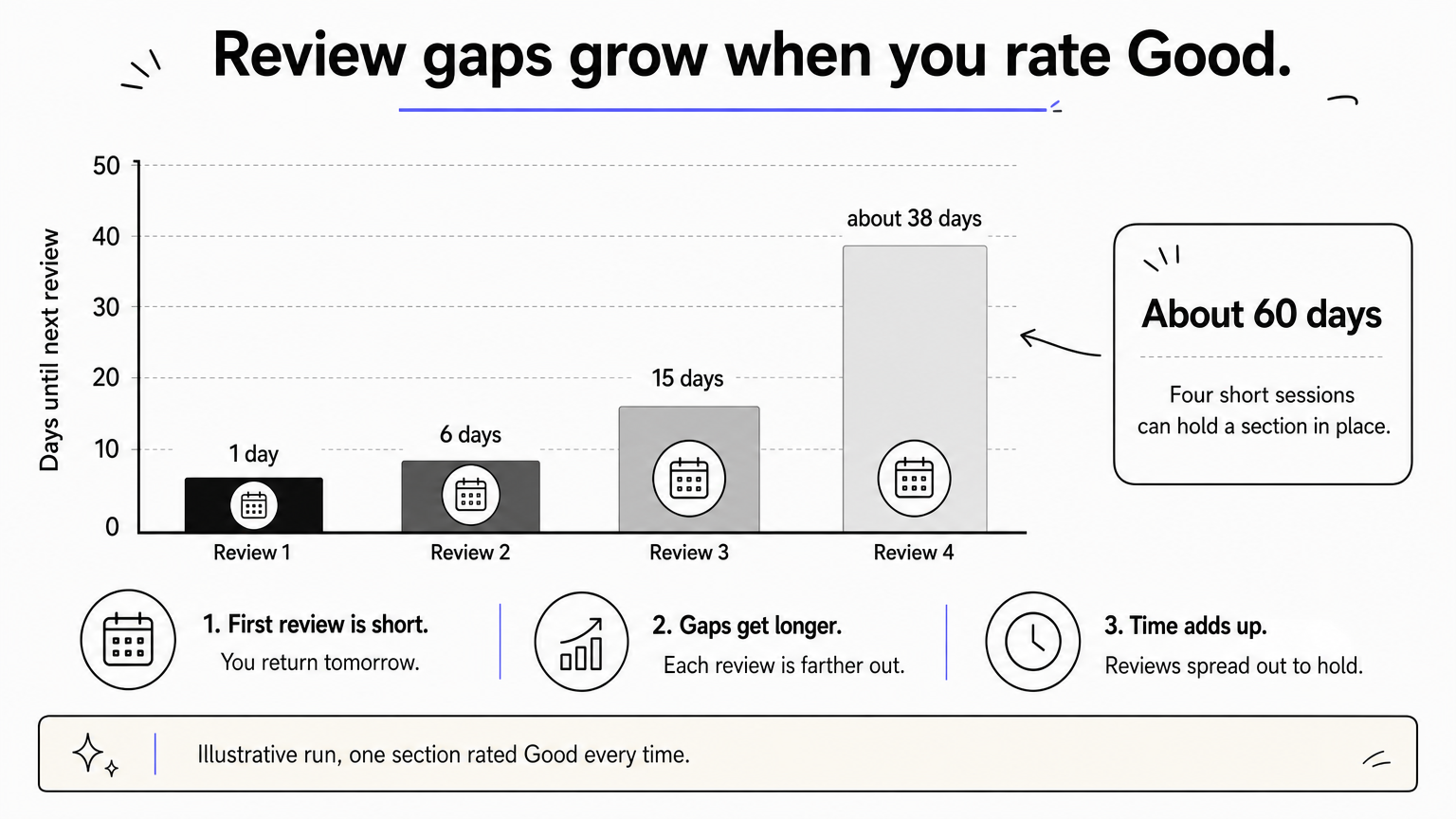
The original SM-2 sets the first gap at 1 day and the second at 6 days. Each later gap is multiplied by an ease factor that starts at 2.5. Here is an illustrative run for one section rated Good every time:
| Review | Gap since last | Day |
|---|---|---|
| 1 | 1 day | 1 |
| 2 | 6 days | 7 |
| 3 | 15 days | 22 |
| 4 | about 38 days | about 60 |
Your real dates will differ, because the app adjusts to your ratings. Four short mental sessions over two months can hold a section in place.
Review a section just before you would forget it, and every recall session counts for more.
Who it suits
This method suits anyone juggling several pieces. It removes the daily question of what to review, and daily practice notifications nudge you when something is due. It also protects older pieces that quietly fade while you work on new ones.
MemoRep does not tell you how to play anything. It only decides when you revisit it. The app is currently in a limited beta where the first 200 users get free premium access.
2. Rehearse the piece mentally with every sense
Mental rehearsal means playing the piece in your head with sight, sound, and movement. It is the core away-from-instrument method for memorizing music.
How it works
Picturing the notes is not enough. Effective mental practice includes the sound at real tempo and the feel of your hands, breath, or posture. Research on mental practice in music and sport suggests it helps most when combined with physical practice, so treat it as a partner to your instrument time, not a replacement.
- Choose one short section.
- Close your eyes and see the page, including where the line breaks and the page turn.
- Hear the section at its real tempo.
- Feel the movement as you would at the instrument.
- Open the score and check. Mark every spot where your mind went blank.
A mental run-through that goes blank has just shown you the exact bar to fix.
Who it suits
This works for anyone stuck on a train, in a waiting room, or in bed. Keep each session to about five minutes, because focus fades quickly and sloppy sessions teach little.
It also helps performers who get nervous. Rehearsing the walk to the stage and the first bars in your head makes the start feel familiar. Follow it with a real run-through when you can reach your instrument.
3. Play the passage on a tabletop
Tabletop playing means "playing" a short passage on a desk or in the air, using the same fingers and motions you would use on the instrument. It keeps your hands involved while the instrument is out of reach.
How it works
Your hands remember a piece as much as your eyes do. Tapping through a passage with real fingering rehearses that motor memory, while your inner ear supplies the sound. The key is to hear the music in your head as you tap. Without that, it becomes mindless drumming.
- Pick a short passage and use only the fingering you already settled on with your teacher.
- Slow the tempo until you can hear every note internally.
- Keep the score out of sight.
- At your next instrument session, play the passage and see whether it felt easier.
If your fingers cannot find the passage on a table, they will not find it under stage lights.
Who it suits
Pianists, guitarists, string players, and wind players benefit most, since their hands have clear patterns to rehearse. Singers can skip this and use method 4.
Do not invent a fingering to fill a gap. If you are unsure, note the spot and ask your teacher. A wrong habit rehearsed away from the instrument is still a wrong habit.
4. Sing or hum it from memory
Singing or humming a line without the score or a recording is a direct test of whether you know it. If you cannot sing it, you do not have it yet.
How it works
Singing forces your memory to hold the melodic shape and the rhythm with no support from your hands. Your voice does not have to be good. A rough, quiet hum exposes the same gaps as a perfect pitch would. Clapping or tapping the rhythm against a metronome app adds a second check.
- Sing the section from memory with no recording.
- Clap the rhythm at the intended tempo.
- Compare against a recording or the score.
- Note where the pitch or rhythm drifted. Those spots go on your next review.
If you can sing a phrase from memory, you can usually find it again on your instrument.
Who it suits
Singers, wind and brass players, and string players tend to get the most from this. It also helps with accompaniment parts, since you can sing your line while a recording plays everything else.
If noise is an issue, hum quietly or sing silently in your head. Silent singing is weaker than audible singing, but it is much better than nothing.
5. Write the piece out from memory
Writing the music out from memory shows you exactly what you know and what you only recognize. Recognizing a page is easy, but producing it is hard.
How it works
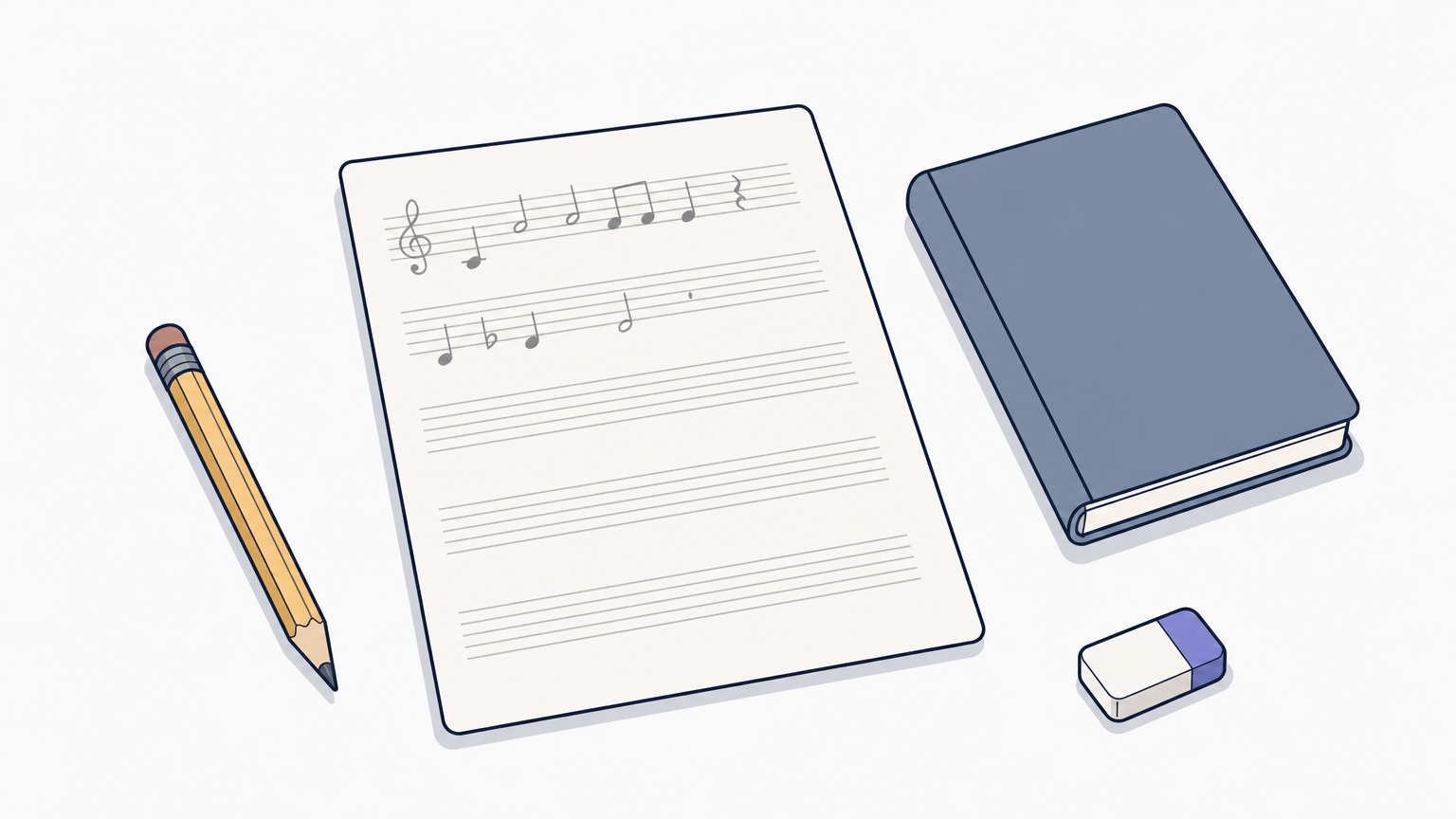
Reading a score tricks you into thinking you know it, because every note is in front of you. Writing removes that help. Use blank staff paper, a notation app, or a plain document, and put down everything you can recall. Mark the gaps with a question mark instead of guessing silently.
- Set a timer for ten minutes.
- Write one section from memory, in notation or in your own shorthand.
- Compare it with the score in a second color.
- Turn each gap into a note for your next review.
Every question mark on your page is a free diagnosis of what to memorize next.
Who it suits
Visual learners and anyone who reads notation comfortably get the most out of this. It suits dense piano textures and ensemble parts, where it is easy to lose track of what comes next.
If you do not read notation fluently, write a plain list instead. List the sections in order, and write how each one begins. That list also feeds method 7.
6. Listen actively, with and without the score
Active listening means giving a recording your full attention, first with the score and then without it. Background music will not memorize anything for you.
How it works
Each pass asks more from your memory. In pass one, you follow the score while you listen. In pass two, you close your eyes and silently anticipate what comes next. In pass three, you stop the recording at a random point and continue the piece in your head for a few bars, then press play to check yourself. A recording of your own last run-through works especially well, because it matches your real tempo.
- Follow the score once through.
- Listen again without it and anticipate each entrance.
- Pause at a random spot and continue silently.
- Resume the recording and see whether you landed together.
Pausing a recording and finishing the phrase yourself turns listening into a memory test.
Who it suits
This suits ear-driven learners and commuters, since headphones are all you need. It also helps ensemble players who must remember how their part fits with others.
Use it for short sessions of ten to fifteen minutes. Long, unfocused listening feels productive but does little for recall.
7. Build a memory map of landmarks
A memory map is a list of the piece's sections, each with a short name and a starting cue. It gives you places to restart if you lose your way.
How it works
Memorizing by repetition from bar one leaves you with one way into the piece. A lapse then means starting over. A map gives you landmarks and restart points, so a slip costs you a few bars instead of the whole performance.
- Divide the piece at its natural breaks, or at the sections your teacher has marked.
- Give each section a short name, such as "the quiet middle" or "the climb".
- Write the first note, word, or gesture of each section.
- Recite the map in order from memory, then jump to a random section from its name alone.
If your teacher has you label harmony or form, use those labels instead of mine.
Memorize the starting points, not just the path, so a lapse costs a bar instead of the whole piece.
Who it suits
Performers preparing for a recital, audition, or concert get the most from this, especially anyone who has blanked mid-piece before. It also suits players who memorize by feel and have no mental picture of the structure.
Build the map early in your learning, not the night before. Then give each landmark its own card in your review schedule.
Start with one method this week
Memorizing music away from your instrument comes down to active recall, repeated at the right intervals. Each method here tests your memory a different way: mentally, physically, by ear, on paper, or by structure. Pick the two that suit how you learn, and add a schedule so you review sections before they fade. Whatever you do, let your teacher decide how the piece should be played.
If you want the schedule handled for you, join the MemoRep beta and turn each section of your piece into a card that comes back when it is ready for another pass.