5 Habits That Help You Practice Trumpet Effectively
Here is how to practice trumpet effectively: work from a short list of specific skills, revisit each one on a spaced schedule, time-box the session, rate how each skill went, and log the result. Habits one and two suit players who keep losing material they already learned. Habit three suits anyone short on time. Habits four and five suit students with a teacher who want each lesson to build on the week before.
Most trumpet players do not struggle from lack of effort. They struggle from vague sessions. You warm up, play whatever feels familiar, run out of time, and cannot say tomorrow what you worked on. Hours go in, and the same passage is still shaky three weeks later.
This article covers the organizing side of practice, the part you control before and after you pick up the horn. It does not teach embouchure, breathing or exercises, because deciding what to play and how to play it is your teacher's job. MemoRep, a spaced repetition practice platform, is built around this organizing approach, so we show where it fits in each habit.
1. Break practice into named skills
The first habit is to replace "practice for 30 minutes" with a list of named skills. A skill is one concrete piece of work that you can play and then judge: a passage, an exercise, a warm-up or a technique. If you cannot say whether you finished it, it is too vague to schedule.
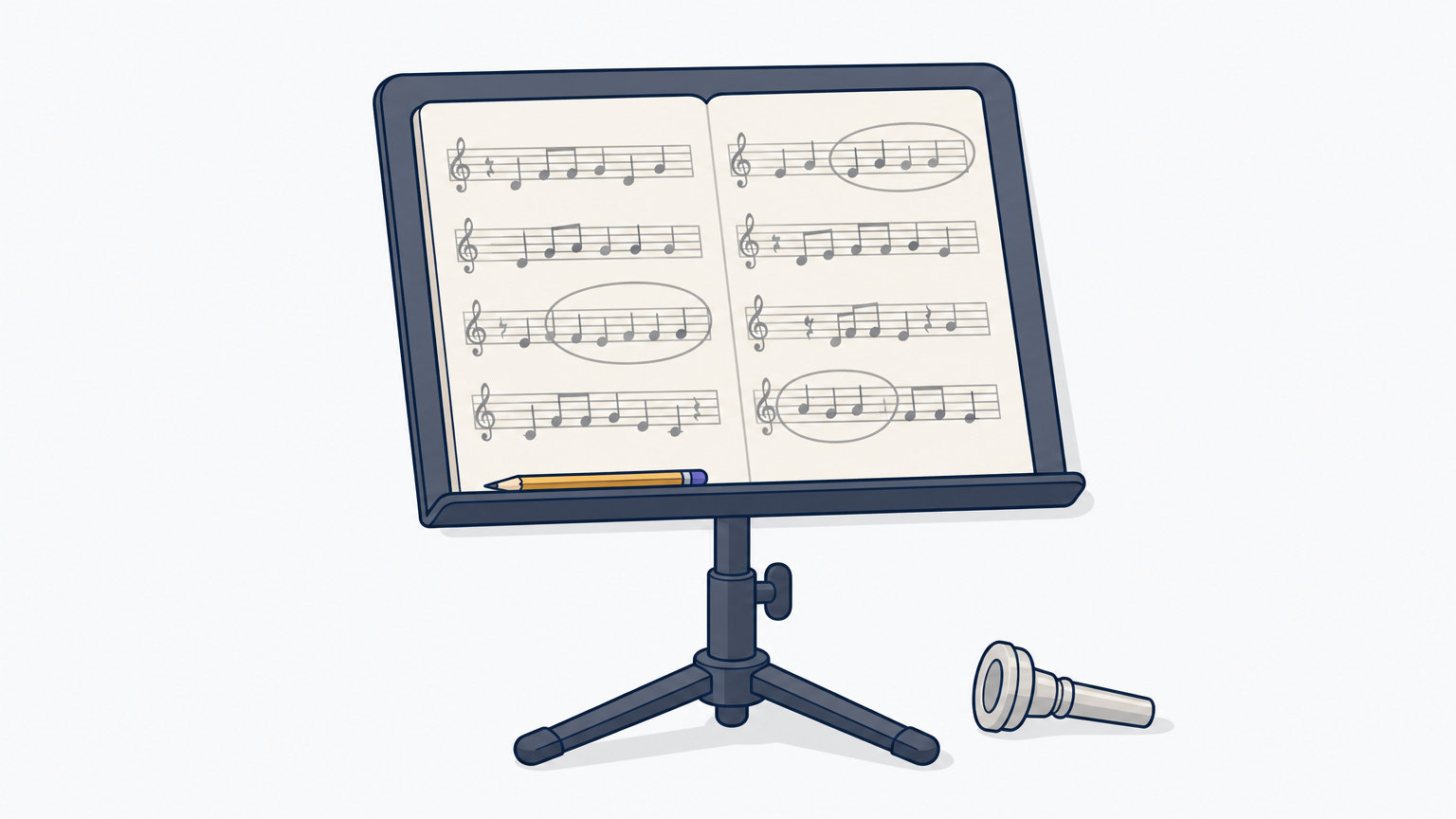
A skill you can name is a skill you can finish, rate and schedule.
How it works
Write each skill as a short label with a clear finish line. Compare these entries:
| Vague entry | Named skill |
|---|---|
| Work on the concerto | Bars 33 to 48 of the second movement, at the marked tempo |
| Do some scales | The scale assigned in your last lesson |
| Warm up | The warm-up routine your teacher gave you |
Your teacher decides what goes on the list. The list only organizes that guidance. In MemoRep, skills live inside projects such as a solo, an audition or a band program. You can keep several projects and mark one as your main focus.
Who it suits
This habit suits players who practice by feel and end up replaying what they already do well. It also helps beginners practicing at home, because a written list removes the daily question of what to do next.
2. Space your reviews instead of cramming
Revisit each skill just before you would forget it, not every day until it feels safe and then never again. This follows the Ebbinghaus forgetting curve, which describes how memory fades without review. Spaced repetition turns that curve into a schedule.
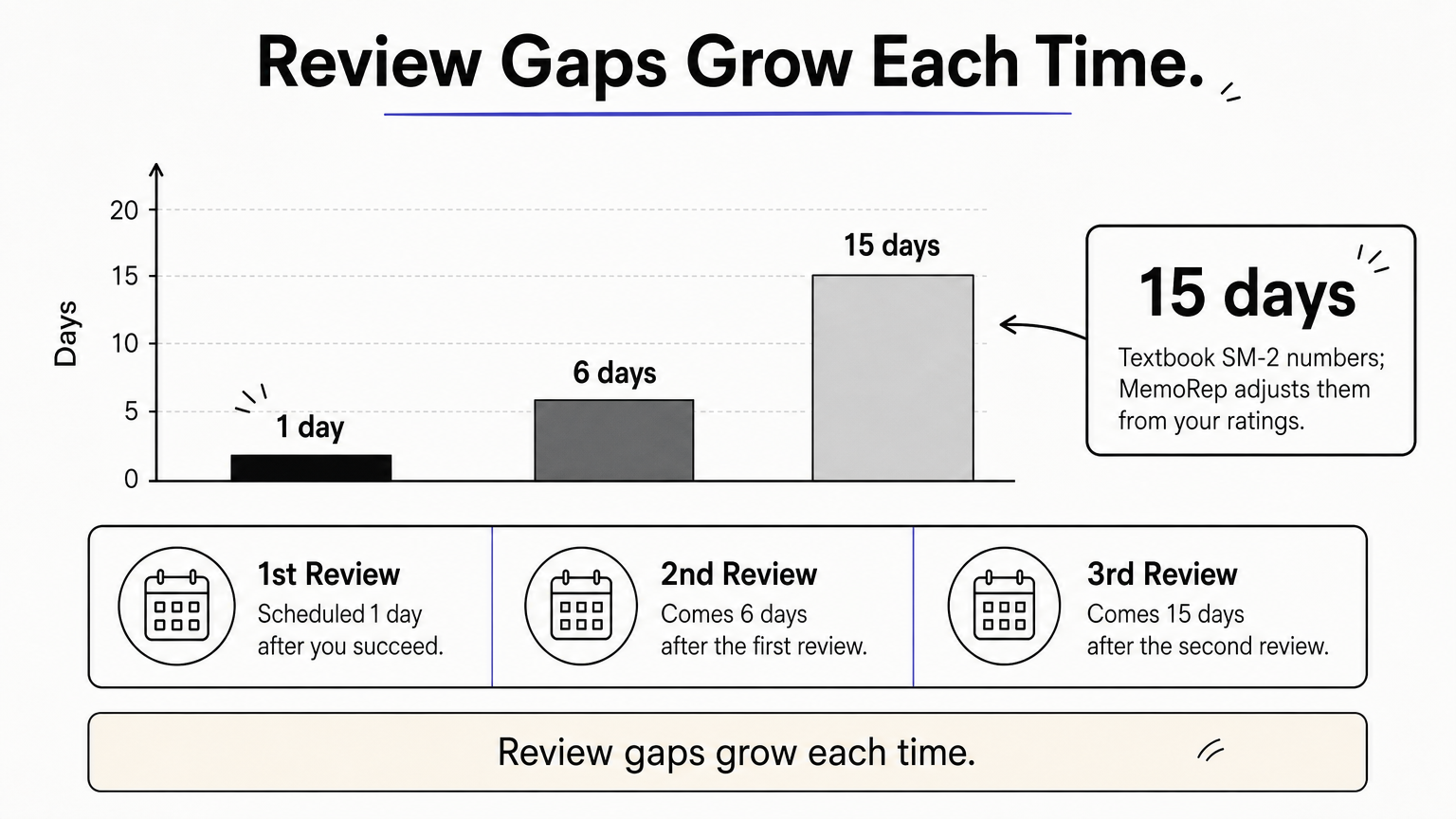
Review a skill when it is about to fade, not when it already has.
How it works
The classic SM-2 algorithm schedules the first review 1 day after you succeed and the second 6 days later. Each gap after that grows by an ease factor, which starts at 2.5. Here is a worked example for one passage you play well on day 0:
| Review | Gap | Counted from day 0 |
|---|---|---|
| 1st | 1 day | Day 1 |
| 2nd | 6 days | Day 7 |
| 3rd | 15 days | Day 22 |
These are textbook numbers. MemoRep uses SM-2 and adjusts the schedule from your ratings, so your real gaps will differ.
Who it suits
MemoRep started because its founder, a musician, kept forgetting guitar techniques he had already learned. If you know that learn-and-forget cycle, spacing is the habit that fixes it. Players with large repertoires or several projects gain the most, because no one can track many review dates by memory.
3. Time-box every session and every skill
Give each session a fixed length and each skill a fixed slice of it. For most learners, one focused session of roughly 20 to 45 minutes beats an unplanned hour of wandering. Your teacher can set the exact number for your level, and for how much rest your playing needs.
A session with a clock and a list beats a session with good intentions.
How it works
Add up the minutes before you start, so the plan fits the time you have. Here is a 30-minute example with generic skills:
| Skill | Minutes |
|---|---|
| Warm-up from your teacher's routine | 8 |
| Passage A from your current piece | 7 |
| Exercise from your last lesson | 6 |
| Rest, no playing | 5 |
| Passage B | 4 |
| Total | 30 |
When you choose a musical focus in MemoRep, it gathers the ready skills and their estimated time. The running session keeps the active skill, timer, notes and controls together. You can pause or skip a skill.
Who it suits
Time-boxing suits students and working adults who practice in short windows. It also suits anyone who drifts to favorite material, because the timer moves you on.
4. Rate every skill honestly after you play it
After each skill, give it a rating, and let that rating decide when you see it again. MemoRep uses four: Again, Hard, Good and Easy. The rating works only if you judge against a fixed standard, such as what your teacher asked for, and not against your mood.
Honest ratings make the schedule smart. Flattering ones make it useless.
How it works
Rate the result, not the effort. Here is a simple reading of each rating:
| Rating | What it means | Effect on the schedule |
|---|---|---|
| Again | You could not do it as asked | Comes back soon |
| Hard | You did it, but with real struggle | Comes back sooner than planned |
| Good | You did it as asked | Normal interval |
| Easy | It was effortless | Longer gap |
MemoRep shows the next-review date before it saves the session, so you see the consequence of each rating right away.
Who it suits
This habit suits players who lean to one extreme. Perfectionists rate everything Again, and optimists rate everything Good. A written standard corrects both. Students with a teacher can borrow the teacher's wording from the last lesson.
5. Log each session and bring it to your lesson
The last habit is to write down what happened: which skills you played, how they went, and what you want to ask next. A log makes progress visible, and it gives your teacher real information instead of "it went okay."
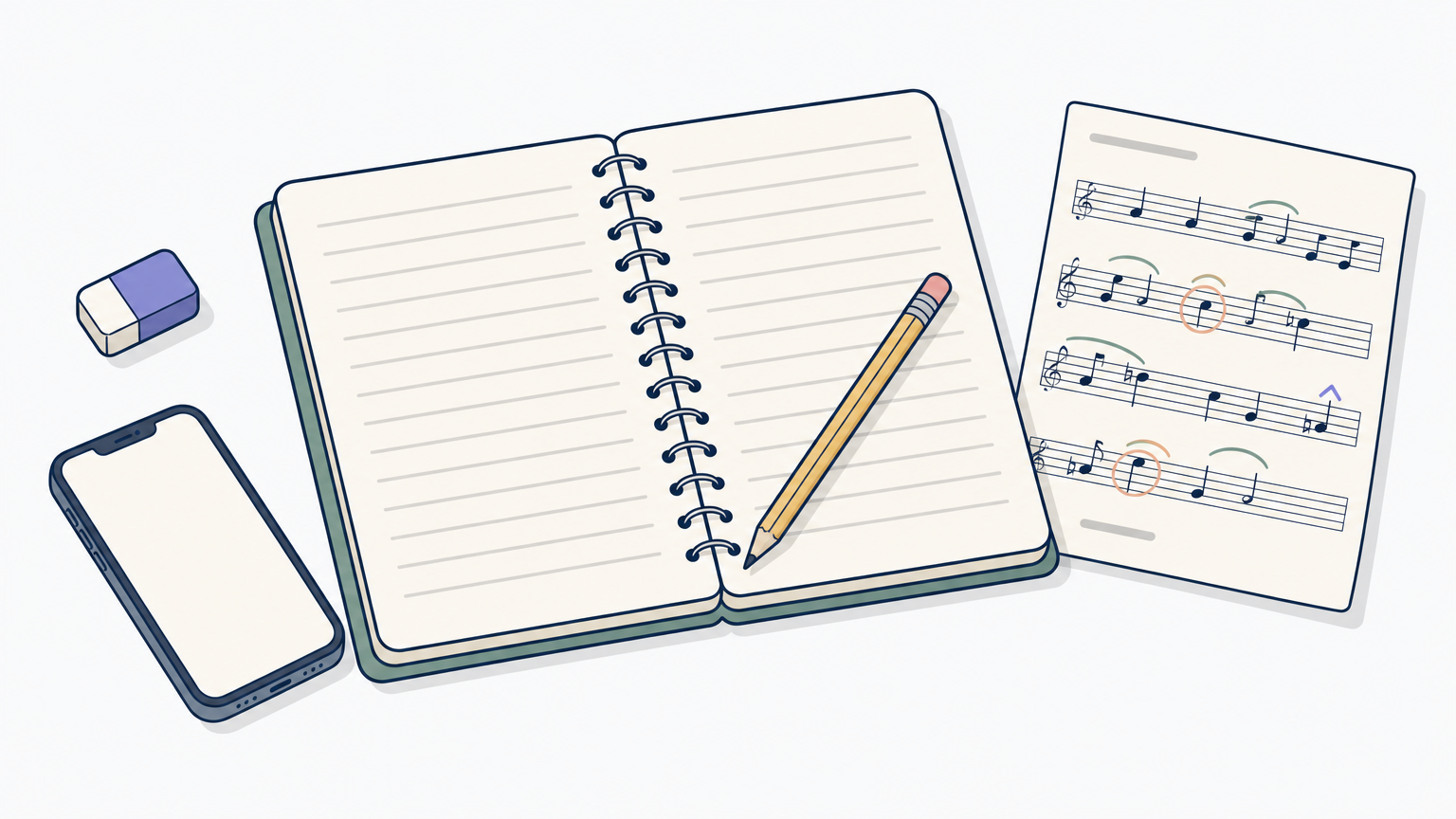
A log turns a week of practice into something your teacher can actually use.
How it works
Keep entries short so you actually write them. Four items are enough:
- The skills you practiced and their ratings
- One sentence on what went wrong or surprised you
- One question for your teacher
- A photo of any marked-up sheet music
MemoRep keeps a practice journal and lets you save notes and image evidence at the skill or session level. Video upload is not available yet. Its progress tracking and visualization show your progress over time.
Who it suits
Students with weekly lessons gain the most, because the log carries the week into the studio. Self-taught players need it too, since it is the only record they have. A teacher is still the right source for what to play next.
Pick one habit and start this week
Effective trumpet practice comes down to organization. Name your skills, space the reviews, fit them in a timed session, rate them honestly and log the result. You do not need all five at once. Start with the named skill list, then add one habit each week.
If you want software to run the schedule for you, try MemoRep and claim free-for-life access. The first 200 musicians to create an account get permanent free access to the future Premium plan. It tells you what to practice and when, and your teacher still decides what to play.