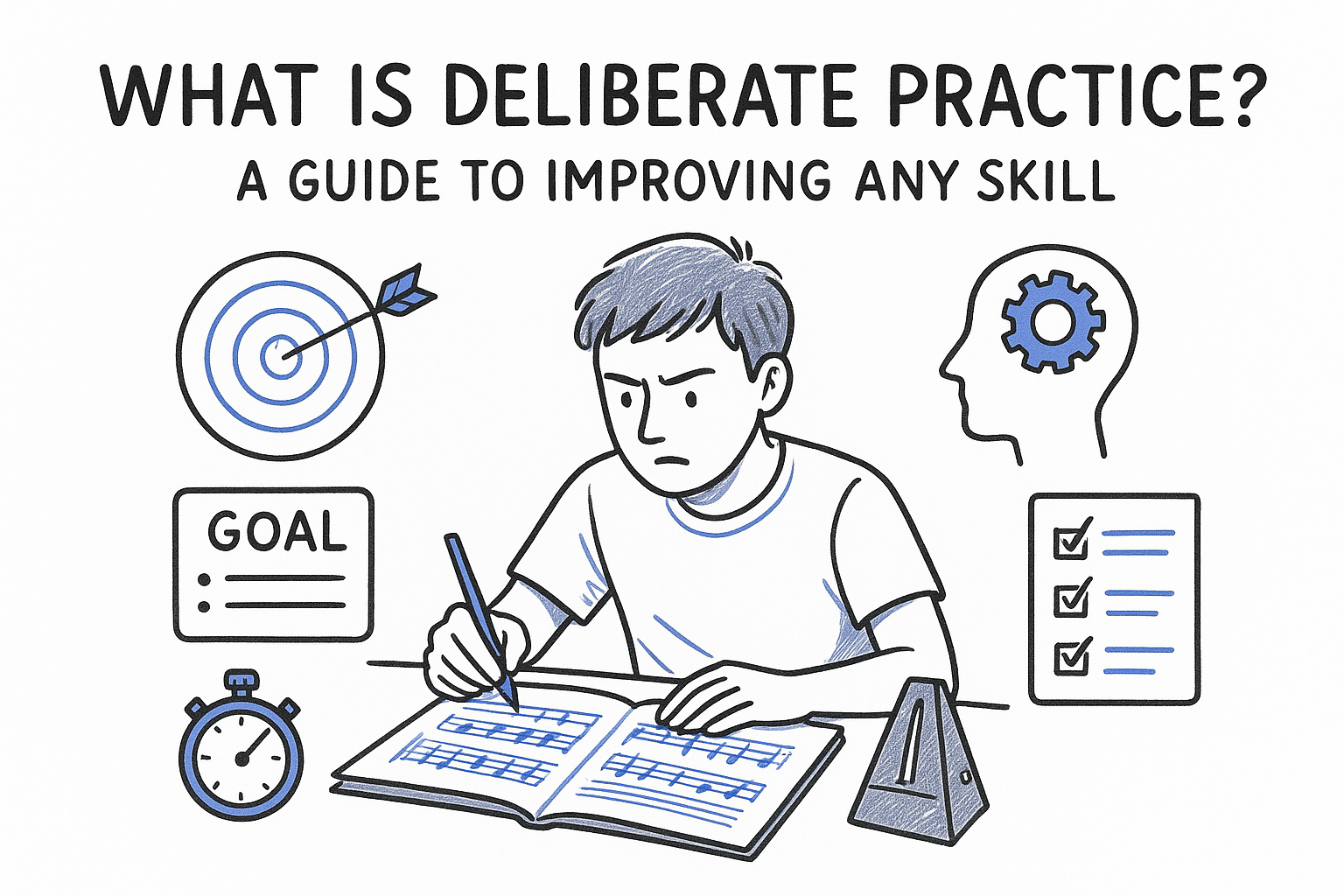
What Is Deliberate Practice? A Guide To Improving Any Skill
Most people confuse putting in hours with getting better. They show up, run through the motions, and wonder why progress stalls after a few months. The difference between someone who plateaus and someone who keeps improving almost always comes down to one thing: understanding what is deliberate practice and actually applying it. It's not about talent. It's not about logging more time. It's about how you structure what you do during that time.
Deliberate practice is a specific, research-backed approach to skill development that cognitive psychologist Anders Ericsson studied for decades. It requires focused effort on weaknesses, immediate feedback, and intentional repetition at the right difficulty level. For musicians, athletes, and anyone building practical skills, it's the clearest path from "decent" to "genuinely good." But here's the problem: knowing about deliberate practice and consistently executing it are two very different things.
That gap between theory and execution is exactly why we built MemoRep. Our platform applies spaced repetition science to your practice routine, scheduling what you should work on and when, so you spend less time planning and more time doing the focused work that actually drives improvement. This article breaks down the principles of deliberate practice, explains the science behind it, and gives you a concrete framework for applying it to any skill you're working on.
Why deliberate practice works
Most people improve quickly at first and then hit a wall. That initial burst of progress comes from your brain adapting to new demands. But unstructured repetition eventually stops producing adaptation. Your brain settles into autopilot, and the skill becomes automatic without becoming more refined. Deliberate practice prevents this from happening by continuously pushing your nervous system to form new connections and sharpen existing ones. To understand why, you need to look at what's actually happening inside your brain during focused, structured practice.
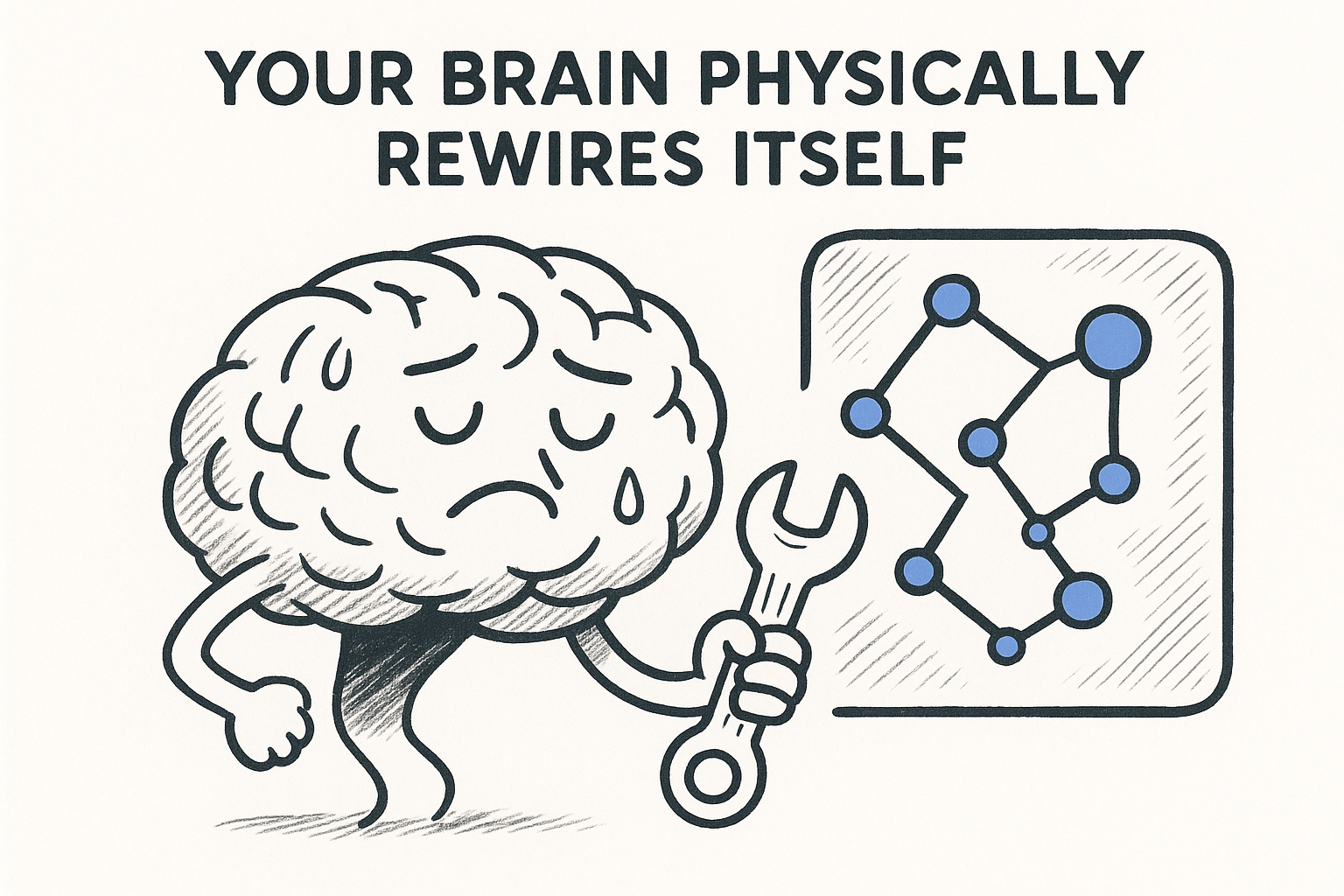
Your brain physically rewires itself
When you practice a skill with focused attention, your brain does something physical: it wraps neural pathways in a substance called myelin. Myelin acts as an insulator around nerve fibers, and the thicker that coating gets, the faster and more accurately signals travel along those pathways. Neuroscientist R. Douglas Fields documented this process in depth, showing that skills are literally built into the structure of your brain through repeated, effortful firing of specific neural circuits.
The quality of your practice determines the quality of the neural wiring you build, not just the quantity of hours you log.
This is why mindless repetition has a ceiling. If you run through the same guitar passage at the same tempo without focusing on precision, your brain isn't being pushed to refine the circuit. You're reinforcing an existing pattern, not building a better one. Deliberate practice works because it demands something your brain hasn't fully automated yet, and that demand forces real physical adaptation in your nervous system.
Mental representations separate experts from beginners
One of the most important ideas in understanding what is deliberate practice is the concept of mental representations. When experts perform a skill, they don't consciously process each small step. They've built rich internal models that let them chunk information, anticipate errors, and self-correct in real time without stopping to think.
A beginner guitarist hears a wrong note after they've already played it. An experienced guitarist feels the tension building in their hand before the note happens and adjusts. That internal sensing comes from years of building detailed mental representations through deliberate, focused repetition. Your goal as a practitioner isn't just to get your fingers in the right place. It's to build the internal model that guides and monitors them automatically.
Discomfort is a signal, not a problem
Deliberate practice feels harder than regular practice. That's not a design flaw. Cognitive strain signals that your brain is working outside its comfort zone, which is exactly where adaptation happens. Researchers studying skill acquisition consistently find that the most productive practice sessions involve difficulty that sits just above your current capability level, not so hard that you fail constantly, but not so easy that you coast through without full attention.
This zone is sometimes called the "zone of proximal development" in educational psychology. In practical skill training, the same principle applies. When a task requires your full concentration to complete without errors, your brain is engaged at the level needed to build new structure. The moment a skill feels easy and automatic, it stops driving growth unless you raise the difficulty, increase the tempo, or shift your attention to a more refined component of that skill. Staying in that productive range of difficulty is the core mechanism that separates improvement from maintenance.
What deliberate practice is
Deliberate practice is a structured method of skill development that requires focused attention, specific goals, and immediate feedback on your errors. It's not the same as putting in hours or repeating what you already do well. When you ask what is deliberate practice in concrete terms, the answer is this: it's working on the precise edge of your current ability, in short intense sessions, with clear criteria for what success looks like. Every repetition serves a specific purpose, and you adjust based on what you observe in real time.
Deliberate practice isn't about working harder. It's about working on the right thing, at the right difficulty, with full attention directed at the gap between where you are and where you need to be.
The five defining characteristics
Anders Ericsson identified several qualities that separate deliberate practice from general skill activity. Understanding these qualities gives you a practical checklist you can hold your sessions against.
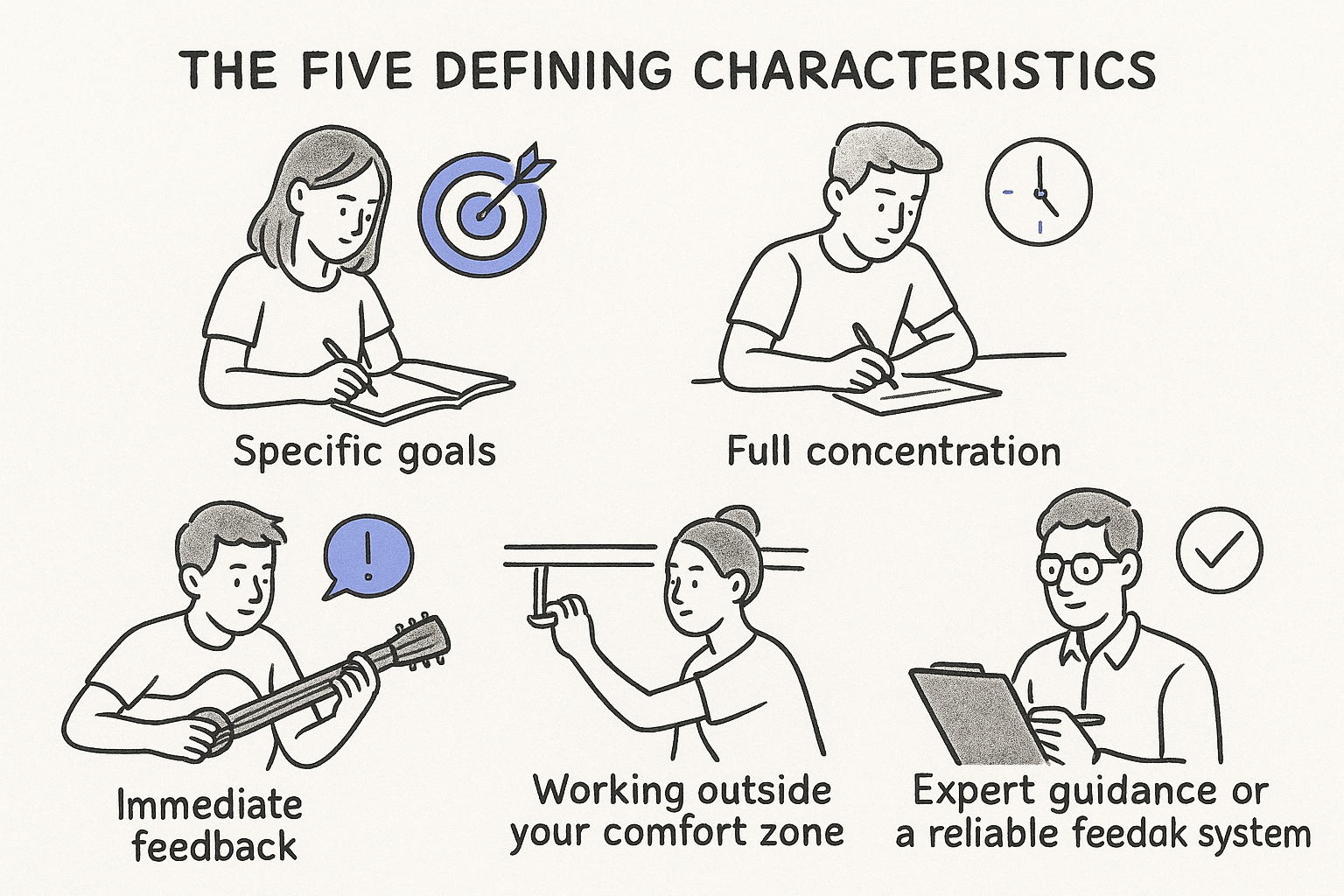
- Specific goals: Each session targets a clearly defined skill or sub-skill, not a broad outcome like "get better at guitar."
- Full concentration: You give your complete attention to the task. No background music, no multitasking, no coasting on autopilot.
- Immediate feedback: You know whether each attempt was correct or incorrect while it's still fresh, so you can adjust before you reinforce errors.
- Working outside your comfort zone: The task sits just above what you can do automatically, demanding effort but remaining achievable with focus.
- Expert guidance or a reliable feedback system: Someone or something tells you when your performance deviates from the target, and you use that information to correct course.
These five characteristics work together. Remove one, and the quality of the practice drops significantly.
What it is not
Deliberate practice is not the same as experience. Spending ten years doing something gives you familiarity, but it doesn't guarantee improvement if you're repeating the same comfortable patterns without targeting weaknesses. It's also not performance: when you perform a piece of music or play a full game of tennis, you're executing what you know, not building something new. Practice and performance serve different functions, and mixing them up wastes valuable development time. Your practice sessions should feel like construction work, not a show.
Where the idea came from and what research shows
The concept of deliberate practice didn't come from a motivational speaker or a productivity blogger. It came from decades of scientific research by Anders Ericsson, a cognitive psychologist at Florida State University who spent his career studying how people achieve expert-level performance. His work fundamentally changed how researchers think about the relationship between practice and skill, and it gave practitioners a science-backed framework for structuring their development. If you want to apply these ideas effectively, it helps to understand where they actually came from.
Ericsson's foundational studies
Ericsson's most influential early study examined violin students at the Berlin Academy of Music. He and his colleagues divided students into groups based on their instructors' assessments of their potential, then tracked their practice histories. The finding that shaped the field: by age 20, the best students had accumulated roughly 10,000 hours of deliberate practice, while the good-but-not-elite students had logged significantly fewer. Talent didn't explain the gap. Practice did.
The research didn't suggest that hours alone made the difference. It was specifically hours of structured, effortful, feedback-driven practice that separated the groups.
A follow-up study looked at pianists and typists, finding that plateaued performers and still-improving performers spent similar total time at their instruments. What differed was how they used that time. Improving performers regularly pushed into uncomfortable territory and sought feedback on errors, while plateaued performers mostly repeated what they already knew.
What the data actually shows
Understanding what is deliberate practice requires separating what Ericsson actually found from how his work got popularized. Malcolm Gladwell's "10,000-hour rule" took the research and stripped out its most important detail: the hours have to be deliberate. Ericsson himself pushed back on oversimplifications of his findings, clarifying that undirected repetition, no matter how long, doesn't produce expert-level skill.
More recent research has added nuance. A 2014 meta-analysis published in Psychological Science examined 88 studies across domains including music, sports, and games. Your takeaway from that analysis should be specific: deliberate practice explained the largest share of performance variance in music and structured skill domains. The conclusion wasn't that deliberate practice doesn't work. It was that structured, feedback-driven practice matters most in skill domains where technique and precision drive outcomes, which describes music and most practical skill areas almost exactly.
Deliberate practice vs regular practice
Most people who say they practice regularly are actually doing something closer to maintenance than development. They show up, they play through material they already know, and they finish the session feeling like they put in work. That feeling is misleading. Understanding what is deliberate practice depends on seeing exactly where it diverges from the kind of practice most people default to without realizing it.
The difference in attention and intent
Regular practice is defined by repetition without a specific target. You run through a scale, you play a song from start to finish, you drill an exercise you've done a hundred times before. Your attention is divided or drifting, and your goal is vague, something like "stay in shape" or "keep the material fresh." Deliberate practice inverts this entirely. You enter a session knowing exactly which component of your skill you're targeting, and every repetition serves that specific purpose.
The gap between deliberate and regular practice isn't about effort. It's about whether your attention is actually engaged with what needs to improve.
Deliberate practice also treats errors differently. In regular practice, you hit a wrong note and move on, or you restart from the beginning of a passage and hope it goes better next time. In deliberate practice, you stop at the error, isolate it, and work the specific moment until the problem is corrected. That might mean slowing down to 60% tempo, isolating two bars, and repeating them twenty times before integrating them back into context.
Why regular practice feels productive but isn't
Regular practice rewards you with a sense of competence because you're mostly doing things you already know how to do. That feels good, but it doesn't signal growth. Your brain isn't building new structure; it's running existing patterns. The problem is that this kind of practice can sustain your current level for a long time, which makes it easy to confuse maintenance with improvement.
Deliberate practice, by contrast, feels harder and less satisfying in the moment because it constantly exposes what you can't do yet. You're spending your session time in the uncomfortable zone where errors are frequent and progress feels slow. That discomfort is the signal that real adaptation is happening. If you finish a practice session feeling like everything went smoothly and nothing challenged you, you probably didn't push your skill forward at all.
The core principles of deliberate practice
Understanding what is deliberate practice at a surface level isn't enough. To actually apply it, you need to internalize the principles that drive its effectiveness. These principles aren't abstract ideals; they're operational rules that determine whether your practice session moves your skill forward or simply maintains what you already have. Each one connects directly to the underlying science of how your brain builds expertise.
Push beyond your current limits
The single most important principle is working at the edge of your current ability. If the task feels comfortable, your brain isn't being asked to do anything new. You need to find the difficulty level where focused effort is required to complete the task without errors, then stay there. As your capability grows, you raise the bar again. This continuous upward pressure is what keeps adaptation happening.
If you can complete a practice task without full concentration, the task is too easy to produce real growth.
Progress only happens in the discomfort zone, not in the space where things feel smooth and automatic. The moment a skill becomes easy, shift your attention to a harder variation, a faster tempo, or a more refined aspect of execution.
Focus on one specific target per session
Broad goals produce unfocused practice. When you walk into a session intending to "work on your technique," you give your brain nothing concrete to optimize. Deliberate practice requires a specific, narrow target: one chord transition, one rhythmic pattern, one fingering position. Narrowing your focus forces your attention directly into the gap that needs work.
Each session should have a single measurable outcome you're trying to achieve. This specificity also makes feedback meaningful, because you can clearly evaluate whether you hit your target or not, which gives you accurate information to adjust with.
Treat feedback as the engine of improvement
Without feedback, you can't distinguish between reinforcing a good pattern and locking in a mistake. Feedback must be immediate and precise: the closer in time it follows your attempt, the faster your brain can connect the result to the action that caused it. Delayed feedback breaks that loop and slows learning significantly.
You don't always need a teacher in the room. Recording yourself, using a metronome, or applying a structured tracking system gives you the objective signal your brain needs to self-correct. The feedback mechanism matters less than the consistency with which you use it.
How to do deliberate practice step by step
Knowing what is deliberate practice in theory is one thing. Translating it into a repeatable session structure is another. The steps below give you a concrete framework you can apply every time you sit down to practice, so you stop guessing about what to work on and start spending your time on what actually drives skill development.
Start by identifying your weakest point
Before each session, pick the specific skill component that's limiting your overall performance. Make it narrow enough to measure, such as one chord transition at a specific tempo, not a broad area like "rhythm" or "technique." One precise target per session produces more improvement than spreading your effort across five loosely related goals.
Use these criteria to sharpen your target before you begin:
- Name the exact skill, not the general category
- Set a specific performance standard (tempo, accuracy, consistency)
- Confirm you can measure whether you hit it or not
Build sessions around short, intense blocks
Short, focused blocks outperform long, unfocused ones almost every time. Aim for 20-45 minute sessions where your full attention stays locked on your target. Research on cognitive load shows that concentration deteriorates sharply after 45-60 minutes of effortful mental work, which means grinding through exhaustion rarely adds value. If you have more time available, take a real break between blocks rather than extending a single session past the point of genuine focus.
The goal of each block is maximum quality of attention, not maximum duration.
Isolate, drill, and integrate
Work through a three-step cycle for every skill gap you identify. First, isolate the exact problem: drill only the two bars where the breakdown happens, not the whole piece. Second, repeat that isolated section at a difficulty level that requires your full attention to execute correctly. Third, integrate it back into context once you can perform it reliably in isolation.
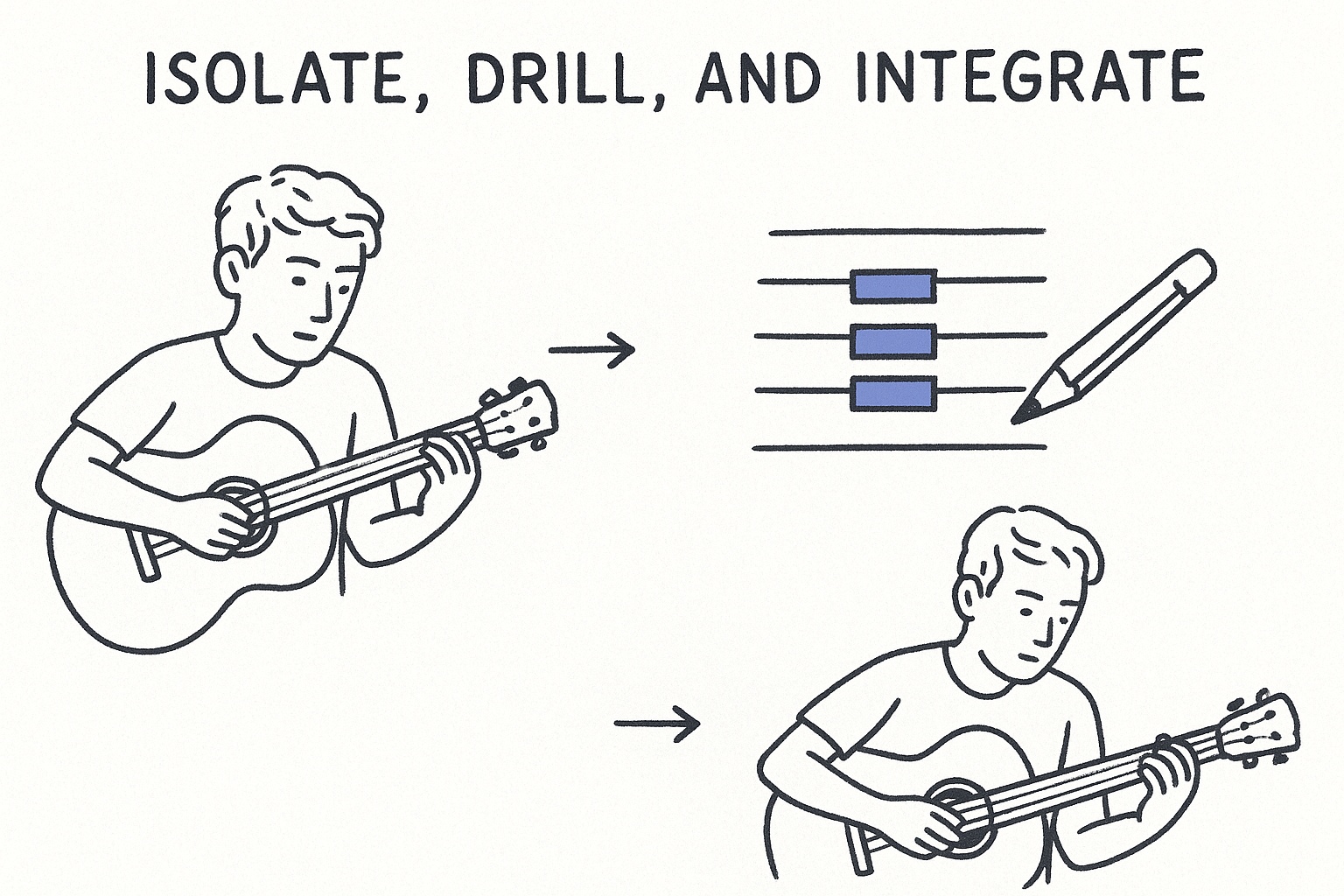
This cycle stops the common habit of always restarting from the beginning and hoping the hard part goes better when you reach it. Isolation forces your brain to build the specific neural pathway that's actually failing, rather than rehearsing everything around the problem while leaving the core issue untouched.
Review each session before you finish
Spend the last two minutes of every session writing down what improved and what still needs work. This brief review anchors your progress and gives you a precise starting point for your next session, so you stop re-diagnosing the same issues instead of building on what you've already fixed.
Track these three things consistently after each session:
- The specific target you worked on
- Whether you hit your performance standard
- What to prioritize next time
How to measure progress and get feedback
Progress without measurement is just a feeling. One of the reasons people struggle with what is deliberate practice in their daily routine is that they rely on subjective impressions, such as whether a session "felt good," rather than concrete data about their actual performance. Feelings lie. You can finish a session feeling accomplished while having reinforced the same mistake you've been making for months. To practice deliberately, you need a system that tells you objectively whether your performance is improving or holding steady.
Define what good looks like before you start
You can't measure progress toward a target you haven't defined. Before each session, set a specific, observable performance standard for the skill you're working on. That might be playing a passage at 120 bpm with zero hesitations, or transitioning between two chords cleanly ten times in a row. The standard needs to be precise enough that you can answer yes or no when the session ends.
A simple framework for setting measurable targets:
- Skill: Name the exact component (not "improve transitions," but "Cmaj to Gmaj chord transition")
- Standard: Set a numeric or binary success condition (10 consecutive clean reps, specific tempo, no string buzz)
- Timeframe: Define how long you'll work on this before reassessing
Use objective tools to capture what you can't self-assess
Your ear misses things your recording won't. Use a metronome to expose tempo inconsistencies you'll rationalize away in real time, and record short video or audio clips of your practice so you can review your execution from the outside. These tools give you feedback that doesn't bend to your wishful thinking.
The gap between how you think you sound and how you actually sound is where most practice problems live.
Reviewing a recording feels uncomfortable because it shows you exactly what still needs work. That discomfort is the point. Objective feedback closes the loop between effort and actual skill gain in a way that self-perception alone never can.
Build a feedback loop into your routine
Tracking your sessions doesn't need to be complicated. After each block, note whether you hit your performance standard and what specifically broke down when you didn't. Over time, this log reveals patterns, which skills are improving, which are stalling, and which haven't been touched in weeks. That information tells you where to direct your attention next, so your practice compounds instead of cycling through the same gaps indefinitely.
How to apply deliberate practice to music
Music is one of the clearest domains where what is deliberate practice produces visible, audible results. Every technical gap you have leaves a trace in your sound, which means feedback is immediate and specific in a way few other skill areas can match. That makes music an ideal environment for these principles, but it also means bad habits get reinforced just as efficiently as good ones if you're not practicing with intention.
Target small technical problems, not whole pieces
Running through a full piece from start to finish feels productive but rarely drives improvement. Every time you restart from bar one, you spend most of your session on sections you already handle well and rush through the parts that actually need work. Instead, identify the specific bars or transitions where your performance breaks down and make those the entire focus of your session.
Drilling ten minutes on two difficult bars will move your skill forward faster than playing through a full piece ten times.
Work those isolated sections at a reduced tempo until you can execute them with zero hesitations and clean tone, then gradually raise the speed. Only integrate the section back into the full piece once it holds up under pressure in isolation.
Apply feedback tools consistently
Your perception of how you sound in real time is unreliable. Recording short audio or video clips of your practice sessions gives you objective information that your in-the-moment ear will miss. Listen back with specific criteria: check for timing inconsistencies, tone quality, and dynamic variation rather than just noting whether it sounded okay overall.
A metronome is non-negotiable for tempo-based feedback. Many musicians avoid it because it exposes problems they'd rather not confront, but that exposure is exactly what makes it useful. Consistent metronome use trains your internal clock and reveals where your timing drifts under pressure.
Rate your sessions honestly
After each session, give yourself a clear assessment of what improved and what didn't. A simple Again/Hard/Good/Easy rating for each skill you worked on tells you where to direct your next session and prevents you from unconsciously avoiding your weakest areas. Honest self-assessment closes the loop between effort and real skill development.
To make this concrete, track these three things after every session:
- Which specific skill you drilled and at what tempo or difficulty
- Whether you hit your performance standard
- What to focus on in your next session based on what fell short
How spaced repetition makes practice stick
Deliberate practice tells you how to work on a skill. Spaced repetition tells you when to revisit it. Without the timing component, even focused sessions lose ground to forgetting. A music practice app can connect those two jobs by recording the result of a skill session and bringing that skill back when it needs attention.
The forgetting curve and why timing matters
Hermann Ebbinghaus mapped how memory decays in the 1880s, and his findings still hold up. After you learn or practice something, your retention drops sharply over the following hours and days. By the time a week passes, most of the gained precision has degraded significantly unless you reinforce it. The key insight from Ebbinghaus is that the rate of forgetting is predictable, which means you can schedule practice to intercept the decay before the skill degrades too far.
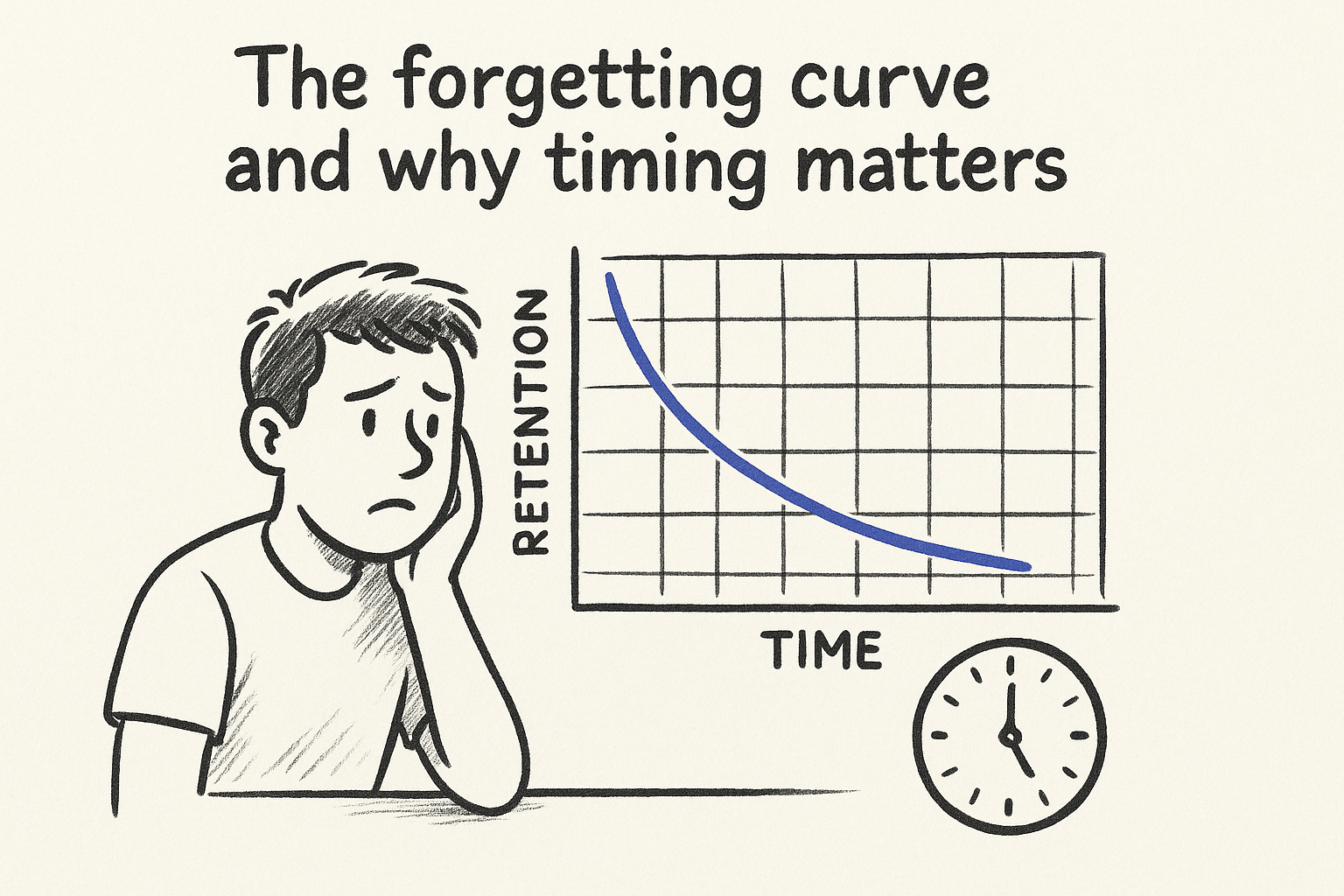
Practicing a skill just before it fades locks it in more durably than practicing it while it's still fresh.
This is the core logic behind spaced repetition. If you revisit a skill too soon, you reinforce something that hasn't had time to consolidate. If you wait too long, you're relearning from a degraded baseline instead of reinforcing a strong one. The optimal window sits right at the edge of forgetting, and hitting that window consistently is what turns short-term improvement into long-term retention.
How spacing intervals work in practice
The SM-2 algorithm, developed for the SuperMemo software, calculates review intervals based on how well you performed during your last session. Rate a skill as easy, and the next review gets scheduled further out. Rate it as hard, and it comes back sooner. This feedback-driven scheduling means your practice calendar reflects your actual skill state rather than a fixed rotation that ignores how well things are holding up.
For musicians and practical skill learners, this matters in a direct way. You stop guessing which exercises need attention today and which ones you can leave alone. Your practice time goes toward the specific skills that are actually at risk of fading, so every session does real work instead of covering ground that doesn't need it.
Common mistakes and how to fix them
Even when you understand what is deliberate practice, the gap between knowing the principles and executing them cleanly is wide. Most practitioners fall into the same patterns repeatedly, and those patterns quietly undo the work they're putting in. Spotting these mistakes early saves months of wasted effort.
Practicing what you're already good at
Comfort-seeking is the most common trap in any skill practice routine. Your brain naturally gravitates toward material you already handle well because completing familiar tasks feels rewarding and requires little effort. The problem is that repeating what you can already do doesn't build new capability; it just maintains current performance.
If you leave every session feeling like nothing challenged you, you've been performing, not practicing.
To fix this, audit your practice log at the start of each week and identify which skills you've been avoiding. Those are the exact areas that need your focused attention. Prioritize uncomfortable material first, before fatigue sets in, so your sharpest concentration goes toward the gaps that most limit your performance.
Skipping the feedback step
Practicing without feedback is one of the fastest ways to lock in bad habits. You can spend hours repeating a flawed motion with full concentration and come away more skilled at doing something wrong. Feedback isn't optional; it's what separates reinforcing errors from building correct patterns.
The fix is straightforward: record short clips of your practice sessions and review them with specific criteria in mind. Use a metronome to expose timing drift you won't catch in real time. If you rate each attempt immediately after completing it, you create the tight feedback loop that drives real correction instead of hopeful repetition.
Grinding through exhaustion
Mental fatigue doesn't just reduce output; it actively degrades the quality of what you're building. Practicing past the point of genuine concentration reinforces sloppy execution and trains your brain to operate below the standard you're aiming for. More time in a degraded state is not a substitute for less time at full focus.
Cap your focused practice blocks at 45 minutes maximum and take a real break before continuing. If you notice your attention drifting during a block, stop the session and return when you can bring full concentration back. A short, sharp session always outperforms a long, unfocused one.
Put deliberate practice to work
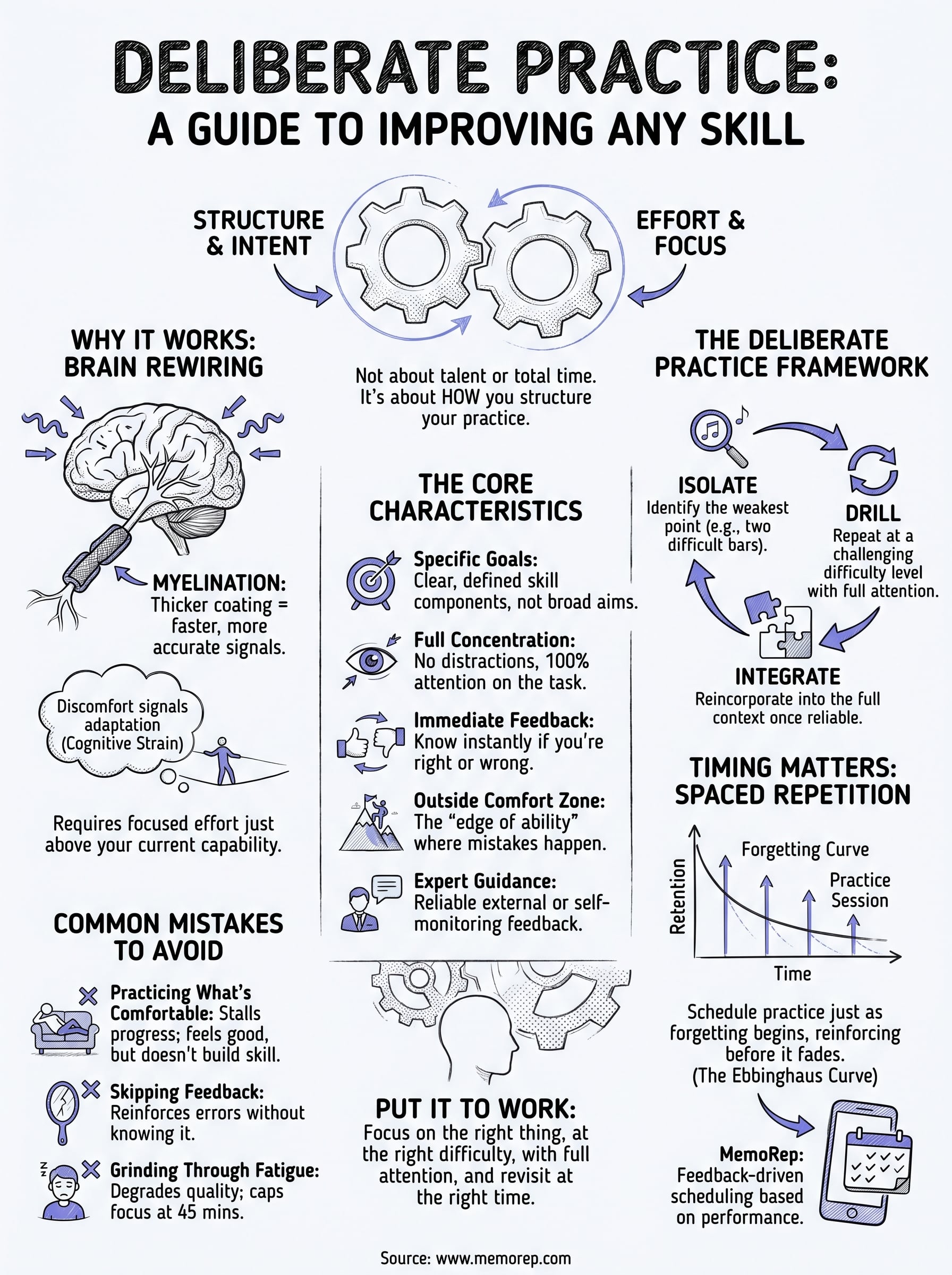
Now you know what is deliberate practice and exactly how it differs from the unfocused repetition most people default to. The principles are clear: target your weakest point, work at the edge of your ability, get immediate feedback, and revisit skills at the right intervals before they fade. Every section of this guide gives you a concrete tool you can use in your next session.
The hardest part isn't understanding the framework. It's showing up consistently and making the right decisions about what to practice next, especially when you're tired or pressed for time. That's where structure matters most.
MemoRep handles the scheduling side for you, using spaced repetition to tell you exactly which skills need attention today so you stop guessing and start doing the focused work that moves your ability forward. Try MemoRep free and build a smarter practice routine before the limited beta spots run out.