How to Build an Acoustic Guitar Practice Routine That Lasts
The best acoustic guitar practice routine is a short daily session split into timed blocks: chord changes, strumming, picking, and songs, in that order. A teacher or course picks the material for each block, and you rotate it on a schedule. Fifteen to thirty minutes on most days of the week beats one long session on the weekend. This guide shows you how to build that routine in four steps, with time splits, a session template, and a simple way to decide what comes back tomorrow and what can wait a week.
Most self-taught players know the problem. You sit down, play whatever feels fun, and get up 40 minutes later with nothing measurably better. The chords you learned two weeks ago have gone rusty. The picking exercise you meant to keep up hasn't been touched since Tuesday. The first five minutes of every session go to deciding what to do. That is not a discipline problem. It is a missing-structure problem.
This article covers structure only: how long to practice, how to divide the time, how to order a session, and how often each item should return. It does not teach you how to play anything, because that is a teacher's job. At MemoRep we build a spaced repetition practice app for musicians, so we focus on the what next, and when of practice. Bring the material from your lessons or course, and this guide gives you the frame to practice it consistently.
Why a routine beats random playing
A routine gives every skill a place in your week, so nothing quietly drops out. Free play favors what you already do well, because it feels good. A routine forces the unglamorous items back into view before they fade.
What a routine does that free play doesn't
Free play has one built-in bias: you drift toward the things you are already comfortable with. A fixed block structure removes that drift. If picking has its own four minutes, picking gets four minutes, whether or not you feel like it.
A routine also removes the decision. Hermann Ebbinghaus showed in the 1880s that memory fades predictably unless it is revisited, and the same applies to hand skills. A skill you stop touching gets rusty, and a routine decides in advance when you touch it again. Deciding in advance matters, because decision fatigue at the start of a session costs you minutes and motivation.
A routine is a decision you make once so you don't have to make it every day.
What this routine covers and what it leaves to your teacher
This guide builds the container, not the contents. You will decide how much time each block gets, how to order them, and how often each item returns. Your teacher, course, or lesson plan decides which chords, patterns, and songs go inside.
That split is deliberate. Only someone who can hear you play can tell you what to work on next or how to approach it. If you have no teacher, use the sequence of a structured beginner course as your source of material. Keep the structure and the material separate, and you can swap either one without rebuilding the other.
Common questions about practice time
Players often ask whether there is a magic number, so here are the usual ones, kept in proportion.
- The 80/20 rule. This is the Pareto principle, the idea that a small share of effort produces most of the results. It is not a law of guitar, but it is a useful lens. A few items cause most of your trouble, so they deserve most of your attention.
- The 10,000 hours rule. This comes from a study of violin students by Anders Ericsson, later popularized by Malcolm Gladwell. It describes an average among elite performers, not a threshold, and Ericsson himself objected to it being treated as a rule. It says nothing about how long a hobbyist needs.
- Why people quit. You will often see "90 percent of people quit guitar." We know of no solid source for that figure. What is certain is that players who feel they are not improving stop playing, and unstructured practice is the likeliest reason progress stalls.
- The most effective schedule. Short, frequent sessions on most days, with a rest day. Consistency matters more than session length.
Step 1. Set your time and pick four blocks
Choose a session length you can repeat on at least five days a week, then divide it into four blocks: chords, strumming, picking, and songs. Start smaller than you think you need to. A routine you skip is worth nothing.
Choose a session length you can repeat
Fifteen to twenty minutes, six days a week, is a common starting point among teachers. Six sessions of 20 minutes add up to 120 minutes a week. If you played those same 120 minutes in one Saturday session, you would touch each skill once. Spread across six days, you touch each one six times, and the repeated contact is what keeps skills from fading.
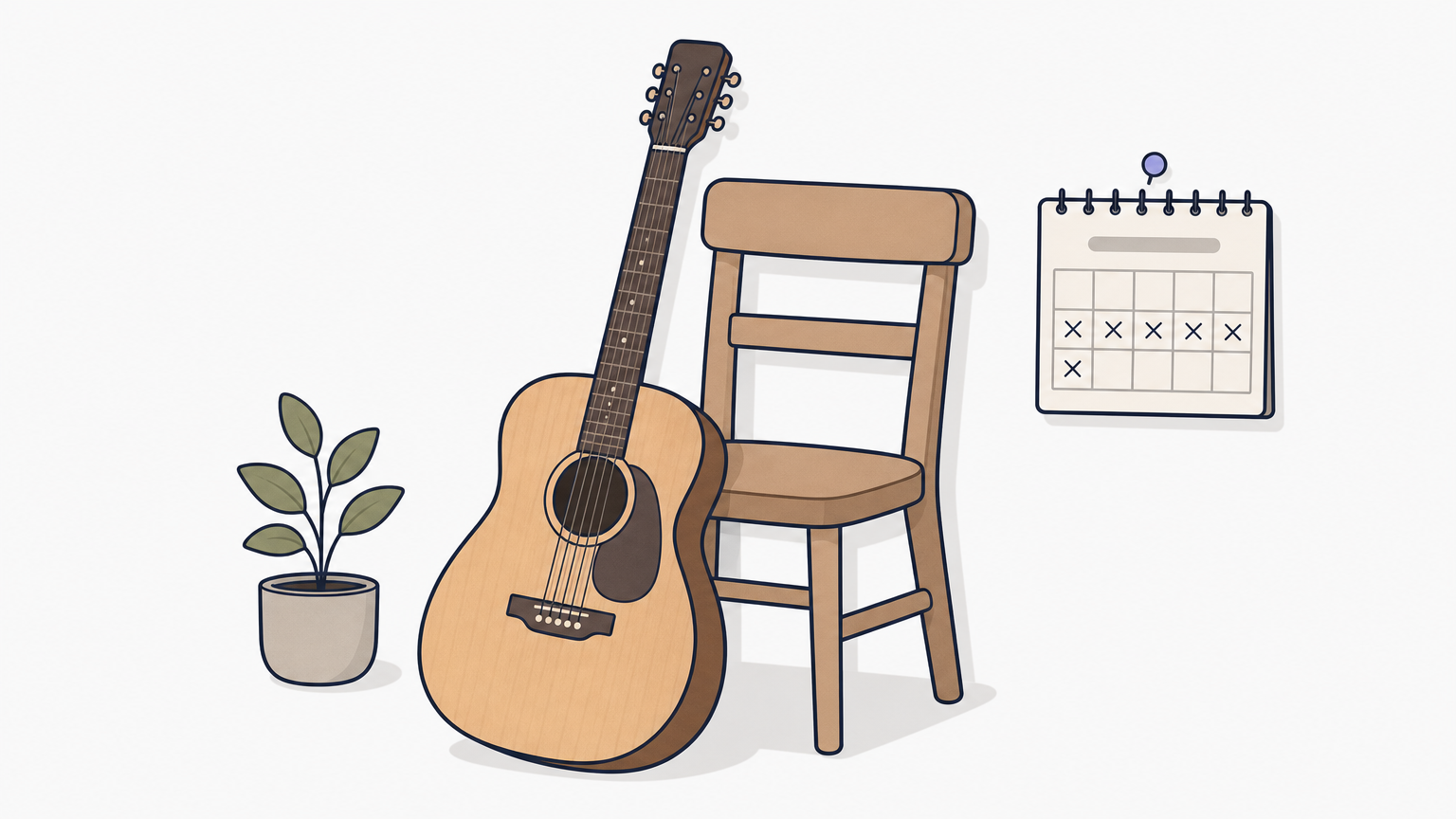
Pick the length from your real schedule, not your ambition. If you have 30 minutes on weekdays but only 15 on Sundays, plan for that. This table shows how to split each length across four blocks, with each row summing to the full session.
| Session length | Chord changes | Strumming | Picking | Songs |
|---|---|---|---|---|
| 15 minutes | 4 | 4 | 3 | 4 |
| 20 minutes | 5 | 5 | 4 | 6 |
| 30 minutes | 7 | 7 | 6 | 10 |
| 45 minutes | 10 | 10 | 10 | 15 |
Songs get the largest share in every row. Songs use everything else at once, and they are the reason you picked up the instrument.
Decide which blocks you need
Not every player needs all four blocks today. If your lessons haven't reached single-note picking yet, drop that block and give its minutes to songs or chords. Add it back when your material includes it. Blocks should mirror what you are actually learning, not an ideal curriculum.
If you want a guitar chords practice routine specifically, keep the same frame but change the proportions. Give chords half the session, keep a small strumming block so the chords are used in context, and keep a song block at the end. For a 20-minute session that could be 10 minutes of chords, 4 of strumming, and 6 of songs. The extra chord minutes get divided among many small items, which Step 2 explains.
Time-box every block in advance, and the session runs itself.
Step 2. Fill each block from your teacher's material
Turn the material you have been given into a list of small, separate items, one per skill, and assign each item to a block. Items are the unit your routine works with. A block with one vague item like "work on chords" gives you nothing to rotate or measure.
Turn your material into a list of items
An item is the smallest piece of practice you can finish in a few minutes and rate afterward. Write each one as a short, specific label. Here is what items look like in each block:
- Chord block: "Change from G to C," "Change from D to A," "Chord set from lesson 3."
- Strumming block: "Pattern from lesson 4," "Pattern from lesson 5 with the new chord."
- Picking block: "Exercise 2 from the course," "Picking pattern from the song intro."
- Song block: "Verse of the first song," "Chorus of the second song," "Full run of the third song."
Take the labels straight from your lesson notes. Whatever your teacher assigns becomes an item, and you never have to decide what the item means. That is how you avoid slipping into giving yourself technique advice you are not qualified to give.
Keep the active list short
Keep eight to twelve active items at any time across all blocks. Too few and you run out of things to practice before the session ends. Too many and each item comes up too rarely to stick. When you finish a lesson, add the new items and retire items you have rated easy for several sessions in a row.
Split big items into small ones. "Play the whole song" is too large to rate honestly, because the first verse may be solid while the bridge falls apart. Break it into verse, chorus, and bridge so each part gets its own rating. A song with three sections becomes three cards, and the weak section comes back sooner than the strong one.
Small, separate items are what make a routine measurable and adjustable.
Step 3. Order the session and rotate the week
Run each session in a fixed order: chords, then strumming, then picking, then songs. Then rotate which items appear on which day, so that nothing shows up every day and nothing disappears for weeks.
Put the session in this order
Start with the material that asks the most from you while you are fresh, and end with music. Here is the sequence I recommend for an acoustic session:
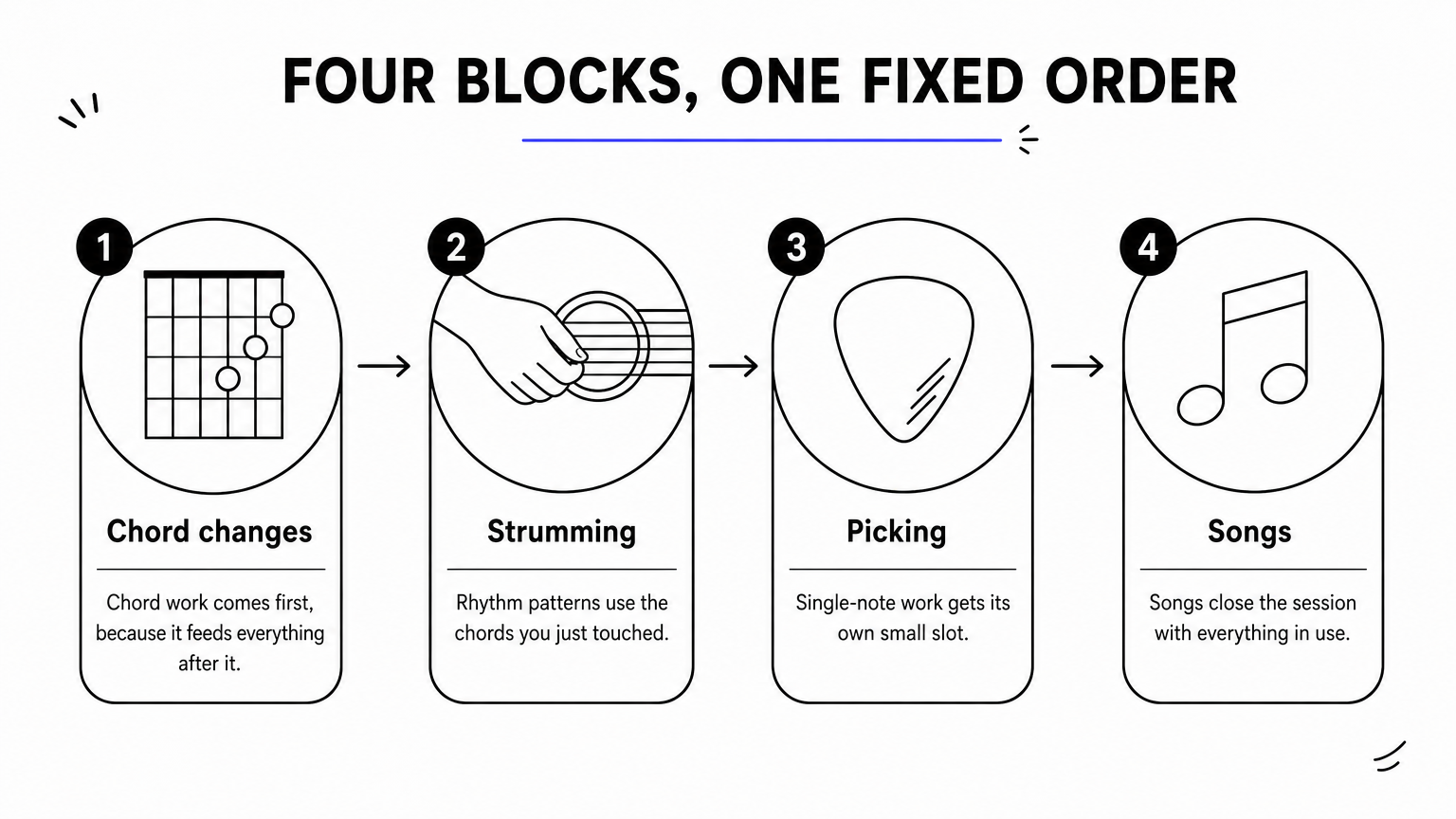
- Chord changes. Chord work comes first, because it feeds everything after it.
- Strumming. Rhythm patterns use the chords you just touched.
- Picking. Single-note work gets its own small slot.
- Songs. Songs close the session with everything in use.
Ending on a song matters more than it seems. Finishing on real music gives you a reason to come back tomorrow. If you ever have to cut a session short, cut from the middle of the order and protect the song block.
Rotate items across the week
Not every item needs to appear daily. A new chord change that keeps going wrong needs daily contact. A pattern you've nailed for three weeks can wait several days. A simple approach to organizing your practice week is to keep your two or three weakest items in every session and fill the remaining minutes with whichever items have gone longest without a visit.
Take one rest day a week, and make one other day lighter, with a song block only. If you are using a 20-minute routine, a lighter day means 20 minutes of songs, which still counts. The point is to keep the habit alive without grinding.
Daily contact for weak items, spaced contact for strong ones.
Step 4. Rate each item and let the schedule adapt
After you play an item, rate how it went with one of four labels: Again, Hard, Good, or Easy. Then let the rating decide when the item comes back. This is the step that turns a fixed routine into an adaptive one, and it is what keeps your practice focused on what is about to fade.
Rate each item after you play it
Rate by how the attempt felt, not by how you hope it will go next time. Here is a plain meaning for each label and a simple manual schedule you can follow with paper or a notes app.
| Rating | What it means | Next visit |
|---|---|---|
| Again | You could not get through it | Tomorrow |
| Hard | You got through it, but with effort | In 2 days |
| Good | You got through it cleanly | In 4 days |
| Easy | It felt effortless | In 7 days |
These intervals are a rule of thumb, not a scientific constant. Adjust them if your week allows. The principle is what matters: struggles come back soon, solid items come back later.
Keep a short log so the ratings do not live only in your head. Copy this template into any notes app and fill it in after each session:
Date:
Time available: 20 min
Chords (5 min): item / rating
Strumming (5 min): item / rating
Picking (4 min): item / rating
Song (6 min): song section / rating
Note for tomorrow:
Why spacing works
Ebbinghaus's forgetting curve shows that recall drops fastest right after learning, and that each well-timed review slows the drop. The SM-2 algorithm from SuperMemo, published in 1987, turns this into a schedule. In its original form, an item reviewed successfully comes back after 1 day, then after 6 days, then after the previous gap multiplied by an ease factor that starts at 2.5.
Here is that example worked through. You learn a chord change on day 0 and rate it Good every time. It returns on day 1, then 6 days later on day 7, then 15 days after that (6 × 2.5) on day 22. A miss resets the interval, so the item returns tomorrow. Over three weeks you practice the item three times instead of 21, and your daily minutes go to items that need them.
Let an app handle the scheduling
Doing this by hand works, but it gets tedious as your item list grows. MemoRep automates the schedule. You create practice cards inside projects, rate each one with Again, Hard, Good, or Easy, and the scheduling algorithm adjusts what comes next based on your answers. It also sends a daily practice notification, so you know what is due without checking a spreadsheet.
MemoRep does not tell you how to play or what to learn next. It schedules the material your teacher or course gives you. It is in a limited beta, with free premium access for the first 200 users.
Rate honestly, and the schedule puts your minutes where they are needed.
Start with one 20-minute session
A good acoustic guitar practice routine is a frame: four timed blocks, a fixed order, small items taken from your lessons, and a rating after each item that decides when it returns. Pick a session length you can repeat, list your items, and run the order for a week before changing anything.
If you would rather not track intervals by hand, try MemoRep and join the free beta. You can also read how MemoRep's scheduling works before you decide. Either way, start tomorrow with one session and a written list.