
How to Build a Carnatic Music Practice Routine
If you sing Carnatic music, you know the struggle: sarali varisai one day, a varnam the next, then three weeks pass before you touch that kriti you were supposed to be polishing. A solid carnatic music practice routine isn't about cramming more exercises into your day. It's about deciding, with some discipline, what gets your voice today and what can wait until tomorrow without going rusty. Most singers default to whatever feels urgent, and that's how gamakas get sloppy and ragas fade from memory.
This guide gives you a way to structure your sessions so nothing important slips through the cracks. You'll see how to organize your repertoire into manageable pieces, when to revisit older kritis versus new ones, and how to rotate technical drills with performance pieces so your voice stays sharp across everything you're learning, not just your latest obsession.
We'll walk through building a weekly structure, spacing out revision so pieces resurface right before you'd forget them, and tracking what actually needs attention. If you've ever finished a practice session wondering whether you worked on the right things, this routine gives you a clearer answer, and a system you can lean on every single day.
Why a structured routine matters for Carnatic practice
Your voice forgets faster than you think
Carnatic music training relies on repetition, but repetition without a plan just means you repeat whatever you remember to repeat. The forgetting curve, and the way timed review pushes back against it, applies to ragas exactly as it applies to vocabulary or dates in a history class. A sangati you nailed last month fades within weeks if you don't revisit it, and gamakas in particular degrade fast because they depend on muscle memory, not just recall. A carnatic music practice routine built around spaced revision keeps pieces fresh right before they'd otherwise slip, instead of letting you rediscover, three months later, that you've forgotten half a varnam.

What unstructured practice actually costs you
Most singers who practice without a schedule fall into one of two traps: they either drill the same three exercises because those feel comfortable, or they chase whatever piece excites them that week. Neither approach covers the full range of what a serious carnatic vocal practice schedule should include. Here's what tends to slip through the cracks:
- Older kritis that were performance-ready six months ago but haven't been touched since
- Alankarams and varisais that get treated as "beginner stuff" and abandoned too early
- Sangatis within a larger kriti that never get isolated and drilled on their own
- Manodharma practice, which needs regular reps just like everything else, but rarely gets scheduled at all
A practice session without a plan is just an improvisation on what to forget next.
The three layers of Carnatic repertoire
Thinking of your material in layers makes it easier to decide what deserves daily attention versus weekly revision. Technical drills like sarali varisai and janta varisai build the foundation and need frequent, short repetition. Varnams sit in the middle, they're demanding enough to require regular practice but stable enough to tolerate a few days between sessions once you've internalized them. Kritis and manodharma work sit at the top, where the retention challenge is highest because there's simply more material to hold onto.
| Layer | Example material | Typical revisit interval |
|---|---|---|
| Foundation | Sarali varisai, janta varisai, alankaram | Daily or every other day |
| Transitional | Varnams, tanam practice | Every 3-5 days |
| Advanced | Kritis, sangatis, manodharma | Weekly, spaced by familiarity |
Structure creates freedom, not restriction
Underneath the anxiety about "what should I practice today" is usually a lack of visibility into what actually needs attention. Building a routine doesn't mean rigidly following a script every single day. It means you've done the thinking once, upfront, so each session starts with clarity instead of guesswork. Once you know your layers and your revisit intervals, the rest of this guide walks you through turning that structure into a schedule you can actually follow.
Step 1. Assess your current skills and set goals
Before you organize a single practice card, spend fifteen minutes being honest about where you actually stand. Pull up your repertoire list and rate each piece: is it stage-ready, shaky, or half-forgotten? Most singers skip this step and just start practicing whatever they last touched, which is exactly how a carnatic music practice routine ends up lopsided, heavy on new material and light on maintenance.
Start with a skills inventory
Go through three categories separately: technical exercises (varisai, alankaram, janta), varnams, and kritis. For each item, note the last time you sang it and how confident you felt. This single exercise usually reveals gaps you didn't know existed, like a varnam you thought was solid but haven't sung in two months.
- List every varisai, alankaram, varnam, and kriti you've learned, even the ones you haven't touched in a year
- Mark each as "strong," "needs work," or "fading fast"
- Note the last practice date for anything in the second or third category
You can't schedule revision for pieces you've forgotten you're supposed to be maintaining.
Set goals that actually shape your week
Goals only help if they're specific enough to dictate what you do on a Tuesday evening. "Get better at Carnatic music" won't tell you what to open your practice notebook to. "Perform this varnam cleanly in six weeks" or "stabilize gamakas in this kriti by month's end" will. Write down two or three goals with rough timelines, because these become the anchor for how you weight your daily and weekly sessions later.
Separate maintenance from growth goals
Unstructured practice tends to chase growth exclusively, new pieces, harder techniques, and forgets that maintenance goals matter just as much. A carnatic vocal practice schedule needs both: goals for pieces you're building and goals for pieces you're protecting from decay. Once you've assessed your skills and written down what you're aiming for, you're ready to sort everything into categories you can actually schedule around.
Step 2. Organize your practice material into categories
Once you know where you stand, the next job is turning a messy repertoire list into something you can actually act on day to day. This is where most singers get stuck, because a notebook full of piece names doesn't tell you what to open your voice with this morning. Breaking everything into clear practice categories turns a vague list into a set of decisions you've already made in advance.
Group material into projects, not one giant list
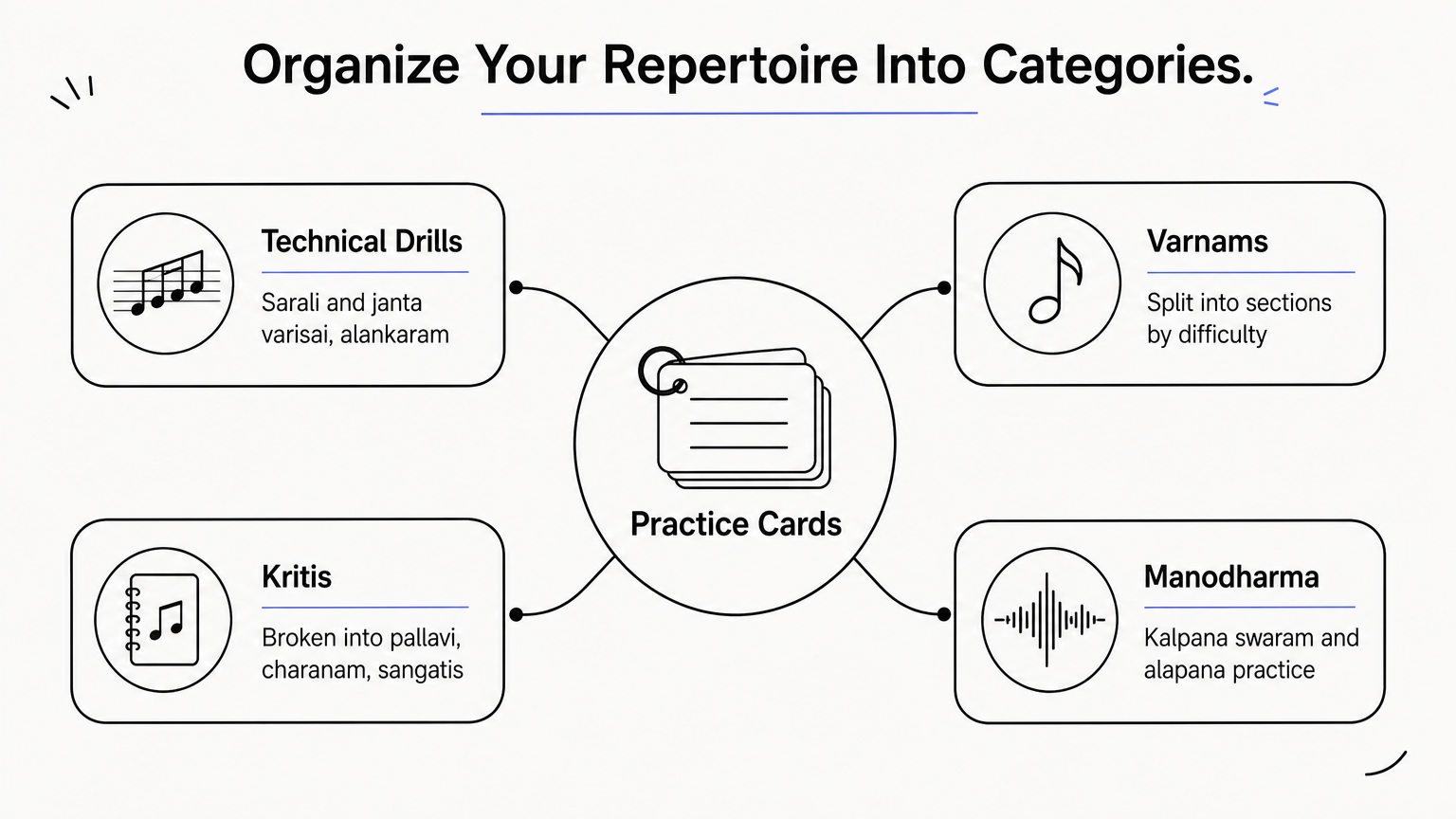
Treat each area of your training as its own project: technical drills, varnams, kritis, and manodharma work. Inside each project, break pieces down further into individual practice cards, so a kriti isn't one blob to "work on" but a set of specific sangatis, phrases, or sections you can rate and revisit separately, the same chunking approach behind memorizing a piece faster. This is exactly the structure MemoRep's project and card system is built around, letting you keep technical exercises, varnams, and kritis separated instead of tangled into one overwhelming to-do list.
A repertoire list tells you what you've learned. A set of organized practice cards tells you what to sing today.
Tag by difficulty and how recently you've sung it
Add a quick tag to each card: how hard it currently feels, and when you last practiced it, the two fields most practice log formats for musicians are built around. These two data points matter more than any subjective sense of "I should probably work on this." A carnatic music practice routine built on tags rather than memory means you're not relying on guesswork to notice a fading kriti.
- Technical drills: sarali varisai, janta varisai, alankaram, each as separate cards
- Varnams: split into sections if they're long or gamaka-heavy
- Kritis: break into pallavi, anupallavi, charanam, and individual sangatis
- Manodharma: kalpana swaram or raga alapana practice, tracked as its own category
With your material broken into cards and tagged honestly, you're ready to decide how often each one deserves a slot in your week.
Step 3. Build your daily and weekly practice schedule
With your cards tagged and sorted, the next step is deciding when each category actually gets sung. A workable carnatic vocal practice schedule doesn't treat every day the same. Foundation drills need short, near-daily reps, while kritis and manodharma can rotate on a longer cycle without losing ground.

Anchor each day around one focus, not everything at once
Give each session a primary focus instead of trying to touch every category every day. Monday might center on varnams, Tuesday on two kritis pulled from your "needs work" pile, Wednesday on manodharma. Technical drills like sarali varisai still get five minutes daily as a warm-up, but they shouldn't eat the whole session.
A schedule that tries to cover everything daily ends up covering nothing well.
A sample weekly structure
Here's a template you can adapt once you know your own card counts, following the same principles as any weekly practice routine built to last:
| Day | Warm-up (10 min) | Main focus (30-40 min) |
|---|---|---|
| Mon | Varisai, alankaram | Varnam revision |
| Tue | Janta varisai | Kritis flagged "fading" |
| Wed | Alankaram | Manodharma practice |
| Thu | Varisai | New kriti or growth goal |
| Fri | Janta varisai | Varnam or sangati drilling |
| Sat | Alankaram | Full run-through of a kriti |
| Sun | Light or rest | Optional, catch up on overdue cards |
Build in slack for overdue cards
Overdue cards will happen, a busy week means something slips. Reserve fifteen minutes on Sundays specifically for whatever's flagged "fading fast" from your assessment in Step 1, rather than letting it push further into next week. This buffer is what keeps a rigid-looking schedule from collapsing the first time life gets in the way, and it's the same logic MemoRep's scheduling system applies automatically once your cards are set up, surfacing overdue material before it's forgotten entirely rather than leaving you to remember on your own.
Step 4. Track progress and adjust with spaced repetition
Watching a schedule work only matters if you're honestly rating how each session actually went. A fixed weekly template gets you moving, but it can't tell the difference between a varnam you nailed on the first try and one where the gamakas fell apart halfway through. That's the gap spaced repetition and its review intervals is built to close: instead of guessing when to revisit something, you log how it went and let the interval adjust itself.
Rate every session, not just the pieces you struggled with
Give every card a quick rating after you sing it: Again if it fell apart, Hard if it was shaky, Good if it held up, Easy if it felt automatic. This takes ten seconds per card but changes everything about your next few weeks, because a carnatic music practice routine that skips rating just repeats the same fixed calendar regardless of what your voice is actually telling you.
- Again: the sangati or phrase needs to come back tomorrow, not next week
- Hard: shorten the interval, revisit in two or three days
- Good: the current gap is working, keep the pace
- Easy: push it further out and free up room for something that needs more attention
Your rating of today's session is what decides what you'll be singing next week, not the calendar.
Let the algorithm carry the memory work
Adjusting every interval by hand for dozens of cards is exactly the kind of overhead that makes singers abandon a routine after a month. This is where MemoRep's adaptive scheduling, built on the SM-2 approach and the other scheduling algorithms behind it, does the recalculating for you, pushing a shaky kriti back into your queue sooner and letting a solid varnam rest longer. Reviewing progress becomes a matter of opening the app and singing whatever surfaces, rather than maintaining a spreadsheet of dates and guesses.
Watch the trend, not just the day
Single sessions fluctuate, a rough voice day doesn't mean a piece is fading. Track ratings over a few weeks and look for cards that keep landing on Hard or Again despite repeated attention. Those are the pieces that need a different kind of focus, maybe isolating a specific sangati rather than running the whole kriti again.
Making your practice routine stick
A carnatic music practice routine only works if it survives contact with a busy week, a sore throat, or a month where kritis pile up faster than you can revisit them. The four steps here, assessing honestly, organizing into cards, scheduling by layer, and rating every session, give you a system that bends instead of breaking when life gets in the way. You don't need a perfect calendar. You need clarity on what your voice actually needs today, and a way to catch what's fading before it's gone.
Running all of this by hand in a notebook works until your repertoire grows past a dozen pieces. That's when spaced repetition software earns its keep, recalculating intervals so you never have to guess. If you want to stop guessing and start singing, see how memoRep schedules a singer's repertoire and claim a free beta spot while they last.