
How to Build a Drum Rudiments Practice Routine
Most drummers own a rudiment sheet, run through it once or twice, then forget half of it within a week. Building a real drum rudiments practice routine means more than picking a few paradiddles at random each day. It means knowing exactly which rudiments need attention right now and which ones can wait, so your hands don't lose ground on skills you already worked hard to build.
If you're searching for how to structure your sessions, the answer isn't a fixed list of exercises to memorize forever. It's a system that rotates rudiments based on how well you actually play them, giving weak spots more repetition and letting solid ones rest longer. That's the core idea behind spaced repetition and the science of review timing, and it applies directly to sticking patterns the same way it applies to any skill you need to retain.
This guide walks through how to organize your rudiments into a rotation, how to judge your own performance honestly, and how to schedule sessions so nothing slips through the cracks. You'll leave with a practical, repeatable framework for daily practice, not another chart to stick on your wall and ignore.
Why rudiments need a structured routine, not random practice
Rudiments decay at different speeds depending on how complex they are and how recently you drilled them. A single paradiddle might stick for weeks, while a double drag tap or a flam paradiddle-diddle can slip away in days if you skip it once. What the Ebbinghaus forgetting curve shows is that memory and motor skill fade fastest right after you stop reinforcing them, then level off. Treating every rudiment the same, running the whole sheet in one pass regardless of difficulty, ignores that curve completely and wastes practice time on things you already own.
A rudiment you haven't touched in two weeks needs more attention than one you nailed yesterday, not the same amount.
Guessing wastes your practice time
Without a system, you default to whatever feels comfortable or whatever you remember to grab that day. That usually means the same five rudiments get reps while the ones you actually struggle with, the ones causing sloppy transitions in your fills, get skipped again. This is exactly the decision fatigue problem: standing at the kit trying to recall which rudiments need work eats into the minutes you should be spending on sticks and drums, not your memory.
Structure turns practice into a feedback loop
A proper drum rudiments practice routine flips this around. Instead of picking exercises by feel, you rate how each one went right after you play it, and that rating decides when you'll see it again. Miss a rudiment and it comes back tomorrow. Nail it clean and it can wait a week or more. This is the same logic behind the scheduling algorithms used in language-learning apps, applied instead to sticking patterns and motor memory. Over weeks, this turns scattered drilling into a self-correcting loop where your weak rudiments get chased down automatically, and your strong ones stop hogging session time they don't need.
Step 1. Pick which rudiments to work on
Start by choosing a working set instead of trying to drill all 40 at once. The Percussive Arts Society's PAS 40 International Drum Rudiments list is the standard reference most teachers use, but pulling every entry into daily rotation on day one guarantees burnout and shallow reps. Pick a smaller batch tied to where you actually are.
A working set of 8 to 12 rudiments beats a full sheet you never finish properly.
Group your selections by family so you can see gaps clearly:
- Rolls: single stroke, double stroke, five stroke, nine stroke
- Diddles: single paradiddle, double paradiddle, paradiddle-diddle
- Flams: flam, flam tap, flam accent, flamacue
- Drags: single drag tap, double drag tap, lesson 25
If you're a beginner, weight your set toward rolls and single paradiddles since these underpin almost everything else. Intermediate players should add flam combinations and drags, since those are the ones that quietly get skipped and cause sloppy fills later. Keep your first batch small enough that you can honestly rate every rudiment each session rather than rushing through a list just to check it off.
Step 2. Decide how often and how long to practice each one
Once you've picked your working set, resist the urge to spend equal time on every rudiment. New rudiments need daily contact for the first week or two, short bursts of two to three minutes at a slow, controlled tempo, focused entirely on clean execution rather than speed. Rudiments you already play well can shift to every third or fourth day, since your muscle memory holds longer once the pattern is grooved in.
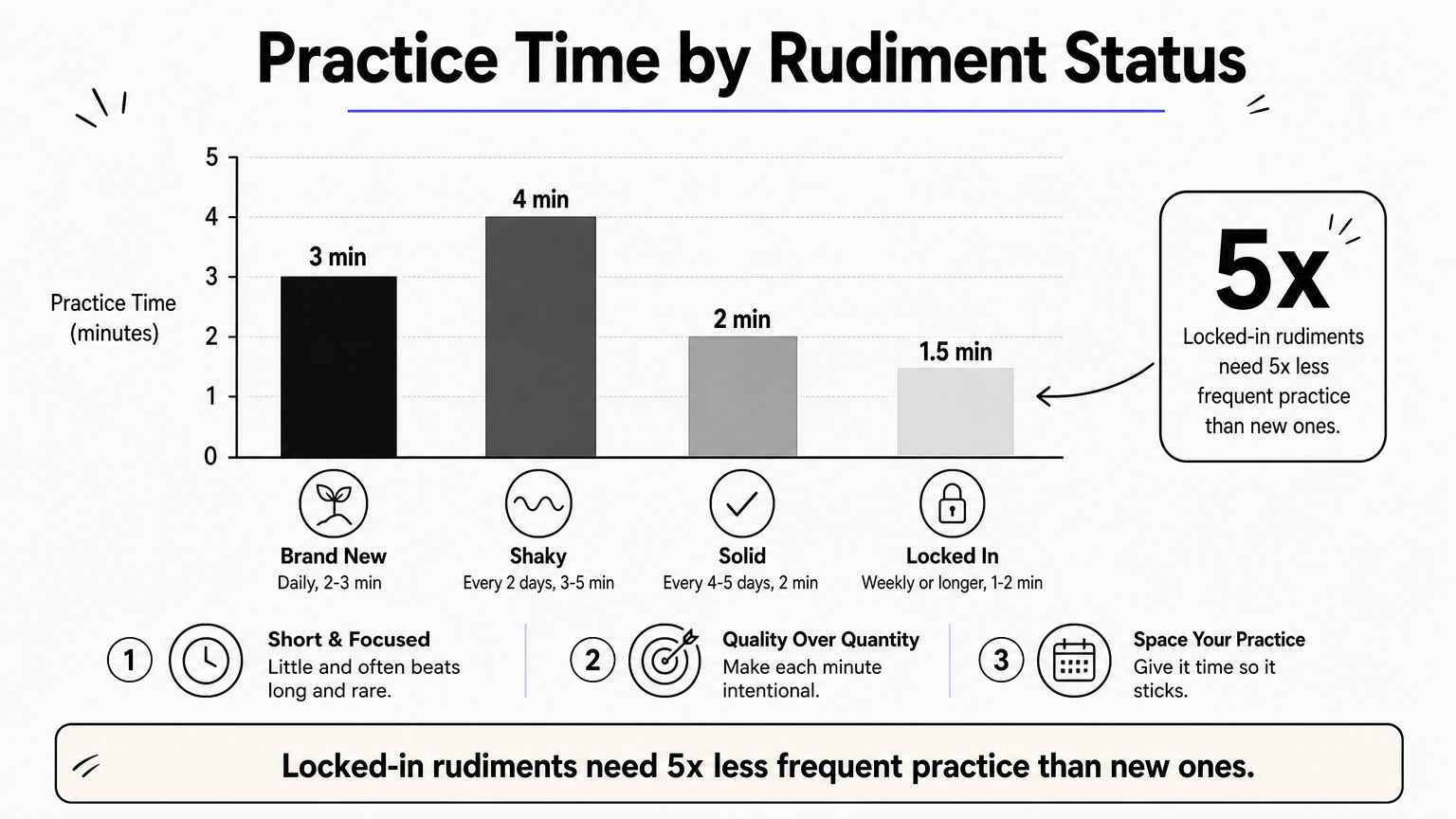
Time spent on a rudiment should match how shaky it is, not how much you enjoy playing it.
Here's a rough starting split by rudiment status:
| Rudiment status | Frequency | Time per session |
|---|---|---|
| Brand new | Daily | 2-3 minutes |
| Shaky, inconsistent | Every 2 days | 3-5 minutes |
| Solid, occasional slip | Every 4-5 days | 2 minutes |
| Fully locked in | Weekly or longer | 1-2 minutes |
Adjusting these intervals manually gets tedious fast once your working set grows past eight or nine rudiments, which is exactly the kind of scheduling work a spaced repetition app made for musicians like MemoRep automates for you. Rather than eyeballing how many days have passed since you last drilled a flam accent, the platform tracks it and surfaces the rudiment right when it needs attention. Building a project inside MemoRep for your rudiment set turns this whole step into something the app handles instead of your memory.
Step 3. Build a rotation so nothing goes rusty
A rotation only works if it keeps moving through your whole working set instead of settling into the same three rudiments every session. Cycling by family rather than by a fixed list keeps your hands honest, since you're forced to touch rolls, diddles, flams, and drags in every pass instead of drifting toward whatever feels fun that day.
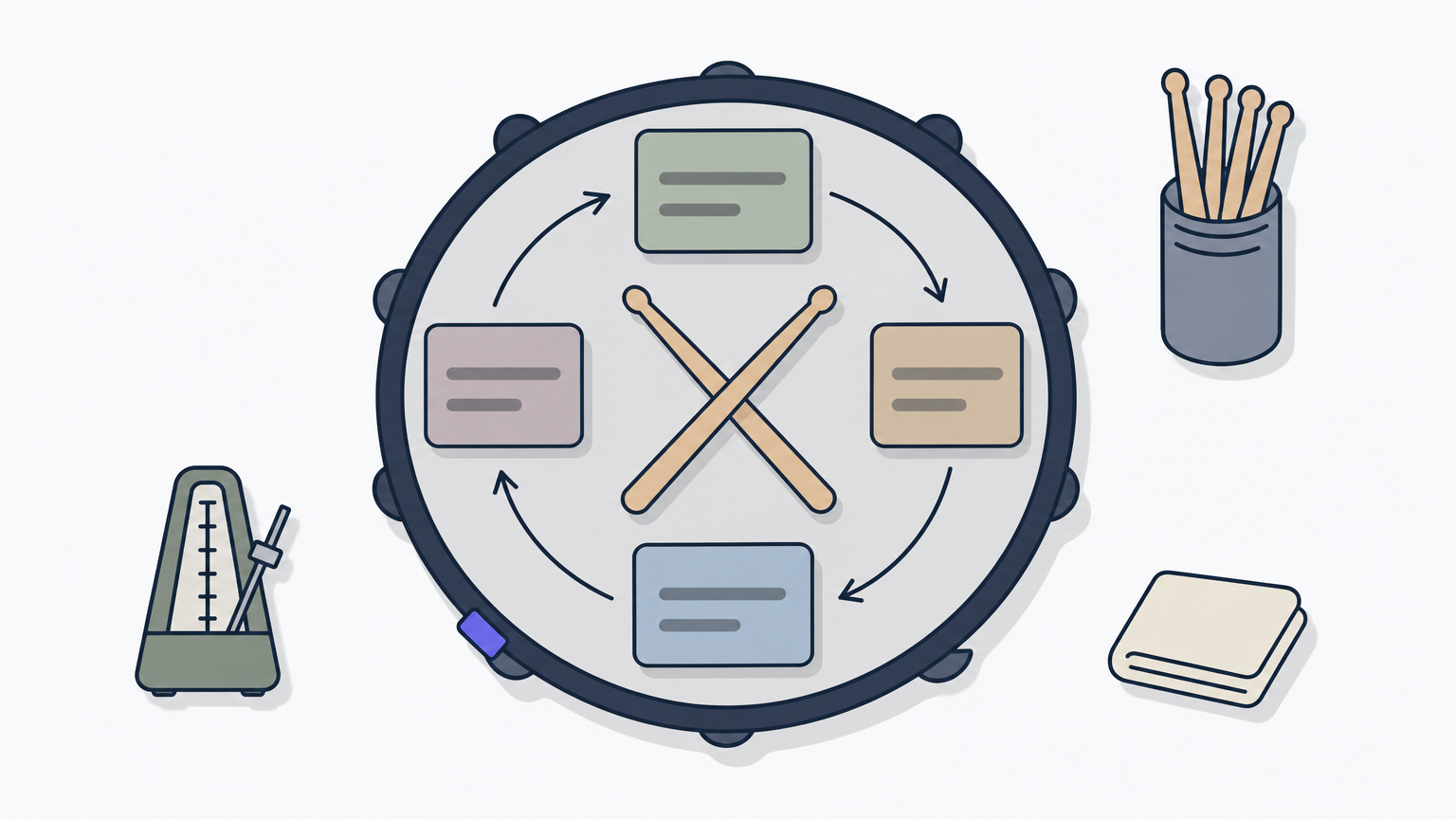
Cycle through families, not a fixed order
Set up your rotation so each session pulls from a different corner of your working set:
- Day 1: rolls + one flam variation
- Day 2: diddles + one drag
- Day 3: flams + one roll
- Day 4: drags + one diddle
Repeat the cycle, but let the feedback loop from Step 2 override the fixed order whenever a rudiment is overdue.
Let ratings drive the next rudiment
Rather than sticking rigidly to the four-day cycle above, treat it as a default that gets bumped by whatever needs attention most. A rudiment you rated "Again" yesterday jumps the line regardless of which family's turn it is.
The rotation exists to guarantee coverage, but your ratings decide what actually gets priority.
This is where a drum rudiments practice schedule built on spaced repetition beats a paper chart. MemoRep handles this reshuffling automatically, so nothing quietly falls out of rotation for weeks.
Step 4. Track your progress and adjust the schedule
Grading yourself right after each rudiment is what makes the whole drum rudiments practice routine actually adapt over time. Use a simple Again/Hard/Good/Easy scale instead of a vague "that felt okay", the same kind of fast, honest feedback deliberate practice runs on: Again means it falls apart under tempo, Hard means it's playable but shaky, Good means clean but not automatic, Easy means you could play it half asleep. That single rating is what pushes the next session's interval up or down.
A honest "Hard" today saves you from a sloppy fill three weeks from now.
Watch the trend, not one bad rep
One rough session doesn't mean a rudiment needs daily drilling forever. Look at how your ratings move across two or three weeks before deciding a rudiment has actually regressed. A progress view that shows this history matters more than memory, and log templates for tracking practice progress make it visible, since it's easy to forget you rated a paradiddle-diddle "Hard" three times in a row before it finally clicked.
Let the schedule adjust itself
Manually recalculating intervals for a dozen rudiments gets old fast. Inside MemoRep, every rating automatically reshapes when that rudiment resurfaces, so your practice schedule stays accurate without spreadsheets or guesswork on your end.
Making the routine stick
A drum rudiments practice routine only works if you keep rating honestly and let the schedule respond, session after session. The moment you skip grading or go back to running the whole sheet by feel, you're back to the same guesswork this whole framework was built to avoid. Picking a working set, matching frequency to how shaky each rudiment is, rotating through families, and tracking your ratings over weeks isn't extra overhead once it's automated. It's what separates drummers who plateau on the same five rudiments from ones whose weak spots actually close.
You don't need to manage any of this by hand. See how MemoRep picks the next thing your hands drill and build your first rudiment rotation today. The beta is free for the first 200 users, so sign up now and let the app decide what your hands practice next.