Deliberate Practice Theory: Definition, Principles, and Examples
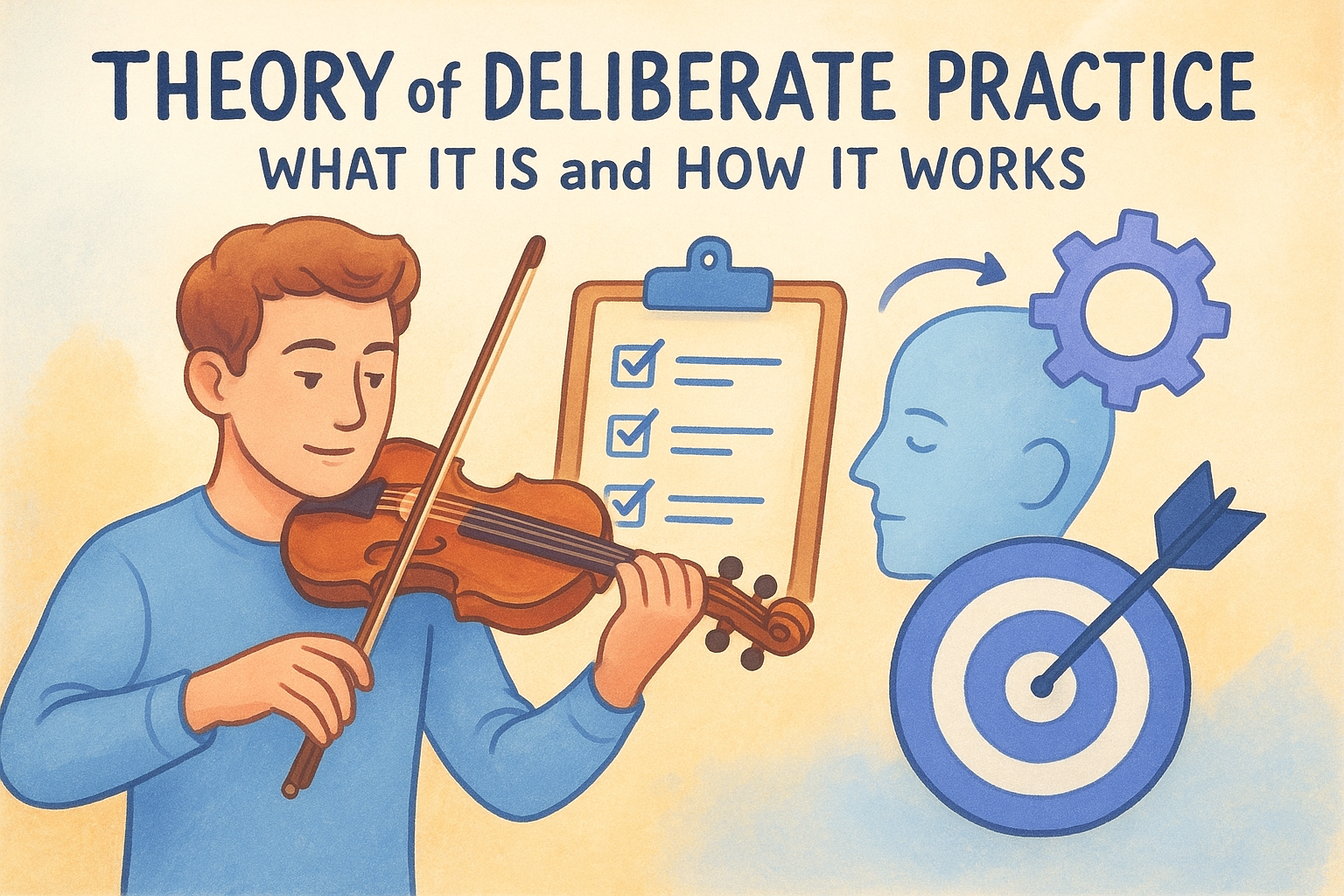
Deliberate practice theory explains expert performance as the result of structured work on specific weaknesses, not simply talent or time spent. The method uses clear goals, full concentration, immediate feedback, and repeated correction at the edge of your current ability. Psychologist Anders Ericsson developed the framework through research on expert performers, including musicians, chess players, and athletes.
The theory does not say that any 10,000 hours will make someone an expert. It says the quality and design of practice matter: playing a song from beginning to end is rehearsal, while isolating the four measures that break down, checking the result, and adjusting the next attempt is deliberate practice.
This guide defines the theory, explains its main principles and evidence, and shows what it looks like in music and other practical skills. For a shorter beginner definition, read what deliberate practice is; this article focuses on the theory and why it can explain continued improvement.
What is deliberate practice theory?
The study that started it all
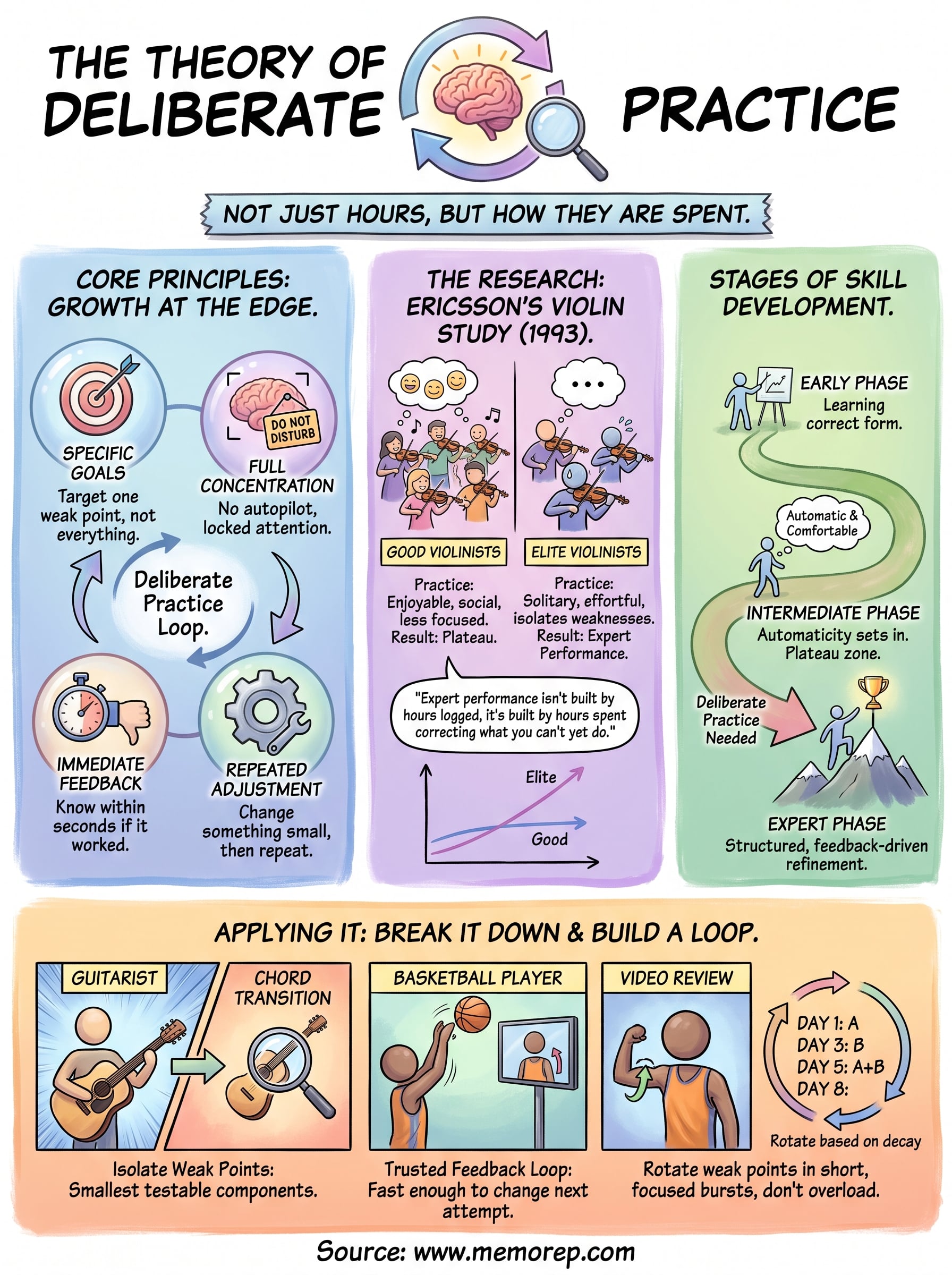
Ericsson's most cited work came out of the Berlin Academy of Music in 1993, where he and his colleagues split violin students into three groups: the best, the good, and those headed for music teaching rather than performance. He asked them to estimate how they spent their time, then tracked actual practice logs. The elite violinists didn't practice more hours overall than the good ones. They spent more hours in solitary, effortful practice aimed at specific weaknesses, and they rated that kind of practice as the least enjoyable but most useful part of their week. That finding is the seed of the whole theory: total time matters far less than what you do with it.
Expert performance isn't built by hours logged, it's built by hours spent correcting what you can't yet do.
Four traits that define deliberate practice
Ericsson's later papers, published through the American Psychological Association and summarized in outlets like the Harvard Business Review, distilled the concept into a short list of traits that separate deliberate practice from ordinary rehearsal:
- Specific goals: you're targeting one weak point (a chord transition, a footwork pattern), not just "getting better at guitar"
- Full concentration: no autopilot, no background TV, attention stays locked on the task
- Immediate feedback: you know within seconds whether the attempt worked, from a teacher, a recording, or a measurable result
- Repeated adjustment: you change something small after each attempt based on that feedback, rather than repeating the same motion unchanged
Miss any one of these and you're doing practice, but not the deliberate kind.
Why untrained repetition stalls out
Repetition without feedback teaches your body to repeat whatever you're already doing, mistakes included, which is why it sits alongside the other popular study techniques that quietly fail. This is why someone can play piano for twenty years and never improve past an intermediate level. They're reinforcing existing patterns instead of correcting them. Skills plateau because the brain has no signal telling it something needs to change; comfortable practice feels productive precisely because it's not challenging anything.
The stages of skill development
In line with the broader science of skill acquisition, Ericsson mapped skill growth in stages: the early phase where you're just learning correct form, an intermediate phase where automaticity starts to set in and improvement slows unless you deliberately fight it, and the expert phase reached only through years of structured, feedback-driven refinement. Most hobbyists get stuck in the intermediate stage because that's where practice starts to feel automatic and comfortable, which is exactly the point where deliberate methods matter most.
How to apply deliberate practice to any skill
Break the skill into isolatable pieces
Start by breaking your skill down into the smallest testable components instead of practicing the whole thing at once. A guitarist isolates a single chord change, a public speaker isolates one transition phrase, a coder isolates one algorithm pattern. Isolating weak points is what makes practice deliberate instead of just repetition, because you can't fix what you haven't separated out from everything you already do well.
If you can't name the exact weak point you're working on, you're rehearsing, not practicing deliberately.
Build a feedback loop you can trust
Feedback has to arrive fast enough to change your next attempt, not your next session. That might mean recording yourself, working with a teacher, or using spaced repetition software that logs your performance rating after each attempt. Without that loop, you're guessing whether you improved, and guessing is how plateaus happen.
Rotate weak points instead of overloading one
Don't drill a single weakness until you're exhausted. Deliberate practice works best in short, focused bursts across multiple weak points, revisited on a schedule rather than crammed into one long session. A simple rotation looks like this:
- Day 1: isolate weak point A, rate the attempt, note the fix
- Day 3: revisit A briefly, then isolate weak point B
- Day 5: revisit both A and B, add weak point C
- Day 8: rotate based on which points are decaying fastest
That rotation is exactly the problem spaced repetition scheduling solves, since it tells you which weak point is about to fade before you forget the fix entirely. Instead of guessing at the interval, a system built on the same spacing principles Ericsson's research points to can track your practice cards and resurface them right when the skill needs reinforcing, not a week too late or a week too early.
What deliberate practice looks like in real skills
Musicians isolating a single passage
A violinist working on the Berlin study's repertoire doesn't play a concerto start to finish for an hour. She isolates the four bars where her bow arm hesitates, plays them at half speed, records the take, and listens back before adjusting her wrist angle on the next pass. That loop, tiny attempt, immediate feedback, small correction, repeats dozens of times in a single session, and it's the backbone of practicing an instrument effectively. Concrete weak points like a shaky shift or a rushed sixteenth note give her something specific to fix, instead of a vague sense that the piece "needs work."
Athletes drilling one movement at a time
A basketball player refining a free throw doesn't scrimmage to fix her form. She shoots from the same spot, checks her elbow position against video, and adjusts her release angle by a few degrees before the next shot. Golfers do the same thing at the driving range, coders do it by rewriting one broken function until the tests pass, and public speakers do it by rehearsing a single transition line until it stops sounding memorized. In every case, isolated repetition with fast feedback replaces the instinct to just run the whole performance again.
The skill doesn't improve during the performance, it improves during the correction that happens right after.
Comparing weak-point practice across skills
| Skill | Isolated weak point | Feedback source | Correction made |
|---|---|---|---|
| Violin | Bow transition in bar 12 | Recording playback | Adjust wrist angle |
| Basketball | Free throw release | Video review | Change elbow position |
| Coding | Failing unit test | Test runner output | Rewrite function logic |
| Public speaking | Awkward transition line | Coach or peer notes | Rephrase and re-time delivery |
Every row follows the same pattern Ericsson documented decades ago: name the exact flaw, get evidence about it fast, and change something small before repeating.
Making deliberate practice part of your routine
Ericsson's research boils down to one idea: growth comes from targeted correction, not repetition for its own sake. The theory of deliberate practice works because it forces you to name your weak points, get fast feedback, and adjust before you drift back into autopilot. Skip any of those pieces and you're just logging hours, not building skill.
Knowing the theory is one thing. Sticking with it is another, especially when you are juggling multiple weak points and trying to remember which one needs revisiting today. A music practice app or habit tracker can help record the routine, while MemoRep adds adaptive scheduling based on how each skill performed. See how MemoRep turns practice ratings into a review schedule, then apply the theory to the weak point due today.