
Ericsson 1993: What the Deliberate Practice Study Found
You've probably heard the claim that it takes 10,000 hours to master a skill, and that idea traces back to one paper: deliberate practice ericsson 1993. The actual study is more precise and more useful than the popularized version, and it says almost nothing about a magic hour count. It's about how experts structure their practice, not just how long they grind.
Anders Ericsson, along with Ralf Krampe and Clemens Tesch-Romer, studied violinists and pianists to figure out what separated top performers from good ones. Their answer: what deliberate practice actually is, a specific kind of effortful, feedback-driven repetition aimed at weaknesses, not just repetition for its own sake. This article walks through what the 1993 paper actually measured, what it found, and where to read the original source if you want to check the data yourself.
We cover this at MemoRep because our whole platform is built around the same principle Ericsson identified: practice needs structure and feedback, not just hours logged. If you're a musician or skill learner, understanding this research explains why scheduled, targeted practice beats random repetition every time.
Why the Ericsson 1993 study still matters
The paper that launched a research field
Few academic papers escape their discipline and become part of everyday conversation, but "The Role of Deliberate Practice in the Acquisition of Expert Performance," published in Psychological Review in 1993, did exactly that. Anders Ericsson, Ralf Krampe, and Clemens Tesch-Romer set out to answer a stubborn question: why do some musicians reach elite performance while others with similar starting talent plateau? The theory of deliberate practice that Ericsson 1993 proposed was radical for its time. It said expertise wasn't mostly about innate gift. It was about a specific, structured kind of practice that most people never actually do, even when they think they're practicing hard.
Why the popular version got it wrong
Malcolm Gladwell's book Outliers picked up the study's numbers and turned them into the "10,000-hour rule," and that phrase is now more famous than the research itself. The problem is that Gladwell's summary flattened the paper's central argument. Ericsson didn't claim that any 10,000 hours of practice produces mastery. He argued that only a specific kind of practice, deliberate practice, moves someone from competent to expert, and that raw hour counts without that structure barely move the needle at all. Ericsson himself pushed back publicly on the misreading, pointing out that the number was an average from one small sample of violinists, not a universal threshold. If you've spent years playing scales the same way without any change in difficulty or feedback, you already know the flaw in the popular version. Volume alone doesn't build skill.
Deliberate practice isn't about logging hours, it's about targeting weaknesses with feedback until they stop being weaknesses.
The four conditions that separate real practice from repetition
What made the original paper rigorous is that it didn't just describe deliberate practice in vague terms. It defined it with conditions that are testable and specific:
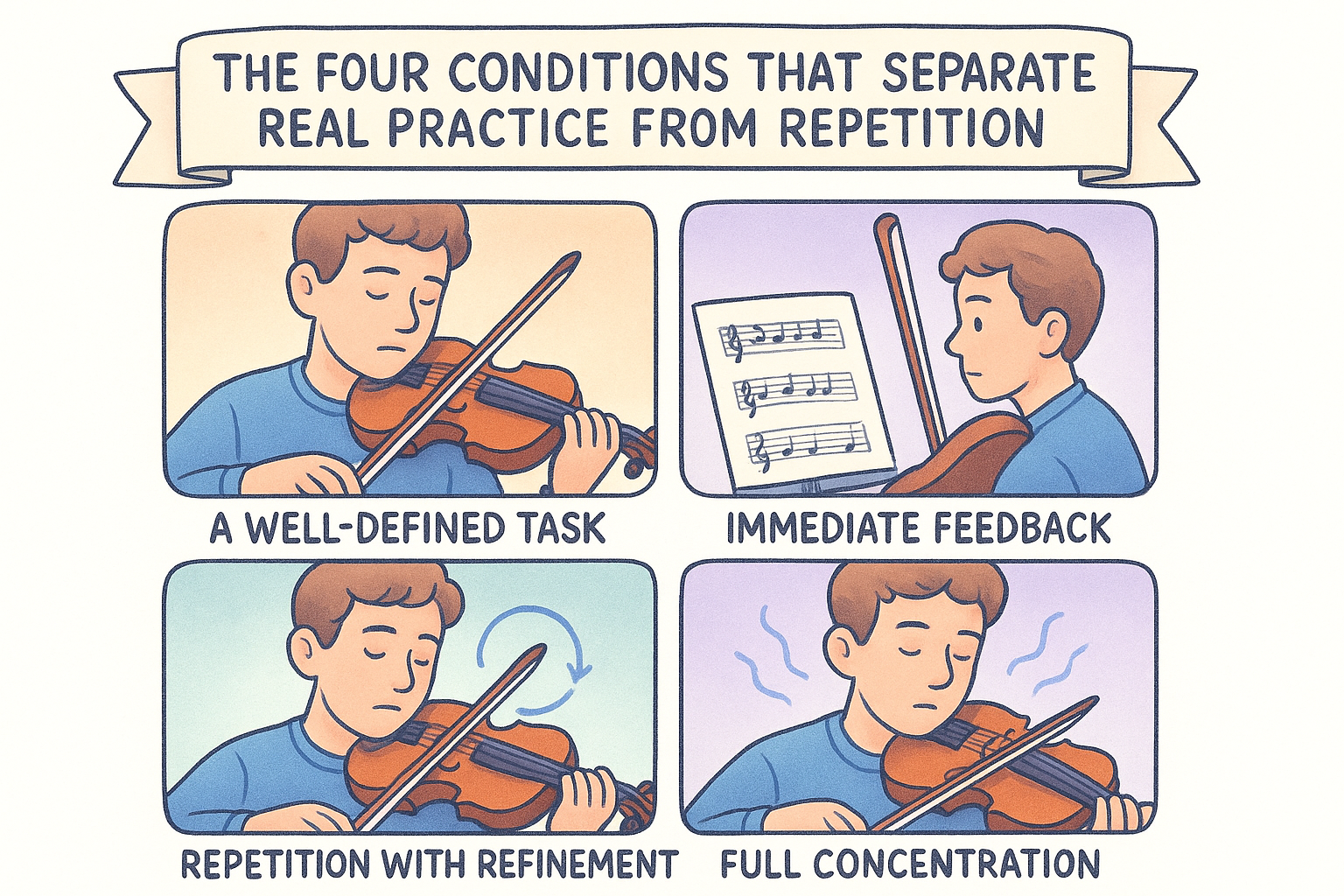
- A well-defined task, not open-ended noodling, aimed at a specific weakness
- Immediate feedback on performance, so errors get corrected right away instead of reinforced
- Repetition with refinement, where the same problem gets attacked repeatedly until it improves
- Full concentration, since practice done on autopilot doesn't count, no matter how long it lasts
Any practice session missing one of these four elements falls short of what Ericsson's data actually measured. That's a useful checklist to hold your own routine against, whether you're a violinist, a rock climber, or a chess player.
Why researchers, coaches, and platforms still cite it
More than three decades later, this paper remains one of the most cited in performance psychology, and it shows up in fields Ericsson never studied directly, from surgery training to software engineering to competitive gaming. Coaches use its framework to design training blocks that target specific technical gaps instead of running generic drills. Sports scientists reference it when building periodized training plans that isolate weaknesses under controlled conditions. Even outside academia, the paper's core insight, that structured, feedback-driven repetition beats unstructured repetition, has become close to common sense in serious training circles, even among people who've never read the original text.
The gap between knowing the theory and doing it
Since this idea is now widely accepted, you'd expect most learners to already practice this way. They don't. Most self-directed practice, especially among adult hobbyists and even semi-serious students, still looks like unstructured repetition: playing through a piece top to bottom, running the same drill without varying difficulty, or practicing whatever feels comfortable that day rather than what actually needs work. Structuring practice around Ericsson's four conditions takes deliberate planning most people don't do on their own, which is exactly the gap platforms built around spaced repetition schedules and skill tracking, including MemoRep, try to close by handling the scheduling and feedback loop automatically. Understanding the theory is step one. Building a system that actually applies it every day is the harder, more valuable step, and it's why this 1993 paper is worth reading directly rather than trusting the shorthand version everyone repeats.
Inside the study: methods and the 10-year rule
Who Ericsson actually studied
The 1993 study didn't rely on surveys or self-reported estimates alone. Ericsson, Krampe, and Tesch-Romer recruited violin students from a top West Berlin music academy and divided them into three groups based on faculty assessments of future potential: the best violinists (headed for international solo careers), the good violinists (headed for orchestra positions), and a comparison group of music teachers. A second study looked at professional pianists against amateur players. Grouping by realistic career trajectory, rather than by age or current skill alone, let the researchers isolate what actually separated the groups instead of just measuring who had played longest.
Diaries, not guesses
Participants kept detailed weekly diaries logging every activity across a full week, broken into half-hour blocks. This wasn't a one-time survey asking "how much do you practice?" It was repeated logging that let researchers separate solitary practice from group lessons, performances, and leisure playing. That distinction turned out to matter enormously. The best violinists didn't just play more hours overall. They spent more of their total time specifically on solitary, effortful practice aimed at improving weak spots, and they rated it as the most effortful and least inherently enjoyable activity in their week, even though they still considered it essential.
The numbers behind the 10-year rule
Here's where the famous number actually comes from. By age 20, the best violinists had accumulated roughly 10,000 hours of solitary deliberate practice, the good violinists around 7,500, and the teachers-in-training around 5,000. That gap is the source of the popularized figure, but the paper's real point was the accumulation rate over time, not the round number itself. Across nearly every domain researchers have since studied, elite performers typically need about a decade of sustained, serious engagement before reaching top-tier performance, a pattern researchers now call the 10-year rule. Chess grandmasters, elite mathematicians, and concert-level musicians all show a similar decade-long runway.
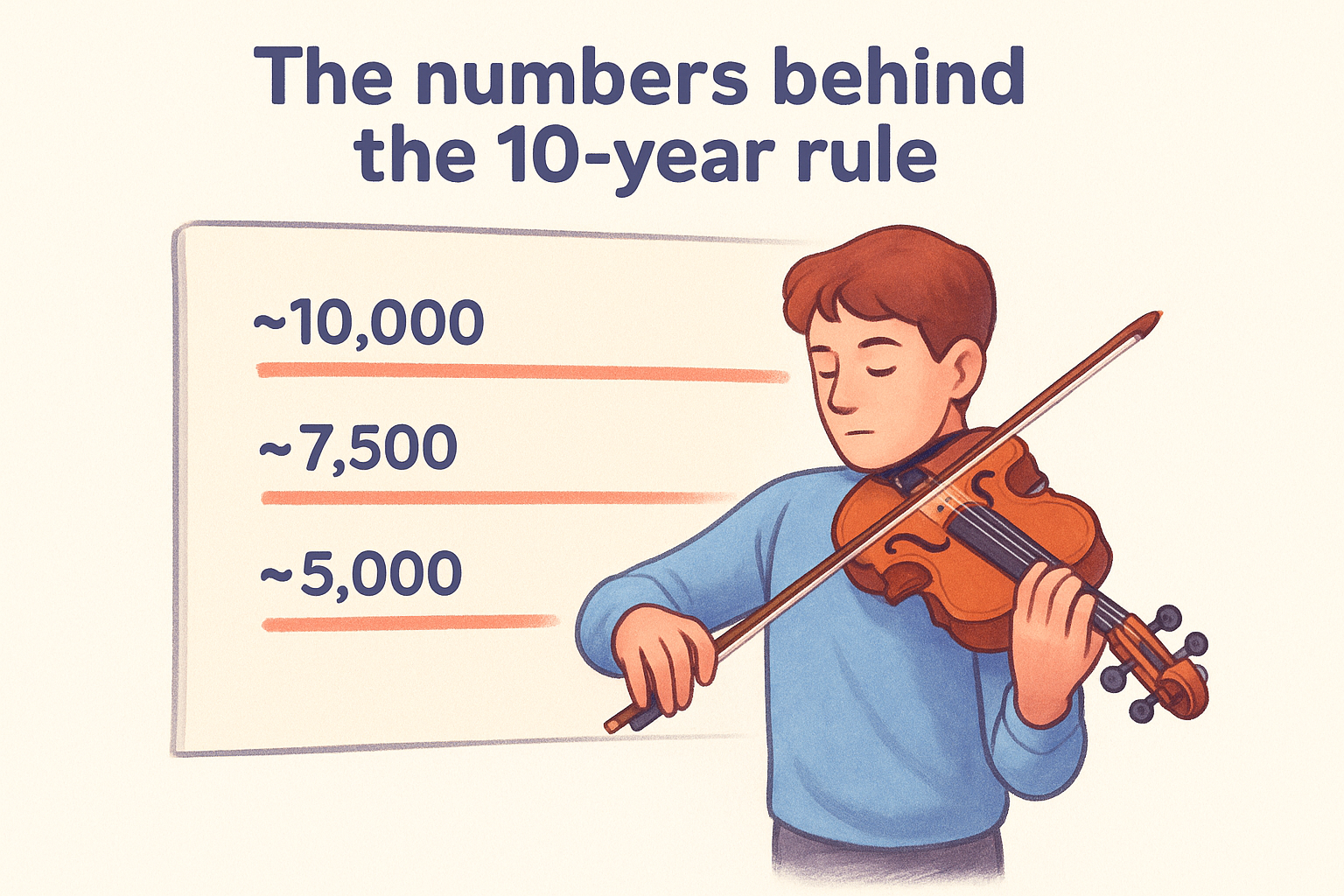
The 10,000-hour figure was an average outcome of a decade of structured practice, not a formula anyone can shortcut.
What the correlation actually shows
Quantity mattered, but Ericsson's data showed something more specific than "practice more." Practice hours correlated closely with skill level only when that time met the four deliberate practice conditions covered earlier. Comparison-group teachers had logged meaningful hours too, but far less of it was structured, solitary, and feedback-driven. Their skill plateaued at a lower level despite years of playing.
| Group | Est. solitary practice hours by age 20 | Career outcome |
|---|---|---|
| Best violinists | ~10,000 | International soloist track |
| Good violinists | ~7,500 | Orchestra positions |
| Music teachers | ~5,000 | Teaching, non-performance track |
Why the timeline matters more than the total
Sustained practice over roughly ten years also gave researchers a window into consistency, not just cumulative volume. Skills degrade without steady reinforcement, the way memory decays without review, and the diary data showed the best performers rarely took long breaks from deliberate practice. Weeks off didn't just delay progress, they required re-earning ground already covered. That pattern, structured effort sustained over years rather than crammed into a short burst, is the practical takeaway buried under the headline number, and it's the part most retellings of the study skip entirely.
How to apply deliberate practice to your own skill
Reading about the deliberate practice ericsson 1993 framework is easy. Applying it to your own guitar practice, golf swing, or coding routine is where most people stall out. The four conditions from the paper (a defined task, feedback, repetition, concentration) sound simple until you try to build a session around them without a coach standing next to you. Here's how to translate the research into a deliberate practice session you can run this week.
Start with a weakness, not a warm-up
Most practice sessions default to whatever feels good: playing through a favorite piece, running a familiar drill, hitting balls at the range without a target. Deliberate practice flips that. You pick the specific thing that's currently holding you back, whether that's a shift you always fumble, a chord change you rush, or a passage where your rhythm falls apart, and you spend the session on that alone. This feels less satisfying than playing something you're already good at, and that discomfort is actually a signal you're doing it right.
If a practice session feels effortless and enjoyable the whole way through, you're probably not doing deliberate practice.
Build feedback into every session
Without feedback, repetition just grooves in whatever you're already doing, mistakes included. Feedback doesn't require a teacher in the room every time. Recording yourself and listening back, using a metronome to catch timing drift, or tracking a measurable outcome (notes missed, reps completed cleanly, time under a threshold) are all science-backed tips for practicing effectively. The point is closing the loop between what you did and what actually happened, fast enough that you can adjust before the error becomes habit.
Schedule it, don't wing it
Ernesto's data showed the best violinists treated solitary practice as scheduled, non-negotiable time, not something squeezed in when motivation struck. You need the same structure:
- Block a fixed time for focused practice, separate from casual playing or performance rehearsal
- Limit session length to 45 to 90 minutes; concentration this intense doesn't hold much longer
- Rotate weak spots across the week instead of hammering one issue every single day
- Log what you worked on and how it went, even in a rough note, so you're not relying on memory
That last point matters more than it looks. Ericsson's violinists kept diaries precisely because memory alone doesn't track deliberate practice reliably. You forget what needs revisiting, and you drift back toward whatever's comfortable.
Let a system handle the scheduling decision
The hardest part of deliberate practice isn't the theory, it's the daily decision-making: what do I work on today, and when do I come back to the thing I fixed last week? This is exactly the gap MemoRep is built to close. Instead of guessing which skill is about to get rusty, you log practice cards for specific weak spots, rate how each attempt went, and the scheduling algorithm tells you what to revisit and when, based on the same forgetting-curve logic that underlies deliberate practice research. You still do the effortful, focused work Ericsson described. The platform just removes the guesswork about timing, so structured practice becomes a habit instead of a project you have to manage yourself.
What later research says about the theory's limits
Erisson's original claims sparked three decades of follow-up research, and not all of it agreed with the strong version of the theory. A 2014 meta-analysis led by Brooke Macnamara, published in Psychological Science, pooled data from 88 studies across music, sports, education, and games, and found that deliberate practice explained only about 12% of the variance in performance overall, with the number dropping even lower in some domains. That's a real effect, but it's far from the near-total explanation the popularized version of the theory implies. If you've assumed hard work alone guarantees expert-level results, this research is the reality check.
The genetics and talent pushback
David Hambrick, one of the researchers behind that meta-analysis, has argued publicly that Ericsson's framework underplays genetic variation in working memory, motor learning speed, and other traits that affect how much a given hour of practice actually produces. Two people can log identical deliberate practice hours under identical conditions and land at different skill ceilings. Ericsson pushed back hard against this reading, maintaining that even apparent "talent" differences often trace back to earlier, undocumented practice, but the debate never fully resolved. Most researchers now land somewhere in between: practice structure matters enormously, but it doesn't erase individual variation in how fast someone improves.
Deliberate practice explains a meaningful share of expert performance, but it was never the whole story, and later research proved that plainly.
Domains where the theory holds up less cleanly
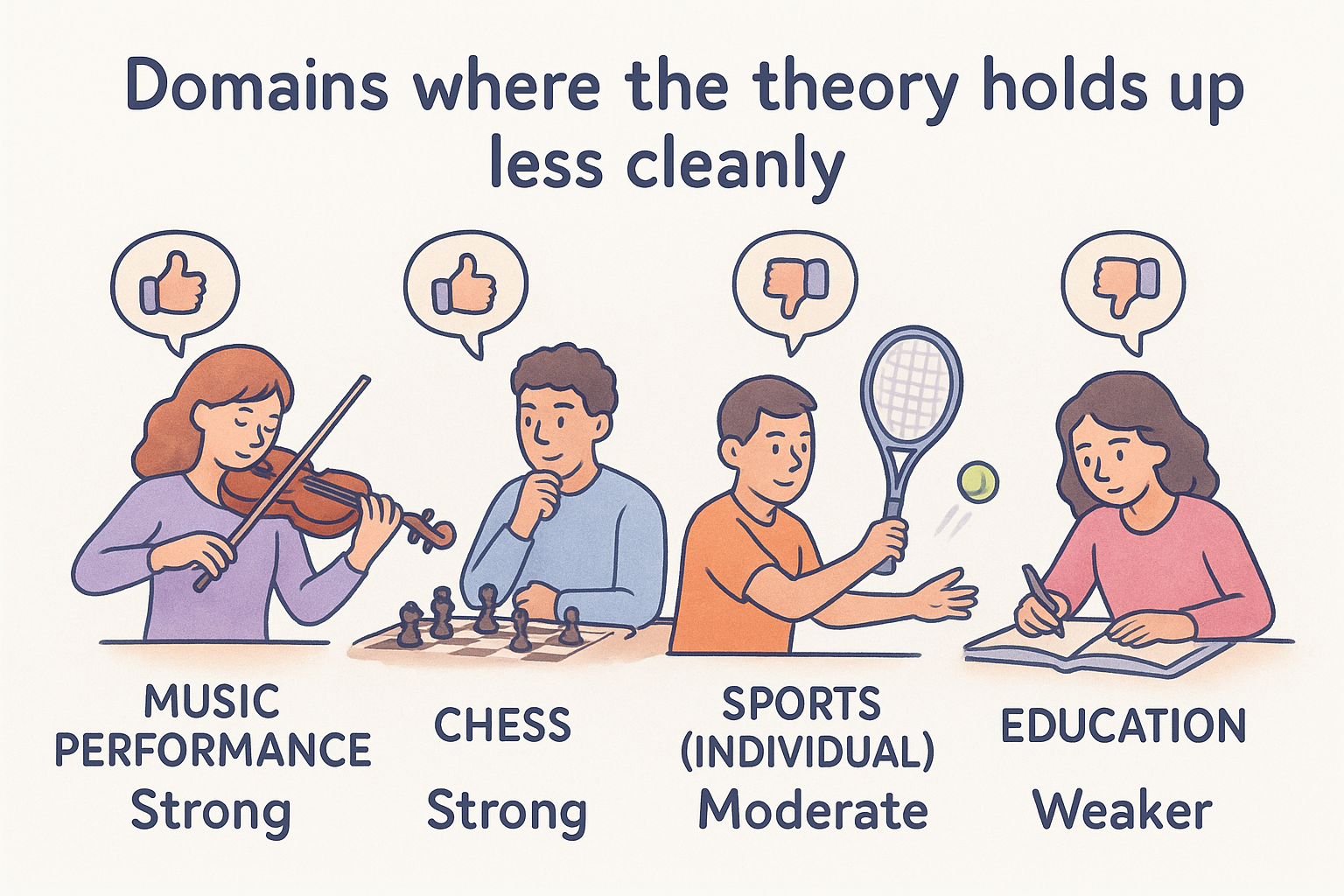
The original study focused on music, a domain with clear, stable rules and unambiguous feedback (a wrong note is a wrong note). Later research found the deliberate practice effect shrinks in domains with less predictable rules or feedback that's slower to arrive.
| Domain type | Deliberate practice effect | Why |
|---|---|---|
| Music performance | Strong | Clear rules, fast feedback, stable task |
| Chess | Strong | Well-defined problems, extensive game data for review |
| Sports (individual) | Moderate | Feedback available but physical variation plays a bigger role |
| Education/academic skills | Weaker | Feedback loops slower, tasks less standardized |
| Business/management | Weakest | Unstable conditions, no consistent "correct" answer to drill |
This pattern suggests deliberate practice theory works best in domains structured enough to define a clear task and deliver immediate correction, exactly the conditions Ericsson's four criteria describe. In messier fields, the theory still applies loosely, but it explains less of the outcome.
Why this doesn't undercut the practical advice
None of this later research argues that deliberate practice is useless or that structured, feedback-driven repetition doesn't beat random repetition. It argues the effect size is smaller than the popular narrative claims, and that other factors (starting age, cognitive traits, quality of instruction, even luck in opportunity) share the credit. For a musician or skill learner deciding how to spend tonight's practice hour, the practical takeaway from the science of skill acquisition barely changes. Structured practice targeting weaknesses with fast feedback still beats unstructured repetition, even if it's not a guaranteed path to elite status. Reasonable expectations matter here: deliberate practice improves your odds and your rate of progress, but it was never a formula that erases every other variable in human skill acquisition, and no serious researcher, Ericsson included, ever claimed otherwise in the original paper.
Deliberate practice examples for musicians and beyond
Theory only sticks when you can picture it in a real practice room, so here's what the deliberate practice ericsson 1993 framework looks like when it's actually applied, across a handful of skills that have nothing in common except structure.
Musicians: the original test case
Violinists in the original study didn't just run through repertoire top to bottom. A violinist working on intonation might isolate a single four-bar phrase, play it at half tempo with a drone note for reference, and stop the instant pitch drifts instead of powering through to the end. A guitarist fixing a sloppy chord change might loop just the transition, not the whole song, until the switch happens cleanly at tempo, which is the backbone of a guitar practice system that works. Neither of these feels like "playing music." That's the point. Isolating the weak four bars produces more improvement than another full runthrough ever will.
The best musicians in Ericsson's data spent their hardest hours on the parts of a piece they were worst at, not the parts they already played well.
Sports and physical skills
Golfers show this pattern clearly. A player who slices every drive doesn't fix it by hitting bucket after bucket of balls at the range. Deliberate practice means isolating the swing flaw, maybe an open clubface at impact, filming each swing, and adjusting one variable at a time based on where the ball actually lands. Basketball free-throw shooters do something similar: instead of shooting 100 shots in a row, they track makes in sets of ten, note the miss pattern, and adjust foot placement or follow-through between sets. Tracking the miss pattern turns a repetitive drill into structured practice.

Chess and cognitive skills
Chess players who improve fastest don't just play more games. They study specific positions from their own losses, work through why a move failed, and drill similar tactical patterns until recognition becomes automatic. This is closer to Ericsson's four conditions than casual play ever gets: a defined task (this exact position), immediate feedback (the engine or a stronger player shows the better move), repetition with refinement (similar positions drilled again), and full concentration on the analysis. Chess is one of the domains, alongside music, where later research still finds a strong deliberate practice effect, precisely because the feedback is so unambiguous.
Everyday skills beyond performance domains
Public speaking, cooking, coding, and language pronunciation all follow the same shape once you look for it. A speaker working on filler words records a five-minute talk, counts every "um," and gives the next attempt one specific goal: cut the count in half. A cook refining knife skills doesn't just chop vegetables faster; they isolate one cut, watch their hand position, and slow down until the technique is clean before adding speed back. Below is a quick comparison of what separates unstructured repetition from deliberate practice across a few common skills:
| Skill | Unstructured repetition | Deliberate practice version |
|---|---|---|
| Guitar | Playing full songs daily | Looping the exact hard transition at reduced tempo |
| Golf | Hitting range balls with no goal | Filming swings, isolating one flaw, tracking ball flight |
| Chess | Playing casual games only | Reviewing lost games, drilling the specific missed tactic |
| Public speaking | Rehearsing a talk repeatedly | Recording, counting filler words, targeting one metric per pass |
Across every one of these examples, the same deliberate practice techniques repeat: name the specific weakness, get feedback fast, and repeat with adjustment. That's the whole model, whether you're holding a violin or a golf club.
Where to read the original 1993 paper
If you want to check the data yourself instead of trusting summaries (including this one), the original paper is worth pulling up directly. "The Role of Deliberate Practice in the Acquisition of Expert Performance" ran in Psychological Review, volume 100, issue 3, pages 363 to 406, in July 1993. It's a dense academic paper, not a blog post or one of the more readable books on deliberate practice, so knowing exactly what you're looking for before you open it saves you a lot of scrolling.
The official citation
Start with the exact reference so you can search for it anywhere, whether that's a university library database, Google Scholar, or a research repository. Here's the full APA-style citation:
Ericsson, K. A., Krampe, R. T., & Tesch-Romer, C. (1993).
The role of deliberate practice in the acquisition of expert performance.
Psychological Review, 100(3), 363-406.
Searching that exact title in Google Scholar will surface the paper along with hundreds of citing works, which is a fast way to see how the theory has been applied and challenged since 1993.
Where to find a free copy
The paper is published through the American Psychological Association, and the official record sits on APA PsycNet, the APA's own database, though full-text access there typically requires a subscription or institutional login. If you don't have university access, a few routes work reliably. Many public libraries offer free database access with a library card, including PsycINFO. Anders Ericsson also hosted PDF copies of his own papers on his personal academic site during his lifetime, and archived versions occasionally surface through Google Scholar's "all versions" link on the search result. Google Scholar itself is a solid starting point since it aggregates PDF links from author repositories, university archives, and citing papers, all in one search.
Search the exact 1993 title in Google Scholar first. It's the fastest route to a legitimate free copy or citing summary.
How to actually read it if you're not an academic
The paper runs over 40 pages and includes statistical tables that aren't necessary for a practical read. If you're not trying to replicate the methodology, focus on three sections: the introduction, which lays out the theory and defines deliberate practice's four conditions; the results section covering the violin study, where the practice-hour breakdown by group lives; and the discussion, where Ericsson addresses objections and limits to his own claims, including some nuance that later got flattened in popular retellings. Skipping the statistical methods section won't cost you the practical takeaway.
What to watch for while reading
A few things trip up first-time readers of the original text:
- The 10,000-hour figure never appears as a rule in the paper itself; it's an average drawn from one violin cohort's data
- Ericsson explicitly discusses individual variation in how much a given hour of practice produces, a nuance often dropped from summaries
- The second study on pianists gets less attention than the violin study but reinforces the same pattern with a different instrument
Reading the source directly won't change the practical advice much, but it will make you far more precise about what the research actually claims versus what got repeated into common wisdom over three decades.
Turning the research into daily practice
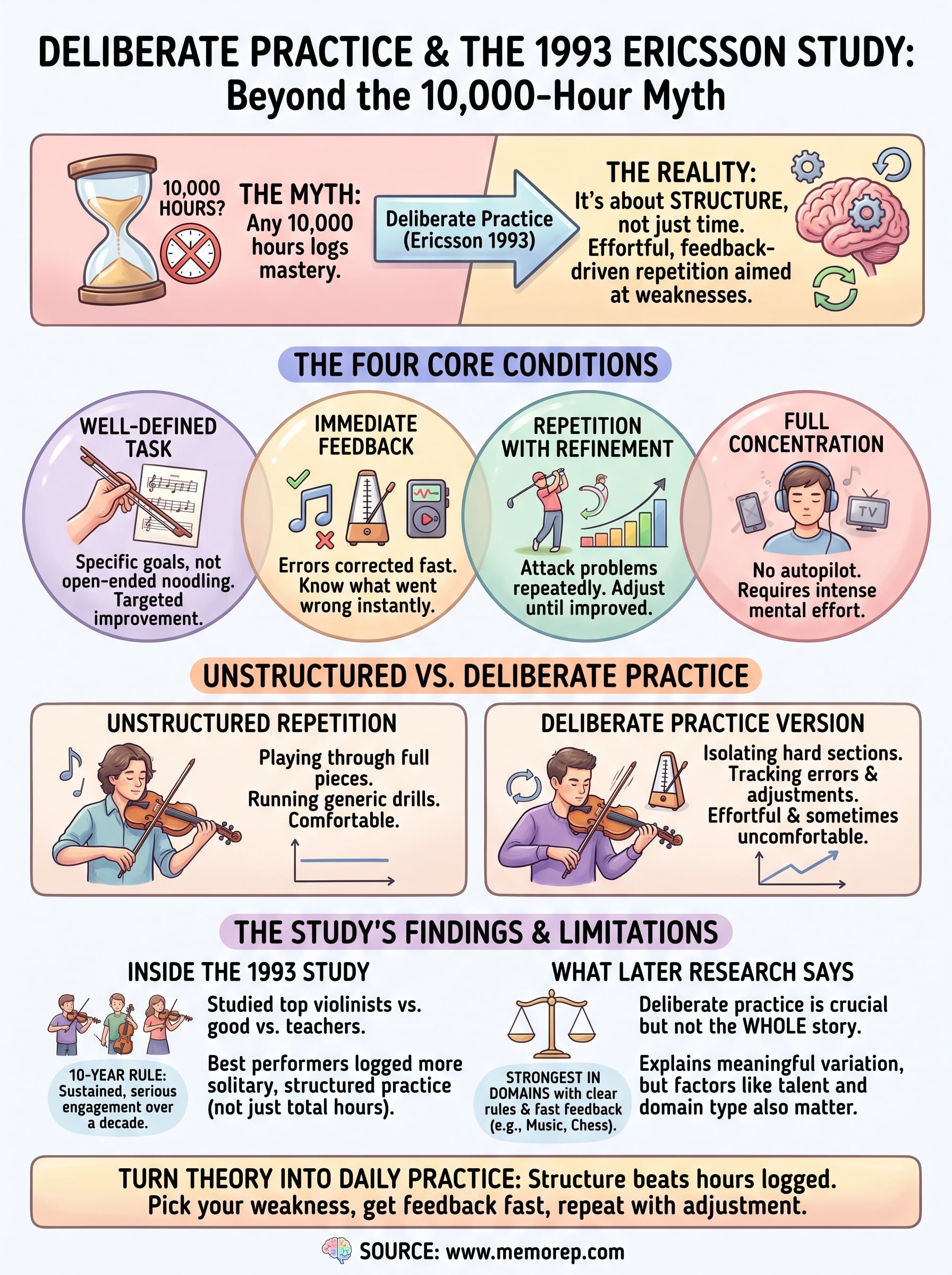
Ericsson's 1993 paper never promised a shortcut. It described a specific kind of effort, targeted, feedback-driven, and sustained over years, and that's still the most reliable path to real skill. The 10,000-hour myth made the research famous, but the actual finding is more useful: structure beats hours logged, every time. Later studies added nuance about talent and diminishing returns in messier domains, but the core advice survives intact. Pick your weakest spot, get feedback fast, repeat with adjustment.
The hard part was never understanding this. It's doing it daily without a coach managing your schedule for you. That's the gap MemoRep is built around, applying the same forgetting-curve logic Ericsson's research points to, so you always know what needs revisiting. If you want to try it yourself, see how MemoRep turns the research into a practice schedule and claim free access during the beta.