"Deliberate Practice Is Unnecessary": True or False, Explained
You saw the statement on a quiz or in a course reading: deliberate practice is unnecessary to gain expertise. Your gut says false, but you want the actual reasoning before you commit to an answer, especially if this is a graded question. Let's settle it clearly and quickly.
The short answer is false. Decades of research, starting with Anders Ericsson's work on expert performance, show that raw talent or hours of casual repetition don't reliably produce expertise. What separates experts from hobbyists is structured, feedback-driven practice aimed at specific weaknesses, not just time logged with an instrument, a sport, or a craft.
Below, you'll get the full explanation behind that answer: what deliberate practice actually means, why the "10,000 hours" myth gets misapplied, and how it differs from simply practicing a lot. We'll also cover the studies most quiz questions reference, so you understand the concept well enough to explain it in your own words, not just repeat a true/false answer.
Why deliberate practice matters for building real expertise
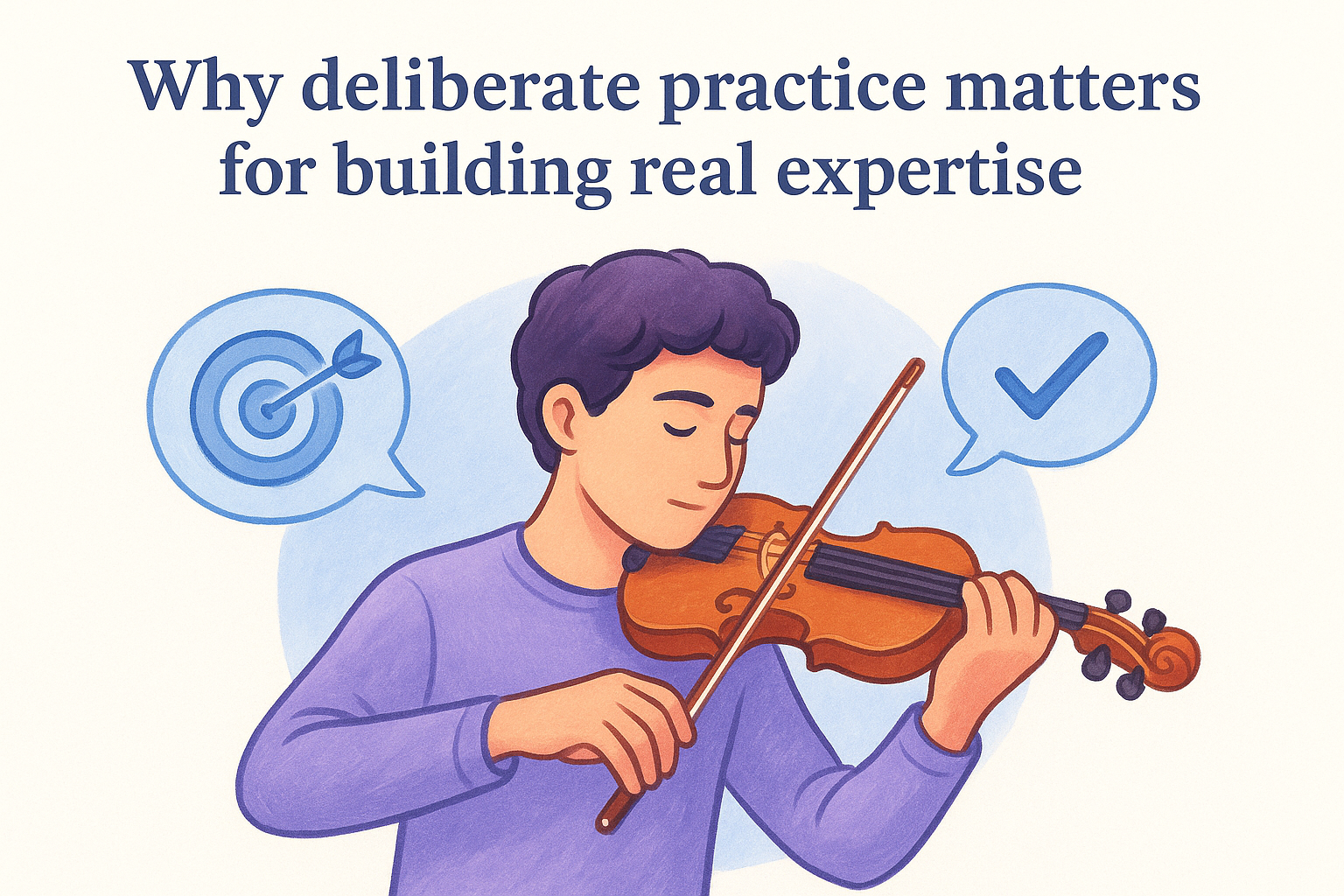
Anders Ericsson's 1993 study on violinists at a Berlin music academy is the paper most textbooks cite, and it's worth understanding why. Ericsson didn't just ask musicians how many hours they'd practiced. He tracked how they practiced, isolating specific technical problems, working slowly through difficult passages, and getting immediate feedback from teachers. The best violinists in the study didn't just play more. They practiced in a fundamentally different way, and that difference in method, not raw hours, predicted who reached elite performance levels.
The gap between practicing and improving
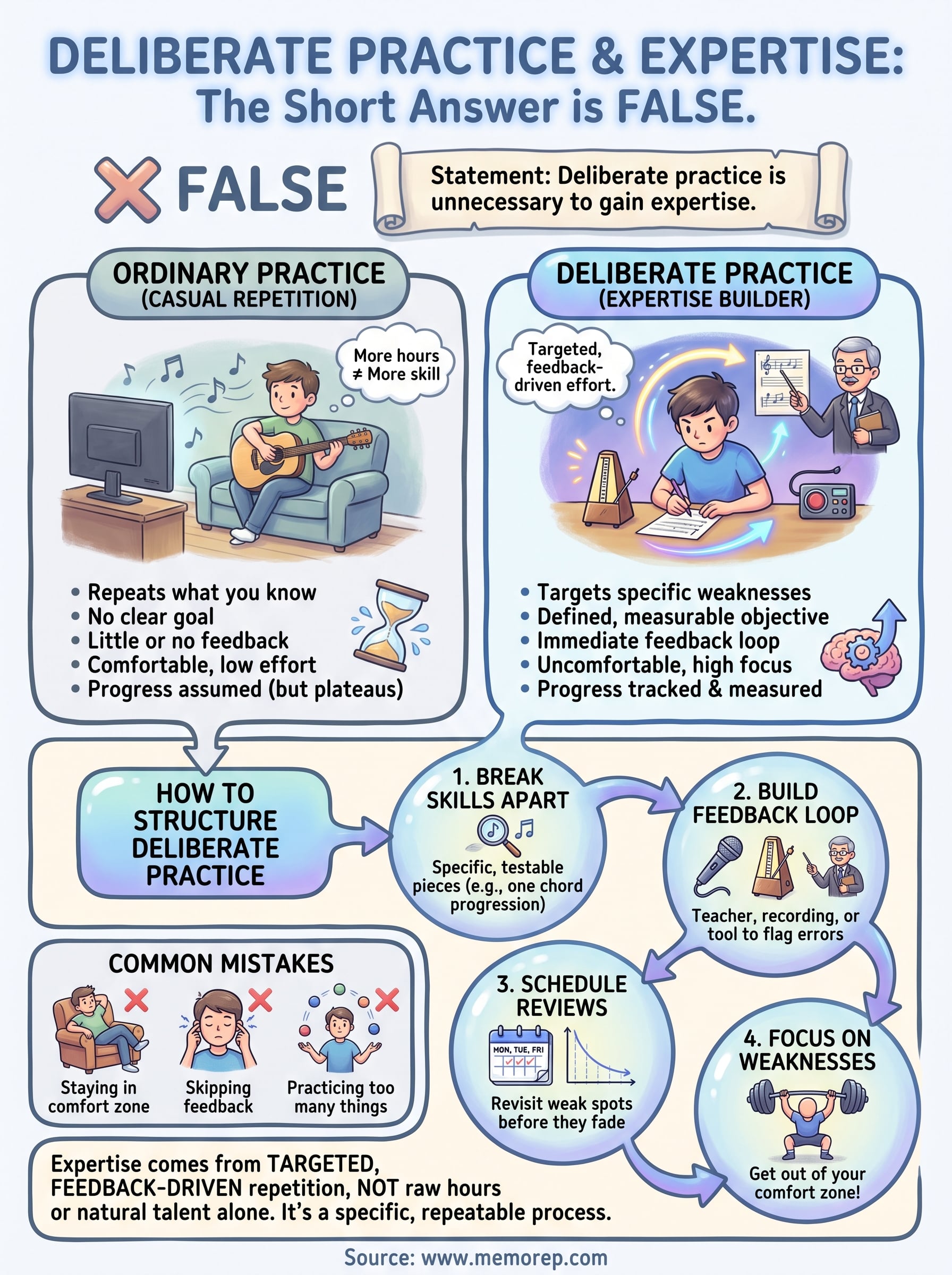
Many people confuse activity with progress. A guitarist who runs through the same three songs every night for ten years isn't accumulating expertise, they're reinforcing whatever habits they already have, good or bad. Skill plateaus happen precisely because casual repetition doesn't force the brain to confront weaknesses. Deliberate practice closes that gap by targeting the exact skill that's holding you back, then measuring whether you actually improved.
Hours alone don't build expertise. Targeted, feedback-driven repetition does.
What separates deliberate practice from ordinary repetition
Here's a quick comparison of deliberate practice versus regular practice that shows why the distinction matters for anyone trying to answer this question with confidence:
| Ordinary Practice | Deliberate Practice |
|---|---|
| Repeats what you already know | Targets specific weaknesses |
| No clear performance goal | Defined, measurable objective |
| Little or no feedback | Immediate feedback loop |
| Comfortable, low effort | Uncomfortable, high focus |
| Progress is assumed | Progress is tracked |
This is also where the phrase purposeful practice enters the conversation. Some researchers use it interchangeably with deliberate practice, though purposeful practice technically refers to focused, goal-directed effort that hasn't necessarily been validated by an expert coach or a proven training method. Deliberate practice is the more rigorous version: the theory requires a domain with established performance benchmarks and structured feedback, which is why it applies cleanly to music, chess, and sports, and less cleanly to fields without clear right answers.
Why this matters beyond the quiz question
Understanding this distinction changes how you practice, not just how you answer a true/false prompt. If skill acquisition worked through passive repetition, anyone who'd played piano for twenty years would be a concert pianist. They're not, because most people plateau early and stop challenging themselves once they reach a comfortable level of competence. Musicians who keep improving into their thirties, forties, and beyond are almost always the ones still identifying weak spots and drilling them with intention, exactly the process Ericsson documented. That's the practical stakes behind the abstract research: expertise isn't a reward for time served, it's the outcome of a specific, repeatable process anyone can apply.
How to structure a deliberate practice routine
Knowing that deliberate practice works is one thing. Building a routine around it is another. A workable structure needs four elements: a specific target, a way to measure progress, immediate feedback, and a system for revisiting weak spots before they fade.
Break skills into specific components
Start by breaking a broad goal, like "get better at jazz improvisation," into narrow, testable pieces: a specific chord progression, a tricky rhythm, a scale pattern you keep fumbling. Specific targets turn vague ambition into something you can actually drill and measure in a single session, and isolating weaknesses like this is the entire point of moving past casual repetition.
Build a feedback loop
Feedback is what separates drilling from guessing. That can mean a teacher, a recording you review critically, or a metronome that flags timing errors. Without it, you can't tell whether a session actually moved the needle or just felt productive.
A routine without feedback is just repetition wearing a disguise.
Schedule practice at the right intervals
This is where most self-taught routines fall apart. You isolate a weak spot, drill it hard for a week, then forget to revisit it until it's rusty again. Scheduling reviews with spaced repetition solves this by resurfacing each skill right before you're likely to forget it, based on how well you performed last time.
A basic weekly structure might look like this:
- Monday: identify one weak skill from your last performance or session
- Tuesday to Thursday: drill it in short, focused blocks with feedback after each
- Friday: rate your progress (again, hard, good, easy)
- Following week: let the schedule decide when that skill resurfaces
This is exactly the gap MemoRep's practice card system is built to close. Instead of guessing when to revisit a passage, the platform's scheduling algorithm tracks your ratings and tells you what to practice and when, so nothing slips through the cracks.
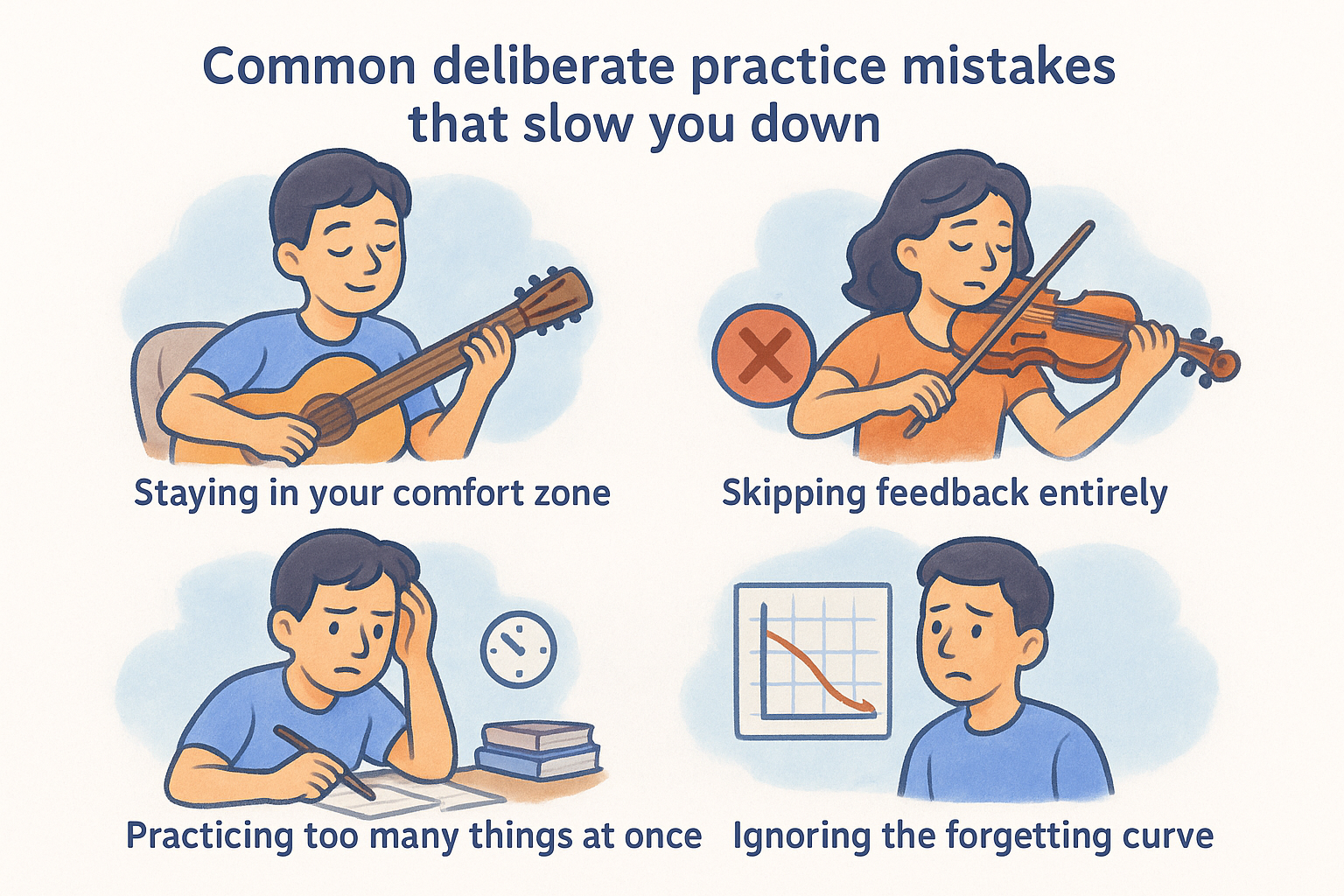
Common deliberate practice mistakes that slow you down
Even learners who understand the theory often sabotage their own routines through a handful of predictable errors. Recognizing these mistakes matters as much as knowing the definition, because a quiz question only tests the concept, but your practice room tests whether you actually apply it.
Staying in your comfort zone
Guitarists, pianists, and athletes alike gravitate toward drills they've already mastered because it feels productive without being uncomfortable. Comfort zone practice produces confidence, not growth. If a drill doesn't feel slightly frustrating, it's probably not deliberate practice, it's a warm-up dressed up as training.
If a drill feels easy, it's not the drill that's building your expertise.
Skipping feedback entirely
Practicing alone, without a teacher, recording, or metronome, means you're guessing at your own errors. Ericsson's research consistently found that immediate feedback was non-negotiable for the violinists who progressed fastest. Self-assessment alone is unreliable because your ear and your hands adapt to your mistakes long before your judgment catches up.
Practicing too many things at once
Decision fatigue kills more practice routines than laziness does. Trying to fix five weaknesses in one session spreads your attention too thin to make measurable progress on any of them. Pick one target, drill it, then move to the next session.
Ignoring the forgetting curve
Many learners drill a skill until it feels solid, then abandon it entirely, assuming it's locked in. It isn't. Research on how memory decays predictably without review shows skills fade on a schedule, which is exactly why timing matters as much as effort.
| Mistake | Why It Slows Progress |
|---|---|
| Comfort zone drills | No new demand on the brain |
| No feedback | Errors go uncorrected |
| Multitasking skills | Attention too thin to improve any one |
| No revisiting schedule | Skills fade before they're reinforced |
Putting the answer into practice
So the statement is false: deliberate practice is unnecessary to gain expertise doesn't hold up against decades of research or basic common sense. Ericsson's violinists, chess grandmasters, and elite athletes all point to the same conclusion. Expertise comes from targeted, feedback-driven repetition, not raw hours or natural talent alone. Now that you can explain why, not just recite the answer, you're better equipped for the quiz and for your own practice room.
Knowing the theory is only half the job. Applying the structure, breaking skills into specific targets, getting real feedback, and revisiting weak spots before they fade, is what actually moves you toward mastery. That's a lot to track manually, especially once you're juggling more than one or two skills.
If you'd rather let a system handle the scheduling for you, see the science behind memoRep's practice scheduling and start turning this answer into a habit.