
How to Build Muscle Memory Faster: 7 Proven Tips
You've drilled a scale, a serve, or a chord change a hundred times, and it still falls apart under pressure. Learning how to build muscle memory faster isn't about grinding out more reps, it's about practicing the right movement at the right moment so your nervous system locks it in instead of letting it fade. Most people waste hours on random repetition when a few targeted adjustments would cut that time in half.
The short answer: muscle memory forms fastest when you combine deliberate practice with spaced review timed to catch skills right before they slip. Your brain encodes motor patterns through repetition, but the interval between sessions matters as much as the reps themselves. Skip a skill too long and you start over. Practice it too often and you waste time on something already solid.
This guide walks through seven specific techniques, from session structuring to feedback loops, that speed up how quickly a movement becomes automatic. Each tip is built around real practice science, not guesswork, so you can apply it to an instrument, a sport, or any physical skill you're trying to master.
What actually speeds up muscle memory
Muscle memory isn't stored in your muscles at all. It lives in your motor cortex and cerebellum, where repeated movement patterns get wired into stronger, faster neural pathways. Every time you execute a movement correctly, your brain reinforces the specific sequence of neurons that produced it. Do that enough times with enough precision, and the movement becomes automatic, meaning you can perform it without consciously thinking through each step. That's the entire goal when you're trying to learn a physical skill fast: shrink the gap between conscious effort and automatic execution.
The two-part process your brain runs
Research on motor learning and the principles behind faster mastery shows the process happens in two stages: encoding and consolidation. Encoding happens while you practice, when your brain builds an initial rough draft of the movement. Consolidation happens afterward, often during sleep, when your brain strengthens that draft into a stable, long-term pattern. Skip either stage and progress stalls. Rush through reps without rest, and you never let consolidation finish. The National Institutes of Health has documented how sleep-dependent consolidation directly improves motor skill retention, which is why practice quality and recovery timing matter as much as rep count.
Muscle memory speeds up when you match focused, correct-form repetition to a recovery schedule your brain can actually consolidate.
Why timing beats brute-force repetition
Getting faster at building muscle memory means fixing three specific inefficiencies most people never address. First, sloppy reps encode the wrong pattern just as strongly as clean ones, so your brain locks in mistakes right alongside good technique. Second, random or inconsistent scheduling means you either drill something already mastered or let a fragile skill go cold. Third, ignoring recovery cuts consolidation short before the pattern stabilizes.
| Inefficiency | Effect on learning speed |
|---|---|
| Practicing with poor form | Wrong pattern gets reinforced |
| Random practice timing | Wasted reps or forgotten skills |
| Skipping rest and sleep | Consolidation never completes |
Address those three, and you'll notice a movement smoothing out in sessions instead of weeks. The next four steps show exactly how.
Step 1. Practice with focused repetition and correct form
Quality reps beat quantity every time you're chasing motor skill acquisition, a point Ericsson's research on expert performance made decades ago. Ten slow, precise repetitions of a golf swing or a guitar riff teach your nervous system more than fifty rushed ones, because your brain encodes exactly what you feed it, mistakes included. Slow the movement down until you can execute it correctly, then gradually add speed once the pattern holds under control.
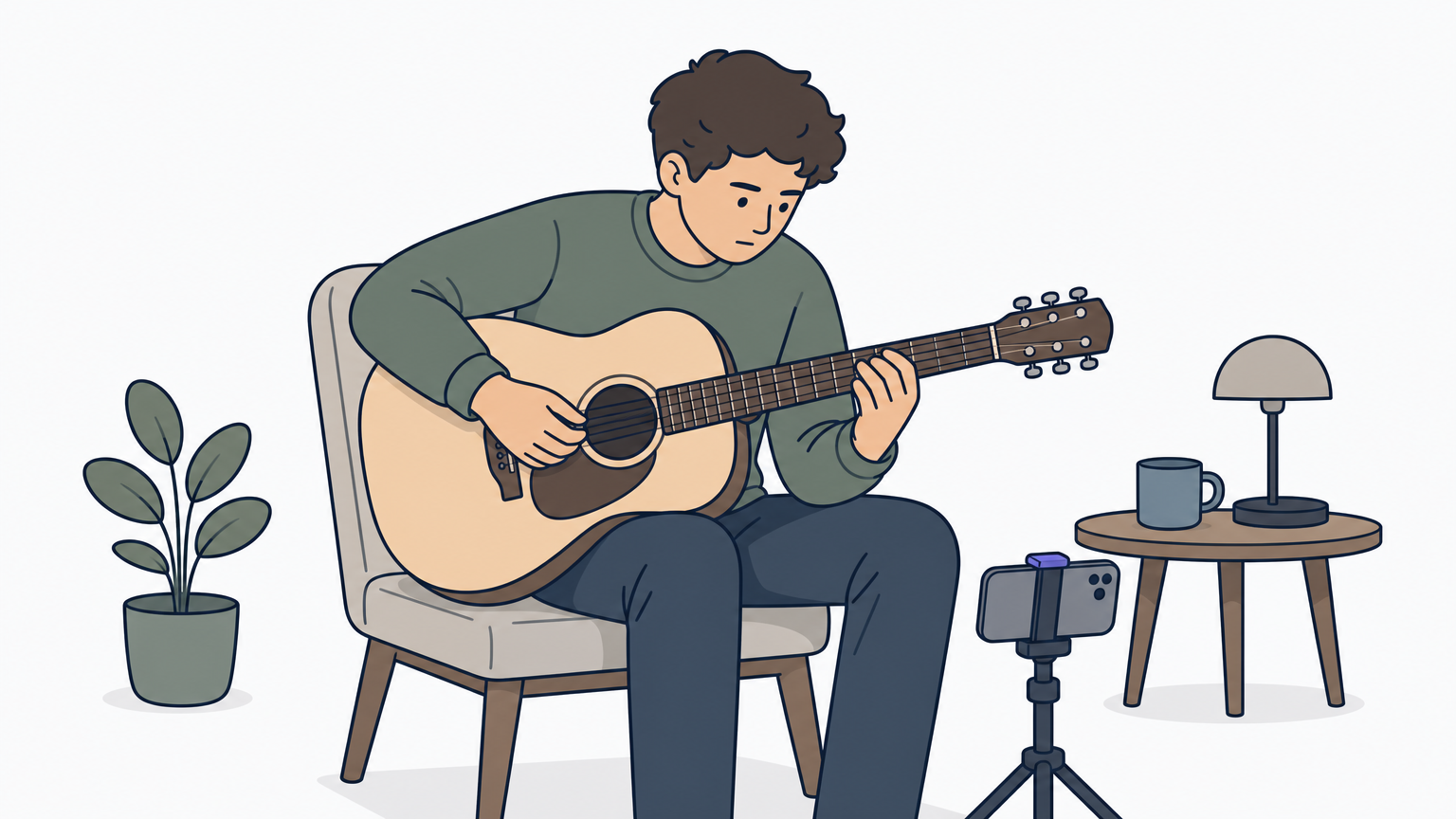
Ten correct reps beat fifty sloppy ones because your brain encodes exactly what you practice, errors and all.
Isolate the movement before you speed it up
Break complex skills into smaller components and drill each one separately before chaining them together. A drummer working on a fill practices each limb's pattern alone before combining them. A basketball player isolates footwork before adding the shot. This isolation forces correct form into each sub-movement instead of letting compensations creep in when you're juggling too many variables at once.
Build a short pre-practice checklist
Before each session, run through a quick form check:
- Confirm your starting position or grip is correct
- Slow the movement to half speed for the first few reps
- Watch or record yourself if the skill allows it
- Stop the moment fatigue starts breaking form
Running this checklist takes under a minute, but it prevents the single biggest cause of slow progress: reinforcing a flawed pattern for weeks before you notice it. Getting this step right sets up everything else in your practice routine to actually stick.
Step 2. Reinforce skills through visualization and mental rehearsal
Visualization activates many of the same neural circuits as physical execution, which means mental rehearsal genuinely reinforces muscle memory even when you're away from your instrument or your court. Studies on athletes have shown that imagining a movement with enough detail fires overlapping regions in the motor cortex, strengthening the same pathways a real rep would build. This doesn't replace physical practice, but it multiplies its effect when you're injured, traveling, or just squeezing extra reps into a day that has no room left, and it pairs well with the other practice techniques that actually work.
Imagining a movement in vivid detail trains the same neural pathways as performing it, making mental rehearsal a free multiplier on physical reps.
Run rehearsal sessions with real detail
Generic daydreaming won't move the needle. Effective rehearsal means closing your eyes and running through the exact sequence, tempo, and sensory feedback of the skill, not just picturing yourself succeeding. Picture the feel of the strings under your fingers, the weight shift in a golf swing, the specific counts in a dance routine. Sitting for even five focused minutes before or after physical practice sharpens the neural pattern without adding physical fatigue.
Pair it with your regular sessions
Treat mental rehearsal as a companion to physical reps, not a substitute:
- Run through the movement mentally right before your physical session
- Rehearse again right after, while the sensory memory is still fresh
- Use it on rest days to keep the pattern active without physical strain
Stacking this habit onto sessions you're already running costs almost nothing and accelerates how quickly the movement becomes automatic.
Step 3. Schedule spaced, progressive practice sessions
Random practice timing wastes more potential than any other mistake on this list. Spacing your reviews works because your brain strengthens a motor pattern most efficiently when you revisit it right before it starts to fade, not the day after you've already nailed it and not three weeks later when it's gone cold. This is the same principle behind what the Ebbinghaus curve tells you about review timing, and it applies to a tennis serve just as much as it applies to vocabulary.
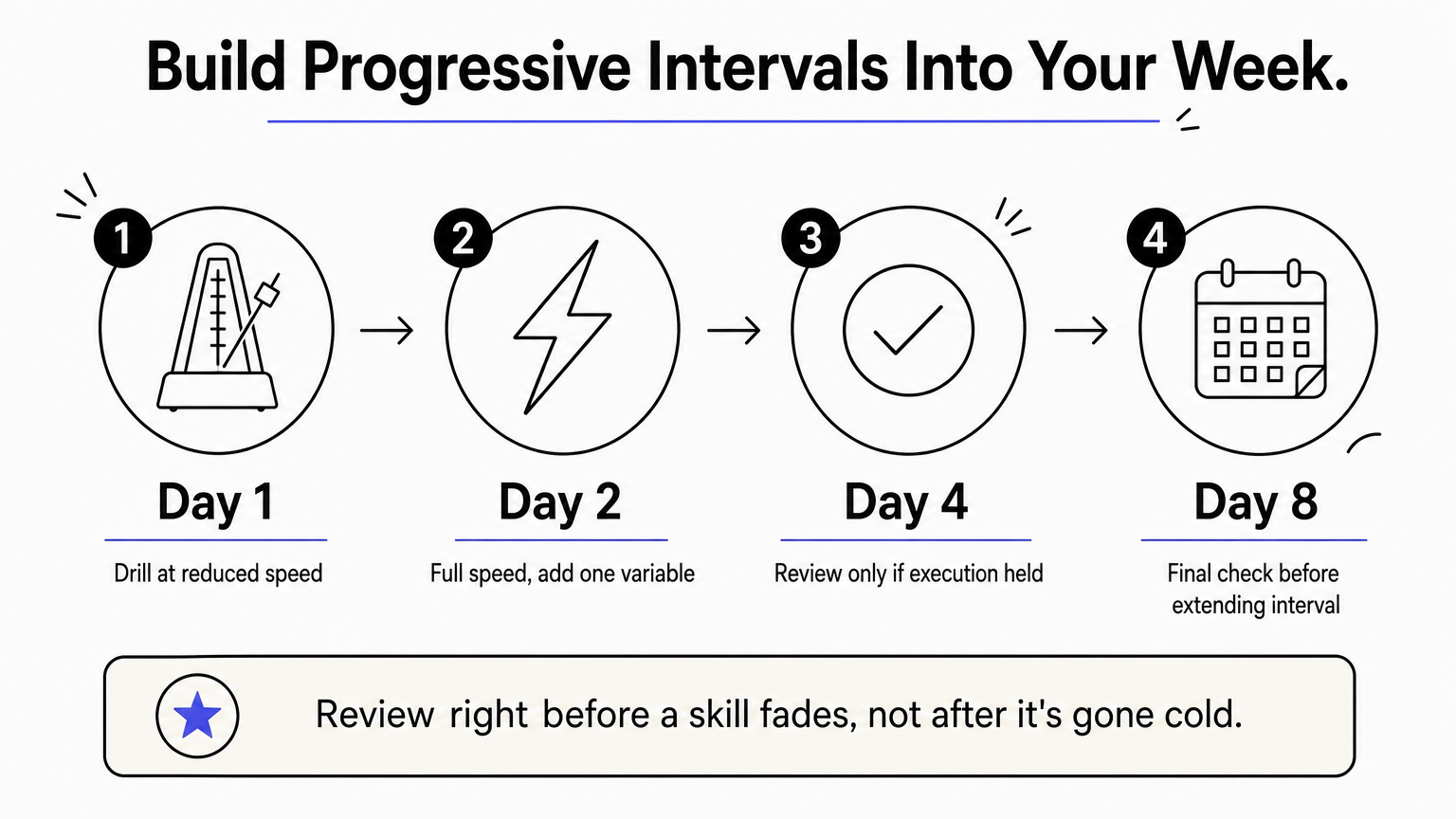
A skill you review right before it fades locks in faster than one you drill daily out of habit or ignore until it's gone.
Build progressive intervals into your week
Spacing alone isn't enough if the difficulty never changes. Pair your spaced intervals with small increases in speed, complexity, or resistance once a skill feels stable, so your nervous system keeps adapting instead of coasting on autopilot, which is exactly what building a deliberate practice plan is for.
- Day 1: learn or drill the movement at reduced speed
- Day 2: review at full speed, add one new variable
- Day 4: review again, only if execution held up
- Day 8: final check before moving the interval further out
Manually tracking which skill needs review on which day gets unmanageable fast once you're juggling a dozen drills. That's the exact gap MemoRep fills for practical skills: it schedules each practice card automatically based on how well you performed last time, so you're never guessing which movement is about to slip.
Step 4. Prioritize rest, sleep, and recovery
Skipping recovery undoes everything the first three steps built. Your brain doesn't finish wiring a movement into long-term memory during the practice session itself, it does the heavy lifting afterward, especially during deep sleep. Cutting sleep short or stacking practice sessions back to back interrupts that consolidation window, so the pattern you drilled all afternoon stays fragile instead of locking in.
A skill practiced perfectly but never consolidated through sleep is a skill you'll have to relearn.
Give consolidation an actual window
Recovery isn't just sleep. Short breaks between practice blocks, easy days between intense sessions, and even light stretching all give your nervous system room to stabilize what you just built. Pushing through fatigue to squeeze in one more rep often reinforces a breakdown in form, which cancels out the gains from the clean reps you did earlier in the session.
A simple recovery routine
- Sleep 7 to 9 hours the night after any session introducing a new pattern
- Insert a rest day between high-intensity practice blocks on the same skill
- Stop a session the moment technique starts slipping from fatigue
- Keep a light, low-stakes practice day once a week instead of skipping entirely
Treating recovery as part of the training plan, not an interruption to it, is one more thing that separates focused practice from simply logging hours and keeps learners improving week over week instead of plateauing. The Sleep Foundation has documented how sleep-deprived learners retain motor skills significantly worse than well-rested ones, even with identical practice volume.
Making faster progress stick
Speed comes from stacking small habits, not from finding one shortcut. Focused reps with correct form give your brain a clean pattern to encode. Visualization multiplies those reps without adding fatigue. Spaced, progressive scheduling hits each skill right before it fades. Recovery lets consolidation finish what practice started. Skip any one of these, and progress slows down even if the others are dialed in.
Tracking all of this by memory works fine when you're drilling one skill. It falls apart once you're juggling a repertoire, a training block, or a handful of techniques that all need review at different times. That's the exact problem spaced repetition software solves, and it's why how to build muscle memory faster ultimately comes down to consistent, well-timed sessions rather than raw effort.
If you want that scheduling handled for you, see how MemoRep times your practice reviews and try it while beta access is still free.