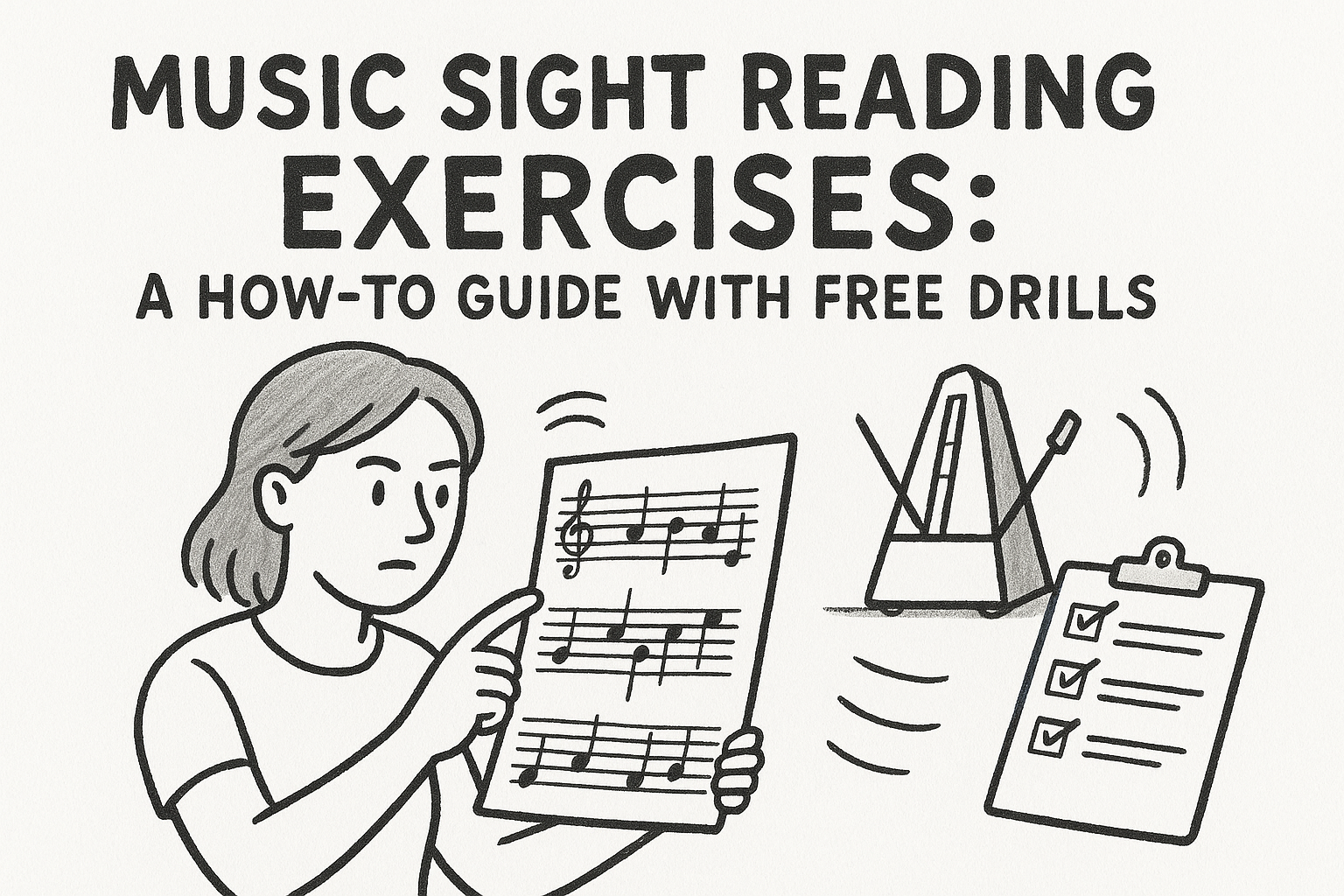
Music Sight Reading Exercises: A How-to Guide with Free Drills
You sit down with a new piece, and your eyes freeze the moment the rhythm gets tricky or the key signature has more than one sharp. That's the sight reading gap, and no amount of practicing pieces you already know will close it. Music sight reading exercises work differently than regular practice: they force you to process notes you've never seen before, in real time, without stopping to fix mistakes.
This guide gives you a practical warm-up routine and a set of free drills you can start today, no subscription or sign-up required. You'll get exercises organized by difficulty, from simple rhythm and pitch drills to full staff reading at tempo, plus the specific habits that separate players who improve from players who plateau at the same skill level for years.
The real challenge isn't finding one good exercise. It's knowing which drills to revisit and when, before the skill fades again. That's the part most sight reading advice skips, and it's exactly the kind of scheduling problem a tool like MemoRep was built to solve for musicians juggling multiple techniques at once. First, though, let's get you drilling.
What you need before you start sight reading
Before you crack open a drill book or generator, get your basic setup right. Sight reading exercises only build the skill if you can execute what you see in real time, which means your instrument, your ear, and your habits all need to be ready to work together.
Know the staff cold
Start with the fundamentals: you should be able to name any note on the staff, in either clef you play, without counting lines from middle C every single time. If you're still calculating "that's the third space, so it's C," you're not ready for tempo-based drills yet. Spend a week on flashcard-style note naming before moving to rhythm, and it helps to know how to build memory cards that actually work before you make a stack of them. This single gap is the most common reason sight reading feels impossible.
If you can't name the note instantly, you can't read it in tempo.
Set a steady pulse
Grab a metronome app or a physical one, it doesn't matter which. Sight reading collapses the moment you slow down to fix a mistake, so training yourself to keep a consistent tempo even through errors is non-negotiable. Set it slow, around 60 beats per minute, and resist the urge to speed up once you're comfortable.
Gather your materials
Here's the short list to have on hand before session one:
- An instrument that's in tune and comfortable to hold for 15 minutes
- A metronome (app, clip-on, or software)
- A stack of unfamiliar sheet music, at or slightly below your current level
- A notebook or app to log what you attempted and how it went
With these in place, you're ready for structured music reading practice, starting with the warm-up drills below.
Step 1. Warm up with notes, rhythms, and intervals
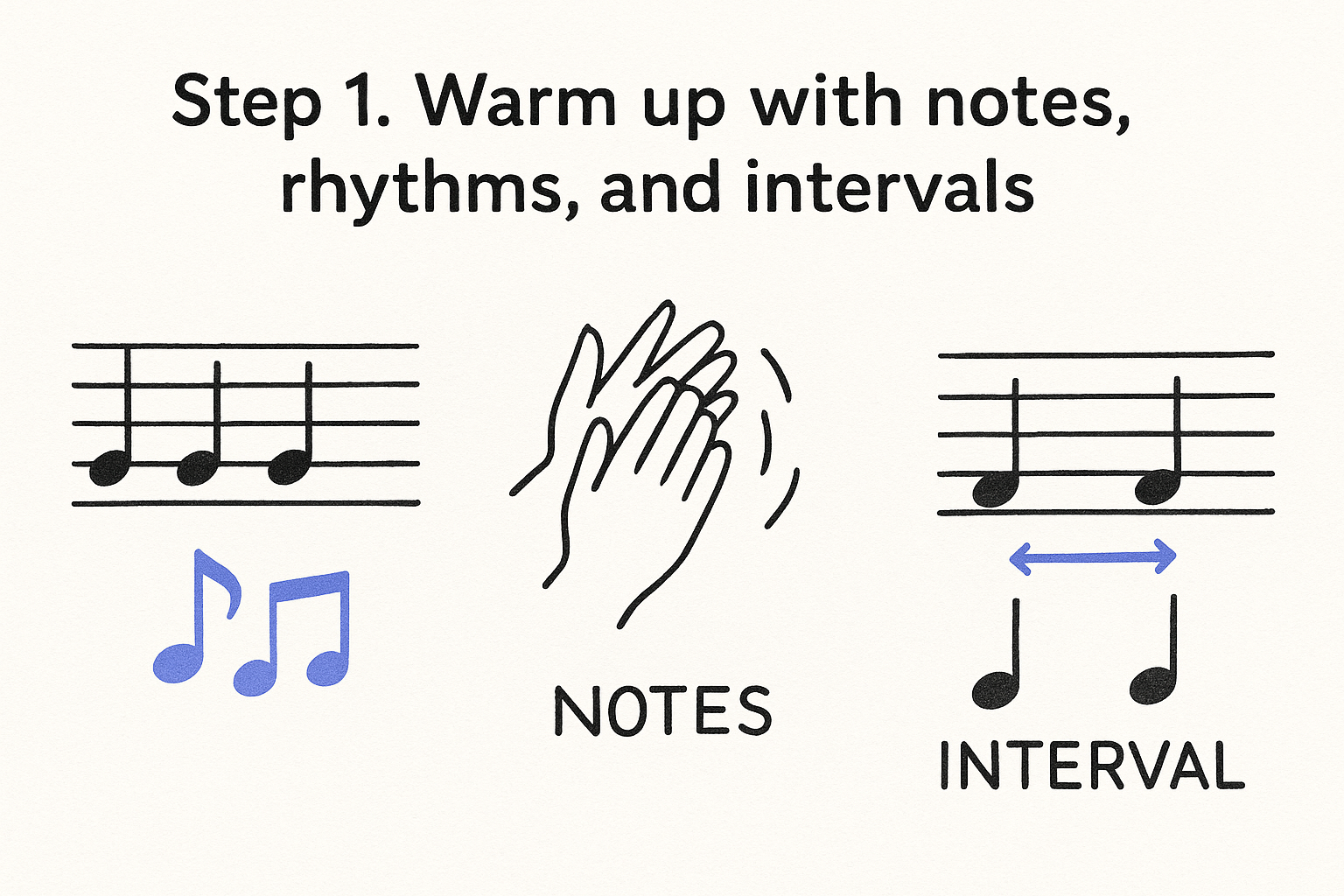
Before you touch a full piece, spend five minutes isolating the three elements that trip up most readers: note names, rhythm, and intervals. Warming up this way trains your brain to recognize patterns instantly instead of decoding them note by note, which is the whole point of sight reading exercises.
Clap rhythms first
Open any method book to a random measure and clap the rhythm before you play a single note. Isolating rhythm removes pitch guessing from the equation, so you can focus entirely on subdivision and pulse.
Name intervals on sight
Pick two random notes on the staff and say the interval out loud, a third, a fifth, a sixth, without playing them. This builds the interval recognition you need to jump between notes cleanly instead of counting lines every time, the same way to make music theory stick that keeps scales and chords from slipping away.
Rhythm and interval recognition, drilled separately, make full sight reading feel half as hard.
Run through this three-part warm-up daily:
- 2 minutes of note naming, mixed clefs
- 2 minutes of rhythm clapping, quarter and eighth note patterns
- 2 minutes of interval spotting, thirds through sixths
Once these feel automatic, you're ready for full-staff drills.
Step 2. Practice short daily sight reading drills
Once your warm-up is solid, move to actual pieces you've never seen. Grab something one or two levels below your comfort zone and play it once, start to finish, without stopping for mistakes. Short daily sight reading drills beat one long weekly session every time, because the skill depends on frequency, not duration, which is the core of practicing an instrument effectively.
Keep sessions under 10 minutes
Cap each session at 10 minutes, split across two or three short pieces. Fatigue kills concentration fast, and a tired brain starts guessing instead of reading. Ending while you're still sharp trains better habits than pushing through until you're sloppy.
Ten focused minutes a day beats one exhausted hour on Sunday.
Never stop, never go back
Treat every drill like a live performance: wrong notes stay wrong, and you keep moving forward. Stopping to correct a mistake defeats the entire purpose of sight reading practice, since real performance never gives you a second pass.
Use this quick checklist each session:
- Pick unfamiliar material, slightly below your level
- Set a slow, steady tempo
- Play straight through, no stopping
- Note one recurring mistake for tomorrow's warm-up
Consistency here matters more than difficulty.
Step 3. Use free generators for fresh material
Running out of unread pages is the fastest way to stall your progress, since your brain starts memorizing patterns instead of reading them. Free sight reading generators solve this by producing endless, never-before-seen exercises tailored to your level, so you never recycle material by accident.
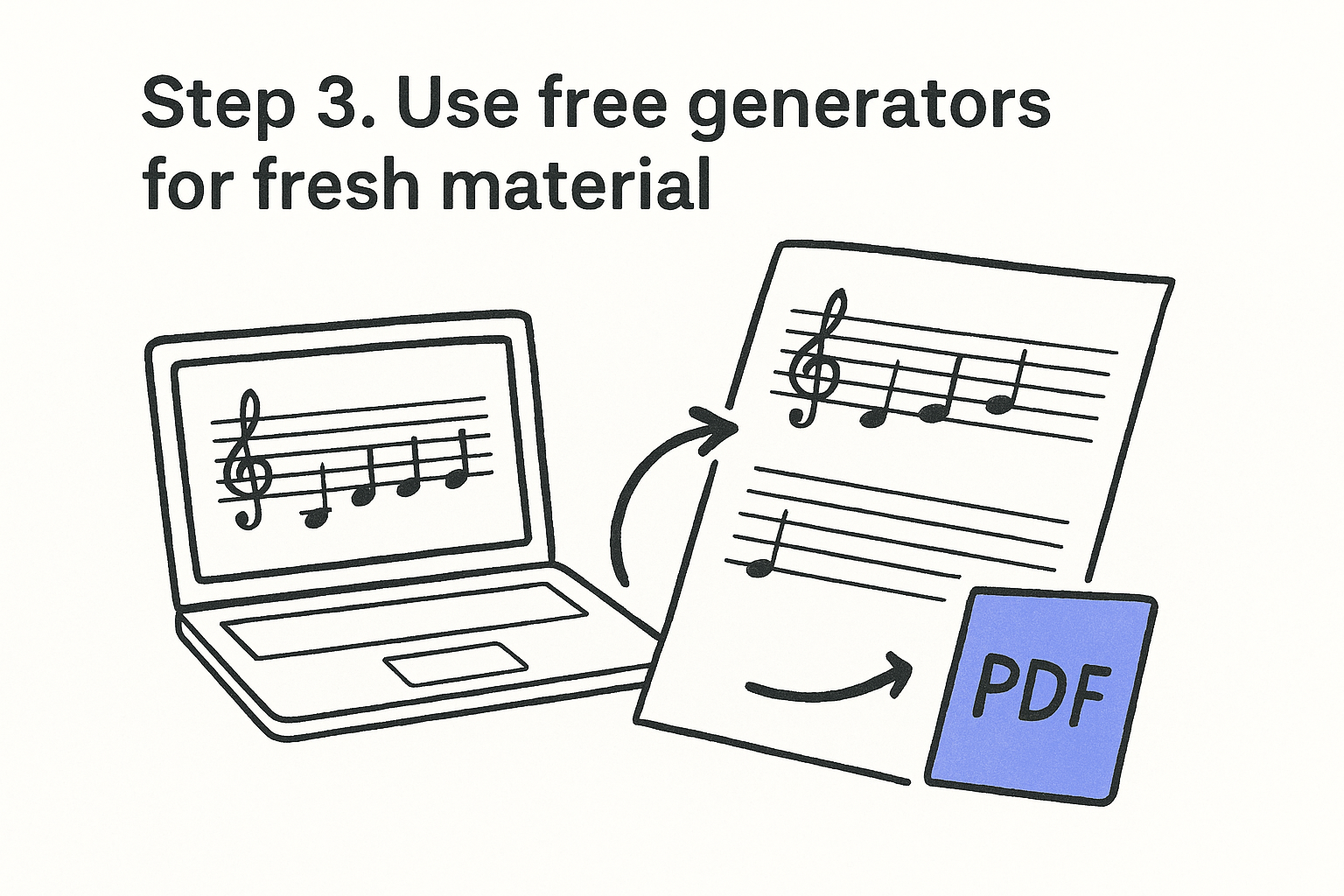
Search for tools that let you set key signature, range, and rhythmic complexity, then generate a fresh page every session. Many band and orchestra directors use free web-based generators for exactly this reason: they're randomized, so no two printouts repeat.
Novelty is the entire point of sight reading, so stop reusing pages you've already half-memorized.
What to look for in a generator:
- Adjustable clef (treble, bass, alto)
- Control over key signature and accidentals
- Rhythmic difficulty settings, from quarter notes to syncopation
- One-click printable or PDF export
Varying your music sight reading exercises this way keeps every session unpredictable, which is exactly the condition real performance throws at you. Rotate between two or three generators weekly so your ear and eye stay flexible instead of adapting to one tool's quirks.
Step 4. Track progress and schedule review sessions
Sight reading gains disappear fast if you never revisit the specific weak spots you found. Tracking your progress means more than counting minutes practiced. You need to know which rhythms, keys, or intervals keep tripping you up so you can bring them back before they fade completely.
Log the specific mistake, not just the session
After each drill, write down one concrete detail: "missed dotted eighth-sixteenth patterns" beats "had a rough session." Vague notes give you nothing to act on tomorrow, while specific ones turn into your next warm-up target, which is what makes deliberate practice different from just logging hours.
A logged mistake is a scheduled fix. An unlogged one just repeats itself.
Schedule the revisit before you forget
Here's where most players lose the thread: they identify a weakness, fix it once, then never check it again until it's rusty. This is exactly the gap spaced repetition closes, and it's why musicians juggling scales, rhythms, and repertoire simultaneously use MemoRep to schedule when each weak spot needs a revisit instead of guessing, using review schedules that are built on science.
- Log the mistake immediately after the drill
- Set a review interval, not just a one-time fix
- Revisit before the skill fades, not after, since memory fades over time on a predictable curve
Making sight reading part of your routine
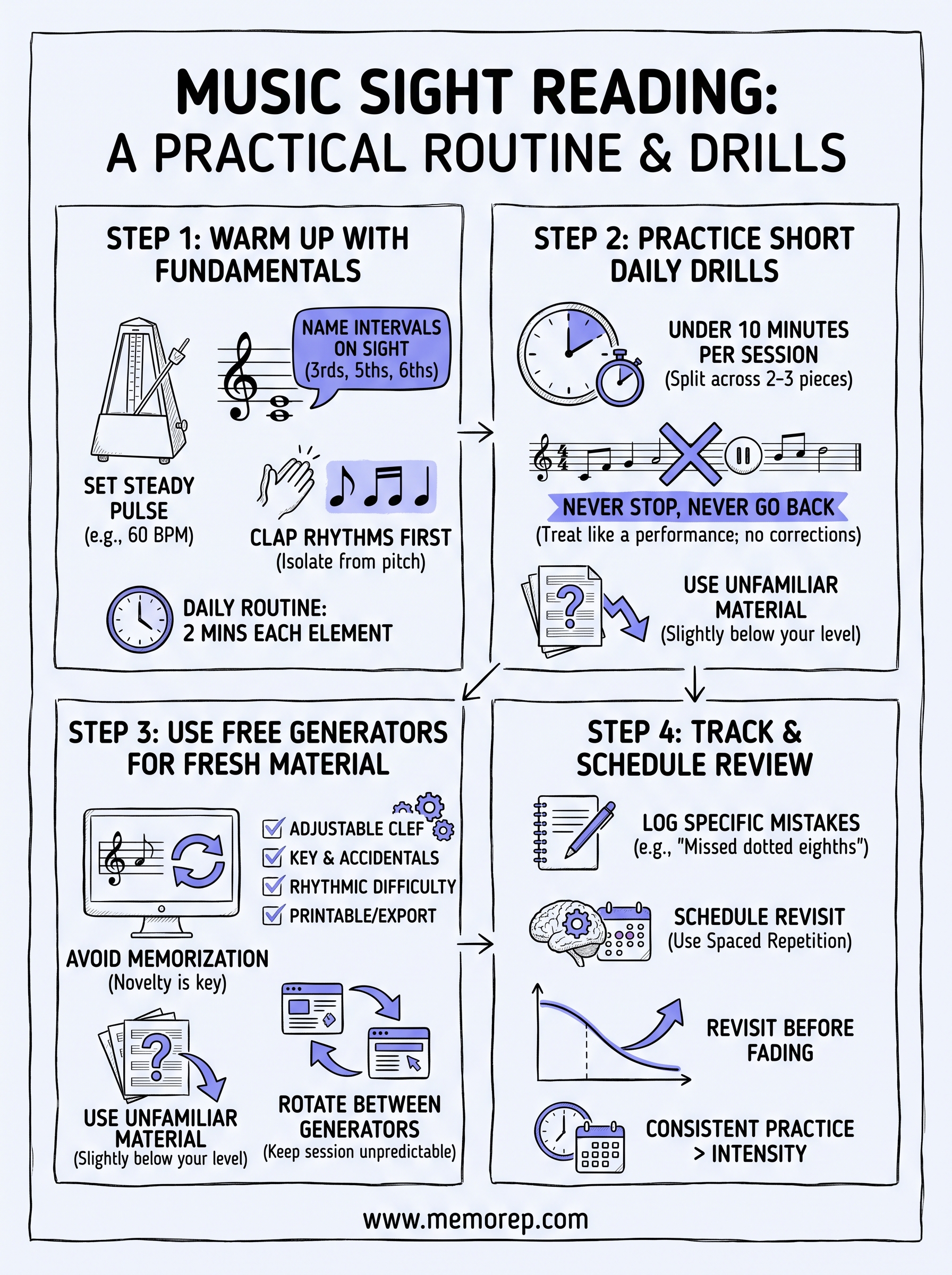
Sight reading only improves with repetition spread over time, not a single marathon session before a recital. The four steps here, warming up, drilling daily, rotating fresh material, and tracking your weak spots, work together because each one feeds the next. Skip the tracking step and you'll keep re-learning the same rhythms every few weeks without noticing the pattern.
The drills in this guide will get you reading faster within a month if you run them consistently. Consistent practice beats occasional intensity every time, especially once you're juggling scales, repertoire, and sight reading drills at once. That's the exact overload MemoRep was built to manage, scheduling each weak spot for review right before it fades instead of leaving you to guess.
If you want to see how the underlying algorithm decides when to bring a mistake back, see how memoRep times your reviews and start scheduling your own practice today.