Music Memorization Techniques: How to Memorize a Piece Fast
You have a performance in three weeks and the piece still lives on the page. Every time you put the music away, a bar or two vanishes. That is normal. Without a plan, music memorization techniques fail for a simple reason: your memory fades on a predictable schedule, and most practice ignores it.
Here is the short answer. To memorize a piece quickly, split it into small chunks, learn each through more than one channel (eyes, ears, and hands), and revisit each chunk at spaced intervals instead of replaying the whole piece daily. Timing matters as much as the technique itself. Reviewing a passage just before you would forget it locks it in with far less effort.
This guide walks through how to memorize a piece of music using chunking, visual, aural, and tactile memory, and spaced review. At MemoRep, we build our scheduling around the forgetting curve, so you will also see how to decide what to review and when, without guessing. We cover how to organize the process, not how to play.
How memory works when you learn a piece
Before you pick a method, it helps to know what you are working with. Memorizing a piece of music means moving it out of short-term attention and into long-term storage, and that move follows rules researchers have measured for well over a century.
The forgetting curve
In 1885, Hermann Ebbinghaus tested his own recall of memorized material and found that most loss happens early. Forgetting is steepest right after you learn something, then levels off. Each review before the memory fades makes the curve shallower, so the next gap can be longer.
That is why a passage you nailed on Monday feels shaky by Thursday. Nothing is wrong with your ear or your talent. Replaying the whole piece every day is the weak spot in most memorization techniques for music, because it spends your time on bars you still know and skips the ones that are fading.
Every well-timed review makes the next safe gap longer.
Three memories working at once
Playing from memory is not one skill. You rely on several kinds of memory at the same time, and each one fails in its own way under pressure.
| Memory type | What it holds | How it fails on stage |
|---|---|---|
| Working memory | The few bars you are thinking about right now | Overloads, so you blank mid-phrase |
| Conscious (declarative) memory | The map: sections, key changes, what comes next | You lose your place and cannot restart |
| Procedural memory | The movement patterns in your hands, breath, or voice | Runs on autopilot until nerves interrupt it |
Working memory is small. Research by psychologist Nelson Cowan suggests it holds about four chunks of information at once. A 64-bar piece cannot fit, so you have to shrink it into chunks before anything sticks. That is the logic behind Step 1.
Most players lean on one channel, usually the hands. It feels fast because procedural memory builds quickly. But hands-only memory is fragile. One slip in a run and there is no other path back in. If you also know the piece by sight, by ear, and by structure, a lapse in one channel gets covered by another.
Put the two ideas together and the plan is clear. Break the piece into pieces your working memory can hold, store each piece through more than one channel, and schedule the reviews so they land just before the forgetting curve drops. The next four steps apply that, in order.
Step 1. Chunk the piece into small sections
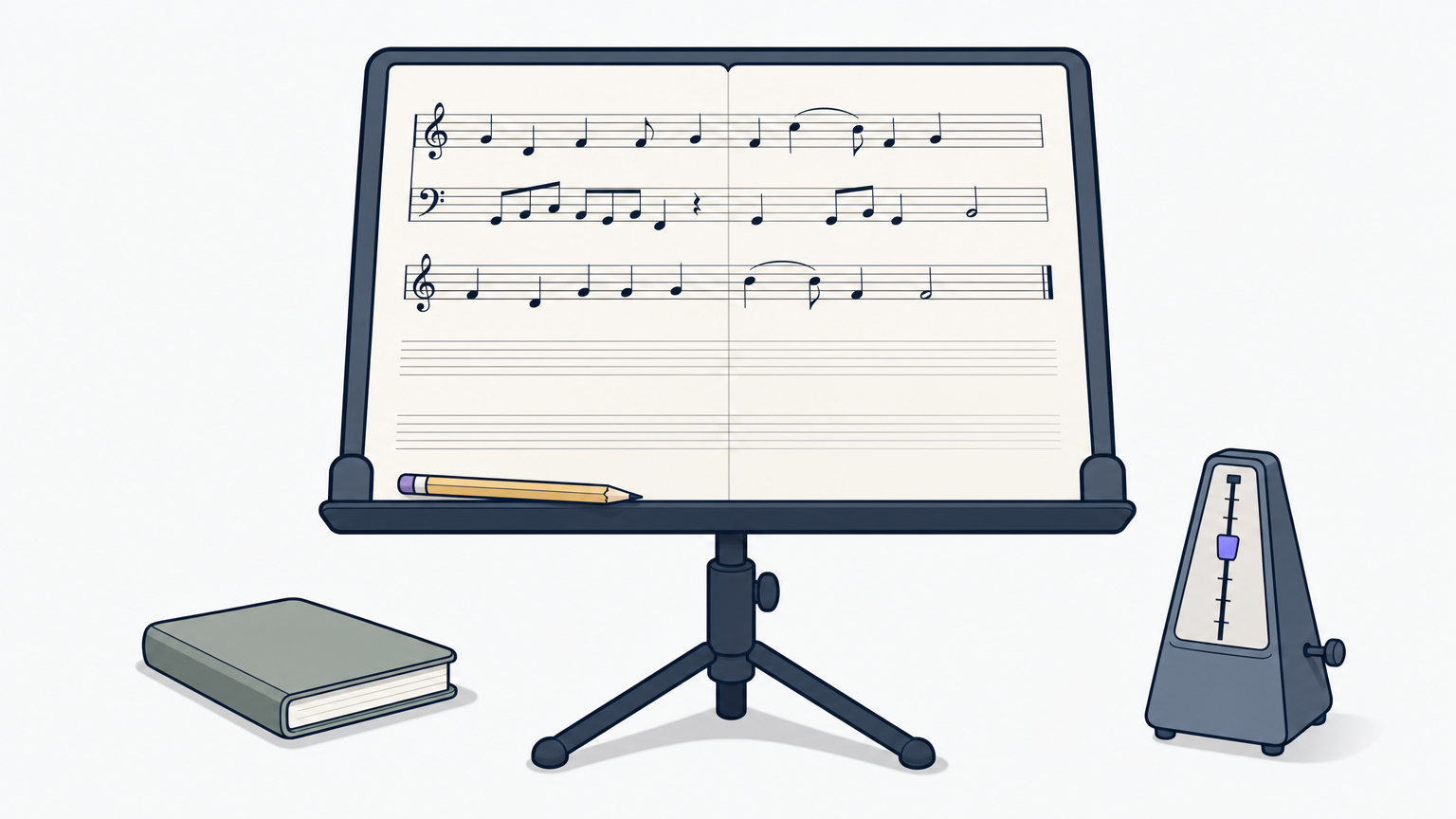
Chunking is the most reliable answer to how to quickly memorize music. Your working memory holds only about four items at once, so your job is to cut the piece into units small enough to fit. A chunk should feel almost too easy. If you can't play it from memory after a few minutes, it is still too big.
How to cut the piece
Start with the boundaries the music already has. Phrases, repeats, and section changes are natural seams. Aim for two to four bars per chunk. If your teacher has marked phrases in your score, use their markings. If you are unsure where a phrase begins, ask before you cut.
- Number every bar in your score.
- Pencil a bracket around each phrase, two to four bars long.
- Label the chunks in order (A1, A2, A3, B1, and so on).
- Treat each label as its own practice item, not as part of one big task.
- Move on only after you can play a chunk from memory twice in a row.
That last rule matters. One clean run can be luck. Two in a row is a signal.
Memorize in pieces your working memory can hold, not in pages.
Join the chunks without merging them
Once two neighboring chunks are solid, practice the seam between them. Play the last bar of one chunk into the first bar of the next. Most memory slips happen at these joins, so they deserve their own attention.
Try learning the chunks out of order too. Starting from the last chunk and working backward means every run-through ends on ground you already know. Your confidence grows as you approach the finish instead of shrinking.
People searching for how to memorize music notes fast often try to absorb every note one by one. That overloads working memory. Inside a chunk, the notes become one unit, and the chunk is the only thing you track. In MemoRep, each chunk becomes its own practice card, which sets you up for the spacing work in Step 3.
Step 2. Build visual, aural, and tactile memory
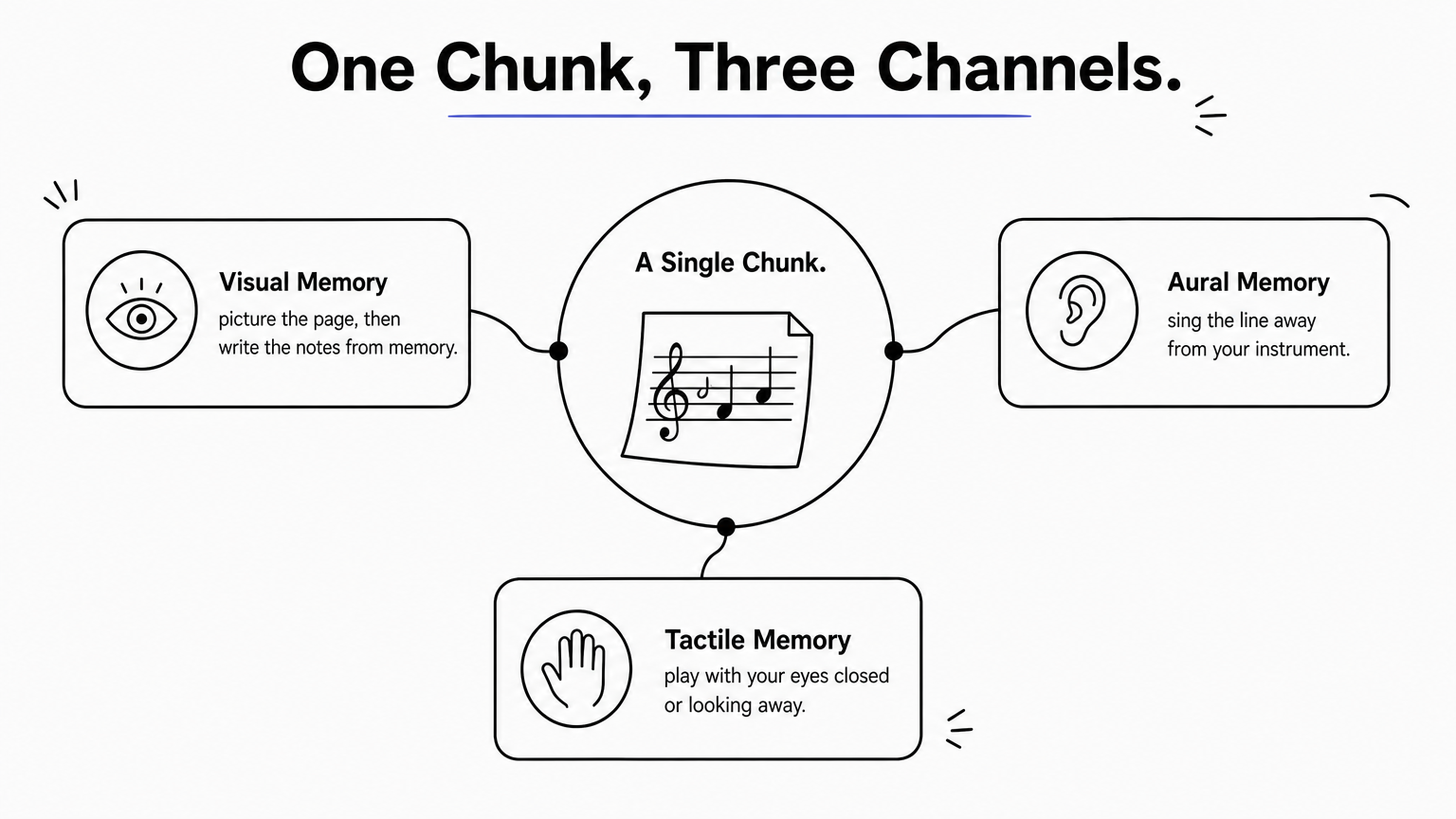
Chunks give you small targets, but a chunk stored in only one channel is still fragile. To memorize instrumental music reliably, lock each chunk in through your eyes, your ears, and your hands. Then a lapse in one channel gets covered by another. These memorization techniques for music notes work for any instrument, voice included.
Three channels, three drills
Each channel needs its own drill, because each one fails in its own way.
| Channel | Drill | What it protects you from |
|---|---|---|
| Visual | Study the chunk, close the score, and picture the page. Then write the notes from memory. | Losing your place after a blank |
| Aural | Hum or sing the line away from your instrument, or follow a recording without the score. | Wrong tones that feel right under your hands |
| Tactile | Play the chunk with your eyes closed, or look away from your hands. | Hands stalling when you can't glance down |
For how to memorize music tones, the aural drill matters most. If you can sing a phrase cleanly with no instrument, you know the tones, not just the motions. Mark any note where you hesitate and bring it to your teacher. Fixing it is their job.
Layer the channels on one chunk at a time
Layer the drills in order, and finish all four on one chunk before you touch the next.
- Play the chunk with the score open.
- Sing or hum it with no instrument.
- Close the score, picture it, then play.
- Play it again with your eyes closed.
A chunk you can see, hear, and feel is a chunk you can recover on stage.
Treat the drills as a test, not a chore. If one step falls apart, that channel is your weak one for that chunk. In MemoRep, rate the card Hard or Again when a channel fails, so the scheduler brings it back sooner. That feeds directly into Step 3.
Step 3. Space your repetitions and sleep on it
Spread reviews instead of cramming
Spacing is where most music memorization techniques either hold or fall apart. Short reviews spread over several days usually beat one long session, because each review lands as the memory starts to fade. Three 10-minute sessions on separate days will typically outlast one 30-minute block.
Cramming feels productive because everything is fresh. It isn't. Recall that feels effortless builds very little. The small struggle of pulling a chunk back after a gap is what strengthens it.
Review a chunk when it starts to fade, not while it is still fresh.
A simple interval schedule
Give every chunk its own expanding gaps. The SuperMemo SM-2 algorithm starts at one day, then six days, then multiplies the gap by an ease factor of about 2.5.
| Review | Typical gap | After a lapse |
|---|---|---|
| First | 1 day | Restart at 1 day |
| Second | 6 days | Restart at 1 day |
| Third | About 15 days | Restart at 1 day |
| Fourth | About 5 weeks | Restart at 1 day |
Work backward from your performance date. With three weeks left, start today so every chunk gets at least three reviews. In MemoRep, you rate each card Again, Hard, Good, or Easy after playing it, and the scheduler sets the next review date for you.
Let sleep do part of the work
Sleep is part of the method. In a 2002 study in Neuron, Matthew Walker and colleagues found that people got faster and more accurate at a finger sequence after a night of sleep, with no extra practice. Your brain keeps consolidating overnight.
So learn new chunks in the evening, then test them the next morning before touching anything else. Guard your sleep in the final week too. Late nights before a performance cost you the consolidation you spent weeks earning.
Step 4. Test your recall and fix weak spots
Testing comes last because it exposes what the first three steps missed. Playing with the score open proves very little, since your eyes can carry you past gaps. If you want to memorize a piece of music that holds up on stage, you have to find the holes before an audience does.
Run a recall test
Set the score out of reach and use active recall: play from memory. Start at a random chunk, not at bar one, because a lapse in performance never waits for a convenient spot. If you can only enter the piece from the top, you know the chunks as one fragile chain.
- Shuffle your chunk labels and pick three.
- Play each one from memory, with the score closed.
- Do not stop to fix mistakes. Keep going.
- Pencil a dot in a clean copy of the score at every hesitation or blank.
- Check your dots against the printed score afterward.
Find your weak spots by testing from random starting points, not by replaying from the top.
Sort the weak spots
Look at each dot and ask one question. Did you blank, or did you play the wrong notes? A blank means the chunk needs another pass through the Step 2 drills and an earlier review. Wrong notes mean you should check the score, then take the spot to your teacher. How to fix it is their call, not yours.
Then rate each chunk honestly. In MemoRep, your rating sets the next review date, so a generous rating just delays the problem.
| What happened | Rating | What comes next |
|---|---|---|
| Blanked or needed the score | Again | Redo the Step 2 drills, review tomorrow |
| Got through, but hesitated | Hard | Shorter gap, one channel drill |
| Clean, with some effort | Good | Normal gap |
| Clean and effortless | Easy | Longest gap |
Test under pressure
Finally, make the test harder as the performance date gets closer. Record yourself on your phone and listen back, because the recording catches slips you forgot about. Then play the piece for a friend or family member. Being watched is the closest rehearsal for nerves, and it shows which chunks only survive in a quiet room.
Making the piece stick for performance
Memorizing a piece comes down to four moves. Chunk it into units your working memory can hold, store each chunk through your eyes, ears, and hands, space your reviews and protect your sleep, then test from random starting points until the weak spots show. These music memorization techniques work because they follow how memory actually fades, not how it feels in the practice room.
The hard part is keeping track. With dozens of chunks on separate schedules, it is easy to slide back into replaying the piece from the top. MemoRep handles that bookkeeping, so you open it and see exactly what to practice today. Put your first chunks on the calendar and try MemoRep with a free-for-life subscription while the limited offer lasts.