How to Practice Drawing Effectively: A Step-by-Step Guide
You've been drawing for months, maybe years, and your sketchbook still looks like it did last spring. That's not a talent problem. It's a practice problem. Most artists draw whatever feels fun that day, skip the skills that actually need work, and wonder why progress crawls. If you want to know how to practice drawing effectively, the answer isn't more hours at the desk, it's a deliberate structure around what you draw and when you revisit it.
This guide gives you that structure. You'll learn how to break drawing into specific, trackable skills (gesture, perspective, shading, anatomy) instead of vague goals like "get better at art." You'll also see why revisiting old exercises at the right interval matters as much as learning new ones, since skills like line control and proportion fade fast without regular touch-ups.
Below, you'll find a step-by-step routine covering warm-ups, focused skill drills, feedback loops, and scheduling that fits around a busy week. The same principles apply whether you're chasing figure drawing or any other practical skill, and tools like MemoRep exist specifically to handle the scheduling piece, so you're not stuck guessing what to draw next.
Why unfocused drawing practice stalls your progress
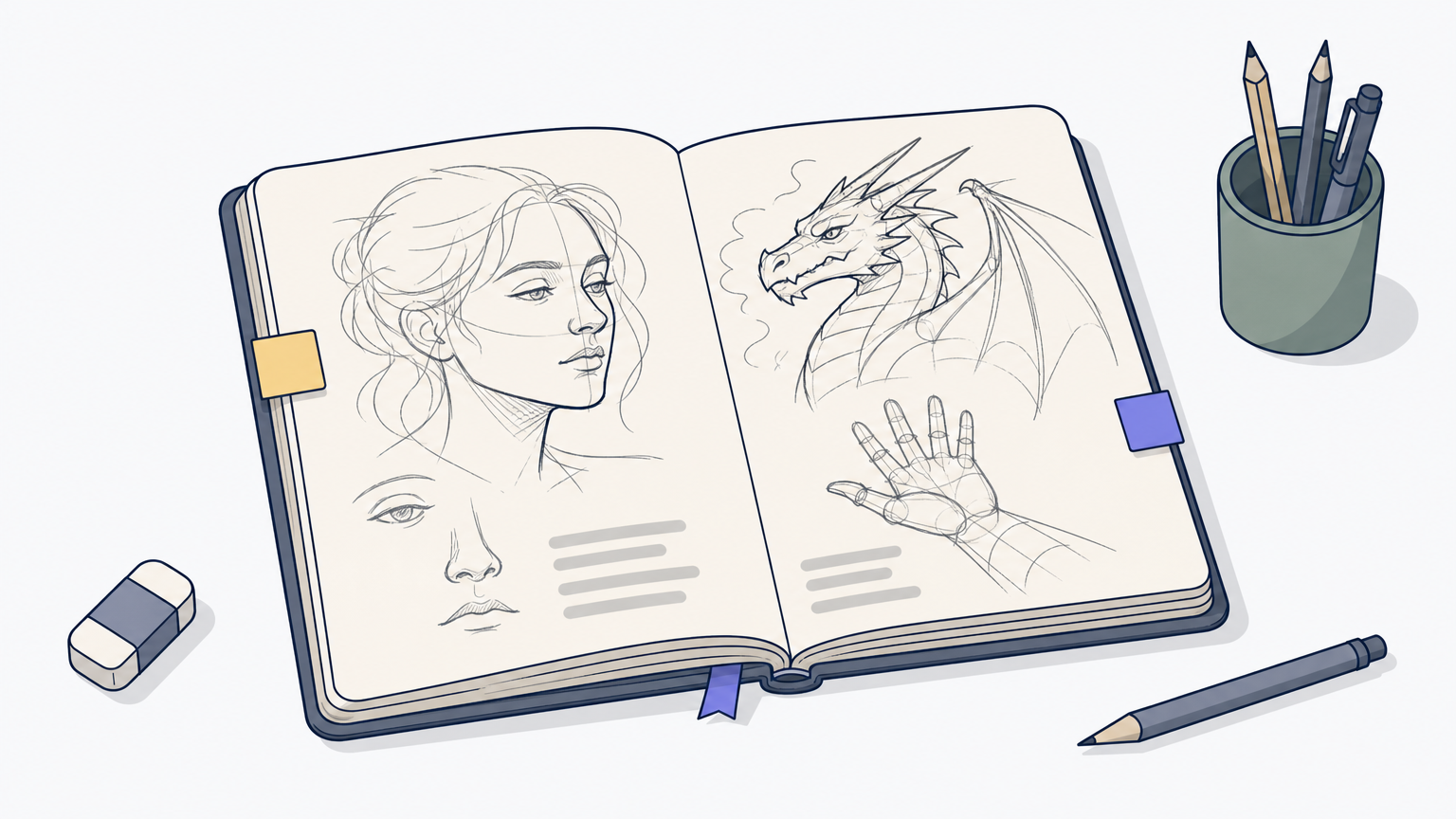
Open ten sketchbooks from ten hobbyist artists and you'll see the same pattern: a face here, a dragon there, a half-finished hand, then three pages of nothing because motivation ran out. This is unfocused practice, and it feels productive because you're drawing, but it rarely builds a specific skill past the point where you already were, which is regular practice versus deliberate practice in a nutshell. You end up circling the same weaknesses year after year because nothing forces you to confront them directly.
The random sketchbook trap
Drawing whatever appeals to you in the moment isn't practice, it's expression, and there's nothing wrong with expression on its own. The problem shows up when you expect that time to also function as skill-building. If you never isolate what's actually holding your work back (maybe it's foreshortening, maybe it's value control), you'll keep drawing around the problem instead of through it. Ask any working illustrator how they got good at hands, and you won't hear "I drew a lot of pictures." You'll hear "I drew hands, specifically, for weeks."
Drawing a lot isn't the same as practicing on purpose.
Why skills fade without repetition
Here's the part most self-taught artists miss: skills you don't revisit don't just plateau, they decay. This lines up with the Ebbinghaus forgetting curve explained in memory research, a well-documented pattern showing that newly learned information (or motor skills, in this case) drops off sharply within days unless it's reinforced. Line confidence, proportion judgment, and perspective construction all behave the same way. Spend three months focused entirely on portraits and your grip on gesture drawing will noticeably slip, even though you didn't "forget how to draw."
Most artists never notice this decay because they don't practice the same skill twice in a controlled way. They learn something, move on, and only rediscover the gap when a client or teacher points it out. That's a slow, expensive way to find your weak spots.
The cost of decision fatigue
Opening a blank sketchbook page and asking "what should I draw today?" sounds harmless, but it's a small tax you pay every single session. Multiply that by 200 sessions a year and you've burned a real chunk of your practice time on decision fatigue instead of actual drawing. Musicians run into the identical problem: too many pieces, techniques, and scales to juggle, no clear order to revisit them in. It's exactly why structured tools built on what spaced repetition actually does for skill practice exist for musicians in the first place, and the same logic transfers directly to visual art.
Below is a quick comparison of what unfocused practice tends to look like next to a structured approach:
| Unfocused practice | Structured practice |
|---|---|
| Draws whatever feels fun that day | Targets one named skill per session |
| No plan for revisiting old techniques | Schedules review before skills fade |
| Progress judged by "feels better" | Progress judged against past work |
| Motivation-dependent | Routine-dependent |
Once you see your practice laid out this way, the fix becomes obvious. Effective drawing practice isn't about grinding longer hours, it's about choosing a specific target, drilling it with the right exercises, and returning to it before it fades. That's the model the rest of this guide walks through step by step, starting with how to actually pick that first target skill instead of drawing whatever crosses your mind.
Step 1. Pick one specific skill to focus on
Before you touch a pencil, name the exact skill you're working on this session. "Get better at drawing" isn't a target, it's a wish. A named skill gives you something concrete to drill and something concrete to measure later. Say "foreshortened arms" or "three-point perspective boxes" instead of "improve anatomy," and suddenly you know exactly what today's page is supposed to prove.
Break broad goals into named skills
Most drawing ability breaks down into a handful of separate, testable components, and treating them separately is the core of how to practice art effectively instead of just drawing more. Pick from a list like this rather than a vague category:
- Gesture and line of action
- Perspective (one, two, and three point)
- Proportion and measurement
- Value and shading control
- Anatomy (hands, faces, joints, weight distribution)
- Line confidence and control
- Color theory and mixing
Each of these can be isolated, drilled, and reviewed on its own, which is exactly what makes progress visible instead of vague.
Pick based on what's weakest, not what's fun
Selecting a skill because it's enjoyable feels productive but usually reinforces something you're already decent at. Look at your last ten drawings and find the part you consistently avoid, rush, or hide behind shading. That's your actual weak link, and it's the one worth targeting this week.
Practice the skill you're avoiding, not the one you're already good at.
Gesture always looks stiff? Hands always end up in pockets? That avoidance pattern is your answer, and it's usually more useful than anything a tutorial video suggests.
Lock it in before you start drawing
Once you've named the skill, write it down somewhere you'll actually see it before your next session starts, not after you've already filled a page with whatever came to mind. This is precisely the gap MemoRep's practice card system was built to close: you create an effective practice card for "foreshortened arms" or "two-point perspective interiors," and it stays visible until you've actually drilled it, instead of quietly getting skipped for three months. Skipping this step is how sketchbooks fill up with variety and still leave the same weaknesses untouched. With the target locked in, the next question is simple: which specific exercises actually train it.
Step 2. Choose exercises that target that skill
Once you've named the skill, the exercise you pick has to isolate it, not just brush past it. A generic "draw a person" prompt touches gesture, proportion, and shading all at once, which dilutes the practice you're trying to run. Targeted exercises strip away everything except the one thing you're drilling, so a session on foreshortening actually trains foreshortening instead of quietly becoming a shading study.
Match the drill to the skill, not the other way around
Grabbing whatever exercise is trending in a tutorial feed feels productive but rarely lines up with what you actually named in Step 1, which is where a step-by-step mastery plan built on isolating weaknesses helps. Match the drill to the skill deliberately, using something like this as a starting reference:
| Skill | Exercise |
|---|---|
| Gesture and line of action | 30-second timed figure sketches from photo references |
| Perspective | Box construction drills in one, two, and three-point setups |
| Proportion | Measured still-life studies using a pencil for unit comparison |
| Value and shading | Grayscale value scales, then a single-object render in five values |
| Anatomy (hands, faces) | Isolated hand or head studies from multiple angles, no full figure |
| Line control | Ellipse and straight-line ladders, no ruler |
Using this kind of table as a running reference means you're never guessing which drill fits which weakness.
Constrain the exercise so it can't drift
Exercises drift toward comfort unless you box them in with a rule. Set a timer, limit yourself to one reference, or ban erasing for the first pass. If you're drilling gesture, cap each pose at 30 to 60 seconds so your hand doesn't have time to fall back into careful, safe line work. Constraints are what separate a focused drill from a loose warm-up doodle that happens to look similar on the page.
An exercise without a constraint is just a sketch with extra steps.
Rotate variations, not the whole skill
Staying on one skill for multiple sessions doesn't mean drawing the identical prompt every time. Vary the reference, the angle, or the time limit while keeping the underlying skill fixed, so boredom doesn't push you toward switching targets too early. This is also where a MemoRep practice card earns its keep: attach two or three exercise variations to the same card for "foreshortened arms," and the app rotates you through them at the interval it schedules, instead of you re-deciding the drill from scratch every session.
Step 3. Warm up before every session
Cold hands produce stiff lines, and stiff lines waste the first ten minutes of every session on drawings you'll immediately toss. A short warm-up loosens your wrist, resets your eye for proportion, and gets the shaky first strokes out of the way before you touch the actual skill you're drilling. Skip it and you're spending real practice time just remembering how to hold a pencil confidently.
Keep it short and unrelated to the day's skill
Five to ten minutes is enough, and the warm-up doesn't need to match the skill you named in Step 1. Loose scribbles, continuous-line doodles, or quick gesture sketches from memory all work fine since the goal is motion and confidence, not accuracy. Overthinking the warm-up defeats the point of having one; it should feel almost too easy.
A warm-up isn't a drawing you keep, it's a drawing you need to get through.
A simple warm-up routine to copy
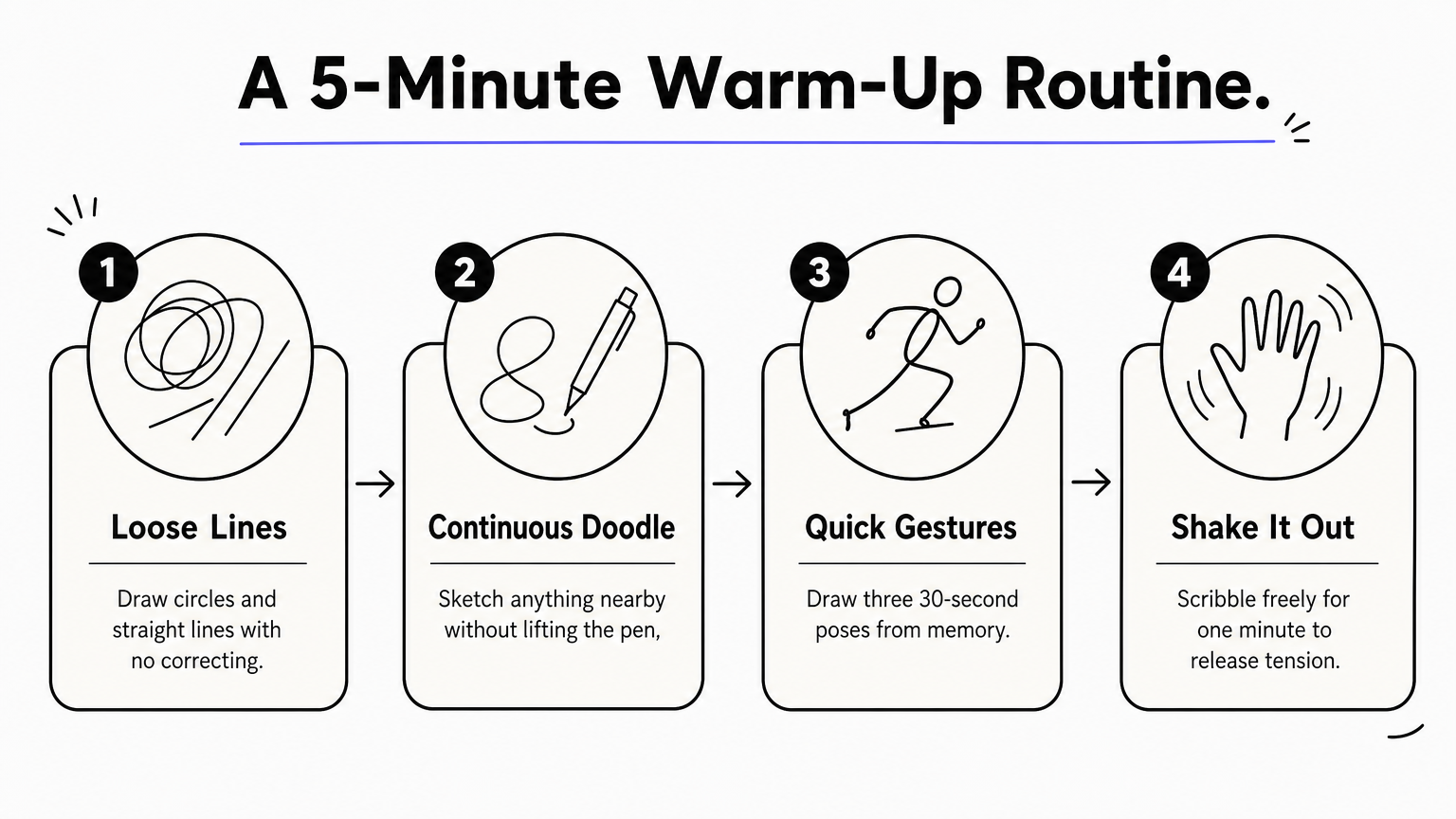
Here's a five-minute sequence you can run before any session, regardless of what skill you're targeting that day:
- Minute 1-2: Loose circles and straight lines across a page, no ruler, no correcting
- Minute 2-3: Continuous-line doodle of anything in the room, pen never leaves the page
- Minute 3-4: Three 30-second gesture sketches from memory or a quick photo
- Minute 4-5: One minute of pure scribbling, just to shake out tension in your hand
Repeating the same rough structure every time removes the decision fatigue of figuring out how to warm up, which is the same reasoning behind naming a specific skill in Step 1.
Treat warm-ups as a habit trigger, not a task
Once the warm-up becomes automatic, it starts doing double duty as the signal that tells your brain a focused session is starting. Pairing that trigger with the practice card you set up in MemoRep works well here too: open the app, see the skill card scheduled for today, then run your five-minute warm-up before diving into the drill itself. Runners stretch before every run without debating it each time, and treating your warm-up the same way keeps you from skipping straight into cold, sloppy attempts at whatever skill you're supposed to be sharpening. Under-warming is a small mistake with a compounding cost: every session that starts stiff pulls your baseline down slightly, and that adds up over months of practice.
Step 4. Practice from observation, not just imagination
Drawing from your head feels natural, but it mostly recycles the same shortcuts you already know. Every hand you draw from memory looks like every other hand you've drawn from memory, because you're copying your own mental symbol instead of looking at an actual hand. Observational drawing forces you to compare what's on the page against something real, and that comparison is where actual correction happens. Skip it and you'll polish the same errors for years without noticing.
Why memory-only drawing locks in errors
Your brain stores drawing knowledge as a simplified symbol, not a photograph, and that symbol rarely gets challenged unless you put a real reference in front of it. Ask five self-taught artists to draw an ear from imagination and you'll get five stiff, generic shapes that don't match any real ear. Ask them to draw the same ear while looking at a reference and the difference is immediate. This is why drawing from observation matters more than raw hours: it's the only version of practice that gives your brain new information to correct against.
Imagination shows you what you already believe. Observation shows you what's actually there.
Rotate through different reference types
Mixing up what you observe keeps a single skill from getting stale while still training it against real information. Cycle through a few source types across the week rather than sticking to one:
- Live models or a mirror for gesture and proportion
- Photo references for anatomy details like hands, feet, and joints
- Household objects for perspective and value studies
- Landscapes or architecture for one and two-point perspective practice
Each type stresses the same underlying skill from a slightly different angle, which is closer to how the skill actually gets used later.
Balance observation with imagination work
None of this means imagination has no place; it's where style and personal voice eventually live. But early on, weight your sessions toward observation, maybe four sessions of reference-based drawing for every one from memory. Once a skill holds up consistently under observation, drawing it from imagination gets noticeably easier and more accurate, because you're now recalling something you've actually verified rather than guessing at a shape you never checked. That balance is part of what separates casual doodling from what effective practice actually looks like over the long run, and it sets up the next problem: fitting all this into a schedule you'll actually stick to.
Step 5. Set a realistic, repeatable practice schedule
Most artists set a schedule they can't actually keep: two hours a day, seven days a week, starting Monday. That plan collapses by Wednesday, and the guilt from missing it does more damage than the missed session ever would. A realistic schedule beats an ambitious one every time, because a schedule you actually follow for six months outperforms a perfect plan you abandon after ten days.
Build around your actual week, not your ideal week
Look at your real calendar, not the version of your week you wish you had. If you genuinely have 20 minutes on weekday mornings and an hour on Saturday, build the schedule around that instead of forcing in a fantasy routine, the same way musicians go about building a practice routine they'll actually keep. Consistency matters more than volume here; four 20-minute sessions a week for a year will move your skills further than three months of ambitious daily sessions followed by three months of nothing.
A schedule you actually follow beats a perfect one you quit after a week.
Short, frequent sessions beat long, rare ones
Spacing sessions out gives your brain time to consolidate what you drilled, which lines up with the same forgetting-curve logic from earlier in this guide. A sample week might look like this:
| Day | Session length | Focus |
|---|---|---|
| Monday | 20 min | Warm-up + named skill drill |
| Wednesday | 20 min | Same skill, different exercise variation |
| Friday | 20 min | Review a skill from two weeks ago |
| Saturday | 45 min | Longer observational session |
Running something close to this weekly, rather than binging on Sunday, keeps each skill fresh instead of letting a week-long gap undo your progress.
Let the schedule tell you what to draw
Once the time slots exist, the remaining decision is what to draw in each one, and that's exactly the piece worth automating rather than re-deciding every session. This is the gap MemoRep was built to close for musicians, and the same logic applies directly to drawing: log your named skills as practice cards, and the app schedules them across your week using spaced repetition math instead of leaving it to memory or motivation. Open the app on a Wednesday morning and it already knows whether today should be a new drill or a review of foreshortening from two weeks back. That removes the daily negotiation of what to draw, which is the same decision fatigue that stalls unfocused practice in the first place. With the schedule handling the timing, the next piece is making sure you're actually judging your own work honestly.
Step 6. Review and critique your own work
Finishing a drawing without looking back at it critically wastes half the value of the session. Self-critique is what turns a page of marks into actual feedback, and skipping it means you're repeating the same errors next week without ever spotting them. Most artists glance at a finished piece, feel a vague sense of "okay" or "not great," and move on, but that vague feeling doesn't tell you anything you can act on next time.
Compare against the reference, not your memory
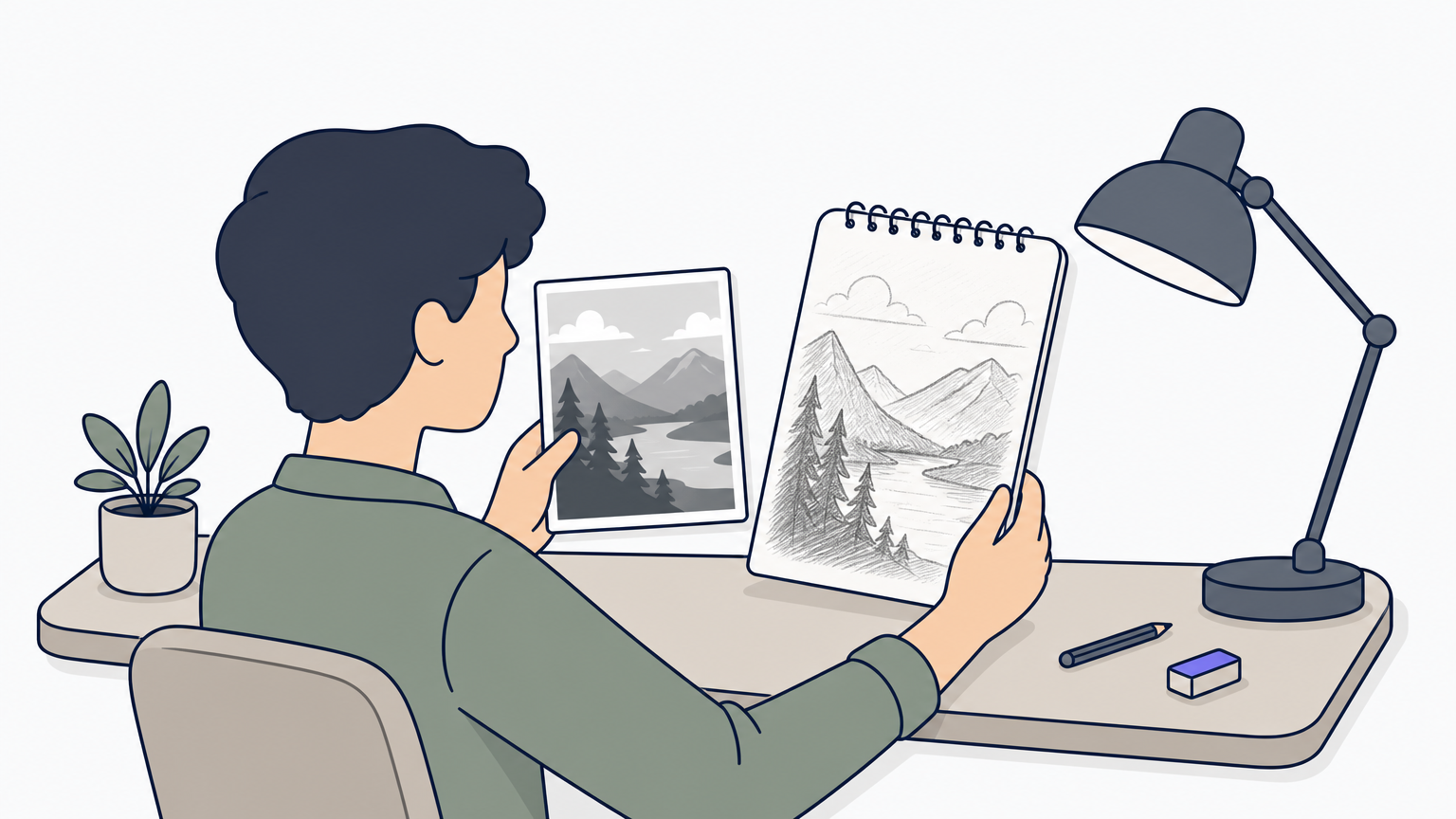
Hold your drawing next to the reference photo or object and look for specific gaps instead of a general impression. Did the proportions actually match, or did you round them off toward what felt familiar? Comparing directly against the source, rather than against your recollection of it, is the only way to catch the small drift that memory-based judgment always misses. This is the same principle behind observational drawing in Step 4: real information beats your internal assumption every time.
Use a short checklist instead of a gut feeling
A structured checklist keeps critique consistent from session to session, rather than depending on whatever mood you're in that day. Run through something like this after every drawing:
- Does the proportion match the reference within a reasonable margin?
- Is the line confident, or does it show hesitation and re-tracing?
- Does the value range actually go from light to dark, or does it sit flat in the middle?
- Did you solve the specific skill you named in Step 1, or drift into something else?
A finished drawing without a critique is just a page you'll forget by next week.
Write the critique down, not just in your head
Jot a one-line note next to the drawing (or in a journal template for logging practice notes) naming the single biggest issue you spotted. "Left arm too short" or "values too flat, no dark accents" is more useful six weeks from now than a mental impression that fades by tomorrow. This is exactly the kind of note worth attaching to a MemoRep practice card, since the app already resurfaces that skill later, and having last session's specific critique sitting right there tells you precisely what to fix instead of starting the review from zero. Feed each critique forward into your next drill on that skill, and progress stops being a vague sense of "getting better" and turns into a documented trail of specific problems you actually solved.
Step 7. Revisit old skills before they fade
Learning a new skill feels productive, but if you never come back to it, that progress quietly evaporates. Skill decay doesn't announce itself; you won't notice your gesture drawing slipping until you sit down after a two-month gap and your lines look tentative again. Revisiting old skills on purpose, before that slide happens, is what locks in the work you already put in.
Schedule reviews before you feel the need
Waiting until a skill feels rusty means you've already lost ground, and rebuilding it takes longer than a quick refresher would have. Instead, plan a review session two to three weeks after you first drill something, then again a month or two after that, stretching the gap each time the skill holds up, which is one of several strategies for reviewing before a skill decays. This spaced-out pattern mirrors the same forgetting-curve logic behind Step 5's schedule, just applied to skills instead of sessions.
The skill you stopped practicing last month is the one quietly getting worse right now.
Rotate through a short list of past skills
Keep a running list of everything you've named and drilled so far, gesture, perspective, hands, whatever it is, and rotate through it deliberately instead of trusting your memory to flag what's fading. A simple version looks like this:
| Skill last drilled | Weeks since | Review status |
|---|---|---|
| Foreshortened arms | 2 | Due for review |
| Two-point interiors | 6 | Due for review |
| Value scales | 3 | Holding steady, extend interval |
Glancing at a table like this once a week takes the guesswork out of deciding what old skill deserves attention today.
Let the app carry the list for you
Manually tracking dozens of skills at different intervals gets messy fast, which is exactly the problem MemoRep's scheduling was built to solve. Every practice card you created back in Step 1 already carries its own review timeline, so foreshortening resurfaces right when the app's algorithm predicts it's about to fade, and value control gets pushed further out because you've held onto it reliably. Rather than juggling a spreadsheet of dates, you open the app and see exactly which old skill needs a touch-up today. That's the same underlying idea musicians rely on for scales and repertoire, applied directly to a sketchbook, and it's what keeps last month's hard-won progress from silently disappearing while you're busy learning something new.
Step 8. Track progress over months, not days
Drawing feels stagnant when you judge it session by session, because the difference between Tuesday's page and Thursday's page is almost never visible. Long-term tracking is what actually reveals improvement, since the gap between a foreshortened arm you drew in March and one you draw in June is real and obvious, even when the daily gap looks like nothing changed at all. Judging progress on a 24-hour cycle sets you up to feel discouraged for no good reason.
Why day-to-day comparisons mislead you
Skill grows in a jagged line, not a straight one, and a rough Wednesday sketch doesn't mean you regressed. Short-term noise (a bad reference photo, a tired hand, an off day) hides the actual trend, so comparing today's drawing to yesterday's tells you almost nothing useful about why skills you don't review quietly fade. Zoom out to a monthly view instead and the noise cancels out, leaving the real trajectory visible.
Progress in drawing shows up in months, not in the next page you flip to.
Compare the same drill across time
Redraw the exact same prompt at fixed intervals so the comparison is fair, not just a general "do I feel better" impression. Try this rhythm:
- Redraw the identical reference or pose at day 1, day 30, and day 90
- Keep the same paper size and time limit each round
- Lay all three drawings side by side, not one at a time from memory
Even a rough three-month spread makes the improvement obvious in a way that daily glances never will.
Let your practice history do the comparing for you
Manually digging up an old sketch from three months back is exactly the kind of upkeep that quietly gets skipped once life gets busy. Since MemoRep already timestamps every practice card and logs your Again/Hard/Good/Easy ratings over time, you get a running record of how a specific skill has moved without keeping a separate log yourself. Opening that history for "foreshortened arms" and seeing your ratings shift from mostly Hard to mostly Good over ten weeks tells you more than any single drawing ever could. Reviewing that trend monthly, rather than fishing for daily reassurance, keeps you focused on the only timescale where drawing improvement is genuinely visible.
Drawing exercises to try at every skill level
Different skill levels need different drills, and pushing an advanced exercise on someone still shaky with basic proportion just breeds frustration. Skill-appropriate exercises keep the challenge matched to where you actually are, so every session builds confidence instead of exposing gaps you're not ready to close yet, which is how cognitive load limits what you can practice at once. Below is a quick reference you can pull from regardless of where you're starting, organized by level rather than by subject matter.
Beginner exercises: build the fundamentals
At this stage, the goal is control, not accuracy. Focus on exercises that train your hand and eye to work together before you worry about anything polished:
- Straight-line and ellipse ladders, no ruler, 50 reps a session
- Basic form studies (spheres, cubes, cylinders) from a single light source
- Blind contour drawing of household objects, eyes on the object, not the page
- Simple gesture sketches from photos, 60 seconds per pose
Intermediate exercises: connect skills together
Once the fundamentals hold up consistently, start combining them instead of drilling each in isolation. This is where structured practice starts paying off, since you're now applying more than one skill at once:
- Figure drawing with gesture and proportion combined, 2 to 5 minutes per pose
- Perspective studies using real interiors, not just constructed boxes
- Value studies on complex still-life setups with multiple light sources
- Hand and face studies from varied angles, no reference repeated twice
Advanced exercises: refine and stress-test
At an advanced level, exercises should expose remaining weaknesses under harder conditions, not just repeat what already works.
The exercise that still feels uncomfortable is the one still worth doing.
- Timed full-figure studies under 5 minutes, from a live model if possible
- Invented perspective scenes combining one, two, and three-point setups
- Anatomy studies focused on foreshortening from unusual angles
- Full-tonal renders in a single sitting, no reference for values after the first pass
Match the level to the skill, not the artist
Here's the part beginners often miss: you can be advanced at gesture and still beginner-level at perspective, so pick the exercise tier per skill, not per person. That's really the core of how to practice drawing effectively long-term, targeting each named skill at the difficulty it actually deserves. If you're logging these as MemoRep practice cards, tag each one with its level so the app resurfaces beginner drills for weaker skills and advanced ones for whatever's already solid.
Turning practice into steady progress
None of this requires talent you don't already have. Effective drawing practice comes down to naming one skill, drilling it with the right exercise, and revisiting it before it fades, then repeating that cycle for months instead of days. Skip the vague sketchbook sessions and you skip the guesswork that's been stalling your progress all along.
You don't need a spreadsheet or a perfect memory to run this system. Spaced repetition scheduling handles the timing question that trips up most self-taught artists: what to draw today, and what's due for review. If you want to see the science behind why this works before committing to anything, check out how MemoRep's scheduling algorithm works. And if you're ready to stop guessing session to session, see how MemoRep puts your drawing skills on a review schedule and grab free lifetime access while beta spots remain open.