How to Practice Violin Effectively: Tips That Work
You picked up your violin, ran through a few passages, and still walked away wondering if that session actually moved the needle. How to practice violin effectively isn't really about finding new bowing tricks or scale patterns, it's about knowing what to revisit and when, so nothing you've worked on quietly slips away.
Most players lose ground not because they lack technique advice from their teacher, but because their practice sessions have no memory. You forget which passage needs work, which excerpt is about to get rusty, and which piece you haven't touched in three weeks. That's the real problem this guide addresses: building a repeatable structure around the material your teacher already gave you, so your practice routine stops running on guesswork.
Below you'll find concrete ways to organize your sessions, track what's fading from memory, and decide what deserves your limited practice time today versus next week. These are the same principles behind spaced repetition tools like MemoRep, applied specifically to the kind of skill-building violin practice demands.
Why practice routine structure matters more than practice time
Many violinists assume that logging more hours guarantees improvement, but time on the instrument and actual retention are two different things. You can spend ninety minutes running through a concerto and still lose the fingering you nailed last Tuesday, simply because nothing in your session reminded you to revisit it. The real driver of progress isn't duration, it's whether your practice has a built-in structure that decides what comes back into rotation and when.
The forgetting curve doesn't wait for your next lesson
Hermann Ebbinghaus documented this over a century ago: memory decays predictably unless it's reinforced at the right intervals. Violin technique behaves the same way. A shift you drilled cleanly in Monday's session will feel shaky by Thursday if you don't touch it again, and by the following week it may need to be relearned almost from scratch. This is why how to practice violin more effectively really comes down to timing your revisits, not just adding more repetitions in a single sitting.
A practice session without a plan for what to revisit tomorrow is just a rehearsal for forgetting.
What unstructured practice actually costs you
Without structure, every session starts with the same question: what do I even work on today? That decision fatigue eats into your limited practice window before you've touched the instrument. Worse, it tends to favor whatever piece is freshest in your memory or most fun to play, while the passage you struggled with two weeks ago quietly fades. The table below shows how the two approaches diverge over a few weeks.
| Approach | Week 1 | Week 3 | Week 6 |
|---|---|---|---|
| Unstructured practice | Covers 5 passages | Recalls 2 clearly | Relearns most from scratch |
| Structured, scheduled revisits | Covers 5 passages | Recalls 4 with minor cleanup | Retains 4, minor tune-up only |
Notice that the unstructured column doesn't fail because the player practiced badly in week one. It fails because nothing told them to come back to that material before it decayed.
Structure turns scattered effort into compounding progress
Given this, the fix isn't a longer practice session, it's a repeatable system that tells you what needs attention today based on how long it's been sitting untouched. Once you separate "what to practice" from "when to practice it," your sessions stop being a guessing game and start compounding, week over week, instead of resetting every time you forget a passage existed. That shift, from open-ended noodling to a scheduled rotation, is what the next four steps walk you through, starting with the simplest change: giving every session an actual goal before you pick up the bow.
Step 1. Set a clear goal for every session
Walking to your stand and thinking "I'll just play through some stuff" is how sessions turn into aimless noodling. Before you lift the bow, name one specific outcome you want from the next 20 or 30 minutes. Not "get better at shifting," but "clean third-position shift in bar 14 without a scratchy landing." A vague goal produces vague practice, and practicing with a defined target is exactly what makes how to practice violin more effectively stop feeling like an unsolvable puzzle.
Pick one target, not five
Resist the urge to fix everything you noticed last lesson in a single sitting. Pick the single passage or technical issue costing you the most points in a run-through, and build the whole session around it. A few examples of session-sized goals:
- Get through the exposition of your sonata at 80% tempo without stopping
- Land the octave shift in measure 32 cleanly five times in a row
- Play the scale pattern with even bow distribution, no accents on string crossings
Each of these is small enough to actually finish and specific enough that you'll know, in real time, whether you succeeded.
A session with one clear target beats an hour of unfocused repetition every time.
Write it down before you touch the strings
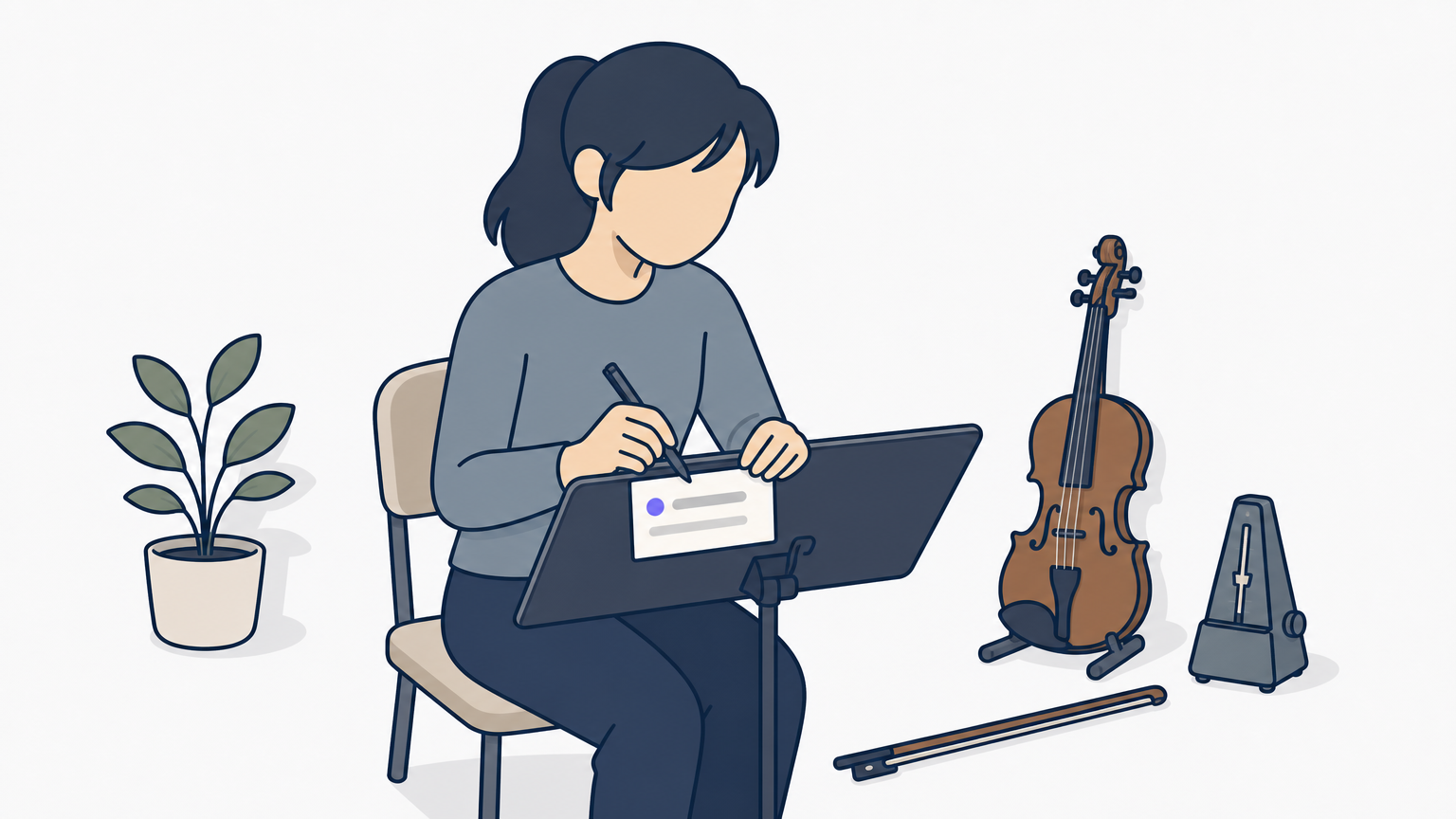
A goal that lives only in your head evaporates the moment a passage frustrates you and you drift toward something easier. Jot it down, on paper or in an app, before you start the clock. This is also the moment to log the goal as its own practice card rather than a mental note, since a written record is what lets you check, days later, whether that shift actually stuck or quietly slipped back to where it started. If you're using MemoRep to organize your sessions, this is exactly what a practice card is built for: one goal, one card, ready to reappear on your schedule when it's due for another look.
Step 2. Break your practice into focused segments
Once you have a goal, resist the urge to chase it for a full uninterrupted hour. Long, unbroken practice blocks feel productive, but your brain retains technical work better when it comes in shorter, focused segments with clear breaks between them. Splitting a 45-minute session into three 12-minute segments, each targeting one goal, beats one long block where fatigue creeps in and your last ten minutes barely register.
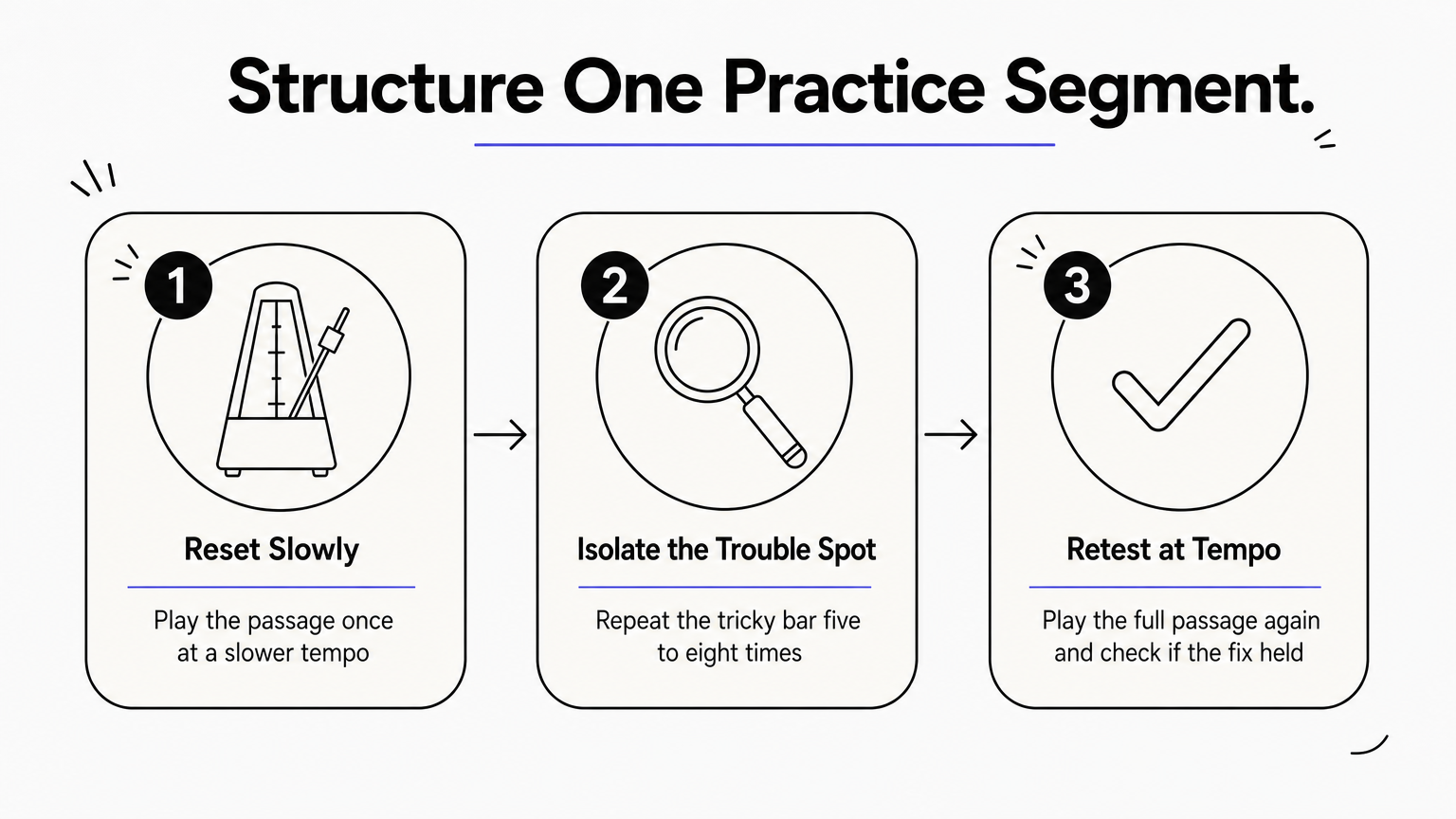
Structure a segment, don't just run the clock
A focused segment isn't just a timer counting down while you play. Give each one a start, a middle, and a checkpoint:
- Play the passage once at a slower tempo to reset your ear and hands
- Isolate the exact bar or shift giving you trouble, repeat it five to eight times
- Play the full passage again at target tempo and note whether the fix held
A segment with a checkpoint teaches you something; a segment that just ends teaches you nothing.
Match segment length to the skill, not the clock
Different material needs different treatment. A tricky shift might only need eight focused minutes before your hands start compensating with tension. A full movement run-through needs more room to breathe. Don't force every task into the same box.
| Task type | Suggested segment length | Signal to stop |
|---|---|---|
| Isolated technical fix (shift, crossing) | 8-12 minutes | Fatigue or tension creeps in |
| Passage at tempo | 12-15 minutes | Three clean repetitions in a row |
| Full run-through | 15-20 minutes | You've covered the whole section once |
Think of each segment as its own miniature session with its own outcome, separate from the broader goal you wrote down in Step 1. That separation matters later: when you log results, a practice card tied to one segment gives you a much clearer signal than a vague note covering an entire hour of mixed work.
Step 3. Track your practice and rate your results
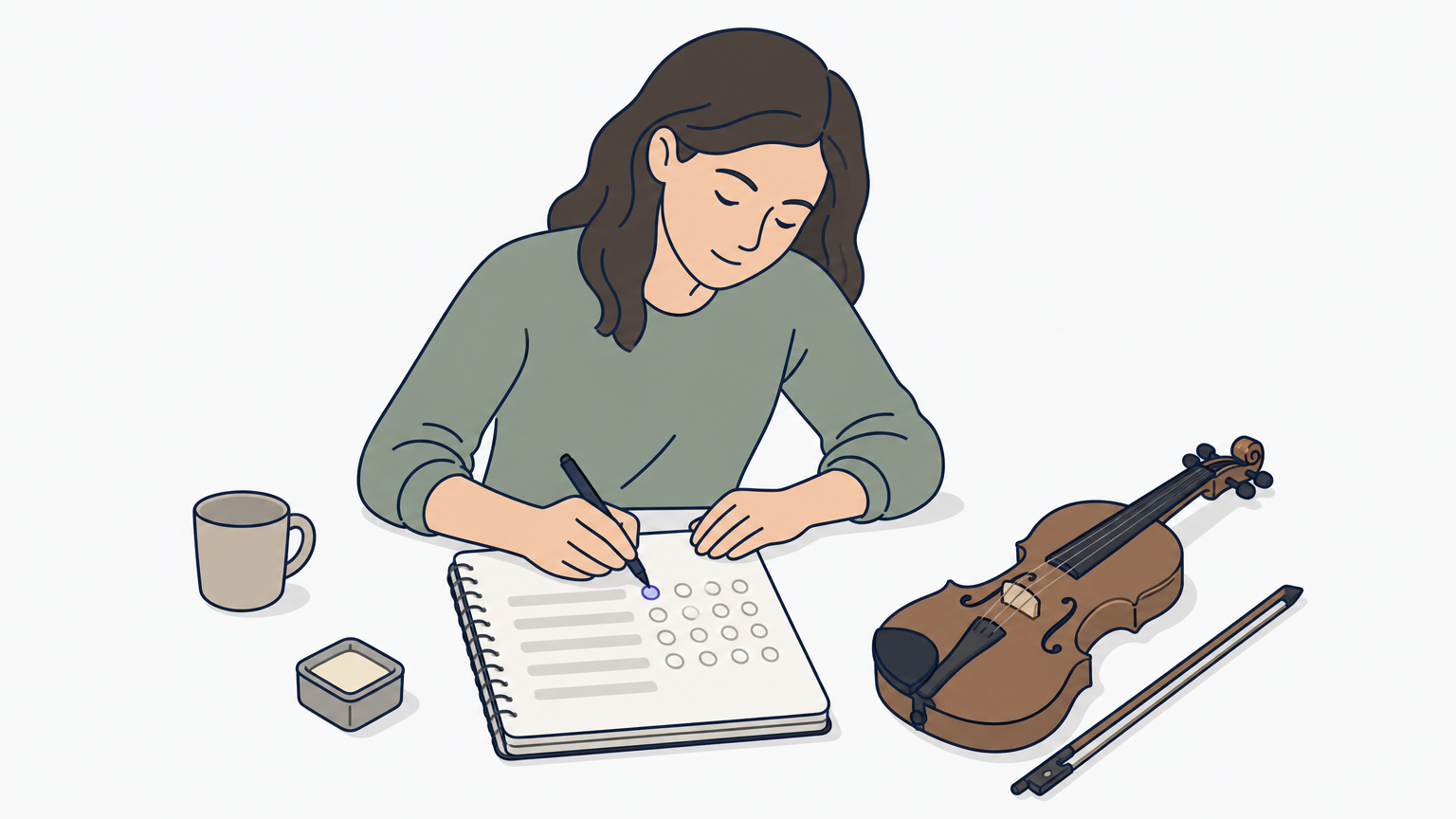
Finishing a segment without writing down how it went is the fastest way to lose the whole point of Step 2. Right after you play the passage at tempo, rate it honestly. Did the shift hold, or did it collapse the moment you stopped focusing? This single habit turns a session from a blur of playing into a dated record you can actually use next week.
Use a simple rating scale, not a paragraph
You don't need a long entry in a practice journal template for musicians. A quick rating, logged against the same practice card every time, is enough to spot patterns. Most spaced repetition systems, including the one behind MemoRep, use a four-point scale:
- Again: the passage fell apart, needs to come back tomorrow
- Hard: it worked, but shakily, needs another look soon
- Good: solid performance, normal revisit interval is fine
- Easy: clean and automatic, push the next review further out
Rating a passage takes ten seconds and saves you from relearning it from scratch next month.
Let the rating do the deciding, not your mood
This is where tracking earns its keep. Without a rating, you decide what to practice tomorrow based on how you feel that morning, and feelings are unreliable. With a rating attached to each practice card, the decision is already made for you: an "Again" card resurfaces almost immediately, an "Easy" one waits weeks before it needs another glance. That's the mechanism that makes how to practice violin more effectively stop being a daily guessing game.
Keep the log lightweight
A spreadsheet works. A notebook works. What matters is consistency, not the tool, so pick whichever practice log format you'll actually keep. If you'd rather not build the tracking system yourself, MemoRep attaches the rating step directly to each card and handles the scheduling math behind it, so the log and the revisit plan live in the same place instead of two separate habits you have to maintain.
Step 4. Schedule revisits with spaced repetition
Rating a passage only pays off if that rating actually changes when you see the material again. This is where what spaced repetition looks like in practice takes over from guesswork: instead of deciding tomorrow morning what to practice, the interval is set the moment you log the result. An "Again" card comes back within a day. A "Good" rating pushes the next look out several days. The gap grows every time you clear a card cleanly, and shrinks the moment you don't.
Set intervals based on the rating, not the calendar
Building this by hand is doable with a notebook and a few rules, at least while your list of passages stays small:
| Rating | Next revisit |
|---|---|
| Again | Next day |
| Hard | 2-3 days |
| Good | 5-7 days |
| Easy | 10-14 days |
Every time you rate a card, you're really answering one question: how soon does this need to interrupt fresh material again? That question is what turns Step 3's ratings into an actual schedule instead of a log nobody checks.
The interval between reviews should shrink or grow with your last performance, never with the day of the week.
Let the rotation grow without overwhelming you
Once you're tracking more than a handful of shifts, scales, and passages, doing this math by hand starts eating the same practice time you're trying to protect. This is exactly the gap MemoRep fills: it applies the SM-2 spaced repetition algorithm to every practice card automatically, so the moment you tap Good or Hard, the next due date is already set. You open the app, and it tells you which cards are due today, no spreadsheet required.
Trust the schedule over your instinct
Most violinists, left to their own judgment, revisit whatever feels urgent that day. A working schedule overrides that instinct on purpose, surfacing the octave shift you rated Hard eleven days ago even though you'd forgotten it existed. That's the entire point of spaced revisits: nothing you've built gets to quietly expire just because it stopped feeling urgent.
Making consistent practice a habit
None of the four steps here work as a one-time fix. Setting a goal, breaking your session into segments, rating what happened, and scheduling the revisit only pay off when you repeat that loop week after week. Consistency, not intensity, is what separates the violinist who retains everything they've learned from the one relearning the same shift every month. The good news is that once the structure is in place, you stop deciding what to practice and just show up for what's due.
Building this system by hand works, but it takes discipline to maintain the log and do the interval math yourself. If you'd rather skip that overhead, see what powers MemoRep's practice scheduling and let the algorithm handle the timing while you focus on playing. MemoRep is currently free for the first 200 beta users, so there's little reason to keep guessing what to practice tomorrow.