Deliberate Play vs Deliberate Practice: Key Differences
You've probably heard both terms tossed around by coaches, teachers, or parents trying to explain why some athletes and musicians improve faster than others. The debate over deliberate play vs deliberate practice shows up in youth sports, music lessons, and skill coaching everywhere, but the two concepts get blurred together more often than they should.
Here's the direct answer: practice that targets specific weaknesses is structured, effortful, and usually guided by a coach or a plan. Deliberate play is unstructured, self-directed, and driven by enjoyment, like kids scrimmaging pickup basketball or a guitarist jamming without sheet music. Both matter, but they serve different jobs in skill development, and mixing them up leads to burnout or stalled progress.
In this article, you'll get clear definitions of each term, see how researchers distinguish their roles in athlete development, and learn when to lean on one versus the other. If you're building a deliberate practice plan, whether for a sport or an instrument, understanding this distinction changes how you structure sessions, which is exactly the kind of decision tools like MemoRep help you automate once you know the difference.
Why the difference matters for skill development
Getting this distinction wrong costs you time, and it costs kids their love of the game or the instrument. Coaches who run every session like a drill sergeant, and parents who schedule every free hour with private lessons, often produce technically sound performers who quit by age fourteen. On the flip side, athletes and musicians who never move past unstructured fun plateau early because nobody ever isolates their weak spots. How skills are actually acquired depends on knowing which mode you're in and why, because the two approaches build different things and burn out different reserves.
The research behind the two paths
Ericsson's 1993 study of expert performance set the framework most coaches still use today: expert performance comes from thousands of hours of effortful, feedback-driven repetition aimed at specific weaknesses, not just time spent doing the activity. Ericsson studied violinists, chess players, and athletes, and found that the elite performers weren't just practicing more, they were practicing with intense focus on the exact skills that needed fixing, often alone, often uncomfortable. A decade later, sport psychologist Jean Côté pushed back with research on youth athletes showing that early specialization and pure deliberate practice actually predicted higher dropout rates. His Developmental Model of Sport Participation introduced deliberate play as the missing piece, unstructured, self-organized activity like street hockey or backyard soccer that builds intrinsic motivation, creativity, and a broad movement vocabulary before kids narrow into specialized training.
What each approach actually builds
Here's where the two diverge in practical terms. Deliberate practice targets a narrow skill with immediate corrective feedback, so it's efficient at closing specific gaps, like fixing a pitcher's release point or a guitarist's chord transition. Deliberate play, by contrast, builds broad motor patterns, decision-making under unpredictable conditions, and the kind of game sense you can't drill in isolation. If your child only ever practices free throws in a controlled gym setting, they'll shoot well in practice but freeze when a defender's hand is in their face during a real game, because they never learned to adapt on the fly.
Deliberate practice fixes what's broken; deliberate play teaches you what to do when nothing goes as planned.
The real cost of picking the wrong one
Jumping straight to eight-hour structured practice schedules for a ten-year-old is a common mistake, and it backfires. Research on youth sport attrition consistently links early, intense specialization to higher injury rates and higher quit rates by the mid-teens, precisely because deliberate practice removes the enjoyment that keeps young learners engaged long enough to reach the years where structured work actually pays off. Overloading a beginner musician with metronome drills before they've had a chance to just noodle around and enjoy the instrument produces the same result: technically competent players who resent practicing and quit lessons within a year or two.
Kids who spend their early years in unstructured play, sampling multiple sports or instruments, tend to show more resilience and stronger long-term engagement once they do specialize. That's not an argument against structure altogether. It's an argument for sequencing it correctly, which is exactly what the next section covers.
A quick side-by-side comparison
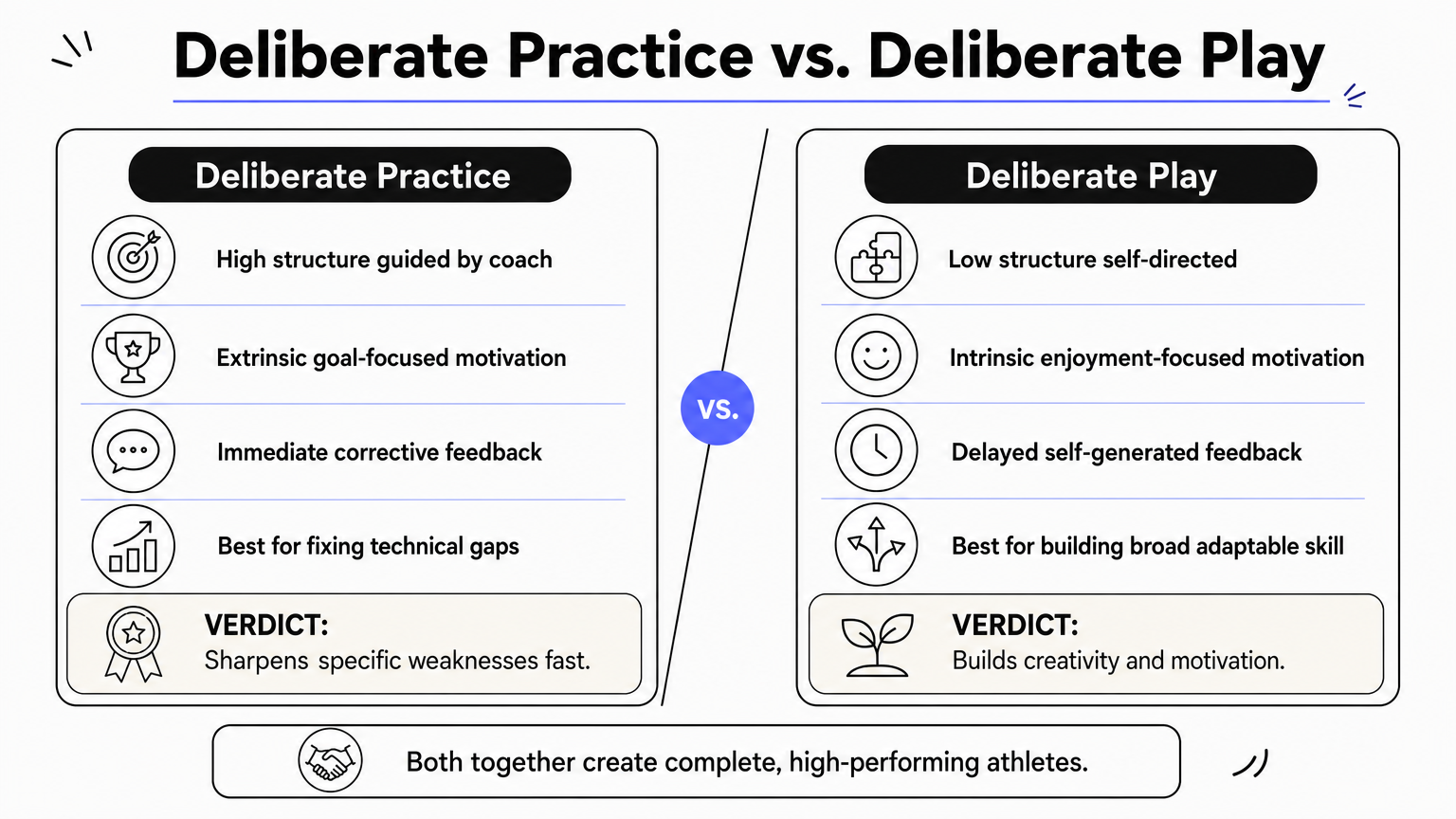
Use this table when you're trying to figure out which mode a given session should fall into:
| Factor | Deliberate Practice | Deliberate Play |
|---|---|---|
| Structure | High, coach or plan-driven | Low, self-directed |
| Motivation | Extrinsic, goal-focused | Intrinsic, enjoyment-focused |
| Feedback | Immediate, corrective | Delayed or self-generated |
| Error tolerance | Low, mistakes get corrected fast | High, mistakes are part of the game |
| Best for | Fixing specific technical gaps | Building broad skill and motivation |
| Typical setting | Lessons, drills, film review | Pickup games, jam sessions, free play |
Notice how the two columns rarely overlap. That's the point. Deliberate play and deliberate practice aren't two versions of the same activity done at different intensities, they're built on opposite assumptions about structure and error. Play tolerates mistakes because that's how creativity and adaptability form. Practice targets mistakes because that's how precision forms.
Why this shapes long-term retention
The forgetting curve doesn't care whether you learned a skill through structured drilling or a pickup game, but it does care whether the skill got reinforced with the right kind of repetition afterward. A skill built through deliberate play often needs deliberate practice later to sharpen the rough edges, and a skill drilled through deliberate practice needs deliberate play to test whether it actually transfers to real conditions. Skipping either step means you end up with athletes who look great in practice but freeze in games, or musicians who nail scales but can't improvise a single bar. Understanding this interplay is exactly why tools that manage spaced review, like the practice cards MemoRep was built around, matter more once you've picked the right mode of practice for the moment, because timing the follow-up review determines whether the skill sticks or fades.
How to decide which approach fits your goal
Every practice session should start with one question: what am I actually trying to fix or build right now? If you can name a specific, isolated weakness, like a slipping bow grip or a wobbly free-throw follow-through, you're squarely in deliberate practice territory. If you're trying to build adaptability, creativity, or sheer love for the activity, deliberate play is the better tool. The mistake most learners make is defaulting to one mode for everything, running every session like a drill even when the goal calls for loose, exploratory reps.
Match the mode to the goal
Think of your goal as a filter. A goal like "clean up my saxophone embouchure" or "stop double-faulting on serve" points straight at [structured, corrective drilling techniques](https://memorep.com/en/blog/deliberate-practice-techniques), because it's narrow, measurable, and fixable with immediate feedback. A goal like "get comfortable improvising over changes" or "read the defense faster" points toward unstructured, self-directed reps, because those skills only sharpen under unpredictable, game-like conditions you can't script in advance. Ask yourself whether the goal is a technical fix or a contextual skill, and the answer usually points you toward the right mode without much guesswork.
A simple checklist for choosing
Run through this short list before you plan your next session:
- Can you name the exact error? If yes, lean toward deliberate practice; if the issue is vague or situational, lean toward deliberate play.
- Does the skill need to hold up under pressure or unpredictability? If yes, you need reps in play-like conditions, not isolated drills.
- Has motivation dropped recently? Low motivation usually signals too much structured practice and not enough play, especially with younger learners.
- Is a competition or performance close? Tight timelines favor targeted practice; open timelines leave room for exploratory play.
- Are you a beginner or advanced performer? Beginners generally need more play to build a broad base; advanced performers need more targeted practice to close remaining gaps.
Let the timeline decide too
Sometimes the calendar makes the decision for you, not the theory. A guitarist with a recital in ten days doesn't have time for open-ended jamming, they need focused reps on the exact passages that keep tripping them up. A twelve-year-old soccer player with an entire off-season ahead has plenty of room for pickup games and scrimmages that build instinct without a coach hovering over every touch. Shorter windows push you toward deliberate practice because it's the more time-efficient way to close a known gap. Longer windows, especially in the off-season or early learning years, favor deliberate play because the payoff shows up months later, not in the next session.
If you can't name the exact mistake you're fixing, you're probably in the wrong mode for the goal.
Don't ignore the emotional signal
Burnout and boredom are data points, not distractions from the plan. If a learner starts dreading practice, that's usually a sign the ratio has tipped too far toward rigid drilling and needs an infusion of low-stakes, self-directed play. Otherwise, if progress has stalled for weeks despite plenty of enjoyable, unstructured reps, that's a signal to add structure and target the specific errors holding things back. Tools like MemoRep are built for exactly the deliberate practice side of this equation, since they schedule targeted review of specific skills at the interval where they're about to fade, but they work best once you've already decided which skills deserve that kind of structured attention versus which ones just need more open reps to develop naturally.
Reasonable people can disagree on the exact ratio, but the decision process itself is simple once you separate what the goal actually requires from how much time you have to hit it. Get those two questions answered honestly, and the choice between structured drilling and open play stops feeling like a guess.
How the balance shifts across developmental stages
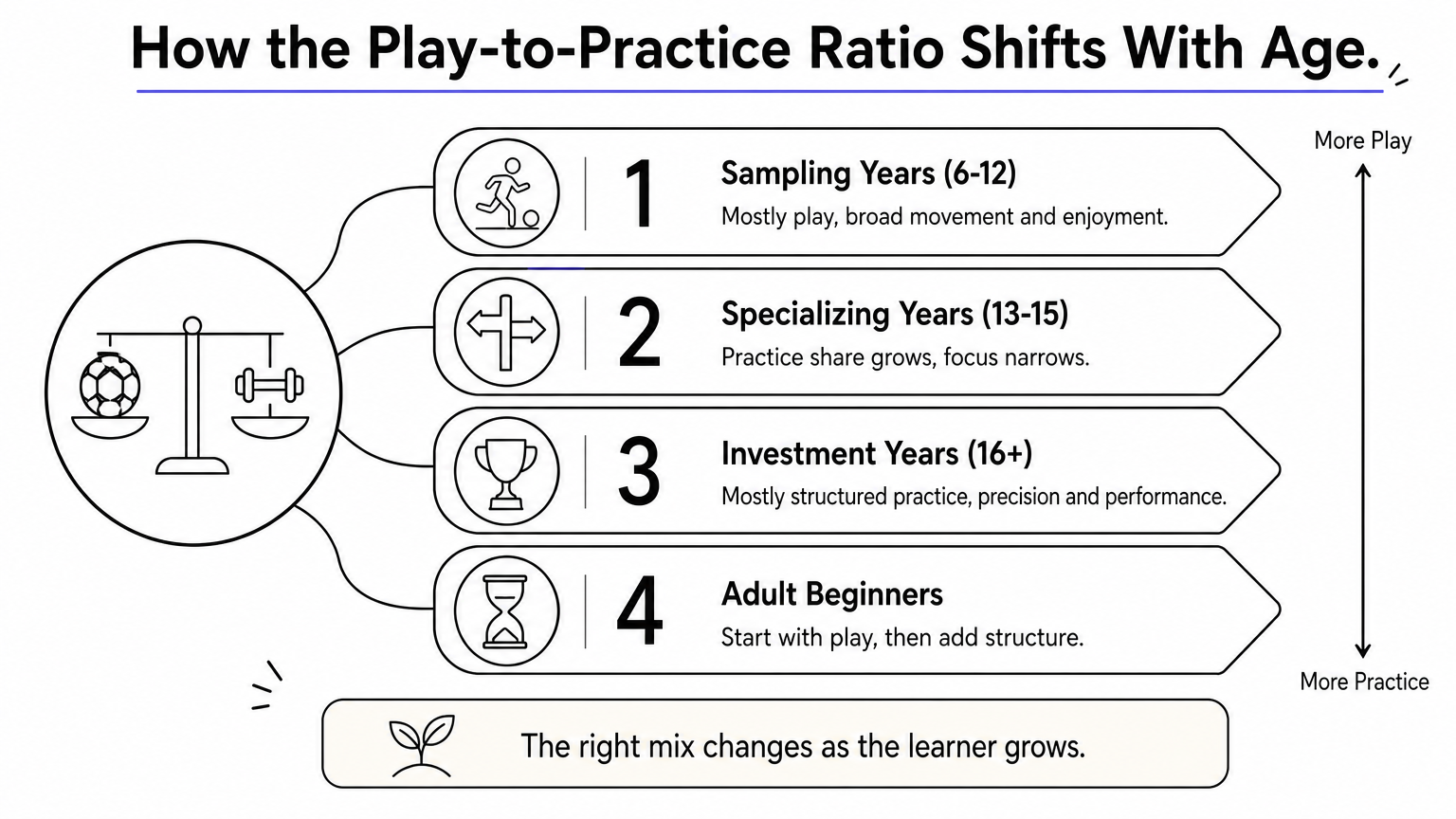
The right ratio between deliberate play and deliberate practice isn't fixed. It shifts as a learner ages, and getting the timing wrong is one of the fastest ways to stall a promising athlete or musician. Côté's Developmental Model of Sport Participation breaks this progression into stages, and while it was built for youth sports, the same logic maps cleanly onto music, dance, and other practical skills. Understanding where a learner sits on this timeline tells you how much structure to add and how much unstructured play to protect.
The sampling years (roughly ages 6 to 12)
Early on, kids need exposure more than expertise. During what Côté calls the sampling years, the goal is broad movement literacy and sheer enjoyment, not narrow technical polish. A nine-year-old who tries soccer, swimming, and piano in the same year is building a wider base of coordination and motivation than one locked into three-hour daily violin drills. Deliberate play should dominate this stage, making up the large majority of practice time, with only light, low-pressure structure mixed in.
- Multiple activities or instruments, sampled rather than mastered
- Practice sessions that look like games, not drills
- Coaching or teaching that corrects gently and rarely
- Almost no talk of long-term outcomes or competition results
Push structured drilling too early, and you trade a decade of enjoyment for a skill that peaks before it should.
The specializing years (roughly ages 13 to 15)
Somewhere around early adolescence, most learners start narrowing their focus, whether by choice or by the demands of a school team or a serious teacher. This is when deliberate practice starts earning a bigger share of total practice time, though it shouldn't take over completely. A young pianist preparing for a competitive audition now benefits from focused technical work on specific passages, but she still needs room to improvise and play music she enjoys without a metronome watching. Cutting play out entirely at this stage is exactly what predicts the dropout spikes researchers keep finding in early-specialization athletes.
The investment years (roughly 16 and up)
Once a learner commits to competing seriously or performing at a high level, deliberate practice takes the lead. Skills need to be precise, weaknesses need to be closed fast, and feedback loops need to be tight. But even elite performers keep some deliberate play in the mix, scrimmages for athletes, jam sessions for musicians, because it's still the mechanism that tests whether drilled skills hold up under real, unpredictable conditions. A violinist who only ever practices from sheet music never develops the ear for improvisation that live performance sometimes demands.
Adult learners don't follow the same clock
Adults picking up a new instrument or sport later in life often skip the sampling years altogether, and that's a mistake worth avoiding. Adult beginners benefit from more play than they usually give themselves permission for, because the instinct is to jump straight into structured lessons and rigid drills. Give yourself the equivalent of a sampling phase, weeks of loose exploration before you start layering on corrective feedback, and you'll build the same broad foundation a younger learner gets naturally.
| Stage | Approximate age | Play-to-practice ratio | Primary focus |
|---|---|---|---|
| Sampling years | 6 to 12 | Mostly play | Enjoyment, broad movement, motivation |
| Specializing years | 13 to 15 | Shifting toward practice | Narrowing focus, adding technical work |
| Investment years | 16 and up | Mostly practice | Precision, competition, performance |
| Adult beginners | Any age | Start with play, add practice | Building a foundation before drilling |
No stage eliminates the other approach entirely. The shift is gradual, and forcing it too fast in either direction, either rushing a ten-year-old into eight-hour practice blocks or letting a serious sixteen-year-old competitor coast on pickup games alone, tends to backfire in predictable ways.
Examples of deliberate play and practice in action
Abstract definitions only get you so far. Seeing how deliberate play and deliberate practice show up in real training sessions makes the distinction stick, and it gives you a step-by-step template to copy for your own routine. Below are concrete examples pulled from sports and music, the two domains where this research gets applied most often.
Basketball: free throws versus pickup games
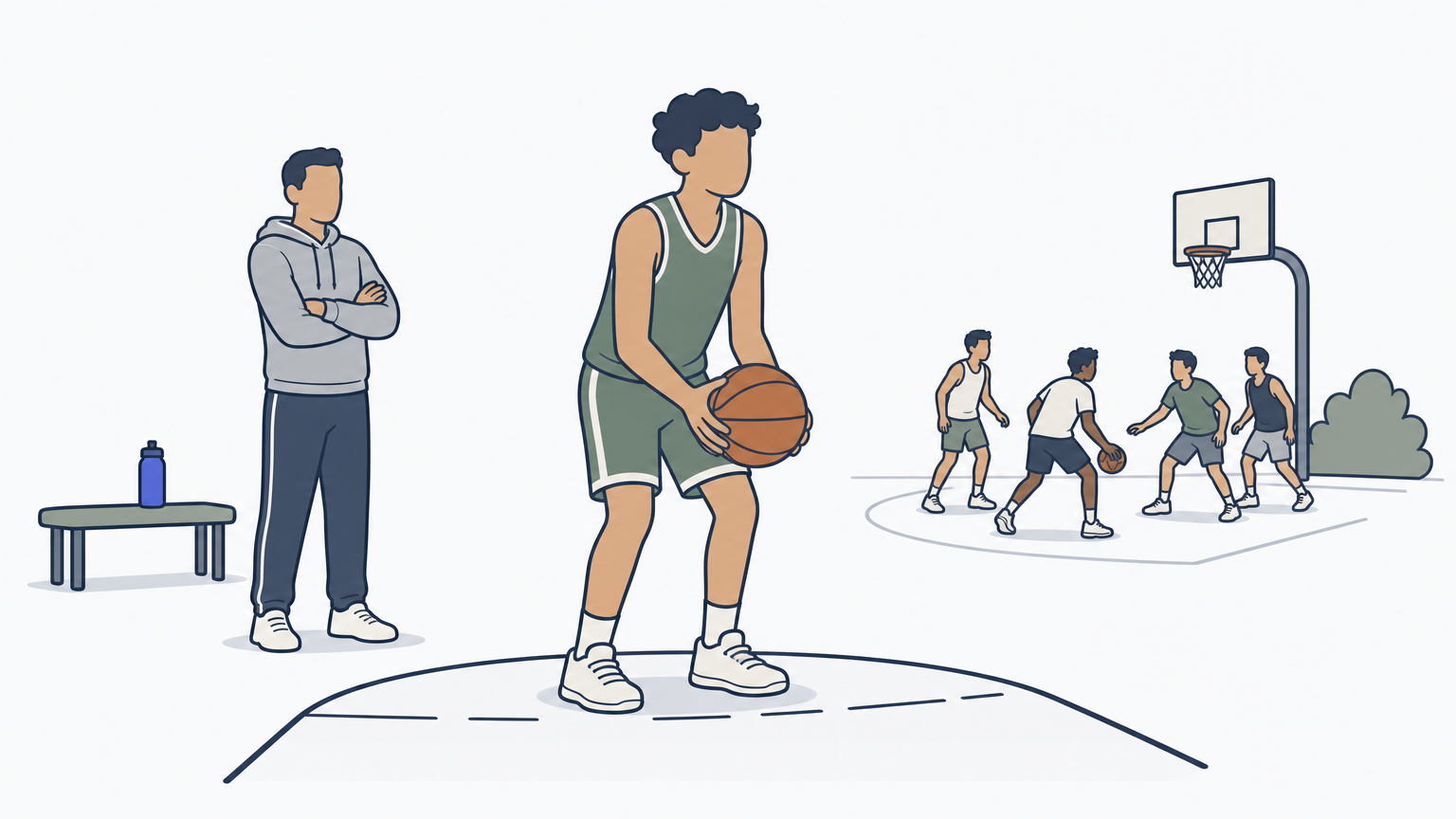
Consider a fourteen-year-old guard working on her shot. Standing at the line, taking a hundred free throws with a coach correcting her elbow angle after every miss, is textbook deliberate practice: narrow focus, immediate feedback, repeated correction of one specific flaw. Later that evening, she joins a three-on-three pickup game at the park with no coach, no drills, and no script. That's deliberate play. Nobody's tracking her shooting percentage, but she's making split-second decisions about when to shoot, pass, or drive, and she's doing it under real defensive pressure. Both sessions improve her game, but they train completely different things.
Guitar: scale drills versus jamming with friends
Musicians face the same split. A guitarist working through a metronome-timed scale exercise, slowing down at the exact tempo where his fingers stumble, is running deliberate practice aimed at a technical bottleneck. Swap that for a Sunday afternoon jam session with friends, no sheet music, no set list, just trading solos over a blues progression, and he's now in deliberate play. The jam session won't fix his sloppy pinky stretch, but it builds the improvisational ear and rhythmic feel that scale drills never touch on their own.
A drill fixes your hands; a jam session teaches your ears what to do with them.
Soccer: cone drills versus street games
Youth soccer offers maybe the clearest contrast in the research literature. Cone drills, where a coach sets up a fixed pattern and a kid dribbles through it repeatedly, target a specific technical skill like ball control at speed. Street soccer, where kids invent their own rules, adjust team sizes on the fly, and argue about out-of-bounds calls, is unstructured deliberate play. Côté's research specifically points to street and backyard games as the setting where young athletes develop the tactical creativity that structured drills rarely produce, because nobody's telling them exactly what to do next.
A side-by-side look at common examples
Here's a quick reference table pairing common structured drills with their unstructured play counterparts across a few skill domains:
| Skill Domain | Deliberate Practice Example | Deliberate Play Example |
|---|---|---|
| Basketball | Free-throw drills with coach feedback | Pickup three-on-three games |
| Guitar | Metronome scale exercises | Jam sessions with other musicians |
| Soccer | Cone dribbling drills | Backyard or street soccer |
| Piano | Repeating a difficult measure slowly | Playing a favorite song by ear |
| Tennis | Serve mechanics drills with a coach | Casual doubles matches with friends |
What ties these examples together
Every example above shares a pattern worth naming explicitly. Structured examples all involve a fixed goal, a corrector watching closely, and low tolerance for error, while the play examples involve open goals, no supervision, and mistakes that get absorbed into the flow rather than corrected on the spot. Look at your own practice log and you'll probably notice the same split already exists, even if you never labeled it. Tracking which sessions fall into which category, and making sure neither one disappears for weeks at a time, is a simple habit that keeps skill development from stalling in either direction.
How to blend both approaches in one practice routine
Most successful practice routines that actually hold up don't pick one mode and stick with it forever, they weave both together in a single week or even a single session. The trick isn't finding some perfect universal ratio, it's building a rhythm where structured correction and open exploration each get consistent time without one crowding out the other. Think of it less like a strict formula and more like a diet: you need both protein and carbs, and the exact split depends on what you're training for right now.
Structure the week, not just the session
A practical way to blend the two is to assign roles to different days or different halves of a session, rather than trying to mix them moment by moment. Early in the week, when energy and focus are highest, front-load the corrective, drill-based work on the specific weakness you identified. Later in the week, once the technical fix has had a chance to sink in, shift toward open, self-directed reps that test whether the fix actually holds up under game-like or performance-like conditions.
- Monday and Tuesday: focused drills on one or two named weaknesses, coach or plan-driven
- Wednesday: light review, low intensity, mostly recovery
- Thursday and Friday: scrimmages, jam sessions, or freeform practice with no corrective feedback
- Weekend: performance, competition, or a casual session that mixes both loosely
This kind of split gives a young athlete or musician a clear reason to show up each day, since drilling all week without a payoff is what drains motivation fastest.
Sandwich the drilling inside the play
Another approach that works well within a single session is bookending structured work with unstructured warm-up and cool-down. Open the session with five or ten minutes of loose, playful reps, no correction, just movement or sound, to get the learner engaged before you introduce any pressure. Practice the specific technical fix in the middle of the session, when focus is sharpest and the stakes of a mistake are still low. Round the session off with another stretch of open play, letting the learner apply whatever got corrected in a freer, less controlled setting.
The best sessions start loose, tighten in the middle, and loosen back up before you leave.
Sandwiching works especially well with younger learners or beginners, since it keeps the emotional tone of the session positive even when the middle stretch involves real, sometimes frustrating correction.
Watch for the warning signs of an unbalanced routine
Even with a plan in place, routines drift, and it helps to know what drift looks like before it costs you weeks of progress. Signs the mix has tipped too far toward drilling include dread before sessions, flat or declining performance despite consistent effort, and a learner who stops experimenting or taking any risks during practice. Signs the mix has tipped too far toward play include stalled technical progress, the same errors showing up session after session with no correction, and a learner who enjoys practicing but can't point to anything specific they've improved lately.
Regularly ask the learner, or ask yourself, whether the last two weeks felt more like grinding or more like coasting. Neither answer is wrong on its own, but if you hear the same answer three weeks running, that's your signal to adjust the ratio before it hardens into a habit that's harder to break.
Keep the loop honest with a quick log
A simple habit that keeps this blend from drifting unnoticed is logging, in a practice journal you'll actually fill in, which mode each session leaned toward and what came out of it. Over a month, that log turns into a rough map of your own ratio, and it makes the next section's discussion of structured scheduling tools far more useful, since you'll already know exactly which skills need the kind of targeted, spaced review that a plan can automate.
Using structured tools to support deliberate practice
Once you've decided a skill needs deliberate practice rather than open play, the next problem is logistical, not theoretical: how do you remember which weaknesses need revisiting, and when? Most learners try to hold this in their heads or scribble it in a notebook, and both approaches fall apart within a few weeks. Structured practice tools exist to solve exactly this problem, they track what you're working on and tell you when to come back to it before the skill fades. This is where a system built around spaced repetition and the intervals it runs on earns its keep, because deliberate practice only works if the corrective feedback loop repeats at the right interval, not randomly.
Why spaced repetition fits deliberate practice specifically
Deliberate practice targets narrow, named weaknesses, and that's precisely the kind of input a spaced repetition algorithm needs to function well. Vague goals like "get better at guitar" don't fit into a scheduling system, but a specific target like "clean transition from G to C chord" does. Ebbinghaus's forgetting curve shows that skills fade predictably without reinforcement, and the SuperMemo SM-2 algorithm, the same logic MemoRep runs on, calculates the exact interval where a skill is about to slip so you revisit it just before it does. Deliberate play doesn't need this kind of scheduling, since it's open-ended by design, but deliberate practice depends on it, because a coach or teacher can't always be there to remind you what needs another rep.
A tool can't decide whether you're in play mode or practice mode, but once you know, it can carry the scheduling weight for you.
What a practice card should capture
When you set up a structured tool for deliberate practice, resist the urge to log vague goals. Each entry should isolate one fixable problem, so the review actually targets something. A useful practice card includes:
- The specific weakness, named precisely, not generally ("bow grip on downstroke," not "technique")
- The last rating, using a simple scale like Again, Hard, Good, or Easy, so the algorithm knows how far to push the next interval
- A short cue or reminder, a sentence describing what fixed it last time
- The date of last review, so drift becomes visible if a card sits untouched too long
This kind of card structure keeps deliberate practice from turning into a vague, feel-good routine that never actually closes the gap it was meant to close.
How MemoRep applies this to practical skills
MemoRep was built specifically for this slice of the play-versus-practice equation, the deliberate practice half that benefits from adaptive scheduling. Instead of flashcards or text memorization, MemoRep's practice cards hold practical skills, a chord change, a bowing pattern, a serve mechanic, and the platform's real-time algorithm adjusts each card's next review based on your Again, Hard, Good, or Easy feedback after every session. That removes the decision fatigue of figuring out what to revisit today, since the schedule already knows which cards are close to fading and surfaces those first. Musicians and athletes in the platform's beta program use it to organize the exact kind of narrow, corrective work this article has been describing, while keeping their open scrimmages, jam sessions, and pickup games entirely separate, exactly as they should be.
Don't try to schedule play
One mistake worth naming directly is trying to force deliberate play into a scheduling tool at all. Play works because it's unstructured, and bolting a rigid review interval onto a jam session or a pickup game defeats its purpose. Structured tools like MemoRep are meant to run alongside your open, unscripted sessions, not replace them, handling the scheduling burden for the corrective work so you have more mental space left over to actually enjoy the parts of practice that were never meant to be structured in the first place.
Bringing play and practice together
The deliberate play vs deliberate practice debate isn't really a debate once you see how each piece fits. Play builds the broad, adaptive foundation, curiosity, motor variety, love for the activity. Practice sharpens the narrow edges that only get fixed through focused, corrective reps. Neither one replaces the other, and treating them as interchangeable is what stalls progress or burns kids out before they hit their potential.
Your job isn't picking a winner. It's sequencing both correctly for whatever stage you or your learner sits in right now, then protecting the time each one needs. Structure the drilling, but never schedule the jam sessions.
Once you know which skills need targeted, spaced review, stop tracking them in a notebook that never gets opened. See how MemoRep times your next practice review and give the deliberate practice half of your routine the same rigor you already bring to the play.